Freedom251 › Anomaly Detection Software

PyOD
What PyOD is
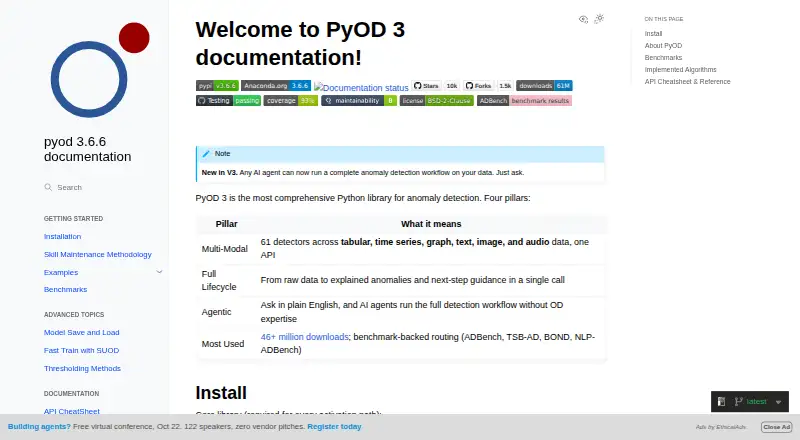
PyOD is a free Python library for anomaly detection, with 61 documented detectors across tabular, time-series, graph, text, image, and audio data. A shared API supports the classic detector workflow, while ADEngine adds orchestration: it profiles data, chooses benchmark-backed detectors, runs them in parallel, calculates consensus scores, and reports diagnostics. ADEngine also works as a Python API without an LLM. PyOD additionally provides an agentic investigation workflow and activation paths for Claude Code, Codex, and MCP-compatible agents. Optional extras enable capabilities such as PyTorch detectors, graph models, embeddings, audio, and an MCP server. Install through pip, conda-forge, or from source; the documented requirement is Python 3.9 or higher. PyOD serves academic research and commercial products. Its documentation cautions that ADEngine’s quality verdict is heuristic rather than a guarantee, and recommends checking results with held-out labels or domain review. The model persistence guide also warns that pickle and joblib can run arbitrary Python code when loading artifacts, so callers must pass trusted=True.
Who it suits
PyOD suits Python users working on anomaly detection across the documented data types, including academic and commercial projects. ADEngine may suit teams seeking orchestration, while optional agent integrations are available for compatible workflows.
What it does well
- Documents 61 detectors across six data types.
- ADEngine runs detectors in parallel and computes consensus scores.
- Available through pip, conda-forge, or source.
- ADEngine works without an LLM.
- Free and open source.
What to know first
- Requires Python 3.9 or higher.
- Optional capabilities require pip extras.
- ADEngine’s quality verdict is a heuristic, not a guarantee.
- Loading pickle or joblib artifacts requires trusted=True.
Limits
The listed plan is free. The installation guide requires Python 3.9 or higher, and optional capabilities require pip extras. ADEngine describes its quality verdict as a heuristic and recommends validation against held-out labels or domain review.
Plans
| Plan | Billed and limits | Price |
|---|---|---|
| PyOD | Open-source Python library · optional capabilities require pip extras | Free |
As pyod.readthedocs.io lists them, read 30 Sept 2026. The maker's own page has the final word.
Getting started
- Use Python 3.9 or higher.
- Install PyOD with pip, conda-forge, or from source.
- Add optional pip extras for capabilities such as PyTorch detectors, embeddings, audio, or MCP.
- Choose the classic detector API or use ADEngine as a standalone Python API.
- For agent workflows, follow the activation path for Claude Code, Codex, or an MCP-compatible agent.
PyOD is a Python library for anomaly detection, best suited to developers and researchers building their own analysis or product workflows. Its broad detector catalog and multiple ways to coordinate detection make it a flexible toolkit, but its quality verdict is not a substitute for validating results.
Overview
Initialized in 2017, PyOD brings 61 detectors for tabular, time-series, graph, text, image, and audio data under one API. It supports hybrid detection, real-time detection, anomaly explanations, and self-hosted deployment. That combination suits custom pipelines more than buyers looking for a turnkey monitoring service.
Users can work directly with the classic detector API, use ADEngine for lifecycle orchestration, or follow an agentic investigation workflow. Python 3.9 or higher is required, and some capabilities rely on optional package extras, so the full catalog may require more than a basic installation.
Key features
Shared detector API
PyOD’s 61 detectors span six data types through a common API. This is useful when a project needs to compare detection approaches or handle different kinds of input without adopting a separate library for each. The breadth still leaves method choice to the user: a large catalog does not determine which detector suits a particular dataset.
ADEngine orchestration
ADEngine profiles data, selects benchmark-backed detectors, runs multiple detectors in parallel, computes consensus scores, and reports diagnostics. This can streamline an evaluation workflow for teams that want a combined view rather than manually coordinating every run. Its quality verdict is explicitly a heuristic, not a guarantee; PyOD recommends checking results against held-out labels or domain review.
Agent and Python workflows
The od-expert skill supports Claude Code and Codex, while an optional MCP server provides a path for MCP-compatible agents. ADEngine also works as a standalone Python API without an LLM, so agent use is not a prerequisite. These options suit teams experimenting with assisted investigations, while conventional users can stay with the direct API.
Installation and optional capabilities
PyOD can be installed through pip, conda-forge, or from source. Optional extras cover capabilities including PyTorch and graph detectors, embeddings, audio, and MCP; the broader integrations also include SUOD, XGBoost, model combination, thresholding, OpenAI embeddings, and Hugging Face encoders. This modularity can keep a basic install focused, but users must choose and manage extras needed for their workflow.
Artifact safety
PyOD warns that pickle and joblib artifacts can execute arbitrary Python code when deserialized. Loading requires callers to pass trusted=True, a meaningful safeguard that also makes artifact provenance a responsibility for anyone handling saved models.
Pricing
PyOD is free: its PyOD plan costs free and provides the open-source Python library. There is no free trial because the plan is free; optional capabilities may require installing pip extras. This is a strong fit for users able to integrate and operate a library themselves, rather than buyers seeking a paid managed service or published support tier.
Platforms
PyOD supports API use on Linux, macOS, and Windows, with self-hosted deployment. Its Python 3.9-or-higher requirement and installation routes make the environment a consideration for teams maintaining their own runtime.
Who it's for
PyOD fits researchers and software teams that want to embed anomaly detection in Python workflows, compare methods across varied data, or use orchestration to coordinate several detectors. The project describes use in academic research and commercial products worldwide. It is less suitable for organizations that want a packaged monitoring interface without building around a library, or for teams unable to validate anomaly outputs in their domain.
Pros and cons
- Pro: 61 detectors across six data types share one API, giving mixed-data projects a broad starting point.
- Pro: ADEngine combines profiling, parallel detector runs, consensus scoring, and diagnostics, reducing manual orchestration work.
- Pro: Free distribution through pip, conda-forge, or source supports teams that prefer to manage their own deployment.
- Con: Python 3.9 or higher is required, and optional extras add setup choices for specialized capabilities.
- Con: ADEngine’s verdict is heuristic, so users must validate results with held-out labels or domain expertise.
- Con: The library’s artifact guidance makes trust in pickle or joblib files essential before loading.
Alternatives
Anomaly Detection Software is the broader category for comparing tools. Consider ManageEngine NetFlow Analyzer instead if you want a freemium product with a free edition capped at two interfaces and paid editions priced by interface count, rather than a Python library.
OpenSearch is another free, open-source option with API, web, and self-hosted platforms, while Anomalib is a free open-source library installable from PyPI or source. PySAD is a free Python framework for readers considering another library. For data-quality monitoring needs, Soda offers a free plan with pipeline testing, metrics observability, and alerting and ticketing integrations.
Axomaly offers a free alpha plan with guided onboarding and direct support. Metaplane has a free plan capped at 10 monitored tables, four users, and three custom SQL monitors, alongside custom-priced Enterprise. ObservabilityOS has a free developer plan with one service, 500MB of monthly logs, and seven-day retention.
Verdict
Choose PyOD if you need a free, self-hosted Python toolkit with a wide detector catalog and orchestration options across varied data types. Its main advantage is the breadth of methods under one API, reinforced by ADEngine’s coordination features. Look elsewhere for a turnkey monitoring product, and do not rely on its quality verdict without domain validation.
Verdict
PyOD offers a broad detector catalog with both a classic API and an orchestration layer. Treat ADEngine’s quality verdict as a starting point and validate results; load serialized artifacts only when trusted.
Questions
How much does PyOD cost?
The PyOD plan is listed as free.
What data types does PyOD support?
Its documentation lists detectors for tabular, time-series, graph, text, image, and audio data.
Which Python versions does it require?
The installation guide requires Python 3.9 or higher.
How can I install PyOD?
The documented options are pip, conda-forge, or installation from source.
Does PyOD work with coding agents?
It provides activation paths for Claude Code, Codex, and MCP-compatible agents, including an od-expert skill and an optional MCP server.
What should I know about ADEngine's quality verdict?
The verdict is a heuristic, not a guarantee. PyOD recommends checking results against held-out labels or through domain review.
Facts from PyOD's own pages
- Agent integrations
- The installation guide describes activation paths for Claude Code, Codex, and MCP-compatible agents. · pyod.readthedocs.io, 30 Sept 2026
- Agent support
- PyOD provides an od-expert skill for Claude Code and Codex, plus an optional MCP server for MCP-compatible agents. · pyod.readthedocs.io, 30 Sept 2026
- Contribution criterion
- PyOD says contributors to newly proposed detectors should commit to at least two years of maintenance. · pyod.readthedocs.io, 30 Sept 2026
- Data types
- PyOD 3 documents detectors for tabular, time-series, graph, text, image, and audio data. · pyod.readthedocs.io, 30 Sept 2026
- Detector catalog
- The documentation describes 61 detectors across multiple data types, exposed through one API. · pyod.readthedocs.io, 30 Sept 2026
- Detector count
- The documentation lists 61 detectors across its supported data types. · pyod.readthedocs.io, 30 Sept 2026
- Distribution
- The guide documents installation through pip, conda-forge, or from source. · pyod.readthedocs.io, 30 Sept 2026
- Founded
- 2017 · pyod.readthedocs.io, 28 Sept 2026
- Install options
- The package is distributed through pip and conda-forge and can also be installed from source. · pyod.readthedocs.io, 30 Sept 2026
- Integrations
- Optional pip extras enable PyTorch, SUOD, XGBoost, model combination, thresholding, embeddings, OpenAI embeddings, Hugging Face encoders, graph models, MCP, and audio features. · pyod.readthedocs.io, 30 Sept 2026
- Intended users
- The project says PyOD serves academic research and commercial products worldwide. · pyod.readthedocs.io, 30 Sept 2026
- Lifecycle orchestration
- ADEngine profiles data, selects benchmark-backed detectors, runs multiple detectors in parallel, computes consensus scores, and reports diagnostics. · pyod.readthedocs.io, 30 Sept 2026
- Optional components
- Optional pip extras include support for PyTorch detectors, graph detectors, embeddings, audio, and an MCP server. · pyod.readthedocs.io, 30 Sept 2026
- Project history
- The About page says Dr. Yue Zhao initialized the project in 2017. · pyod.readthedocs.io, 30 Sept 2026
- Purpose
- PyOD is a Python library for anomaly detection. · pyod.readthedocs.io, 30 Sept 2026
- Python integration
- ADEngine can be used as a standalone Python API without an LLM. · pyod.readthedocs.io, 30 Sept 2026
- Requirements
- The installation guide lists Python 3.9 or higher as a requirement. · pyod.readthedocs.io, 30 Sept 2026
- Result quality limits
- ADEngine describes its quality verdict as a heuristic, not a guarantee that results are correct, and recommends validation against held-out labels or domain review. · pyod.readthedocs.io, 30 Sept 2026
- Runtime requirement
- The installation guide requires Python 3.9 or higher. · pyod.readthedocs.io, 30 Sept 2026
- Security guidance
- The model persistence guide warns that pickle and joblib can deserialize arbitrary Python code and requires callers to pass trusted=True before loading artifacts. · pyod.readthedocs.io, 30 Sept 2026
- Support
- The FAQ invites users to open an issue or contact the maintainer at [email protected]. · pyod.readthedocs.io, 30 Sept 2026
- Support and community
- The documentation links to a GitHub repository for source installation and examples; it does not state a paid support plan on the pages reviewed. · pyod.readthedocs.io, 30 Sept 2026
- Usage
- PyOD offers a classic detector API, ADEngine lifecycle orchestration, and an agentic investigation workflow. · pyod.readthedocs.io, 30 Sept 2026
Where PyOD stands on Freedom251
- Anomaly Detection Software#5 of 22