Freedom251 › Anomaly Detection Software

Axomaly
What Axomaly is
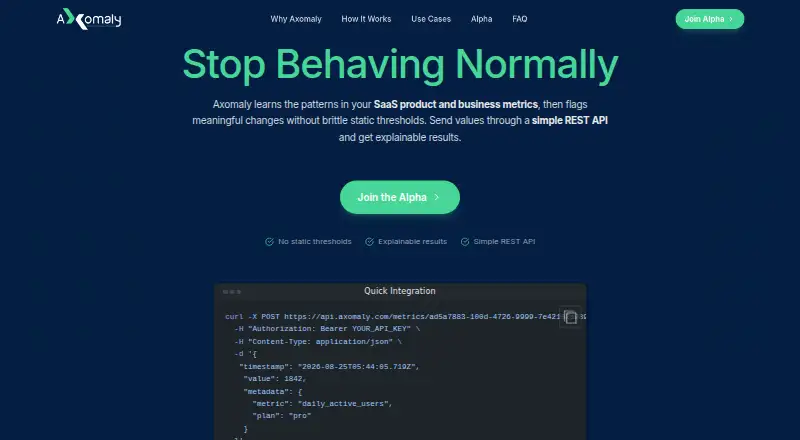
Axomaly analyzes SaaS product and business metrics to flag meaningful changes without relying on fixed thresholds. It accepts timestamped time-series values, with optional metadata, for business, operational, and application metrics. Before a metric is created, Smart Metric Creation prepares a detection configuration and baseline requirements for review.
Values are submitted through a REST API, one timestamped value per POST request. Detection starts after enough history is available; the required amount depends on metric cadence and detector configuration. Results include an anomaly decision, confidence, an expected range, the direction of change, and detector evidence. These responses can be used in existing workflows alongside logs, traces, dashboards, and alerting.
The alpha supports starting with one metric and includes guided onboarding and direct support. It is free during alpha, with no credit card required. During the alpha, metric data and detection results are hosted in the EU, isolated by organisation, and encrypted in transit using HTTPS/TLS. Data is retained for up to 12 months before automatic rolling deletion.
Who it suits
Axomaly may suit SaaS teams that want to monitor business, operational, or application metrics through an API. The alpha is limited to starting with one metric.
What it does well
- Flags changes without relying on fixed thresholds.
- Results include confidence, expected range, and detector evidence.
- Can feed detection responses into existing workflows.
- Alpha includes guided onboarding and direct support.
- Free during alpha with no credit card required.
What to know first
- Alpha starts with one metric.
- Detection waits for sufficient history.
- Alpha data and results are hosted in the EU.
- Data is retained for up to 12 months.
Limits
The free alpha starts with one metric. Detection begins only after the required history is available, with the amount determined by metric cadence and detector configuration.
Plans
| Plan | Billed and limits | Price |
|---|---|---|
| Axomaly Alpha | Free during alpha. No credit card required. · Start with one metric · Guided onboarding · Direct support | Free |
As axomaly.com lists them, read 4 Oct 2026. The maker's own page has the final word.
Getting started
- Open the Axomaly website
- Use the web service or API
- Review the configuration and baseline requirements prepared by Smart Metric Creation
- Create one metric for the alpha
- Send timestamped metric values through the REST API, one value per POST request
Axomaly is a cloud API for statistical anomaly detection across business, operational, and application metrics. It is aimed at teams that already collect telemetry and can feed a metric stream into an API. The strongest case is explainable anomaly output that can slot into current monitoring; the main trade-off is the alpha’s single-metric scope and the wait for a usable baseline.
Overview
Axomaly learns recurring metric behaviour instead of asking you to maintain fixed thresholds. You submit timestamped time-series values, optionally accompanied by metadata, and the service evaluates changes against a learned pattern. That approach fits metrics whose normal range shifts over time, but it also means a newly created metric cannot produce detection immediately.
The service is delivered as a cloud deployment through web and API access. It is positioned as a complement to logs, traces, dashboards, and alerting rather than a replacement for those systems. Teams therefore need an existing place to route responses and investigate the surrounding telemetry.
Key features
Smart Metric Creation builds a proposed detector configuration and identifies the history needed for a baseline before the metric is created. Reviewing that preparation can reduce surprises in setup, although the required history varies with metric cadence and detector configuration. Detection begins only once that requirement has been met.
Each response supplies more than a yes-or-no flag: an anomaly decision, confidence, expected range, direction of change, and detector evidence are included. Those fields give an operator material for judging whether a change merits action. The underlying method is statistical, so Axomaly is best for teams comfortable interpreting statistical signals rather than expecting a manually authored rule for every condition.
Metric values are sent with a REST API, one timestamped value per POST request. That is a clear integration contract, but it places responsibility on your systems to generate and deliver the individual requests reliably. Returned detections can then be incorporated into existing workflows.
For the alpha, metric data and detection results are hosted in the EU. Data and detector state are isolated by organisation and are not shared between customers, while transport is encrypted with HTTPS/TLS. Alpha data is retained for up to 12 months and then deleted automatically on a rolling basis, a useful boundary for teams that do not need long historical storage.
Pricing
Axomaly Alpha: free, billed Free during alpha, with no credit card required. The package covers one business, operational, or application metric, guided onboarding, and direct support. It is a sensible way for a team to validate the detection workflow or for an individual metric owner to try the service. The one-metric ceiling makes it unsuitable as a broad monitoring layer, and the alpha terms do not provide a multi-metric path in this plan.
Platforms
Axomaly runs in the cloud and is available through a web interface and REST API. Metric ingestion is API-based; the published deployment does not describe an on-premises option.
Who it's for
Choose Axomaly if you have a business, operational, or application metric with enough historical observations to establish a baseline and want contextual anomaly results in an existing observability process. The guided alpha and direct support suit teams evaluating a focused use case. It is a poor fit when you need immediate alerts on a brand-new metric, several metrics under the free offering, or a complete logs-and-traces platform rather than a detection component.
Pros and cons
Pros
- Context-rich detections: confidence, expected range, change direction, and detector evidence help people assess a signal.
- Threshold-free patterning: learned statistical behaviour can address changing normal conditions without maintaining static limits.
- Practical onboarding: Smart Metric Creation previews configuration and baseline requirements, while the alpha includes direct support.
- Clear data controls: EU hosting during alpha, organisation isolation, HTTPS/TLS transport, and rolling deletion after up to 12 months.
Cons
- One-metric alpha: the free scope cannot serve teams wanting coverage across a portfolio of metrics.
- Baseline delay: detection waits for sufficient history, with the duration dependent on cadence and configuration.
- Per-value ingestion: one POST request per timestamped value may require additional integration work.
- Cloud-only delivery: teams requiring self-hosted deployment have no stated option.
Alternatives
For network-flow monitoring across many device types, consider ManageEngine NetFlow Analyzer, which has a free two-interface edition and paid editions starting at $172 a month. Choose OpenSearch when you want a free, Apache 2.0 open-source platform with API, web, desktop, and self-hosted deployment options. PyOD is the better choice for developers seeking an open-source Python library with optional pip extras, while Anomalib suits an Apache-2.0 library installable from PyPI or source. Pick PySAD for a free open-source Python framework. Soda is aimed at pipeline testing, metrics observability, and alerting integrations through its free SPU plan. Metaplane fits data teams monitoring up to 10 tables, four users, and three custom SQL monitors on its free plan. ObservabilityOS is an alternative for source-available observability with one service, 500MB of logs per month, and seven-day retention in its free developer plan. Browse more options in Anomaly Detection Software.
Verdict
Axomaly is a good choice for a team that wants statistically derived, explainable anomalies from one important metric and can wait for baseline history before acting. Its API-first design, guided setup, and workflow-friendly response fields are the reasons to choose it. Look elsewhere if your requirement is multi-metric coverage now, self-hosting, or immediate detection without historical data.
Verdict
Axomaly offers API-based anomaly detection with details that can be used in existing workflows. Its free alpha is limited to one metric, and detection depends on sufficient metric history.
Questions
How much does Axomaly cost?
The Axomaly Alpha plan is free during alpha. No credit card is required.
Which platforms does Axomaly support?
Axomaly is available through API and web.
How does Axomaly receive metric values?
Values are sent through a REST API, with one timestamped value per POST request.
When does detection begin?
Detection starts after the required history is available. The amount of history depends on metric cadence and detector configuration.
Where is alpha data hosted and how long is it retained?
Submitted metric data and detection results are hosted in the EU during the alpha. Data is retained for up to 12 months and then automatically deleted on a rolling basis.
Does Axomaly integrate with other monitoring tools?
Axomaly says it complements existing logs, traces, dashboards, and alerting, and its detection responses can be used in existing workflows.
Facts from Axomaly's own pages
- Alpha data location
- During the alpha, submitted metric data and detection results are hosted in the EU. · axomaly.com, 4 Oct 2026
- Alpha scope
- The alpha starts with one business, operational, or application metric and includes guided onboarding and direct support. · axomaly.com, 4 Oct 2026
- API
- Metric values are sent through a REST API, one timestamped value per POST request. · axomaly.com, 4 Oct 2026
- Baseline requirement
- Detection starts after the required history is available; the amount needed depends on metric cadence and detector configuration. · axomaly.com, 4 Oct 2026
- Data isolation
- Metric data and detector state are isolated by organisation and are never shared between customers. · axomaly.com, 4 Oct 2026
- Data retention
- Alpha data is retained for up to 12 months and automatically deleted on a rolling basis afterward. · axomaly.com, 4 Oct 2026
- Detection
- Detection results include an anomaly decision, confidence, expected range, direction of change, and detector evidence. · axomaly.com, 4 Oct 2026
- Encryption
- The maker says data is encrypted in transit using HTTPS/TLS. · axomaly.com, 4 Oct 2026
- Integrations
- Axomaly says it complements existing logs, traces, dashboards, and alerting, and returns detection responses for use in existing workflows. · axomaly.com, 4 Oct 2026
- Metrics
- It accepts timestamped time-series values and optional metadata for business, operational, and application metrics. · axomaly.com, 4 Oct 2026
- Metric setup
- Smart Metric Creation prepares a detection configuration and baseline requirements for review before a metric is created. · axomaly.com, 4 Oct 2026
- Purpose
- Axomaly learns patterns in SaaS product and business metrics, then flags meaningful changes without relying on static thresholds. · axomaly.com, 4 Oct 2026
Where Axomaly stands on Freedom251
- Anomaly Detection Software#2 of 22