Freedom251 › Machine Learning Data Catalog Software
OpenMetadata
What OpenMetadata is
OpenMetadata is an open-source platform that brings technical context, business meaning, and organizational memory together in a knowledge graph. Its catalog capabilities include discovery, governance, data quality, observability, lineage, semantics, and memory. The graph can connect schemas, tables, columns, dashboards, pipelines, ML models, owners, classifications, and lineage. Glossary terms, metric definitions, and relationships using RDF, OWL, DCAT, and Schema.org provide shared business meaning. For AI workflows, OpenMetadata offers a native MCP server, an AI SDK, and a Context Center for articles, documents, and memories. Its ingestion framework connects to more than 130 data services, including Airflow, BigQuery, Databricks, dbt, Kafka, MySQL, Snowflake, and Tableau. The schema-first architecture includes more than 700 open specifications in JSON Schema and RDF/JSON-LD. Organizations can deploy it in their own environment, explore a live sandbox with demo data, or sign up for a free cloud service with their own data. The self-hosted plan is listed as free, with no usage limits stated on the page. Security documentation describes Fernet encryption for stored passwords and connection secrets, SSL/TLS connections, and support for external secrets managers. The deployment guide lists several identity providers, but says simultaneous use of multiple authentication mechanisms is unsupported.
Who it suits
OpenMetadata may suit organizations that need a catalog, governance, lineage, and shared business definitions across data services. Its MCP server, AI SDK, and Context Center may also suit teams building AI workflows around organizational data.
What it does well
- Catalog includes discovery, quality, observability, and lineage.
- Connectors support 130+ data services.
- Can be self-hosted or tried in a live sandbox.
- Provides a native MCP server and AI SDK.
- Self-hosted plan is listed as free.
What to know first
- Multiple authentication mechanisms cannot be used simultaneously.
- Self-hosted deployment requires managing the organization’s own environment.
Plans
| Plan | Billed and limits | Price |
|---|---|---|
| OpenMetadata (self-hosted) | Deploy in your own environment · no usage limits stated on the page | Free |
As open-metadata.org lists them, read 7 Oct 2026. The maker's own page has the final word.
Getting started
- Visit the OpenMetadata website.
- Choose a deployment route: your own environment, the live sandbox with demo data, or the free cloud service with your own data.
- For self-hosting, use the OpenMetadata self-hosted plan at no cost.
- Connect data services using the ingestion framework's connectors.
OpenMetadata is a free, open-source platform for cataloging and governing data assets alongside business context. It best suits organizations that want a shared map of data, lineage, and definitions across many services. Its breadth is compelling without a license fee, but self-hosting makes deployment and operation the team’s responsibility.
Overview
OpenMetadata brings technical assets and organizational context into one knowledge graph. Schemas, tables, columns, dashboards, pipelines, machine-learning models, owners, lineage, and classifications can be connected rather than maintained as separate inventories. That makes the platform useful not only for finding data, but also for understanding its meaning and relationships.
Glossary terms, metric definitions, and relationships use RDF, OWL, DCAT, and Schema.org to support shared business meaning. The scope extends beyond cataloging to governance, data quality, observability, and memory, giving teams a broader data-management environment than a basic asset directory.
Key features
Catalog, lineage, and governance
OpenMetadata includes automated discovery, column-level lineage, impact analysis, pipeline lineage, and report lineage. These capabilities help teams trace assets and assess the reach of changes across connected data work. Its coverage is a strength for organizations seeking one place to follow assets from pipelines through reports, though the platform’s breadth is most useful when teams are prepared to establish and maintain shared definitions and connections.
AI context and extensibility
A native MCP server and AI SDK make the catalog’s context accessible to AI agents, while Context Center holds articles, documents, and memories. This gives organizations a way to connect operational metadata with additional institutional knowledge rather than relying on technical schemas alone.
The schema-first architecture includes more than 700 open specifications in JSON Schema and RDF/JSON-LD. Its ingestion framework supports connectors for over 130 data services, including Airflow, BigQuery, Databricks, dbt, Kafka, MySQL, Snowflake, and Tableau. That range makes it a plausible fit for varied data stacks; teams should still confirm that their specific services are covered before choosing it.
Deployment and security
Teams can deploy the software in their own environment, explore a live sandbox with demo data, or sign up for a free cloud service using their own data. The self-hosted option is attractive for organizations that want control without license charges, but it carries operational responsibility. Security documentation describes Fernet encryption for stored passwords and connection secrets, SSL/TLS connections, and support for external secrets managers.
Supported identity providers include Google, Okta, custom OIDC, Auth0, Azure, Amazon Cognito, and OneLogin. A significant constraint is that simultaneous use of multiple authentication mechanisms is unsupported, which may rule it out for teams that need to combine sign-in methods.
Pricing
OpenMetadata (self-hosted): free. The plan allows deployment in your own environment and states no usage limits. OpenMetadata is open source, and the service also offers a free cloud option. The zero-price self-hosted plan avoids licensing costs, but it does not eliminate the work of running the system yourself.
Platforms
OpenMetadata supports API access, self-hosted deployment, and web use. The combination gives teams a choice between integrating programmatically, operating their own instance, or using the web interface.
Who it's for
OpenMetadata is a strong fit for data teams that need cataloging, lineage, governance, quality, and business definitions to work together across a broad collection of services. Its Context Center and AI interfaces may also suit organizations that want agents and people to draw on the same metadata and organizational memory. Teams seeking a free, self-hosted system should weigh that benefit against their capacity to deploy and operate it. Organizations requiring multiple authentication mechanisms at once should look elsewhere.
Pros and cons
- Broad catalog and lineage coverage: automated discovery, column-level lineage, impact analysis, and pipeline and report lineage connect discovery with change assessment.
- Business context alongside technical metadata: glossary terms, metric definitions, and organizational memory help give assets meaning beyond their schemas.
- Wide integration and extension base: connectors for 130+ services and 700+ open specifications support varied environments.
- No self-hosted license charge: the plan is free with no usage limits stated, but teams must run it in their own environment.
- Authentication constraint: simultaneous use of multiple authentication mechanisms is unsupported, limiting flexibility for organizations with mixed sign-in requirements.
Alternatives
For a wider comparison, see Metadata Management Software and Data Lineage Tools.
- DataHub is another free, open-source option with a free trial and self-hosted deployment; choose it if that alternative better suits your team’s preferred product and operating approach.
- Apache Atlas is a free metadata governance option with no paid plans or usage limits stated; consider it if you want a governance-focused alternative.
- Aurelius Atlas is open source with no licensing costs and optional paid consulting; consider it if that commercial support option matters to your decision.
- Ab Initio Data Platform requires a free proof of concept before purchase, making it a candidate for organizations willing to evaluate it before buying.
- Alation Data Intelligence Platform uses a pool of consumption units for AI capabilities, with pool size estimated with Alation; consider it if that model suits your AI needs.
- Atlan Lakehouse has no free trial and directs pricing enquiries to sales, so it is an option for buyers prepared to discuss pricing directly.
- Collibra asks prospective buyers to request a demo and does not state a public price; choose it if a demo-led evaluation fits your process.
- Dawiso starts at €445 a month for five user seats, five contributor licenses, and 20 viewer licenses, with unlimited connectors and Slack forum support. Its defined seat counts may suit teams that want a paid plan with explicit user allowances.
Verdict
Choose OpenMetadata if your organization wants a broad, open-source catalog that connects technical lineage with business definitions and organizational memory, and can take responsibility for deployment or use its free cloud service. Its connector range and no-cost self-hosted plan make it a compelling foundation for cross-service data governance. Look elsewhere if your authentication needs require multiple mechanisms to operate simultaneously or you need a self-hosted product without the operational burden.
Verdict
OpenMetadata combines data cataloging and governance with business definitions and organizational memory. Teams choosing an authentication setup should note that simultaneous use of multiple mechanisms is unsupported.
Questions
What does OpenMetadata cost?
The OpenMetadata self-hosted plan is listed as free. The product also offers a free cloud service.
Can I host OpenMetadata myself?
Yes. You can deploy it in your own environment.
Which data services can it connect to?
Its ingestion framework supports connectors for 130+ services, including Airflow, BigQuery, Databricks, dbt, Kafka, MySQL, Snowflake, and Tableau.
Does OpenMetadata support lineage?
Yes. Its capabilities include column-level lineage, pipeline lineage, and impact analysis.
What authentication providers are listed?
The deployment security guide lists Google, Okta, custom OIDC, Auth0, Azure, Amazon Cognito, and OneLogin. Simultaneous use of multiple authentication mechanisms is unsupported.
What security provisions does its documentation describe?
The documentation describes Fernet encryption for stored passwords and connection secrets, SSL/TLS connections, and support for external secrets managers.
Facts from OpenMetadata's own pages
- AI features
- OpenMetadata offers a native MCP server, an AI SDK, and a Context Center for articles, documents, and memories. · open-metadata.org, 7 Oct 2026
- Authentication
- The deployment security guide lists Google, Okta, custom OIDC, Auth0, Azure, Amazon Cognito, and OneLogin identity providers, and says simultaneous use of multiple authentication mechanisms is unsupported. · docs.open-metadata.org, 7 Oct 2026
- Business meaning
- Glossary terms, metric definitions, and relationships using RDF, OWL, DCAT, and Schema.org provide shared business meaning. · open-metadata.org, 7 Oct 2026
- Catalog and governance
- The platform includes data cataloging, discovery, governance, data quality, observability, lineage, semantics, and memory. · open-metadata.org, 7 Oct 2026
- Community
- The site lists 14,000+ open-source members and 450+ code contributors. · open-metadata.org, 7 Oct 2026
- Deployment
- Users can deploy OpenMetadata in their own environment, try a live sandbox with demo data, or sign up for a free cloud service with their own data. · open-metadata.org, 7 Oct 2026
- Extensibility
- The schema-first architecture includes 700+ open specifications in JSON Schema and RDF/JSON-LD. · open-metadata.org, 7 Oct 2026
- Integrations
- Its ingestion framework supports connectors for 130+ data services, including Airflow, BigQuery, Databricks, dbt, Kafka, MySQL, Snowflake, and Tableau. · open-metadata.org, 7 Oct 2026
- Knowledge graph
- Its graph captures schemas, tables, columns, dashboards, pipelines, ML models, owners, lineage, and classifications. · open-metadata.org, 7 Oct 2026
- Purpose
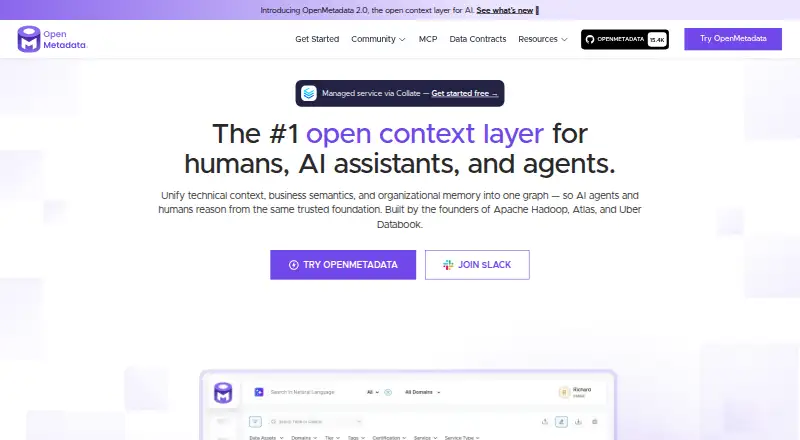
- OpenMetadata unifies technical context, business semantics, and organizational memory in a knowledge graph for people and AI agents. · open-metadata.org, 7 Oct 2026
- Security
- The documentation describes Fernet encryption for stored passwords and connection secrets, SSL/TLS connections, and external secrets manager support. · docs.open-metadata.org, 7 Oct 2026
- System architecture
- The product site describes a streamlined architecture with four system components, designed for technical and non-technical users. · open-metadata.org, 7 Oct 2026
Where OpenMetadata stands on Freedom251
- Machine Learning Data Catalog Software#2 of 14
- Data Lineage Tools#9 of 43
- Active Metadata Management Software#6 of 25
- Metadata Management Software#4 of 15