Freedom251 › Data Lineage Tools

Apache Atlas
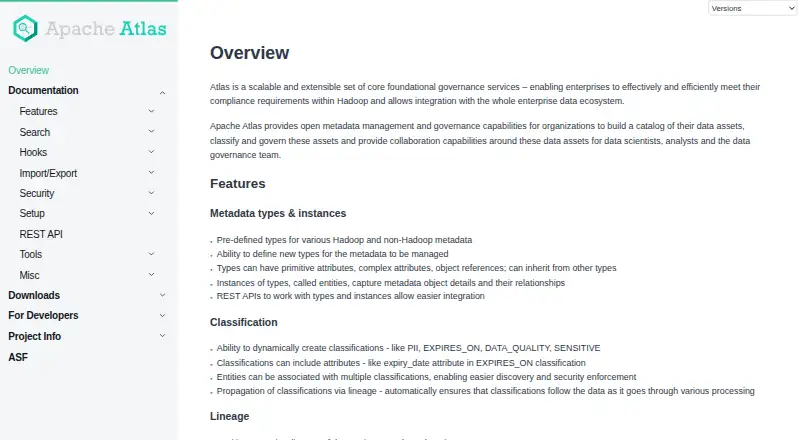
What Apache Atlas is
Apache Atlas is open metadata management software for cataloging and governing data assets. It gives teams a way to describe metadata with predefined types or create their own types, entities, and relationships. Classifications can be attached to multiple entities and carried through data lineage, which the interface displays and REST APIs can access or update. For discovery, users can search by metadata type, classification, attribute value, or free text, including with a SQL-like query language. Atlas offers fine-grained controls over metadata entities and classification operations. Its integration with Apache Ranger can use classifications for authorization and data masking. REST endpoints cover metadata types, entities, lineage, and discovery; documented integrations include Hive, HBase, Sqoop, Storm, and Kafka. Atlas is server software for self-hosted deployment and is listed for Linux, web, and API use. Deployment involves building and packaging it for an environment with HBase and Solr. The software is open source and costs nothing. The project also provides user and developer mailing lists for community discussion.
Who it suits
Apache Atlas suits teams that need to catalog and classify data assets, trace lineage, and control access to metadata. It is a fit for self-hosted environments that can deploy server software, especially where the documented integrations or Apache Ranger connection are useful.
What it does well
- Define metadata types, entities, and relationships.
- Propagate classifications through data lineage.
- Search by type, classification, attribute, or free text.
- Fine-grained controls cover entities and classification operations.
- REST endpoints cover metadata, lineage, and discovery.
- Integrates with Hive, HBase, Sqoop, Storm, and Kafka.
What to know first
- Deployment involves an environment with HBase and Solr.
- Requires installing and operating server software.
Plans
| Plan | Billed and limits | Price |
|---|---|---|
| Apache Atlas | Open metadata governance software · no paid plans or usage limits stated | Free |
As atlas.apache.org lists them, read 7 Oct 2026. The maker's own page has the final word.
Getting started
- Visit the Apache Atlas website.
- Build and package Atlas for deployment in an environment with HBase and Solr.
- Install the server software in a self-hosted environment.
- Use its web interface or REST endpoints to work with metadata.
Apache Atlas is an open-source platform for managing metadata and governance across data assets. It is best suited to teams that can build, deploy and operate server software. Its appeal is the combination of flexible metadata modeling, lineage and classification controls; the trade-off is ownership of the deployment environment.
Overview
Atlas provides predefined metadata types and lets teams define their own types, entities and relationships. That flexibility can fit an organization’s particular data landscape, but it also calls for decisions about how to model that landscape. Atlas is installed as server software and can be built and packaged for an environment with HBase and Solr, so it is a better fit for teams prepared to manage infrastructure than for those seeking a ready-to-use hosted service.
Its scope joins cataloging and discovery with governance. Classifications can be associated with multiple entities and propagated through lineage, while automated discovery, column-level lineage and pipeline lineage extend its coverage across data assets and flows.
Key features
Modeling, search and lineage
Atlas supports both predefined and user-defined metadata structures. Users can search by metadata type, classification, attribute value or free text, with a SQL-like DSL for more structured queries. The interface displays data lineage, and REST endpoints let applications access and update lineage. This is useful for teams that need people and integrations to work with data relationships, though it puts Atlas’s APIs and deployment within the team’s operating responsibilities.
Classification and security
Classifications can follow lineage across related entities, making governance labels useful beyond the asset on which they were first applied. Fine-grained access controls cover metadata entities and classification operations. Integration with Apache Ranger can use Atlas classifications for authorization and data masking, a meaningful option for organizations already working with Ranger. Authentication documentation describes SSL, service authentication and SPNEGO-based HTTP authentication, including Kerberos options.
Integrations and operation
The architecture names Hive, HBase, Sqoop, Storm and Kafka among Atlas integrations. REST endpoints cover metadata types, entities, lineage and discovery, giving engineering teams ways to access these capabilities programmatically. Atlas is server software rather than a lightweight client installation; teams also need an environment with HBase and Solr for the described build and packaging approach. The project recommends checking release artifacts distributed through mirrors with GPG signatures or SHA checksums. User and developer mailing lists provide community discussion.
Pricing
Atlas is free, open-source software, with no paid plans or usage limits stated. The Apache Atlas plan costs free. That makes it a fit for teams seeking metadata governance software without a license charge; the practical cost to consider is operating the server deployment and its supporting environment.
Platforms
Atlas supports API, Linux, self-hosted and web platforms. Its self-hosted deployment and REST API suit organizations that want to run the service in their own environment and connect applications programmatically. The need to build and package it for an environment with HBase and Solr is a substantial operational consideration, not a turnkey deployment path.
Who it's for
Atlas is a strong candidate for data and platform teams that need a flexible metadata model, lineage-aware classifications, discovery and fine-grained controls under their own operational ownership. Ranger integration is particularly relevant where authorization or data masking should use Atlas classifications. Teams without capacity to manage the server deployment and its supporting environment should look for a solution that better matches their operating model.
Pros and cons
- Pro: User-defined types, entities and relationships let teams model their own data assets alongside predefined metadata types.
- Pro: Classifications propagate through lineage, connecting governance labels to related entities.
- Pro: Search, displayed lineage and REST endpoints serve both interactive discovery and programmatic access.
- Pro: Fine-grained controls and Apache Ranger integration support governance use cases involving authorization and data masking.
- Con: Building and packaging Atlas for an environment with HBase and Solr makes deployment a poor fit for teams seeking minimal infrastructure responsibility.
- Con: Its flexible metadata model gives teams room to adapt Atlas, but requires them to define structures suited to their assets.
Alternatives
For a broader comparison, see Metadata Management Software and Data Lineage Tools.
- DataHub is another free, open-source self-hosted option with a free trial. Choose it instead if its self-hosted approach better suits your team, while accounting for manual installation, configuration, upgrades, uptime and troubleshooting.
- Aurelius Atlas offers a free, open-source self-hosted plan with optional consulting services; consider it if that model fits your needs.
- OpenMetadata has a free self-hosted plan with no usage limits stated; it is another option for teams seeking a self-hosted catalog.
- Ab Initio Data Platform is a paid alternative that requires a free proof of concept before software purchase.
- Alation Data Intelligence Platform is a paid option with an AI capability pool whose size is estimated with Alation.
- Atlan Lakehouse is a paid alternative with no free trial.
- Collibra is a paid alternative that asks prospective customers to request a demo.
- Dawiso has a Standard plan starting at €445 a month, with five user seats, five contributor licenses, 20 viewer licenses, unlimited connectors and Slack forum support. Consider it if those published seat and connector terms suit your team.
Verdict
Choose Apache Atlas if your team wants open-source metadata governance with flexible modeling, lineage-aware classifications and fine-grained controls, and can own a self-hosted deployment. Its strongest reason to choose is how discovery and governance work together across metadata and lineage. Look elsewhere if building and operating Atlas in an environment with HBase and Solr does not fit your team’s infrastructure capacity.
Verdict
Choose Apache Atlas if your team needs open-source metadata governance, lineage, and classification controls in a self-hosted environment. Consider another option if your deployment cannot accommodate building and packaging Atlas for an environment with HBase and Solr.
Questions
How much does Apache Atlas cost?
The listed Apache Atlas plan costs nothing. It is open source.
What platforms does Apache Atlas support?
It is listed for API, Linux, self-hosted, and web use.
What does Atlas integrate with?
Documented integrations include Hive, HBase, Sqoop, Storm, and Kafka. Apache Ranger integration can use Atlas classifications for authorization and data masking.
Can teams use Atlas to view data lineage?
Yes. The interface displays lineage, and REST APIs can access and update it.
How is Apache Atlas deployed?
Atlas is installed as server software. Building and packaging it for deployment involves an environment with HBase and Solr.
Where can users get community support?
The project lists user and developer mailing lists for community discussion.
Facts from Apache Atlas's own pages
- API surface
- The published API includes discovery, entity, glossary, lineage, notification, relationship and type REST services. · atlas.apache.org, 14 Oct 2026
- Authentication
- Supported authentication methods include file credentials, Kerberos, LDAP or Active Directory, Keycloak OpenID Connect/OAuth2 and PAM. · apache.googlesource.com, 14 Oct 2026
- Build requirements
- The project documents builds with Java 8, Java 11 or Java 17 and recommends 2 GB minimum and maximum Maven heap settings. · github.com, 14 Oct 2026
- Classification
- Classifications such as PII, expiry and data quality can be created dynamically, attached to entities and propagated through lineage. · atlas.apache.org, 14 Oct 2026
- Community support
- The project lists user and developer mailing lists for community discussion. · atlas.apache.org, 7 Oct 2026
- Deployment
- The repository provides Docker build instructions and produces server, source and multiple hook distribution archives. · github.com, 14 Oct 2026
- Documentation
- Official documentation covers architecture, type system, search, glossary, security, authentication, authorization, notifications, bridges and high availability. · atlas.apache.org, 14 Oct 2026
- Download integrity
- The downloads page says release artifacts are distributed through mirrors and recommends verifying them with GPG signatures or SHA checksums. · atlas.apache.org, 7 Oct 2026
- Founded
- 2015 · atlas.apache.org, 28 Sept 2026
- High availability
- For redundant Kafka notifications, Atlas recommends at least two brokers and topic replication of at least two. · atlas.apache.org, 14 Oct 2026
- Hive integration
- The Hive hook listens for create, update and delete operations and sends metadata changes through Kafka notifications. · atlas.apache.org, 14 Oct 2026
- Hive lineage
- The Hive bridge captures column-level lineage for simple, expression and script transformations, subject to a Hive 1.2.1 patch. · atlas.apache.org, 14 Oct 2026
- Import utilities
- An import-hive.sh command can initialize Atlas from selected tables, databases or all Hive databases and tables. · atlas.apache.org, 14 Oct 2026
- Integrations
- Documented metadata sources include Hive, Sqoop, Falcon, Storm and HBase. · atlas.apache.org, 14 Oct 2026
- Kafka extensibility
- Kafka-based messaging lets applications publish metadata to Atlas and consume metadata-change events. · atlas.apache.org, 14 Oct 2026
- Known limitation
- If HBase region servers hosting the Atlas table are unavailable, Atlas cannot store or retrieve metadata until they return. · atlas.apache.org, 14 Oct 2026
- Latest release
- Apache Atlas 2.5.0 was released on 2026-04-30. · release-catalog-test.apache.org, 14 Oct 2026
- Licence
- Apache Atlas is distributed under the Apache License 2.0. · atlas.apache.org, 14 Oct 2026
- Limit: implementation effort
- G2 reviewers repeatedly describe initial setup as resource-intensive and the learning curve as a barrier to using the full product. · g2.com, 14 Oct 2026
- Lineage
- Atlas provides a web lineage view and REST operations for reading and updating lineage. · atlas.apache.org, 14 Oct 2026
- Maker founded
- The Apache Software Foundation lists 1999 as its founding year. · linkedin.com, 14 Oct 2026
- Maker headquarters
- The Apache Software Foundation lists Wilmington, Delaware as its headquarters. · linkedin.com, 14 Oct 2026
- Maker legal name
- The Apache Software Foundation is a nonprofit software-development organization. · linkedin.com, 14 Oct 2026
- Maker size
- LinkedIn lists the foundation's company size as 5,001–10,000 employees. · linkedin.com, 14 Oct 2026
Where Apache Atlas stands on Freedom251
- Data Lineage Tools#1 of 43
- Metadata Management Software#1 of 15