Freedom251 › Active Metadata Management Software
OpenDataDiscovery Platform
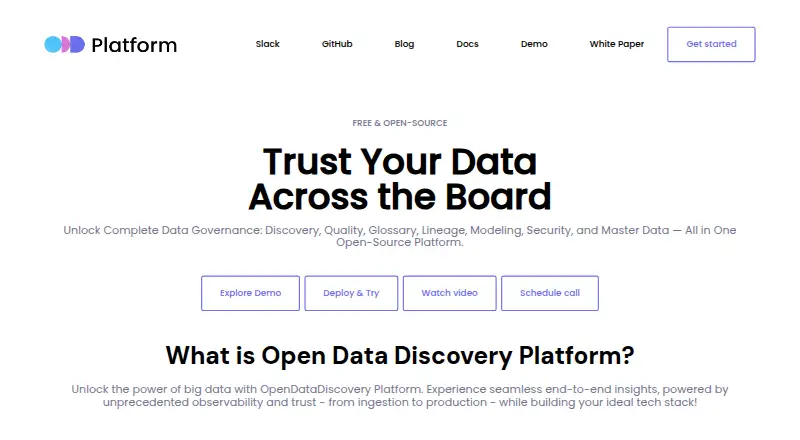
What OpenDataDiscovery Platform is
OpenDataDiscovery Platform (ODD) is an open-source platform for data discovery, governance, and collaboration across data teams. Its catalog supports search and filtering by attributes such as source, owner, and tag, and helps users explore ownership and related-source links. ODD tracks lineage across data objects and microservices, imports data-quality test results, and displays dataset quality statuses. It also catalogs machine-learning experiment metadata and lineage and supports experiment logging.
The product lists integrations including MongoDB, ClickHouse, dbt, Snowflake, Tableau, BigQuery, Kafka, and PostgreSQL. Deployment options include local Docker Compose, Kubernetes with Helm charts, and AWS Marketplace QuickLaunch. Users can access collected metadata through a user interface or REST API. ODD supports LDAP authentication and USER and ADMIN roles; its documentation warns against using simple login-form authentication in production. Metadata attachments are limited to 20 MB, though links can point to larger or remotely stored files. The platform is free and open source, with a listed plan of $0. Its stated audience includes data teams of any size, from enterprises to small and midsize companies and data science teams.
Who it suits
ODD may suit data teams looking to catalog assets, inspect lineage, and track dataset quality. Its deployment options and REST API may also fit teams building a self-hosted data discovery setup.
What it does well
- Search and filtering include source, owner, and tag.
- Tracks data-object and microservices lineage.
- Imports test results and displays dataset quality statuses.
- Offers Docker Compose, Kubernetes, and AWS Marketplace deployment.
- Free and open source.
What to know first
- Metadata attachments are limited to 20 MB.
- Documentation warns against simple login-form authentication in production.
Limits
Attachments to metadata entities are limited to 20 MB; links can be used for larger or remotely stored files. The platform documentation warns against simple login-form authentication in production.
Plans
| Plan | Billed and limits | Price |
|---|---|---|
| Open-source platform | Free and open-source; no price stated | Free |
As opendatadiscovery.org lists them, read 11 Oct 2026. The maker's own page has the final word.
Getting started
- Open the OpenDataDiscovery website.
- Choose a deployment route: local Docker Compose, Kubernetes with Helm charts, or AWS Marketplace QuickLaunch.
- Deploy the platform in the selected environment.
- Use the interface or REST API to access collected metadata.
- Configure LDAP authentication for production use.
OpenDataDiscovery Platform (ODD) is a self-hosted catalog that unites data assets, services, quality signals, and machine-learning experiment metadata. It is a strong match for data engineering and data science groups that need a shared governance view; organizations unwilling to operate infrastructure or review authentication choices should look elsewhere.
Overview
ODD provides one place to locate data and understand how it is used. Search and faceted filters can narrow assets by source, owner, or tag, while ownership information and links to related sources help people move from a result to its surrounding context. End-to-end lineage covers data objects and microservices, so teams can trace dependencies across both pipelines and the services that support them.
The catalog also accepts data-quality test results and presents dataset quality statuses. Machine-learning entities are treated as part of discovery rather than a separate inventory: experiment metadata, experiment lineage, and logged runs can be cataloged alongside engineering assets. An open metadata collection standard connects catalogs, tools, and feature stores, and Lookup Tables provide a place to maintain reference data for governance. Owners of affected entities receive alerts after the first ETL execution, giving teams a defined point for change follow-up.
Key features
Discovery and lineage
Automated discovery, impact analysis, pipeline lineage, and report lineage make ODD useful for dependency reviews and change planning. The combination is more informative than a catalog that only stores descriptions, particularly when analysts, engineers, and data scientists need to see the same relationships.
Quality and ML metadata
Imported test outcomes turn quality checks into visible catalog status, although teams must feed those results into ODD for the status view to be meaningful. ML experiment metadata and lineage support collaboration between data science and data engineering, keeping experiments connected to the data products that feed them.
Integrations and operation
Listed integrations include MongoDB, ClickHouse, dbt, Snowflake, Tableau, BigQuery, Kafka, and PostgreSQL, with additional connectors in the wider ecosystem. Teams can run ODD with local Docker Compose, Kubernetes Helm charts, or an AWS Marketplace QuickLaunch. A web interface and REST API expose collected metadata, making the platform workable for both browsing and programmatic access.
Security and administration
LDAP authentication is supported. The documentation cautions against using the simple login-form method in production, so a production rollout needs an appropriate identity setup. Access control defines USER and ADMIN roles; ADMIN has all permissions by default, which is straightforward but calls for careful assignment of administrative accounts.
Pricing
The Open-source platform plan costs nothing. It is free and open source, with public development described as continuing indefinitely, and a free trial is offered. There are no paid tiers, seat charges, or usage quotas stated for this plan. That removes licensing cost for organizations able to host and maintain the system, but the trade-off is responsibility for deployment, upgrades, identity integration, and ongoing operations.
Attachments to metadata entities are limited to 20 MB. Larger or remotely stored material should be represented with links instead, which may require teams to manage storage elsewhere.
Platforms
ODD is available through an API and web interface, and supports Linux and self-hosted deployment. Docker Compose suits a local installation, while Helm charts target Kubernetes and AWS Marketplace QuickLaunch offers an AWS deployment route.
Who it's for
Enterprises, small and midsize companies, and data-science teams can use ODD when they want a common catalog across engineering and ML work. It is particularly appropriate for organizations with Kubernetes, AWS, or Linux operations expertise and a governance program that values lineage and reference data. Teams seeking a managed service, minimal administration, or production authentication without configuration work should consider a hosted alternative.
Pros and cons
Pros
- Broad technical scope: Data-object and microservices lineage, quality statuses, and ML experiment metadata share one catalog.
- Flexible deployment: Docker Compose, Kubernetes Helm, and AWS QuickLaunch cover local, cluster, and cloud installations.
- Open integration model: An open metadata standard links catalogs, tools, and feature stores, while the REST API supports automation.
- No license fee: The platform plan is free and open source, with public development.
Cons
- Operational burden: Self-hosting leaves deployment, maintenance, and security configuration to your team.
- Authentication caution: The simple login form is unsuitable for production according to the documentation; LDAP or another properly managed approach is needed.
- Attachment ceiling: Entity attachments stop at 20 MB, requiring links or external storage for larger files.
- Quality depends on ingestion: Dataset status reflects imported test results, so teams must connect their quality tooling.
Alternatives
Choose Data Lineage Tools when you want to compare lineage-focused products as a category rather than adopt one catalog.
Atlas is a freemium, open-core option with API, Linux, macOS, self-hosted, and Windows support; pick it when cross-platform migration tooling and an Apache 2.0 core matter.
Apache Atlas is a free open metadata-governance project with no paid plans stated, suited to teams wanting a direct open-source governance alternative.
Coalesce Catalog fits teams preferring a hosted freemium catalog with a free Developer plan capped at one user, 2,000 monthly actions, one project, and one environment.
Databricks Notebooks is better when notebook-based work in a web workspace is the priority, with a free edition offering one serverless workspace and limited compute.
Grai suits organizations wanting a fully open-source, self-hosted project with control over data and hosting.
Amazon DataZone is a paid, usage-billed choice for teams seeking an AWS service with a free allowance and metered metadata, compute, and recommendation costs.
Collate is a freemium catalog and lineage option with a free tier and self-hosted support; choose it when its OpenMetadata-based model matches your governance stack.
Google Cloud Knowledge Catalog is for organizations committed to Google Cloud and willing to use paid, consumption-based processing rather than operate an open-source platform.
Verdict
Choose OpenDataDiscovery Platform if you need an open, self-hosted catalog that connects data lineage, quality results, and ML experiments for one data organization. Its main reason to choose it is breadth without a license charge; its main reason to look elsewhere is the operational and security work, compounded by the 20 MB attachment limit.
Verdict
ODD brings catalog search, lineage, quality results, and machine-learning metadata into one platform. Review its authentication guidance and attachment limit when deciding how it fits your governance workflow.
Questions
Is OpenDataDiscovery Platform free?
Yes. The open-source platform is listed as free.
Is ODD open source?
Yes. It is described as forever open-source, with public development.
Which deployment options are available?
The listed options are local Docker Compose, Kubernetes with Helm charts, and AWS Marketplace QuickLaunch.
What integrations are listed?
Examples include MongoDB, ClickHouse, dbt, Snowflake, Tableau, BigQuery, Kafka, and PostgreSQL.
How does ODD handle authentication and roles?
It supports LDAP authentication and defines USER and ADMIN roles. ADMIN has all permissions by default, and the documentation warns against simple login-form authentication in production.
Facts from OpenDataDiscovery Platform's own pages
- Access control
- ODD defines USER and ADMIN roles, with ADMIN having all permissions by default. · docs.opendatadiscovery.org, 11 Oct 2026
- Alerts
- The site says the platform alerts owners of affected entities after the first ETL execution. · opendatadiscovery.org, 11 Oct 2026
- Audience
- The platform targets data teams of any size, including enterprises, small and midsize companies, and data science teams. · docs.opendatadiscovery.org, 11 Oct 2026
- Collaboration
- The platform treats ML entities as first-class parts of data discovery to support collaboration between data science and data engineering teams. · opendatadiscovery.org, 11 Oct 2026
- Data quality
- The platform supports integration with data quality tools and connects quality information to lineage and alerts. · opendatadiscovery.org, 11 Oct 2026
- Deployment
- The site offers local Docker Compose, Kubernetes deployment with Helm charts, and AWS Marketplace QuickLaunch. · opendatadiscovery.org, 11 Oct 2026
- Discovery
- Users can search data and explore tags, ownership details, and links to related sources. · opendatadiscovery.org, 11 Oct 2026
- Federated catalog
- The platform uses an open metadata collection standard to connect data catalogs, tools, and feature stores. · opendatadiscovery.org, 11 Oct 2026
- Integrations
- The product site lists integrations including MongoDB, ClickHouse, dbt, Snowflake, Tableau, BigQuery, Kafka, PostgreSQL, and others. · opendatadiscovery.org, 11 Oct 2026
- Interface and API
- The platform provides a user interface and REST API for collected metadata. · github.com, 11 Oct 2026
- Lineage
- The platform provides automatic company-wide ingestion-to-product lineage to help identify issues and affected stakeholders. · opendatadiscovery.org, 11 Oct 2026
- Machine learning
- ODD catalogs ML experiment metadata and lineage, and supports logging experiments. · docs.opendatadiscovery.org, 11 Oct 2026
- Metadata cataloging
- The documentation says the platform catalogs ML experiment metadata and lineage generated by its collectors. · docs.opendatadiscovery.org, 11 Oct 2026
- Notable limit
- Attachments to metadata entities are limited to 20 MB; links can be attached for larger or remotely stored files. · docs.opendatadiscovery.org, 11 Oct 2026
- Open development
- The site describes the platform as forever open-source with public development. · opendatadiscovery.org, 11 Oct 2026
- Purpose
- ODD is an open-source data discovery platform for improving productivity, collaboration, and governance of modern data products and teams. · docs.opendatadiscovery.org, 11 Oct 2026
- Reference data
- Lookup Tables support creating and maintaining reference data as part of data governance. · opendatadiscovery.org, 11 Oct 2026
- Search
- The catalog supports search and faceted filtering by attributes such as data source, owner, and tag. · docs.opendatadiscovery.org, 11 Oct 2026
- Security
- ODD supports authentication through LDAP, and its documentation warns against using its simple login-form authentication in production. · docs.opendatadiscovery.org, 11 Oct 2026
- Support
- The product site lists a dedicated team, a helpful team, and a community as support options. · opendatadiscovery.org, 11 Oct 2026
Where OpenDataDiscovery Platform stands on Freedom251
- Active Metadata Management Software#4 of 25
- Data Lineage Tools#7 of 43