Freedom251 › Data Lineage Tools

Amazon DataZone
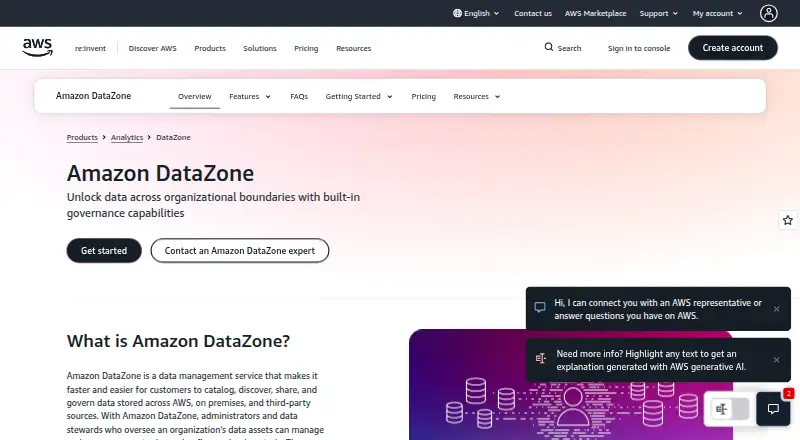
What Amazon DataZone is
Amazon DataZone is a cloud service for cataloging, finding, sharing, and governing data from AWS, on-premises, and third-party sources. Its business catalog lets users search published data and request access, while projects help teams collaborate on data assets and manage and monitor them. Governed workflows are designed to align access with a user and purpose. Large language models can generate business names for structured data, including columns, to aid discovery. Producer sources include AWS Glue Data Catalog and Amazon Redshift; analytics integrations include Amazon Athena and Redshift Query Editor. DataZone can fulfill and manage permissions automatically for AWS Lake Formation-managed Glue tables and Redshift tables and views. Amazon SageMaker integration supports access to data and ML assets and publishing new assets to the catalog. Listed capabilities include automated discovery, column-level lineage, impact analysis, and pipeline lineage. Data is encrypted at rest by default with an AWS-owned KMS key; customer-managed keys are supported for catalog data. Traffic uses TLS and client-side encryption, and service communication is over HTTPS. AWS CloudTrail records actions by users, roles, or services. Charges may also apply to associated AWS services.
Who it suits
DataZone is designed for engineers, data scientists, product managers, analysts, and business users who need to work with organizational data. It may suit teams using its listed AWS data sources and analytics integrations.
What it does well
- Catalogs data from AWS and other sources.
- Supports governed sharing and access requests.
- Includes column-level lineage and impact analysis.
- Encrypts data at rest by default.
What to know first
- Associated AWS services may add charges.
- Free monthly allowances are limited to specified usage.
Limits
The free usage allowance includes 20 MB of metadata storage, 4,000 API requests and 0.2 compute units per account each billing month. Charges may also apply for associated AWS Glue, KMS, Athena, Redshift and S3 use.
Plans
| Plan | Billed and limits | Price |
|---|---|---|
| Pay-as-you-go | Charges depend on requests, metadata storage, compute, and AI recommendation tokens; no upfront fees or long-term commitments. · 20 MB metadata storage · 4,000 API requests · 0.2 compute units per account each billing month; some core APIs are free | Free |
As aws.amazon.com lists them, read 7 Oct 2026. The maker's own page has the final word.
Getting started
- Open the Amazon DataZone website.
- Use the web service or its API.
- Connect producer data through AWS Glue Data Catalog or Amazon Redshift.
- Use analytics integrations such as Amazon Athena or Redshift Query Editor.
- Create projects to collaborate around data assets and manage them.
Amazon DataZone is a cloud service for cataloging, discovering, sharing, and governing organizational data across AWS, on-premises, and third-party sources. It is best suited to organizations already invested in AWS analytics, storage, and machine-learning services. The main decision is whether its connected catalog and access workflows justify usage charges from DataZone and the AWS services around it.
Overview
DataZone gives engineers, data scientists, product managers, analysts, and business users a shared business catalog. People can search published data, request access, and work with approved assets instead of relying on separate inventories and ad hoc permission requests.
Projects add a collaboration layer: teams organize data assets by initiative and manage and monitor those assets within the project. Governed sharing workflows are intended to match access with the right user and purpose, which is valuable where data use needs review rather than unrestricted distribution.
The service reaches AWS, on-premises, and third-party sources, but its most direct integrations are AWS-focused. AWS Glue Data Catalog and Amazon Redshift can provide producer data, while Amazon Athena and Redshift Query Editor connect analytics work to the catalog. That orientation favors AWS-centered estates over teams seeking a platform-neutral catalog.
Key features
Discovery, lineage, and catalog enrichment
Search and access requests form the practical core of the business catalog. Automated discovery, column-level lineage, pipeline lineage, and impact analysis help users trace assets and understand likely effects when data or pipelines change.
Large language models can generate business names for structured data, including columns. This can make technical metadata more understandable to non-specialists, although organizations should still review generated terminology before treating it as authoritative.
Governed access and AWS operations
DataZone can automatically fulfill and manage permissions for AWS Lake Formation-managed Glue tables and for Redshift tables and views. That reduces manual coordination in AWS environments, while the governed workflow keeps requests tied to an explicit purpose.
Its Amazon SageMaker integration lets users access data and machine-learning assets and publish newly created assets to the business catalog. Cloud deployment suits organizations that want a managed service rather than operating catalog infrastructure themselves.
Security and audit
Data is encrypted at rest by default with an AWS-owned KMS key, with customer-managed KMS keys supported for catalog data. TLS, client-side encryption in transit, and HTTPS protect communications. AWS CloudTrail records actions by users, roles, and AWS services, providing an audit trail for access and administration.
Pricing
Amazon DataZone is a paid service with pricing from $10. Its Pay-as-you-go plan has no upfront fees or long-term commitments, but charges vary with requests, metadata storage, compute, and AI recommendation tokens. Related AWS usage can add charges for Glue, KMS, Athena, Redshift, and S3, so the DataZone bill is not the whole operating cost.
The plan includes a monthly free allowance of 20 MB of metadata storage, 4,000 API requests, and 0.2 compute units per account; some core APIs are free. This allowance is useful for evaluation or small catalogs, but active organizations can exceed it quickly, particularly when automation and metadata volumes grow. A free plan is therefore a starting cushion, not a promise of a permanently cost-free deployment.
Platforms
DataZone is delivered as a cloud service with web and API access. It is not presented as a self-hosted deployment, so teams needing to run the catalog in their own infrastructure should consider alternatives.
Who it's for
Choose DataZone when AWS Glue, Redshift, Athena, Lake Formation, or SageMaker already anchor your data estate and you want one workflow for discovery, collaboration, permission fulfillment, and audit. It is also a strong fit for mixed-source organizations willing to manage AWS-centered integrations.
Look elsewhere if minimizing variable cloud-service charges is the priority, if you need a self-hosted catalog, or if your primary requirement is a vendor-neutral metadata platform independent of AWS tooling.
Pros and cons
Pros
- Catalog plus collaboration: Projects connect finding data with managing it across team initiatives.
- Governed AWS access: Automated fulfillment for Lake Formation Glue tables and Redshift objects can reduce permission administration.
- Useful lineage coverage: Column, pipeline, and impact analysis support change assessment.
- Operational controls: KMS options, encrypted transport, and CloudTrail auditing address common governance requirements.
Cons
- AWS cost complexity: Glue, KMS, Athena, Redshift, and S3 usage can all add to the bill.
- Usage-based limits: The free allowance is modest for a busy account, with charges tied to requests, storage, compute, and AI tokens.
- AWS-oriented integrations: The strongest workflows favor teams already using AWS services.
- Cloud-only delivery: Organizations requiring self-hosting do not get that deployment option.
Alternatives
For a broader comparison, see Data Lineage Tools.
- Atlas is a freemium, open-core option with API, Linux, macOS, Windows, and self-hosted support; choose it when open-source deployment matters.
- Apache Atlas is free open metadata governance software with no stated paid plans or usage limits, suited to teams wanting a self-hosted open-source route.
- Coalesce Catalog offers a free Developer plan for one user and capped monthly actions, with paid tiers for broader usage; it fits teams wanting explicit seat and action limits.
- Databricks Notebooks provides a free edition with one serverless workspace and limited compute, making it a better fit when notebook-based work is central.
- Grai is a free, fully open-source, self-hosted project for organizations prioritizing control of data and hosting.
- OpenDataDiscovery Platform is a free and open-source platform with self-hosted options.
- Collate combines a freemium model with self-hosted and web access for teams evaluating open-source lineage tooling.
- Google Cloud Knowledge Catalog is a paid, web-based alternative for organizations operating primarily in Google Cloud.
Verdict
Amazon DataZone is a sensible choice for AWS-focused organizations that need a business catalog tied directly to governed access, project collaboration, lineage, and SageMaker workflows. Choose it for that integrated AWS operating model; look elsewhere when self-hosting, platform neutrality, or tighter cost predictability matters more than native AWS coordination.
Verdict
Amazon DataZone combines a business data catalog, collaborative projects, and governed access workflows across multiple source environments. Review the usage-based charges, including costs from related AWS services, before choosing it.
Questions
Does Amazon DataZone have a free plan?
Its pay-as-you-go plan lists free monthly allowances of 20 MB metadata storage, 4,000 API requests and 0.2 compute units per account. Some core APIs are free.
What does Amazon DataZone cost?
The pricing note says From $10. The pay-as-you-go plan has no upfront fees or long-term commitments, and charges depend on requests, metadata storage, compute and AI recommendation tokens.
Which data sources and analytics tools does it integrate with?
Built-in producer sources include AWS Glue Data Catalog and Amazon Redshift. Analytics integrations include Amazon Athena and Redshift Query Editor.
Can it work with machine learning assets?
Yes. Amazon SageMaker integration lets users access data and ML assets and publish newly created assets to the business catalog.
How does DataZone protect data and track actions?
It encrypts data at rest by default with an AWS-owned KMS key and supports customer-managed KMS keys for catalog data. It uses TLS and client-side encryption in transit, HTTPS communication, and integrates with CloudTrail to record actions.
What other AWS charges may apply?
Charges may apply for AWS Glue, KMS, Athena, Redshift and S3 usage associated with DataZone.
Facts from Amazon DataZone's own pages
- Access fulfillment
- DataZone can automatically fulfill and manage permissions for AWS Lake Formation-managed Glue tables and Redshift tables and views. · aws.amazon.com, 7 Oct 2026
- AI cataloging
- Large language models can generate business names for structured data, including columns, to help users discover catalog data. · aws.amazon.com, 7 Oct 2026
- Audit and access
- DataZone integrates with AWS CloudTrail to record actions taken by users, roles, or AWS services. · docs.aws.amazon.com, 7 Oct 2026
- Business catalog
- Users can search published data, request access, and work with cataloged data through a business data catalog. · aws.amazon.com, 7 Oct 2026
- Encryption in transit
- DataZone uses TLS and client-side encryption in transit, and communication with the service is over HTTPS. · docs.aws.amazon.com, 7 Oct 2026
- Founded
- 2023 · aws.amazon.com, 28 Sept 2026
- Governed sharing
- Governed workflows help ensure data is accessed by the right user for the right purpose. · aws.amazon.com, 7 Oct 2026
- Integrations
- Built-in producer sources include AWS Glue Data Catalog and Amazon Redshift, and analytics integrations include Amazon Athena and Redshift Query Editor. · aws.amazon.com, 7 Oct 2026
- ML tools
- Amazon SageMaker integration lets users access data and ML assets and publish newly created assets to the business catalog. · aws.amazon.com, 7 Oct 2026
- Pricing limits
- Charges may also apply for AWS Glue, KMS, Athena, Redshift, and S3 usage associated with DataZone. · aws.amazon.com, 7 Oct 2026
- Projects
- Projects let teams collaborate around data assets and manage and monitor those assets across projects. · aws.amazon.com, 7 Oct 2026
- Purpose
- Amazon DataZone helps customers catalog, discover, share, and govern data across AWS, on-premises, and third-party sources. · aws.amazon.com, 7 Oct 2026
- Security
- DataZone encrypts data at rest by default with an AWS-owned KMS key and supports customer-managed KMS keys for catalog data. · docs.aws.amazon.com, 7 Oct 2026
- Users
- The service is designed to help engineers, data scientists, product managers, analysts, and business users access and collaborate around organizational data. · aws.amazon.com, 7 Oct 2026
Where Amazon DataZone stands on Freedom251
- Data Lineage Tools#4 of 43