Freedom251 › Fuzz Testing Software
Schemathesis
What Schemathesis is
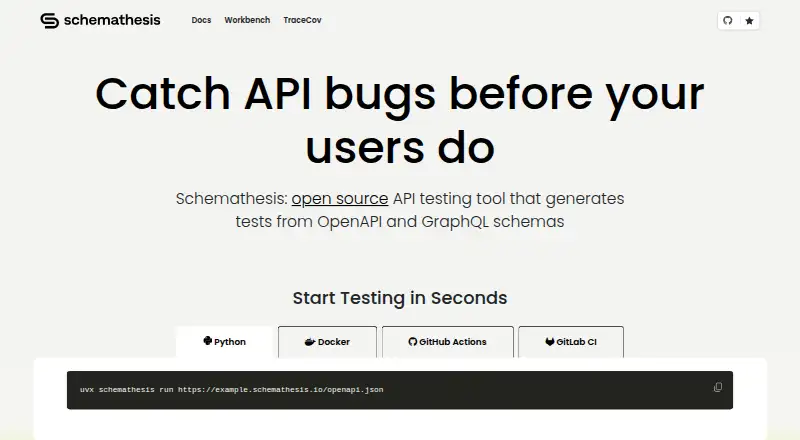
Schemathesis generates property-based tests from OpenAPI and GraphQL schemas to help engineers find API bugs. Generated cases probe boundary values, type mismatches, and constraint violations, while response validation checks results against the OpenAPI specification. For multi-step testing, it can chain API operations using links inferred from a schema. During a run, it can learn validation rules, resource IDs, and authentication requirements from server responses and reuse them. Users can add Python checks for business rules alongside built-in checks. It supports OpenAPI 2.0, 3.0, 3.1, and 3.2, as well as GraphQL schemas. Authentication options include Bearer tokens, Basic authentication, and API keys, with environment variable substitution and Python hooks for dynamic flows. Integrations include a GitHub Action, Docker image, pip or uvx installation, and pytest. Reports can be exported as JUnit, VCR, HAR, NDJSON, JSON, or Allure, and failures can be saved with curl commands for replay. Schemathesis is free, MIT-licensed, and self-hosted, with support for Linux, macOS, and Windows.
Who it suits
Schemathesis suits engineers testing OpenAPI or GraphQL APIs, particularly those integrating API tests into CI/CD. Python checks, pytest integration, and several report formats support teams with those workflows.
What it does well
- Generates tests from OpenAPI and GraphQL schemas.
- Supports stateful, multi-step API workflows.
- Includes a GitHub Action, Docker image, and pytest integration.
- Exports JUnit, VCR, HAR, NDJSON, JSON, and Allure reports.
- Supports Bearer, Basic, and API key authentication.
What to know first
- Self-hosted deployment model.
- Custom business-rule checks use Python.
- Privacy policy says absolute data security cannot be guaranteed.
Plans
| Plan | Billed and limits | Price |
|---|---|---|
| Schemathesis | Open-source API testing tool; generates tests from OpenAPI and GraphQL schemas | Free |
As schemathesis.io lists them, read 4 Oct 2026. The maker's own page has the final word.
Getting started
- Visit https://schemathesis.io/.
- Install with pip or uvx, or use the Docker image.
- Use Schemathesis with an OpenAPI or GraphQL schema.
- Configure authentication with Bearer tokens, Basic authentication, or API keys as needed.
- Integrate with pytest or use the GitHub Action for CI/CD.
Schemathesis is a self-hosted testing tool for engineers who build and maintain OpenAPI or GraphQL APIs. It is best suited to teams that want generated, repeatable checks in a Python and CI/CD workflow. The trade-off is a developer-focused product rather than a managed testing service, so teams must operate it and write domain-specific checks themselves.
Overview
Schemathesis turns OpenAPI 2.0, 3.0, 3.1, and 3.2 documents, as well as GraphQL schemas, into property-based API tests. Instead of relying only on hand-picked examples, it probes boundary values, type mismatches, and constraint violations. That makes it useful for finding defects hiding outside normal happy-path requests, particularly when an API specification is kept current.
It also performs contract testing by validating responses against the OpenAPI specification. The project is MIT-licensed, free, and self-hosted, which suits organizations that need control over execution and data. It is less suitable for teams seeking a hosted dashboard or a nontechnical workflow.
Key features
Generated and stateful coverage
Generated cases target invalid and extreme inputs without requiring engineers to enumerate every value. Stateful testing goes further by chaining operations into multi-step workflows using links inferred from the schema. This can expose failures that appear only after creating a resource, retrieving its identifier, and using that identifier in a later operation.
Adaptive runs and custom rules
During a run, Schemathesis learns from responses and reuses validation rules, resource IDs, and authentication requirements it discovers. That adaptive behavior can make workflows more realistic than static request generation. Built-in checks can be extended with Python checks for business rules, giving application teams a way to test logic that a schema cannot express. The requirement to write Python is a strength for engineering teams and a barrier for users without that skill.
Authentication, integrations, and reports
Bearer tokens, Basic authentication, and API keys are supported, with environment-variable substitution and Python hooks for dynamic flows. Integrations include a GitHub Action, Docker image, pip or uvx installation, and pytest integration, so existing automation can invoke the tests in several ways. Scheduled runs and CI/CD integration support recurring regression checks.
Reports can be exported as JUnit, VCR, HAR, NDJSON, JSON, or Allure. Failed cases can also be saved with curl commands for replay, which helps developers move from a failing generated case to diagnosis. Discord is the support channel for configuration questions, bug reports, and integration examples.
Pricing
| Plan | Price | What it includes |
|---|---|---|
| Schemathesis | free | Open-source API testing tool that generates tests from OpenAPI and GraphQL schemas |
There is one free plan and no published seat, usage, or trial restrictions. Its free price removes licensing cost, but self-hosting transfers deployment and maintenance responsibility to your team. Commercial support beyond the Discord channel is not part of the published offer.
Platforms
Schemathesis runs on Linux, macOS, and Windows, and is designed for self-hosted deployment. Python is the supported language, with pytest, pip, uvx, Docker, and a GitHub Action providing practical ways to install or integrate it.
Who it's for
Choose Schemathesis if you are an engineer responsible for an OpenAPI or GraphQL API and want schema-driven tests in source control and CI/CD. It is particularly well matched to Python teams that can add custom business-rule checks and operate their own runners. Organizations that need a hosted security program, visual management, or broad non-Python authoring should look elsewhere.
Pros and cons
Pros
- Broad schema support: OpenAPI versions 2.0 through 3.2 and GraphQL cover common contract formats.
- More than isolated requests: Stateful and adaptive workflows can exercise resource lifecycles and response-dependent behavior.
- Pipeline-ready output: GitHub Actions, Docker, pytest, scheduled runs, and several report formats fit established delivery processes.
- Extensible checks: Python hooks and custom checks let teams cover rules beyond the schema.
- No license charge: The MIT-licensed project is free and self-hosted.
Cons
- Operational responsibility: Self-hosting means your team handles execution environments and maintenance.
- Developer-centric workflow: Python is required for custom checks and dynamic authentication flows.
- Schema dependence: Generated coverage is strongest when the OpenAPI or GraphQL contract accurately describes the API.
- No absolute security guarantee: The privacy policy says commercially acceptable protections are used but cannot guarantee absolute security.
Alternatives
Pick 42Crunch API Security Platform instead if you want a paid platform with a free tier, OpenAPI auditing, vulnerability scans, automatic fixes, and hosted or extension-based options.
OWASP Amass is a free, Apache-licensed open-source framework when your priority is its security-focused framework rather than schema-based API test generation.
Choose APISec Platform for a freemium service offering public API testing, basic test simulations, and community support through a web-oriented platform.
Automatic API Attack Tool is a free MIT-licensed option built around Java 8 or later, Gradle, and Swagger 2.0 specifications.
Consider Pynt when a freemium API-security product with a free tier capped at 10 endpoints is a better starting point.
VulnAPI is another free MIT-licensed open-source choice for educational and testing use.
WuppieFuzz suits readers seeking a free, open-source REST API fuzzer.
Choose AquilaX API Security Scanner if you need a freemium scanner with secrets scanning, PII detection, compliance auditing, unlimited scans, and CI/CD and IDE integration.
Verdict
Schemathesis is a strong choice for engineering teams that maintain reliable API schemas and want powerful, generated contract tests inside a Python-based CI/CD pipeline. Its main reason to choose it is the combination of property-based generation, adaptive stateful workflows, and extensible checks at no license cost. Look elsewhere if you need a managed service, a visual security platform, or testing workflows that do not depend on self-hosting and Python.
Verdict
Schemathesis provides schema-based API testing with adaptive and stateful workflows, authentication options, and CI/CD integrations. It is free and self-hosted, with custom business-rule checks written in Python.
Questions
How much does Schemathesis cost?
The Schemathesis plan is free, and the pricing model is free.
Is Schemathesis open source?
Yes. The project repository states that it is licensed under MIT.
Which platforms does Schemathesis support?
It supports Linux, macOS, Windows, and self-hosted deployment.
Does Schemathesis support GraphQL?
Yes. It supports GraphQL schemas as well as OpenAPI 2.0, 3.0, 3.1, and 3.2.
Can it run tests in CI/CD?
Yes. The listed integrations include a GitHub Action and pytest, and CI/CD integration is supported.
Where can users get technical support?
The maker directs users to Discord for technical support, configuration questions, bug reports, and integration examples.
Facts from Schemathesis's own pages
- Adaptive testing
- During a run, it learns from server responses and reuses discovered validation rules, resource IDs, and authentication requirements. · schemathesis.io, 4 Oct 2026
- Authentication
- It supports Bearer tokens, Basic authentication, and API keys, with environment variable substitution and Python hooks for dynamic flows. · schemathesis.io, 4 Oct 2026
- Custom checks
- Users can add Python checks for business rules alongside built-in checks. · schemathesis.io, 4 Oct 2026
- Integrations
- The maker lists a GitHub Action, Docker image, pip or uvx installation, and pytest integration. · schemathesis.io, 4 Oct 2026
- Intended users
- The maker presents Schemathesis for engineers testing OpenAPI or GraphQL APIs and integrating API tests into CI/CD. · schemathesis.io, 4 Oct 2026
- License
- The project repository states that Schemathesis is licensed under the MIT license. · github.com, 4 Oct 2026
- Purpose
- Schemathesis generates property-based tests from OpenAPI and GraphQL schemas to find API bugs. · schemathesis.io, 4 Oct 2026
- Reports
- It can export JUnit, VCR, HAR, NDJSON, JSON, and Allure reports, and save failures with curl commands for replay. · schemathesis.io, 4 Oct 2026
- Response validation
- It validates API responses against the OpenAPI specification. · schemathesis.io, 4 Oct 2026
- Security and privacy
- The privacy policy says the company uses commercially acceptable means to protect personal data but cannot guarantee absolute security. · schemathesis.io, 4 Oct 2026
- Specifications
- It supports OpenAPI 2.0, 3.0, 3.1, and 3.2, plus GraphQL schemas. · schemathesis.io, 4 Oct 2026
- Stateful testing
- It chains API operations into multi-step workflows using links inferred from the schema. · schemathesis.io, 4 Oct 2026
- Support
- The maker directs users to Discord for technical support, configuration questions, bug reports, and integration examples. · schemathesis.io, 4 Oct 2026
- Test generation
- It generates cases that probe boundary values, type mismatches, and constraint violations. · schemathesis.io, 4 Oct 2026
Where Schemathesis stands on Freedom251
- Fuzz Testing Software#12 of 26
- API Security Testing Software#13 of 27
- API Development Tools#16 of 32
- API Design Tools#13 of 26
- Integration Testing Tools#14 of 26
- API Testing Tools#19 of 34
- Contract Testing Tools#14 of 22