Freedom251 › API Security Testing Software
VulnAPI
What VulnAPI is
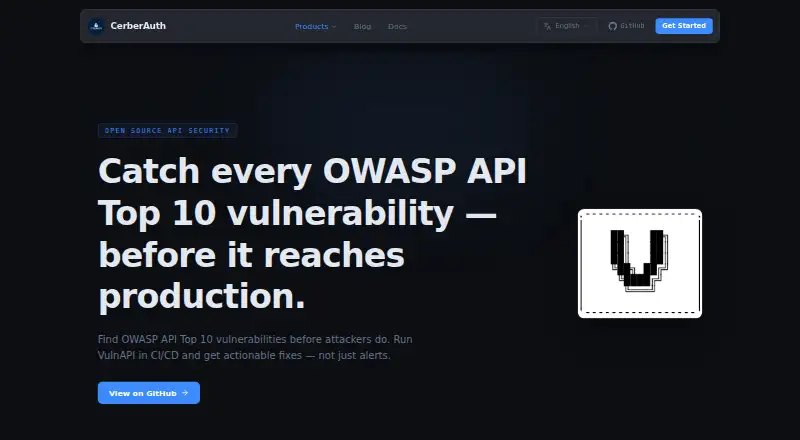
VulnAPI is an open-source dynamic application security testing tool for finding vulnerabilities and security risks in APIs. It can scan through a curl-like command-line interface, OpenAPI contracts, or a GraphQL endpoint; the listed formats also include REST. Its product page says it detects all ten OWASP API Security Top 10 categories out of the box. Listed testing areas include API discovery, authentication, authorization, input validation, and business logic. Reports show a finding’s risk level, vulnerability, description, and operation. Each finding also includes the request that triggered it and remediation steps written in plain English. Teams can tailor assessments to their requirements and environments, and the maker lists GitHub Actions, GitLab CI, and Jenkins integrations for CI/CD pipelines. VulnAPI is self-hosted, with pre-built binaries and installation instructions for Linux, Windows, and macOS; Docker is also available. The scanner collects anonymous data about scan counts and detected vulnerability counts and severity, with a command-line flag to opt out. Proxy settings can be configured with HTTP_PROXY or HTTPS_PROXY environment variables or a --proxy argument. The MIT-licensed tool is free to use, modify, and distribute for educational and testing purposes.
Who it suits
It suits security-minded teams that want to scan APIs in a self-hosted setup. Teams can tailor assessments and connect scans to GitHub Actions, GitLab CI, or Jenkins.
What it does well
- Scans through CLI requests, OpenAPI contracts, or GraphQL endpoints.
- Covers all ten OWASP API Security Top 10 categories, per its product page.
- Reports include triggering requests and remediation steps.
- Supports GitHub Actions, GitLab CI, and Jenkins.
- Anonymous usage data collection can be disabled with a command-line flag.
What to know first
- Deployment is self-hosted.
- The scanner collects anonymous scan and finding statistics unless users opt out.
Limits
The tool is described as free to use, modify, and distribute for educational and testing purposes. It collects anonymous scan and finding statistics by default, though users can opt out with a command-line flag.
Plans
| Plan | Billed and limits | Price |
|---|---|---|
| Open source (MIT License) | Free to use, modify, and distribute for educational and testing purposes | Free |
As cerberauth.com lists them, read 3 Oct 2026. The maker's own page has the final word.
Getting started
- Choose Linux, Windows, or macOS and follow the installation instructions, or use Docker.
- Select a curl-like request, OpenAPI contract, or GraphQL endpoint to scan.
- Configure a proxy with HTTP_PROXY, HTTPS_PROXY, or the --proxy argument if needed.
- Run scans locally or connect them to GitHub Actions, GitLab CI, or Jenkins.
- Use the command-line flag to opt out of anonymous usage data collection if desired.
VulnAPI is a self-hosted dynamic application security testing scanner for REST, OpenAPI, GraphQL, and request-driven APIs. It is aimed at security-minded teams that can operate command-line tooling and want checks embedded in development pipelines. The zero-cost MIT-licensed release offers unusually broad baseline coverage, but its self-managed deployment and telemetry setting deserve attention.
Overview
VulnAPI tests APIs for discovery, authentication, authorization, input-validation, and business-logic weaknesses. The maker says it detects all ten OWASP API Security Top 10 categories out of the box, making it a broad first pass rather than a narrowly focused checker. Teams can tailor scans to their own requirements and environments, which is valuable when standard checks need to reflect an organisation's architecture or risk priorities.
Deployment is self-hosted on Linux, macOS, or Windows, with Docker also supported. That keeps scanning under the user's control and can suit networks where API traffic should remain inside existing infrastructure. It also means the team must handle installation, upgrades, runtime configuration, and the surrounding execution environment.
Key features
Multiple ways to scan
The scanner accepts curl-like CLI requests, OpenAPI contracts, and GraphQL endpoints. Request-oriented scans fit APIs without a maintained specification, while contract and GraphQL inputs support schema-led workflows. Support for REST, OpenAPI, GraphQL, and raw curl-like requests gives mixed API estates a single testing approach, although teams still need suitable targets and definitions for each assessment.
Actionable findings
Reports identify a finding's risk level, vulnerability, description, and affected operation. Each result also includes the request that triggered it and concrete remediation steps in plain English. That context helps developers reproduce and prioritise issues instead of receiving only a category label; the practical value is highest when the team has an owner ready to apply and verify fixes.
Automation and network control
GitHub Actions, GitLab CI, and Jenkins integrations let teams place scans in common CI/CD pipelines. This supports repeatable checks before release or during development, while custom assessments can reflect environment-specific rules. Proxy settings work through HTTP_PROXY or HTTPS_PROXY variables, or a --proxy argument, which is useful when test traffic must pass through an organisational gateway.
Open project practices
Pre-built binaries and installation instructions are provided for all three supported desktop and server operating systems, reducing the effort of getting a scanner running. The repository invites requests for additional vulnerability checks and best practices through issues or pull requests, giving technically involved users a route to influence coverage. VulnAPI collects anonymous scan-count and vulnerability-count data, including severity; users can disable that collection with a command-line flag.
Pricing
Open source (MIT License): free. The plan is free to use, modify, and distribute for educational and testing purposes. There are no paid tiers, seat charges, scan quotas, trial periods, or renewal terms stated. This is the natural fit for teams that can self-host and maintain an open-source scanner, and for organisations that need to adapt the tool rather than buy a managed service. The trade-off is that the plan provides no vendor-hosted operation; infrastructure and upkeep remain with the user.
Platforms
VulnAPI runs on Linux, macOS, and Windows and can be deployed with Docker. Its self-hosted model and CLI orientation fit developer workstations, build agents, and internally managed security environments. GitHub Actions, GitLab CI, and Jenkins are the named pipeline targets.
Who it's for
Choose VulnAPI if your security or engineering team wants broad OWASP API coverage, can run a self-hosted tool, and values scan inputs that range from raw requests to OpenAPI and GraphQL definitions. It is particularly suitable for teams integrating security gates into existing CI/CD systems or tailoring checks to unusual environments. Look elsewhere if you need a hosted console, vendor-operated maintenance, or a packaged service for users who do not manage command-line infrastructure.
Pros and cons
Pros
- Broad baseline: all ten OWASP API Security Top 10 categories are stated as covered out of the box.
- Flexible targets: curl-like requests, OpenAPI contracts, and GraphQL endpoints accommodate different API development practices.
- Developer-ready results: risk, operation, triggering request, plain-English explanation, and remediation steps make findings easier to act on.
- Pipeline reach: named GitHub Actions, GitLab CI, and Jenkins integrations support automated assessment.
- Fully open source: the MIT licence allows free use, modification, and distribution for educational and testing purposes.
Cons
- Self-hosting required: teams must provide and maintain the runtime, rather than relying on a hosted service.
- Operational expertise matters: custom scans and CLI-based workflows reward security engineers comfortable configuring assessments.
- Telemetry is enabled unless changed: anonymous scan and vulnerability counts are collected by default, though a command-line opt-out is provided.
Alternatives
Compare API security testing software for a wider shortlist. Pick 42Crunch API Security Platform instead if you want a paid platform with a free tier, free trial, OpenAPI auditing, vulnerability scans, and automatic fixes across web and extension environments. OWASP Amass is a free, Apache-licensed open-source option for teams whose priority is its framework rather than VulnAPI's API scanning scope. Choose APISec Platform for a freemium hosted or self-hosted route with public API testing, basic simulations, and community support. Automatic API Attack Tool suits users seeking a free MIT-licensed tool built around Java, Gradle, and Swagger 2.0 specifications. Pynt is the better fit when a limited free starter covering up to 10 API endpoints or a paid business service matches your rollout. Consider Schemathesis for an open-source generator that derives tests from OpenAPI and GraphQL schemas. WuppieFuzz is a free open-source REST API fuzzer. AquilaX API Security Scanner is worth considering for a freemium service with unlimited scans, secrets scanning, PII detection, compliance auditing, and CI/CD plus IDE integrations.
Verdict
VulnAPI is a strong choice for security-minded teams that want comprehensive API checks, useful fix guidance, and CI/CD integration without a licence bill. Choose it when self-hosting and operating a configurable CLI scanner are acceptable. Look elsewhere when you need a managed platform, a polished hosted workflow, or support responsibilities carried by a vendor.
Verdict
VulnAPI brings API security scanning, detailed findings, and remediation guidance to a free, self-hosted tool. Its published coverage and CI/CD integrations may suit teams looking to tailor assessments to their environments.
Questions
How much does VulnAPI cost?
The Open source (MIT License) plan is free.
Is VulnAPI open source?
Yes. It is open source under the MIT License and is described as free to use, modify, and distribute for educational and testing purposes.
Which platforms does VulnAPI support?
Installation instructions and pre-built binaries are available for Linux, Windows, and macOS. Docker is also available, and deployment is self-hosted.
Which API formats can it scan?
It supports REST, OpenAPI, GraphQL, and curl-like requests. Scans can use a curl-like CLI, an OpenAPI contract, or a GraphQL endpoint.
Which CI/CD systems does it integrate with?
The maker lists GitHub Actions, GitLab CI, and Jenkins.
Does VulnAPI collect usage data?
It collects anonymous scan counts and detected vulnerability counts and severity. Users can opt out with a command-line flag.
Facts from VulnAPI's own pages
- CI/CD integrations
- The maker lists GitHub Actions, GitLab CI, and Jenkins as supported CI/CD pipeline integrations. · cerberauth.com, 3 Oct 2026
- Custom scans
- The product page says teams can tailor security assessments to their requirements and environments. · cerberauth.com, 3 Oct 2026
- Installation
- Pre-built binaries and installation instructions are provided for Linux, Windows, and macOS, with Docker also available. · cerberauth.com, 3 Oct 2026
- OWASP coverage
- The product page says VulnAPI detects all ten OWASP API Security Top 10 categories out of the box. · cerberauth.com, 3 Oct 2026
- Proxy support
- The scanner supports proxy configuration through HTTP_PROXY or HTTPS_PROXY environment variables or a --proxy argument. · github.com, 3 Oct 2026
- Remediation guidance
- The product page says findings include a plain-English description, the triggering request, and concrete remediation steps. · cerberauth.com, 3 Oct 2026
- Reports
- Scan reports include the risk level, vulnerability, description, and operation where the finding was detected. · cerberauth.com, 3 Oct 2026
- Scan methods
- It scans APIs through a curl-like CLI, OpenAPI contracts, or a GraphQL endpoint. · cerberauth.com, 3 Oct 2026
- Support channel
- The repository invites users to request additional vulnerability checks or best practices by opening an issue or submitting a pull request. · github.com, 3 Oct 2026
- Target audience
- The product page describes VulnAPI as built for security-minded teams. · cerberauth.com, 3 Oct 2026
- Telemetry
- The scanner collects anonymous usage data about scan counts and detected vulnerability counts and severity; users can opt out with a command-line flag. · github.com, 3 Oct 2026
- What it does
- VulnAPI is an open source dynamic application security testing tool that scans APIs for vulnerabilities and security risks. · cerberauth.com, 3 Oct 2026
Where VulnAPI stands on Freedom251
- API Security Testing Software#14 of 27