Freedom251 › API Security Testing Software
WuppieFuzz
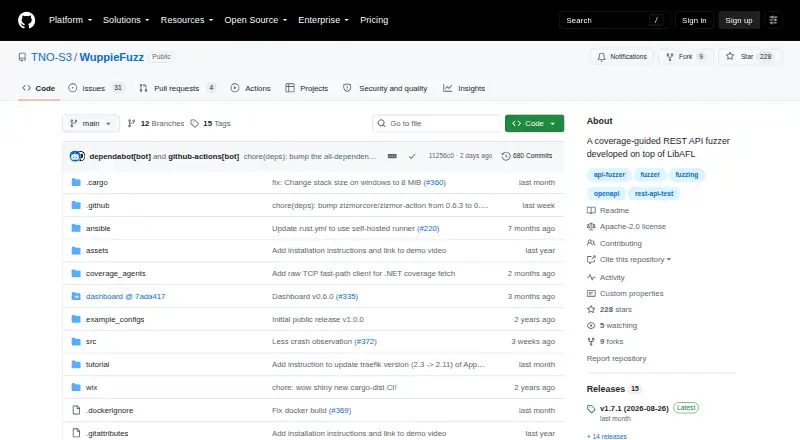
What WuppieFuzz is
WuppieFuzz is a free, open-source REST API fuzzer built on LibAFL. It generates and mutates requests from an OpenAPI specification to look for potential errors and security flaws. Testing modes include black-box, grey-box, and white-box, with authentication and input-validation testing. Authentication documentation describes Bearer, custom, cookie, OAuth, and Web Fuzzing Commons formats. It can produce endpoint coverage reports; code coverage is supported for Java, JavaScript, and Python, while code coverage reports are currently limited to JaCoCo. A Grafana dashboard can visualize and explore request data from a fuzzing campaign. The self-hosted tool runs on Windows, macOS, and Linux. TNO says fuzzing data is not shared with it or third parties. The project uses the Apache 2.0 license, and TNO invites users to contact it for help or information about automated reliability and security testing tools. Its intended uses include software development, supply-chain quality control, and penetration testing. An OpenAPI specification is required to generate and mutate requests.
Who it suits
WuppieFuzz may suit developers and testers who want to fuzz REST APIs described by OpenAPI documents. Its stated uses also include supply-chain quality control and penetration testing.
What it does well
- Supports black-box, grey-box, and white-box testing
- Tests authentication and input validation
- Endpoint coverage reports are available
- Grafana can display campaign request data
- Fuzzing data is not shared with TNO or third parties
What to know first
- Requires an OpenAPI specification
- Code coverage reports currently support only JaCoCo
- Deployment is self-hosted
- API discovery is not supported
Limits
The tool requires an OpenAPI specification and does not provide API discovery. Code coverage reports are currently limited to JaCoCo.
Plans
| Plan | Billed and limits | Price |
|---|---|---|
| WuppieFuzz | Free, open source REST API fuzzer | Free |
| WuppieFuzz Free | Open-source REST API fuzzer · self-hosted · Apache-2.0 | Free |
As github.com lists them, read 8 Oct 2026. The maker's own page has the final word.
Getting started
- Open the WuppieFuzz project website on GitHub.
- Choose a supported environment: Linux, macOS, Windows, or self-hosted.
- Provide an OpenAPI specification in JSON or YAML.
- Configure the authentication format needed for the API.
- Run a fuzzing campaign and review endpoint coverage or request data through Grafana.
Verdict
WuppieFuzz offers several testing modes and coverage features for OpenAPI-described REST APIs, with self-hosted deployment. Its JaCoCo reporting limit and lack of API discovery are important scope constraints.
Questions
How much does WuppieFuzz cost?
The listed plan is free, and the project is open source.
Which operating systems does it support?
WuppieFuzz supports Linux, macOS, and Windows, with self-hosted deployment.
Which API formats can it use?
It uses OpenAPI/Swagger specifications in JSON or YAML to generate and mutate requests.
Does it test authentication?
Yes. Authentication documentation covers Bearer, custom, cookie, OAuth, and Web Fuzzing Commons formats.
What code coverage reports are supported?
Code coverage support is described for Java, JavaScript, and Python, but generated code coverage reports currently support JaCoCo.
Who makes WuppieFuzz?
TNO is the organization behind the project and invites users to contact it for help, ideas, or information about its automated reliability and security testing tools.
Facts from WuppieFuzz's own pages
- API specification
- It requires an OpenAPI specification to generate and mutate requests. · github.com, 8 Oct 2026
- Audience and uses
- TNO describes the tool as intended for a broad audience and usable during software development, supply-chain quality control, or penetration testing. · tno.nl, 8 Oct 2026
- Authentication
- Authentication documentation describes Bearer, custom, cookie, OAuth, and Web Fuzzing Commons formats. · github.com, 8 Oct 2026
- Automated harness
- The tool automates creation of the HTTP fuzzing harness, reducing manual setup work. · arxiv.org, 15 Oct 2026
- Black-box fallback
- Black-box testing remains available without a coverage agent, but provides less detailed feedback than line coverage. · researchgate.net, 15 Oct 2026
- CLI and configuration
- The command-line interface accepts an OpenAPI file, and YAML configuration files can be combined with command-line flags, with flags taking precedence. · github.com, 15 Oct 2026
- Code coverage
- The maker says code coverage is supported for Java, JavaScript, and Python, and that adding languages is possible. · tno.nl, 8 Oct 2026
- Coverage agents
- The research describes coverage agents for Java, Python and JavaScript, with a modular design intended to allow more languages. · researchgate.net, 15 Oct 2026
- Coverage feedback
- Scheduling can use code coverage and endpoint coverage gathered through coverage agents. · researchgate.net, 15 Oct 2026
- Dashboard
- A Grafana dashboard is supplied to visualize and explore fuzzing results. · github.com, 15 Oct 2026
- Developer prerequisites
- Building from source requires build-essential, pkg-config, CMake and Rust, with OpenSSL, SQLite and Z3 system-library options documented. · github.com, 15 Oct 2026
- Docker
- The project documents building a Docker image and running it with a mounted fuzzing directory and host networking for local targets. · github.com, 15 Oct 2026
- Documentation depth
- The repository includes a low-level tutorial, example configurations, coverage-agent instructions and generated Rust API documentation support. · github.com, 15 Oct 2026
- Extensibility
- The project invites contributions such as new language coverage agents and mutation techniques. · tno.nl, 15 Oct 2026
- Independent registry status
- The Dutch open-source registry marks the repository status as stable and lists Linux, macOS and Windows platforms. · oss.developer.overheid.nl, 15 Oct 2026
- Independent technical description
- An ETSI workshop presentation characterizes WuppieFuzz as an open-source, LibAFL-based coverage-guided REST API fuzzer using OpenAPI response conformance and endpoint coverage. · docbox.etsi.org, 15 Oct 2026
- Install platforms
- The README points users to releases or Homebrew for macOS, Windows and Linux installation. · github.com, 15 Oct 2026
- Latest repository release
- The GitHub repository page currently presents WuppieFuzz v1.8.0. · github.com, 15 Oct 2026
- Licence
- WuppieFuzz is distributed under the Apache-2.0 licence. · github.com, 15 Oct 2026
- License
- WuppieFuzz is available under the Apache 2.0 license. · github.com, 8 Oct 2026
- Limit: black-box detail
- Without a coverage agent, testing can measure endpoint coverage but cannot provide the detail of line-coverage feedback. · researchgate.net, 15 Oct 2026
- Limit: result minimization
- The research paper identifies automated minimization of the request sequence and parameters causing a failure as future work. · researchgate.net, 15 Oct 2026
- Limit: specification dependency
- The research architecture requires an OpenAPI specification describing the system under test before fuzzing can start. · researchgate.net, 15 Oct 2026
- Maker founded
- LinkedIn lists TNO's founding year as 1932. · linkedin.com, 15 Oct 2026
Where WuppieFuzz stands on Freedom251
- API Security Testing Software#1 of 27