Freedom251 › API Security Testing Software
GraphQL-Cop
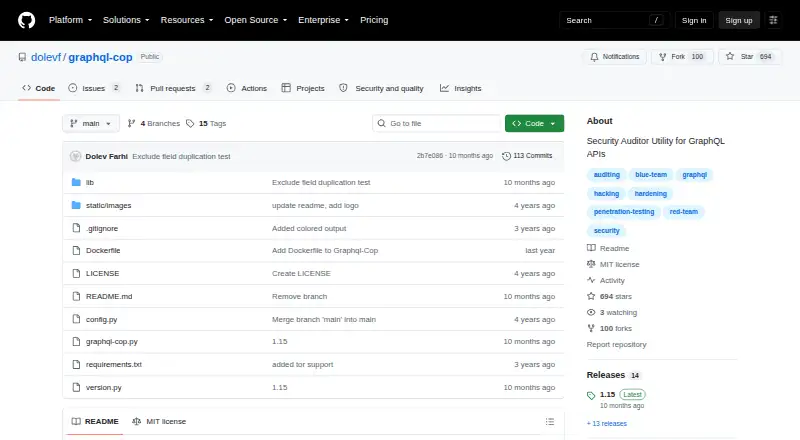
What GraphQL-Cop is
GraphQL-Cop is a lightweight Python utility for checking GraphQL APIs for common security issues. The project describes it as suitable for security auditing and lightweight CI/CD checks. Its listed tests cover alias and batch query overloading, CSRF risks, information leaks, duplicated fields, denial-of-service risks, and circular introspection queries. When it identifies vulnerabilities, it can provide cURL commands to reproduce them. Results can be written as JSON and can include those reproduction commands.
Users can supply request headers, exclude tests, force a scan, configure a proxy, or provide a custom wordlist of endpoint paths. When the target URL does not specify a GraphQL path, the tool tries a series of common paths. It can be run from Python or built and run as a Docker container. Its listed requirements are Python 3 and the Requests library.
GraphQL-Cop is available for Linux, macOS, Windows, and self-hosted use, and its repository includes an MIT License. The README provides command-line help and troubleshooting guidance for Docker file and dependency issues. The project states that it does not cover API discovery, authentication or authorization testing, input-validation testing, or business-logic testing.
Who it suits
GraphQL-Cop suits developers and security practitioners auditing GraphQL APIs, including teams adding lightweight checks to CI/CD. It is a fit for users comfortable running a Python utility or Docker container and who need findings with reproducible cURL commands.
What it does well
- Checks GraphQL APIs for several listed security risks.
- Can provide cURL commands to reproduce findings.
- Supports JSON results with reproduction commands.
- Accepts headers, proxy settings, and custom endpoint wordlists.
- Can run from Python or as a Docker container.
- Repository includes an MIT License.
What to know first
- Does not test authentication or authorization.
- Does not test input validation or business logic.
- Does not perform API discovery.
Getting started
- Visit the project at https://github.com/dolevf/graphql-cop.
- Install Python 3 and the Requests library, or use the documented Docker build and run route.
- Provide a target GraphQL API URL; if it omits a GraphQL path, the utility tries common paths.
- Configure request headers, excluded tests, a proxy, or a custom endpoint wordlist as needed.
- Run the scan and use JSON output or cURL commands to review and reproduce findings.
Verdict
Choose GraphQL-Cop for lightweight GraphQL security checks that can run in CI/CD and produce reproducible findings. Look elsewhere if your review needs API discovery, authentication or authorization checks, input-validation testing, or business-logic testing.
Questions
Is GraphQL-Cop free?
Yes. It is listed as free, and its repository includes an MIT License.
Which platforms can I use it on?
It is listed for Linux, macOS, Windows, and self-hosted use.
What does GraphQL-Cop test?
Its checks include alias and batch query overloading, CSRF risks, information leaks, duplicated fields, denial-of-service risks, and circular introspection queries.
What does it require?
The listed requirements are Python 3 and the Requests library. The README also documents building and running it as a Docker container.
Can it help reproduce findings?
Yes. For identified vulnerabilities it provides cURL commands, and JSON results can include those commands.
Does it test authentication or business logic?
No. It does not test authentication, authorization, input validation, or business logic.
Facts from GraphQL-Cop's own pages
- CI/CD
- The project describes itself as suitable for lightweight GraphQL CI/CD checks. · github.com, 7 Oct 2026
- Configuration
- Users can supply request headers, exclude tests, force a scan, configure a proxy, or provide a custom endpoint wordlist. · github.com, 7 Oct 2026
- Deployment
- The README documents running GraphQL-Cop from Python and building and running it as a Docker container. · github.com, 7 Oct 2026
- Detection coverage
- Its listed checks include alias and batch query overloading, CSRF risks, information leaks, and circular introspection queries. · github.com, 7 Oct 2026
- Docker
- The README documents building and running the tool in a Docker container. · github.com, 7 Oct 2026
- Endpoint discovery
- If no GraphQL path is provided, the tool iterates through common GraphQL paths. · github.com, 7 Oct 2026
- Findings
- It tests for issues including alias overloading, batch queries, CSRF, information leaks, field duplication, and denial-of-service risks. · github.com, 7 Oct 2026
- Installation
- The README lists Python 3 and the Requests library as requirements. · github.com, 7 Oct 2026
- Intended users
- The repository describes the tool as suitable for GraphQL security auditing and CI/CD checks. · github.com, 7 Oct 2026
- License
- The repository includes an MIT License. · github.com, 7 Oct 2026
- Maintainer
- The repository owner profile identifies dolevf as Dolev Farhi and describes him as a security engineer. · github.com, 7 Oct 2026
- Output
- It supports JSON output and can include cURL reproduction commands in the results. · github.com, 7 Oct 2026
- Purpose
- GraphQL-Cop is a lightweight Python utility for running common security tests against GraphQL APIs, including CI/CD checks. · github.com, 7 Oct 2026
- Reproduction
- For identified vulnerabilities, it provides cURL commands to reproduce the findings. · github.com, 7 Oct 2026
- Requirements
- The listed requirements are Python 3 and the Requests library. · github.com, 7 Oct 2026
- Support
- The README provides command-line help and troubleshooting guidance for Docker file and dependency issues. · github.com, 7 Oct 2026
- Target discovery
- If the target URL omits a GraphQL path, it iterates through a series of common GraphQL paths. · github.com, 7 Oct 2026
Where GraphQL-Cop stands on Freedom251
- API Security Testing Software#11 of 27