Freedom251 › Fuzz Testing Software
Csmith
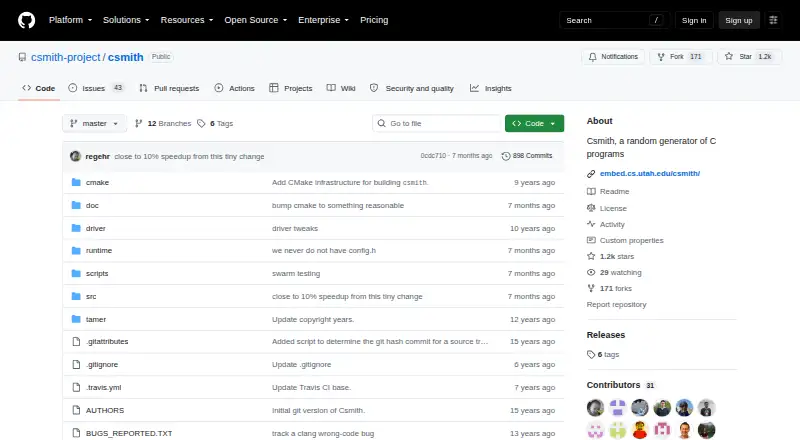
What Csmith is
Csmith is a free C program generator for finding compiler bugs through differential testing. It creates random C programs that are free of undefined behavior and includes statistics with each generated program. A documented workflow uses GCC and Clang to compile generated programs, then compares their outputs to look for differences. Csmith can also supply programs for a C test suite when users do not want to write one themselves.
Command-line options displayed by `csmith -h` and `csmith -hh` let users customize generation. The tool runs locally and supports Linux and Windows. The project documents Windows builds with Visual Studio or WSL; its Ubuntu instructions name g++, CMake, and m4 as prerequisites for building from source with CMake and make. The INSTALL file says Csmith should build on most modern machines with a C++ compiler. Generated programs may run indefinitely, so the README recommends timeouts during execution. The repository includes a COPYING license file. GitHub issues are available for bug reports and suggestions, and a mailing list supports discussion. Maintainers say replies may be delayed because they maintain the project in their discretionary time.
Who it suits
Csmith suits compiler developers and testers who need generated C programs for differential testing or want material for a C test suite. It is also relevant to users who can build and run command-line software locally on Linux or Windows.
What it does well
- Generates C programs without undefined behavior.
- Includes statistics with each generated program.
- Supports comparing GCC and Clang output.
- Command-line options customize program generation.
- Runs locally on Linux and Windows.
- CI/CD support is listed.
What to know first
- Generated programs may contain infinite loops and need timeouts.
- Building from source on Ubuntu requires g++, CMake, and m4.
- Maintainer responses may be delayed.
Plans
| Plan | Billed and limits | Price |
|---|---|---|
| Csmith | Open-source C program generator | Free |
As github.com lists them, read 4 Oct 2026. The maker's own page has the final word.
Getting started
- Open the Csmith GitHub repository.
- Choose a Linux or Windows build route.
- On Ubuntu, install g++, CMake, and m4, then use CMake and make to build from source.
- On Windows, build with Visual Studio or WSL.
- Use `csmith -h` or `csmith -hh` to inspect generation options.
- Compile generated programs with GCC and Clang and compare their outputs; apply timeouts when executing them.
Verdict
Choose Csmith when you need locally generated C programs for compiler comparisons or test-suite creation. Timely maintainer responses are not assured.
Questions
How much does Csmith cost?
The listed Csmith plan is free.
Is there a free trial?
No. Csmith is listed as free, with no free trial.
Which platforms does it support?
Linux and Windows. The project documents Windows builds with Visual Studio or WSL.
What languages and targets does it cover?
Its supported languages are C and C++; listed target types include C programs, C++ programs, and compilers.
Is Csmith open source?
The repository includes a COPYING license file, and the listed plan describes it as an open-source C program generator.
Where can users get support?
The project points users to GitHub issues for bug reports and suggestions and provides a mailing list for discussion. Maintainers say replies may be delayed.
Facts from Csmith's own pages
- Build compatibility
- The INSTALL file says Csmith should build on most modern machines with a C++ compiler. · github.com, 4 Oct 2026
- Compiler workflow
- The README demonstrates compiling generated programs with GCC and Clang and comparing their outputs to identify compiler bugs. · github.com, 4 Oct 2026
- Customization
- Command-line options shown by `csmith -h` and `csmith -hh` customize random generation. · github.com, 4 Oct 2026
- Execution limit
- Generated programs might contain infinite loops, and the README recommends applying timeouts to their execution. · github.com, 4 Oct 2026
- License
- The repository includes a COPYING license file. · github.com, 4 Oct 2026
- Linux build
- The Ubuntu build instructions list g++, CMake, and m4 as prerequisites and use CMake and make to install from source. · github.com, 4 Oct 2026
- Origin
- Csmith was originally developed at the University of Utah as part of a compiler-testing research project and was open-sourced in 2009. · github.com, 4 Oct 2026
- Other use
- The project suggests using Csmith to create a C-program test suite when users do not want to write one themselves. · github.com, 4 Oct 2026
- Purpose
- Csmith generates random C programs to find compiler bugs using differential testing. · github.com, 4 Oct 2026
- Safe output
- Generated C programs are free of undefined behaviors and include per-program statistics. · github.com, 4 Oct 2026
- Support
- The project directs users to GitHub issues for bug reports and suggestions and provides a mailing list for discussion. · github.com, 4 Oct 2026
- Support response
- The maintainers say they maintain Csmith in their discretionary time and responses to bug reports or feature requests may be delayed. · github.com, 4 Oct 2026
- Windows build
- The project documents building on Windows with Visual Studio or WSL. · github.com, 4 Oct 2026
Where Csmith stands on Freedom251
- Fuzz Testing Software#9 of 26