Freedom251 › Fuzz Testing Software
cargo-fuzz
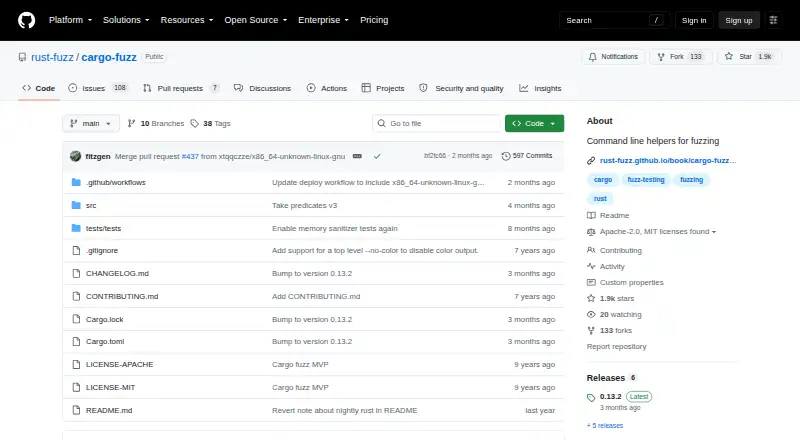
What cargo-fuzz is
cargo-fuzz is a free, open-source Cargo subcommand for fuzzing Rust code with libFuzzer. It invokes the fuzzer rather than supplying one itself. To get started, `cargo fuzz init` creates fuzzing files for a crate, while `cargo fuzz add <target>` creates a target and `cargo fuzz run <target>` runs it to look for bugs. The tool can reduce a failing input or a corpus of inputs, and version 0.10.0 or newer can produce source-based coverage information. Its documentation includes structure-aware fuzzing and a GitHub Actions workflow for building and running targets in CI. Listed systems include x86-64 Linux, x86-64 and Apple-Silicon macOS, and Windows with LLVM sanitizer support; Windows programs can also use MSVC AddressSanitizer. The project requires the nightly Rust compiler because it uses a `-Z` compiler flag for address sanitization, as well as a C++ compiler with C++11 support. It is distributed under the MIT and Apache 2.0 licenses.
Who it suits
It suits Rust developers who want to fuzz crate targets locally or include fuzz runs in GitHub Actions. Users need a nightly Rust compiler and a C++11-capable compiler.
What it does well
- Free and open source under MIT and Apache 2.0.
- Commands create projects, targets, and run fuzzing.
- Can minimize failing inputs and input corpora.
- Coverage information is available from version 0.10.0 onward.
- Documentation includes a GitHub Actions workflow.
What to know first
- Requires the nightly Rust compiler.
- Requires a C++ compiler with C++11 support.
- Coverage requires cargo-fuzz version 0.10.0 or newer.
Limits
The project requires nightly Rust and a C++ compiler with C++11 support. Source-based coverage generation requires cargo-fuzz version 0.10.0 or newer.
Plans
| Plan | Billed and limits | Price |
|---|---|---|
| cargo-fuzz | MIT license · Apache License (Version 2.0) | Free |
As github.com lists them, read 2 Oct 2026. The maker's own page has the final word.
Getting started
- Open the cargo-fuzz GitHub project page.
- Install it with `cargo install cargo-fuzz`.
- Use a nightly Rust compiler and a C++11-capable compiler.
- Run `cargo fuzz init` in a crate to create fuzzing files.
- Run `cargo fuzz add <target>` to add a fuzz target.
- Run `cargo fuzz run <target>` to search for bugs.
cargo-fuzz is a Rust-focused Cargo subcommand for running libFuzzer against fuzz targets. It is best suited to Rust developers who can use a nightly compiler and C++11-capable toolchain. Its concentrated workflow covers target setup, fuzzing, and reducing failures, but those build requirements narrow its fit.
Overview
Rather than implementing a fuzzer, cargo-fuzz invokes libFuzzer through the libfuzzer-sys crate. The Rust Fuzz Book recommends it for fuzz testing Rust code, making it a natural choice for Rust crates, not a general-purpose tool for teams fuzzing across languages.
Installation uses cargo install cargo-fuzz. Address sanitization depends on Rust's -Z compiler flag, so the project requires nightly Rust as well as a C++ compiler with C++11 support. Those prerequisites are a real constraint for stable-only environments or machines without a suitable native toolchain.
Key features
Targets and execution
cargo fuzz init creates fuzzing files for a crate, and cargo fuzz add <target> creates a target. Run it with cargo fuzz run <target> to search for bugs. Cargo feature options—including --features, --no-default-features and --all-features—let targets exercise different feature configurations.
Input reduction and coverage
cargo fuzz tmin minimizes a failing input, while cargo fuzz cmin reduces a corpus of input files. These commands help narrow a failure to a more manageable case and trim accumulated inputs. cargo fuzz coverage generates source-based coverage information, but requires cargo-fuzz 0.10.0 or newer.
Structured fuzzing and automation
For inputs with meaningful structure, the fuzz_mutator! macro and Arbitrary trait support structure-aware fuzzing rather than limiting developers to raw byte buffers. Documentation also provides a GitHub Actions workflow that installs the tool, builds targets, runs them for a configured time, and uploads artifacts on failure. That gives Rust projects a documented CI path, though the actual run duration is configured by the user.
Windows support includes fuzzing Windows programs with MSVC AddressSanitizer. The setup documentation covers x86-64 Linux, x86-64 macOS, Apple-Silicon macOS, and Windows with LLVM sanitizer support; verify the compiler and sanitizer requirements for the intended setup before adopting it.
Pricing
cargo-fuzz is free and open source, with a listed price of free. The plan is distributed under both the MIT License and Apache License, Version 2.0. There are no paid tiers or seat and usage charges in the plan, making it straightforward for individual developers and teams to adopt without a software fee.
Platforms
The listed platforms are Linux, macOS, and Windows. Supported setup configurations include x86-64 Linux, x86-64 and Apple-Silicon macOS, and Windows with LLVM sanitizer support; Windows fuzzing can also use MSVC AddressSanitizer. Platform availability does not remove the nightly Rust and C++11 requirements.
Who it's for
Choose cargo-fuzz if you maintain Rust code and want a Cargo-oriented route from target creation to local fuzzing, input minimization, and coverage. Its structure-aware options and documented GitHub Actions workflow also suit projects that need more than raw-byte inputs or want fuzzing in CI. It is a poor fit for stable-only Rust environments, teams seeking a language-neutral fuzzer, or projects whose target platform cannot meet the toolchain and sanitizer requirements.
Pros and cons
- Pros: Target creation, execution, failure reduction, and coverage are available through dedicated Cargo commands, keeping the workflow focused on Rust crates.
- Pros: Structure-aware fuzzing and documented GitHub Actions integration support richer inputs and automated runs.
- Pros: Free, open-source distribution under MIT and Apache 2.0 removes licensing fees.
- Cons: Nightly Rust is mandatory because address sanitization uses a -Z flag, ruling out stable-only toolchains.
- Cons: A C++11-capable compiler and compatible sanitizer setup add native build requirements, including on supported platforms.
- Cons: Its current fuzzer support is libFuzzer through libfuzzer-sys, so it is not a broad, multi-language fuzzing solution.
Alternatives
Fuzz Testing Software is the broader category directory for comparing tools beyond this Rust-focused option.
- ClusterFuzz is another free, open-source option for readers looking beyond cargo-fuzz's Rust-and-libFuzzer focus; production deployment depends on Google Cloud services.
- Accessibility Test Framework for Android is a free alternative for readers choosing an Android accessibility testing framework rather than a Rust fuzzing workflow.
- AFL++ is a free, AGPL-licensed alternative for readers who prefer that project's licensing terms or platform listing.
- Mayhem is worth considering for readers seeking an API-oriented option with a free plan of up to 50 scans per month; paid API plans start at $236 a month.
- boofuzz is a free Python library for building fuzzer scripts, a better fit when Python scripting is central to the work.
- EvoMaster offers a free, open-source alternative with no paid external services required.
- EvoMaster is another free listing for the tool, also described as open source with no paid external services required.
- Fuzzilli is a free Apache-2.0 option for readers fuzzing JavaScript engines who can build the fuzzer and use a supported, instrumented engine.
Verdict
Rust developers who can meet the nightly and native-toolchain requirements should choose cargo-fuzz for its direct Cargo workflow from target setup through execution and failure reduction, with coverage and CI support alongside it. Look elsewhere if stable Rust, another language, or a different fuzzer is a requirement: cargo-fuzz's focused libFuzzer integration is also its central limitation.
Verdict
cargo-fuzz provides Rust projects with commands for fuzz-target setup, execution, input minimization, and coverage. Check the compiler and platform requirements before using it.
Questions
How much does cargo-fuzz cost?
It is free. The listed plan is free.
Is cargo-fuzz open source?
Yes. It is distributed under the MIT license and Apache License Version 2.0.
Which platforms does it support?
It lists Linux, macOS and Windows. Documented systems include x86-64 Linux, x86-64 and Apple-Silicon macOS, and Windows with LLVM sanitizer support.
Which fuzzer does it use?
cargo-fuzz invokes libFuzzer through the libfuzzer-sys crate; it is not itself a fuzzer.
What does it require?
It requires the nightly Rust compiler and a C++ compiler with C++11 support.
Can it run in CI?
Yes. Its documentation provides a GitHub Actions workflow that installs cargo-fuzz, builds targets, runs them for a configured time and uploads artifacts on failure.
Facts from cargo-fuzz's own pages
- Build requirement
- The setup requires a C++ compiler with C++11 support. · rust-fuzz.github.io, 2 Oct 2026
- CI integration
- The documentation provides a GitHub Actions workflow that installs cargo-fuzz, builds targets, runs them for a configured time, and uploads artifacts on failure. · rust-fuzz.github.io, 1 Oct 2026
- Compiler requirement
- The project requires the nightly Rust compiler because it uses the -Z compiler flag for address sanitization. · rust-fuzz.github.io, 2 Oct 2026
- Configuration
- Fuzz targets can use Cargo feature options including --features, --no-default-features, and --all-features. · rust-fuzz.github.io, 2 Oct 2026
- Corpus minimization
- cargo fuzz tmin minimizes a failing input and cargo fuzz cmin minimizes a corpus of input files. · github.com, 2 Oct 2026
- Coverage
- cargo fuzz coverage generates source-based code coverage information from a fuzz target and corpus. · rust-fuzz.github.io, 2 Oct 2026
- Fuzzer support
- cargo-fuzz is a tool to invoke a fuzzer, and currently supports only libFuzzer through the libfuzzer-sys crate. · rust-fuzz.github.io, 2 Oct 2026
- Fuzz execution
- `cargo fuzz run <target>` runs a fuzzing target to find bugs. · github.com, 1 Oct 2026
- Fuzz targets
- cargo fuzz add creates a new fuzzing target and cargo fuzz run runs a fuzzing target to find bugs. · github.com, 2 Oct 2026
- Input minimization
- The tool provides `cargo fuzz tmin` to minimize a failing input and `cargo fuzz cmin` to minimize a corpus of input files. · github.com, 1 Oct 2026
- Installation
- The documented installation command is cargo install cargo-fuzz. · rust-fuzz.github.io, 2 Oct 2026
- Licensing
- cargo-fuzz is distributed under both the MIT license and Apache License Version 2.0. · github.com, 1 Oct 2026
- Package metadata
- The Cargo package is version 0.13.2 and lists its authors as The rust-fuzz Project Developers. · github.com, 1 Oct 2026
- Platforms
- The setup documentation lists x86-64 Linux, x86-64 macOS, Apple-Silicon macOS, and Windows support. · rust-fuzz.github.io, 2 Oct 2026
- Project setup
- cargo fuzz init initializes a cargo-fuzz project for a crate. · github.com, 2 Oct 2026
- Purpose
- cargo-fuzz is a cargo subcommand for fuzzing with libFuzzer. · github.com, 2 Oct 2026
- Recommended use
- The Rust Fuzz Book describes cargo-fuzz as the recommended tool for fuzz testing Rust code. · rust-fuzz.github.io, 2 Oct 2026
- Security status
- GitHub reports that the repository has no security policy detected and no published security advisories. · github.com, 2 Oct 2026
- Structured fuzzing
- The documentation supports structure-aware fuzzing through the fuzz_mutator! macro and the Arbitrary trait. · rust-fuzz.github.io, 2 Oct 2026
- Supported systems
- The setup documentation lists x86-64 Linux, x86-64 macOS, Apple-Silicon macOS, and Windows with LLVM sanitizer support. · rust-fuzz.github.io, 1 Oct 2026
- Windows integration
- cargo-fuzz can fuzz Windows programs using MSVC AddressSanitizer. · rust-fuzz.github.io, 1 Oct 2026
Where cargo-fuzz stands on Freedom251
- Fuzz Testing Software#6 of 26