Freedom251 › AI Photo Culling Software
Project Kestrel
What Project Kestrel is
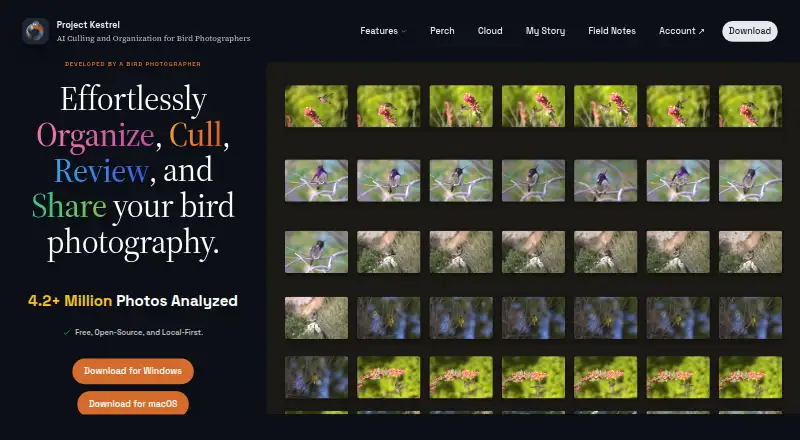
Project Kestrel is a bird-photography app for organizing, culling, reviewing, and searching images. Its desktop app runs locally on Linux, macOS, and Windows without an account or internet connection; photos stay on the user's machine unless an optional cloud or sharing feature is used. Kestrel groups high-speed bursts into scenes so similar frames can be compared. Its detection model locates and segments birds so background pixels do not affect quality scores. A machine-learning model scores noise, motion blur, and focus, sorting sharper frames first. Detected birds can be tagged by species and family for searches across folders and outings. Automatic classification currently covers North American species; manual tagging can cover birds worldwide. Ratings can be exported to Lightroom, Darktable, Capture One, and other editors. Perch lets users upload an outing, add timeline notes, and share it. The maker says Cloud Compute deletes source images after analysis and deletes results upon download or after 30 days if they remain undownloaded. Job records retain counts and timestamps for billing. The desktop app is free and open source, and the Apple App Store version costs 10.00 USD as a one-time purchase. Cloud Compute includes 2,500 free images for every new account.
Who it suits
Project Kestrel suits bird photographers who want to review and search large collections locally, or use optional cloud and sharing features. It supports automatic species classification for North American birds and manual tagging for birds worldwide.
What it does well
- Groups burst photos into scenes for comparison.
- Scores noise, motion blur, and focus.
- Exports ratings to Lightroom, Darktable, and Capture One.
- Desktop app runs without an account or internet connection.
- New Cloud Compute accounts include 2,500 free images.
What to know first
- Automatic classification currently covers North American species.
- App Store version costs 10.00 USD as a one-time purchase.
- Cloud results expire after 30 days if not downloaded.
Limits
Cloud Compute provides 2,500 images free for each new account. The listed paid plans provide 15,000 images per month for Blue Jay at $20 a month and 50,000 images per month for Sandpiper at $50 a month.
Plans
| Plan | Billed and limits | Price |
|---|---|---|
| Project Kestrel desktop app | Free and open source; always free. · Windows and macOS downloads; Linux run from source | Free |
| Cloud Compute — free allowance | 2,500 images free for every new account; no card required. · 2,500 images | Free |
| Apple App Store version | One-time purchase; includes automatic updates. · macOS; same app as the free direct download | $10, paid once |
| Blue Jay | $20/mo · 15,000 images / month | $20 a month |
| Sandpiper | $50/mo · 50,000 images / month | $50 a month |
As projectkestrel.org lists them, read 7 Oct 2026. The maker's own page has the final word.
Getting started
- Download the free desktop app for Windows or macOS, or run it from source on Linux.
- Use the desktop app locally without an account or internet connection.
- Create a Cloud Compute account to use its allowance of 2,500 free images; no card is required.
- If using a Mac App Store version, purchase it for 10.00 USD as a one-time payment.
- Send feedback through the button inside the app.
Overview
Project Kestrel is a desktop tool for sorting, reviewing, and searching bird photographs. It is best suited to bird photographers who want to compare burst shots and export ratings to an editor; its North American species classification and optional cloud tools are important boundaries to weigh.
Its strongest case is a focused workflow that combines scene grouping, bird-aware image scoring, and species search while keeping desktop work local. Worldwide photographers can still tag species manually, but should not expect automatic classification beyond North American birds.
Key features
Culling and search
Kestrel groups high-speed bursts into scenes, making it easier to compare near-duplicate frames rather than review a whole outing as an undifferentiated set. Its detection model identifies and segments birds before scoring, so background pixels do not influence quality ratings. A separate machine-learning score weighs noise, motion blur, and focus, then sorts sharper frames first. That combination is relevant to photographers handling many similar shots, though the scoring is a way to prioritize review, not a substitute for choosing the keeper.
Detected birds can be tagged by species and family, allowing searches across folders and outings. Automatic classification currently covers North American species; elsewhere, manual tagging is the route to searchable species labels. Kestrel exports ratings to Lightroom, Darktable, Capture One, and other editors, which makes it more useful alongside an existing editing workflow than as a replacement for one.
Local work and sharing
The desktop app works locally without an account or internet connection, and photos remain on the machine unless a cloud or sharing feature is used. Perch is the sharing option: users can upload an outing, annotate its timeline, and share it. Cloud Compute handles images for analysis; source images are deleted after analysis, with cleanup and storage-expiry safeguards if deletion fails. Results are deleted when downloaded or after 30 days if left undownloaded, while job records keep counts and timestamps for billing. Users who want to avoid uploading photos can stay with the local app and skip those optional services.
Pricing
The desktop app is free and open source. Windows and macOS downloads are provided; Linux users run it from source. The separate Apple App Store version costs 10.00 USD once and is the same app as the free direct download, with automatic updates included. It suits Mac users who prefer the App Store update route; the direct download avoids that purchase.
Cloud Compute has a free allowance of 2,500 images for every new account, with no card required. For larger cloud workloads, Blue Jay costs $20 a month for 15,000 images per month, while Sandpiper costs $50 a month for 50,000 images per month. The paid tiers fit users whose image volumes exceed the free allowance; photographers who do not need cloud analysis can use the local desktop app instead.
Platforms
Kestrel supports Linux, macOS, and Windows, although Linux users run the desktop app from source rather than downloading it as a packaged build. The App Store purchase is for macOS. Perch and Cloud Compute are optional services, not requirements for local desktop use.
Who it's for
Kestrel is a good fit for bird photographers who shoot bursts, want bird-specific culling signals, and organize outings by species. Its export options suit people who already finish images in Lightroom, Darktable, Capture One, or another editor. Automatic species tagging is most useful for North American collections; photographers focused elsewhere will need to tag manually. The maker describes it as a one-person project built for the developer's own bird photography, a useful context for readers considering how specialized its focus is.
Pros and cons
- Pros: Bird segmentation keeps backgrounds out of quality scoring, while burst grouping and sharpness ranking help narrow similar frames.
- Pros: Local use needs neither an account nor internet, and photos stay on the device unless optional cloud or sharing features are used.
- Pros: Ratings export to several established editors, so culling can feed into an existing workflow.
- Cons: Automatic species classification is limited to North American birds; other regions require manual tags.
- Cons: Linux requires running from source, which is less direct than the Windows and macOS downloads.
- Cons: Cloud capacity beyond the 2,500-image new-account allowance requires a monthly plan, making the larger-volume workflow a recurring cost.
Alternatives
For a broader set of culling choices, browse AI Photo Culling Software. Zno is worth considering for photographers who want Android, iOS, web, and desktop access alongside a free starting plan and free trial. Choose Facet if a free local tool with no cloud, accounts, or subscriptions is the priority. PixCull offers a free, MIT-licensed open-source option, with optional cloud model calls potentially adding API costs. Optyx is another Lightroom-compatible choice, with a free tier for previews, image rating, and metadata.
ShotSieve is a free and open-source option for Linux, macOS, and Windows. AccioPix Photo Culling is a free web tool with no sign-up and no photo limit beyond the computer's capacity. Futura Photo offers a Windows Community tier with unlimited analyses of up to 100 images each. Kepla is another option to consider.
Verdict
Choose Project Kestrel if bird photography is your main use case and you want burst-aware culling, bird-focused scoring, species search, and editor rating exports in a local desktop workflow. Look elsewhere if automatic species classification outside North America is essential, or if you need Linux without running software from source.
Verdict
Project Kestrel focuses on bird-photo culling, species search, and editor rating exports, with local desktop use and optional cloud tools. Automatic classification is limited to North American species, while worldwide tagging is manual.
Questions
Is Project Kestrel free?
The desktop app is free and open source. Cloud Compute also includes 2,500 images free for every new account, with no card required.
Which platforms does the desktop app support?
It supports Windows and macOS downloads, and Linux users can run it from source.
Does it require an account or internet connection?
The desktop app runs locally without requiring either. Photos stay on the user’s machine unless an optional cloud or sharing feature is used.
Which editors can receive exported ratings?
Kestrel can export ratings for Lightroom, Darktable, Capture One, and other editors.
How much do the cloud plans cost?
Blue Jay costs $20 a month for 15,000 images per month. Sandpiper costs $50 a month for 50,000 images per month.
Is there a paid App Store version?
Yes. The Apple App Store version is listed at 10.00 USD as a one-time purchase and includes automatic updates.
Facts from Project Kestrel's own pages
- Bird detection
- Its object-detection model locates and segments birds so background pixels do not affect quality scores. · projectkestrel.org, 7 Oct 2026
- Cloud image handling
- Cloud Compute says source images are deleted after analysis, with automatic cleanup and storage expiry safeguards if deletion fails. · projectkestrel.org, 7 Oct 2026
- Cloud result retention
- Cloud results are deleted when downloaded or after 30 days if they are not downloaded; job records retain counts and timestamps for billing. · projectkestrel.org, 7 Oct 2026
- Editor integrations
- Kestrel can export ratings for Lightroom, Darktable, Capture One, and other editors. · projectkestrel.org, 7 Oct 2026
- Intended users
- The maker describes Project Kestrel as a one-person project built for the developer's own bird photography. · projectkestrel.org, 7 Oct 2026
- Local privacy
- The desktop app runs locally without requiring an account or internet connection, and photos stay on the user's machine unless an optional cloud or sharing feature is used. · projectkestrel.org, 7 Oct 2026
- Perch sharing
- Perch lets users upload an outing, add notes to its timeline, and share it with others. · projectkestrel.org, 7 Oct 2026
- Purpose
- Project Kestrel organizes, culls, reviews, and helps search bird photography. · projectkestrel.org, 7 Oct 2026
- Scene grouping
- It groups high-speed bursts into scenes so similar frames can be compared together. · projectkestrel.org, 7 Oct 2026
- Sharpness scoring
- A machine-learning model scores each frame for noise, motion blur, and focus, sorting the sharpest shots first. · projectkestrel.org, 7 Oct 2026
- Species coverage
- Automatic classification currently covers North American species; manual tagging can cover birds worldwide. · projectkestrel.org, 7 Oct 2026
- Species search
- Kestrel tags detected birds by species and family so users can search across folders and outings. · projectkestrel.org, 7 Oct 2026
- Support and feedback
- The download page asks users to send feedback through the button inside the app. · projectkestrel.org, 7 Oct 2026
Where Project Kestrel stands on Freedom251
- AI Photo Culling Software#10 of 29