Freedom251 › Zero Trust Network Access Software

Pomerium
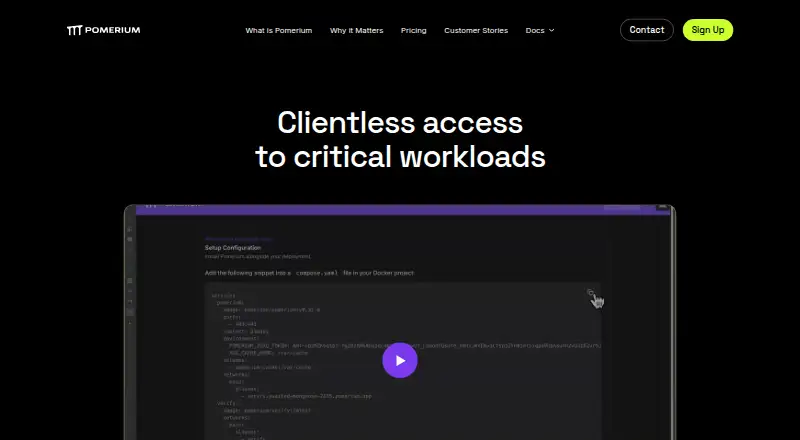
What Pomerium is
Pomerium is an open-source identity-aware proxy built around BeyondCorp and zero-trust principles. It provides clientless access to internal applications, servers, services, and workloads without requiring VPN client software. Before allowing access, it continually checks user identity, device state, and request context. Pomerium supports HTTP, MCP, SSH, gRPC, TCP, and UDP scenarios, and authenticates through identity providers that support OpenID Connect. It strips authentication cookies before forwarding requests to upstream services, and encrypts sensitive databroker data at rest. Downstream TLS accepts TLS 1.2 as the minimum. Core deployment options include Linux and macOS binaries, packages, Docker images, and source builds; desktop clients are available for Windows, macOS, and Linux. The Personal Free plan lists 10 users, 10 routes, five policies, and two service accounts. Business costs $7 a month, billed annually, and lists limits of 1,000 users, 100 routes, 100 policies, and 20 service accounts. A free trial is listed. Support options include a community forum, email, a dedicated Slack channel, phone support, and a dedicated customer success manager.
Who it suits
Pomerium suits organizations that need controlled access to internal applications and services without VPN client software. Its plans and deployment options cover personal use as well as business and enterprise environments.
What it does well
- Access checks include identity, device state, and request context.
- Supports HTTP, SSH, gRPC, TCP, and UDP scenarios.
- Authenticates with OpenID Connect identity providers.
- Sensitive databroker data is encrypted at rest.
- Free Personal plan lists 10 users.
What to know first
- Business is $7 a month, billed annually.
- Personal Free is limited to 10 routes.
- Downstream TLS minimum is TLS 1.2.
Limits
Personal Free includes 10 users, 10 routes, five policies, and two service accounts. Business, at $7/user/mo billed annually, includes 1,000 users, 100 routes, 100 policies, and 20 service accounts.
Plans
| Plan | Billed and limits | Price |
|---|---|---|
| Personal Free | 10 users · 10 routes · 5 policies · 2 service accounts | Free |
| Business | billed annually · 1,000 users · 100 routes · 100 policies · 20 service accounts | $7 a month |
| Zero Personal | 1 cluster · 10 routes · 5 policies · 1 custom domain · community support | Free |
| Zero Business | annually · 5 admins · 20 service accounts · 20 policies · 100 routes · 100 automatic TLS certificates · 1000 users | $7 a month |
| Zero Business (annual) | Billed annually · 5 clusters · 100 routes · 100 policies · 5 custom domains with automatic TLS · access logs · configuration history · email support | $7 a month |
| Zero Business (monthly) | Billed monthly · 5 clusters · 100 routes · 100 policies · 5 custom domains with automatic TLS · access logs · configuration history · email support | $9 a month |
| Enterprise | Self-hosted control plane · delegated administration · policy inheritance · directory sync · external data · Rego policies · session management · SSH session recording · dedicated Slack · customer success manager | On request |
As pomerium.com lists them, read 20 Sept 2026. The maker's own page has the final word.
Getting started
- Visit the Pomerium website.
- Choose a deployment route: hybrid access, self-hosting, or Pomerium Core.
- For Core, use an available Linux or macOS binary, package, Docker image, or source build.
- Use the Windows, macOS, or Linux desktop client if needed.
- Choose a listed plan; a free trial is available.
Pomerium is an open-source proxy for controlling access to internal systems without requiring a VPN client. It is best suited to organizations that need identity, device, and request context in access decisions across several protocols. Its strongest case is policy-driven, clientless access; smaller teams should weigh the firm free-tier caps and annual billing on the paid plan.
Overview
Pomerium applies BeyondCorp and zero-trust principles to applications, servers, services, and workloads. Users reach protected resources through a browser, while Pomerium continually verifies identity, device state, and request context before allowing access. Device posture checks and session recording add controls beyond a basic tunnel, making it a better fit for differentiated access policies than for teams that only need private-network connectivity.
The deployment model is hybrid. Pomerium Core has Linux and macOS binaries, Linux deb/rpm packages, Docker images, and source builds. Pomerium Desktop runs on Windows, macOS, and Linux, and the CLI is distributed as binaries, packages, Homebrew software, Docker, or source. That breadth accommodates mixed estates, but operating the platform still requires technical ownership.
Key features
Identity-aware authorization
Pomerium authenticates against identity providers and supports any provider using OpenID Connect. It then evaluates identity, device condition, and request context continuously. This supports policies that can vary by user and device rather than by network location, although administrators must design and maintain those policies.
Broad protocol coverage
Access scenarios include HTTP, MCP, SSH, gRPC, TCP, and UDP. Supported application protocols also include HTTPS, HTTP/2, HTTP/3, WebSocket, and SSH. That makes Pomerium relevant to browser applications, infrastructure services, and networked workloads instead of only conventional web routes.
Security controls
Authentication cookies are removed before requests are forwarded to upstream services, limiting exposure of credentials and tokens. Sensitive databroker data—such as session, user, directory, and service-secret data—is encrypted at rest, and downstream TLS requires at least TLS 1.2. These safeguards strengthen an access gateway, but they do not remove the need for sound identity and policy administration.
Integrations and support
Listed integrations cover Grafana, Kubernetes, Okta, Cloud Run, Docker, Google Kubernetes Engine, FleetDM, BambooHR, Auth0, Azure Active Directory, GitHub, GitLab, Google Workspace, OneLogin, OpenID Connect, and Ping Identity. Support options range from a community forum and email to a dedicated Slack channel, phone support, and a dedicated customer success manager.
Pricing
Pomerium uses a freemium model, with a free trial and paid plans from $7/user/mo when billed annually.
Personal Free and Zero Personal
Personal Free costs nothing and allows 10 users, 10 routes, 5 policies, and 2 service accounts. Zero Personal is also free, with 1 admin, 1 service account, 2 policies, 5 routes, 10 automatic TLS certificates, and 10 users. These tiers suit personal projects or very small deployments; the low route, policy, and account ceilings make them poor choices for a growing access program.
Business plans
Business costs $7 a month, billed annually, and raises capacity to 1,000 users, 100 routes, 100 policies, and 20 service accounts. Zero Business costs $7 a month, billed annually, and includes 5 admins, 20 service accounts, 20 policies, 100 routes, 100 automatic TLS certificates, and 1,000 users. The larger quotas fit operational teams, but annual billing is a commitment even when usage varies.
Enterprise
Enterprise has custom pricing and is fully self-hosted, with an on-premise option, full Pomerium API access, and no usage limits. It is the relevant tier for organizations that need unlimited capacity or control over an on-premise deployment.
Platforms
Pomerium supports API, Linux, macOS, self-hosted, web, and Windows environments. Browser access is the primary access method, while Desktop and CLI options extend administration and client coverage across the major desktop operating systems.
Who it's for
Pomerium fits startups through Global Fortune 2000 organizations that need centralized, context-sensitive access to varied internal resources. It is particularly suitable for teams combining web applications with SSH, gRPC, TCP, UDP, or Kubernetes workloads. It is less suitable when a small, fixed set of users and routes can be served by a simpler free proxy, or when annual billing is unacceptable.
Pros and cons
- Pro: Clientless access avoids distributing VPN client software.
- Pro: Identity, device, and request checks support fine-grained authorization.
- Pro: HTTP, MCP, SSH, gRPC, TCP, and UDP coverage spans web and infrastructure use cases.
- Pro: Hybrid deployment, self-hosting, and broad integrations accommodate mixed environments.
- Con: Free plans cap users, routes, policies, and service accounts tightly.
- Con: Business pricing is billed annually, reducing month-to-month flexibility.
- Con: Policy design and the range of deployment choices demand capable administration.
Alternatives
Choose Fabio if you want free, MIT-licensed reverse-proxy software and already use Consul for service discovery. Choose freenginx for a free proxy distributed under a 2-clause BSD-like license. Choose frp for free, self-hosted client and server reverse-proxy binaries, including Android support.
LocalXpose is a better fit for simple free tunneling, with two active HTTP/HTTPS tunnels, SSL/TLS encryption, unique subdomains, time limits, and an interstitial warning page. Choose ngrok for a freemium tunneling service with a free trial, up to three online endpoints, and included usage. Openport suits device-oriented deployments where enterprise pricing is charged per device and includes 20 connections per device. Choose Zoraxy for a free AGPL open-source option. Envoy Proxy is the alternative when you want a free open-source proxy installable with Docker, macOS Homebrew, or a static binary.
For broader category comparisons, see Reverse Proxy Software, Zero Trust Network Access Software, and Business VPN Software.
Verdict
Choose Pomerium if your organization needs clientless, identity- and device-aware access across web and infrastructure protocols, with deployment flexibility and strong integration coverage. Look elsewhere if your requirements are limited to basic tunneling, your deployment is too small for its policy model, or annual Business billing and free-tier caps do not fit.
Verdict
Pomerium provides clientless, identity-aware access with checks on user, device, and request context. Its free plan has defined user and route limits; Business adds higher listed capacities for an annual-billed monthly price.
Questions
Is Pomerium open source?
Yes. Pomerium is described as an open-source identity-aware proxy, and Core can be built from source.
Is there a free plan?
Yes. Personal Free costs $0 and includes 10 users, 10 routes, five policies, and two service accounts.
How much does Business cost?
Business costs $7/user/mo, billed annually. The listed limits are 1,000 users, 100 routes, 100 policies, and 20 service accounts.
Which platforms are supported?
Listed platforms include API, Linux, macOS, self-hosted, web, and Windows. Desktop clients are available for Windows, macOS, and Linux.
Which identity providers and integrations are listed?
Pomerium supports identity providers using OpenID Connect. Listed integrations include Grafana, Kubernetes, Okta, Docker, GitHub, GitLab, Google Workspace, Azure Active Directory, and others.
Is a free trial available?
Yes, a free trial is listed.
Facts from Pomerium's own pages
- Access model
- It provides clientless access to internal applications, servers, services, and workloads without requiring VPN client software. · pomerium.com, 30 Sept 2026
- API licensing
- The API documentation identifies Apache License 2.0 as its license. · pomerium.com, 21 Oct 2026
- Audience
- Businesses from startups to Global Fortune 2000 companies rely on Pomerium for access control. · pomerium.com, 30 Sept 2026
- Audit logging
- The product emits verbose authorization and access logs for auditing, administration and troubleshooting. · pomerium.com, 21 Oct 2026
- Authentication and SSO
- Pomerium authenticates through an existing identity provider and supports any provider implementing OpenID Connect. · pomerium.com, 21 Oct 2026
- Authorization
- Pomerium continually verifies user identity, device state, and request context before granting access. · pomerium.com, 30 Sept 2026
- Authorization policies
- Route policies can use identity and contextual data to make fine-grained access decisions. · pomerium.com, 21 Oct 2026
- Bug-bounty limitation
- The security policy states that Pomerium does not currently operate a paid bug-bounty program. · pomerium.com, 21 Oct 2026
- Changelog: MCP
- A July 6, 2026 update added upstream OAuth, dynamic client registration fallback, route discovery and safer metadata fetching for MCP. · pomerium.com, 21 Oct 2026
- Changelog: SSH
- A January 20, 2026 release added OAuth authorization-code SSH login, reverse tunneling, jump-host mode, routes portal and per-key revocation. · pomerium.com, 21 Oct 2026
- Clientless web access
- Web applications can be reached through a browser without installing endpoint client software. · pomerium.com, 21 Oct 2026
- Company size and headquarters
- LinkedIn lists Pomerium as privately held, headquartered in Los Angeles, with 11–50 employees. · linkedin.com, 21 Oct 2026
- Compliance mapping
- SSH session-recording documentation maps capabilities to SOC 2, PCI DSS, HIPAA and NIST/FedRAMP controls. · pomerium.com, 21 Oct 2026
- Context integrations
- Enterprise context sources include FleetDM, HR systems, endpoint tools, IP geolocation and CMDB platforms for policy inputs. · pomerium.com, 21 Oct 2026
- Cookie protection
- Pomerium strips its authentication cookies before forwarding requests to upstream services to prevent credential stuffing and token leakage. · pomerium.com, 30 Sept 2026
- Deployment
- Pomerium Core provides official binaries for Linux and macOS, Linux deb/rpm packages, Docker images, and source builds. · pomerium.com, 30 Sept 2026
- Deployment requirements
- The Docker quickstart requires a publicly reachable server with ports 80 and 443, DNS-controlled domain, Docker and Docker Compose. · pomerium.com, 21 Oct 2026
- Desktop clients
- Pomerium Desktop is available for Windows, macOS, and Linux, while the CLI can be installed as binaries, packages, Homebrew software, Docker, or source. · pomerium.com, 30 Sept 2026
- Direct token authentication
- Configured deployments can accept an IdP access or identity token in a bearer header for CLI and service workflows. · pomerium.com, 21 Oct 2026
- Documentation depth
- Documentation includes fundamentals courses, deployment guides, configuration reference, API reference, integrations and troubleshooting material. · pomerium.com, 21 Oct 2026
- Encryption
- Sensitive databroker data, including session, user, directory, and service-secret data, is encrypted at rest. · pomerium.com, 30 Sept 2026
- Extensibility
- Official integrations include a Terraform provider, Kubernetes Ingress Controller, CLI/Desktop clients and Go and JavaScript SDKs. · pomerium.com, 21 Oct 2026
- Founded
- Pomerium's company history records its founding in 2019 by Bobby, who wrote the original code. · pomerium.com, 21 Oct 2026
- Free plan
- Yes · pomerium.com, 20 Sept 2026
Where Pomerium stands on Freedom251
- Zero Trust Network Access Software#1 of 42
- Business VPN Software#3 of 94
- Reverse Proxy Software#3 of 33