Freedom251 › Reverse Proxy Software
freenginx
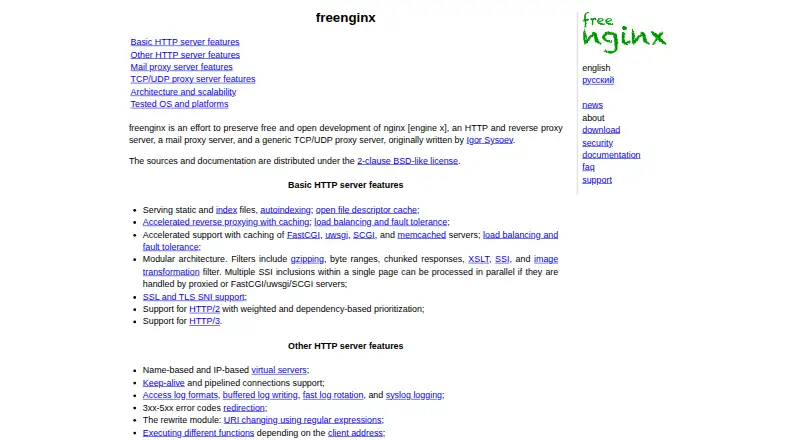
What freenginx is
freenginx is an effort to keep development of nginx server software free and open. It can serve static files and act as an HTTP and reverse proxy, a mail proxy, or a general TCP/UDP proxy. HTTP functions include caching, load balancing, fault tolerance, and support for SSL/TLS SNI, HTTP/2, and HTTP/3. It can connect with caching and acceleration to FastCGI, uwsgi, SCGI, and memcached servers. Mail proxy functions cover IMAP, POP3, and SMTP authentication, with SSL and STARTTLS/STLS. TCP and UDP proxying supports load balancing, fault tolerance, and client-address access control. Configuration can be reloaded and the executable upgraded without interrupting client servicing. The source code and documentation use a 2-clause BSD-like license. The free software is self-hosted, with file-based configuration; downloads include mainline and stable versions, Windows builds, and source code. Support is provided through mailing lists, which require an email subscription before posting.
Who it suits
freenginx suits people who need self-hosted HTTP, mail, or TCP/UDP proxying and want source code under a 2-clause BSD-like license. It is also relevant to operators needing configuration reloads or executable upgrades without interrupting service.
What it does well
- Supports HTTP/2 and HTTP/3.
- Offers caching, load balancing, and fault tolerance.
- Supports IMAP, POP3, and SMTP proxying.
- Reloads configuration without interrupting client service.
- Source and documentation use a 2-clause BSD-like license.
What to know first
- Self-hosted deployment is required.
- Mailing-list posting requires an email subscription.
- Support is through mailing lists.
Plans
| Plan | Billed and limits | Price |
|---|---|---|
| freenginx | Sources and documentation distributed under a 2-clause BSD-like license | Free |
As freenginx.org lists them, read 4 Oct 2026. The maker's own page has the final word.
Getting started
- Visit the freenginx website
- Choose a mainline or stable version, a Windows build, or source code
- Configure the server using files
- Subscribe an email address to a mailing list before posting for support
Overview
freenginx is a free, self-hosted server and proxy for HTTP, mail, and generic TCP/UDP traffic. It suits operators who want a configurable, open-source component and can manage it themselves; its breadth and upgrade model are compelling, while support runs through subscription-based mailing lists.
Key features
For HTTP workloads, freenginx combines static file serving with reverse proxying, caching, load balancing, and fault tolerance. It supports SSL/TLS SNI, HTTP/2, HTTP/3, and WebSockets, plus access controls based on client IP, HTTP Basic authentication, or a subrequest result. These options make it useful for serving and routing web traffic without adding a separate proxy for each role.
It can cache and accelerate connections to FastCGI, uwsgi, SCGI, and memcached servers. For teams running those backends, that integration breadth is a practical advantage; the configuration method is file-based, so it is better suited to operators comfortable managing configuration directly than to readers seeking a managed service.
Beyond HTTP, the mail proxy supports IMAP, POP3, and SMTP authentication methods, along with SSL and STARTTLS/STLS. Generic TCP and UDP proxying adds load balancing, fault tolerance, and client-address access control; TCP also supports SSL and TLS SNI. That makes freenginx a broader choice than a web-only reverse proxy.
The architecture uses one master process and several worker processes, with workers running as an unprivileged user. The project says 10,000 inactive HTTP keep-alive connections use about 2.5M of memory and that it keeps data-copy operations to a minimum. Configuration reloads and executable upgrades can happen without interrupting client servicing, a useful operational feature for services that need to stay available during changes.
Pricing
freenginx costs nothing. Its source code and documentation are distributed under a 2-clause BSD-like license. There is no free trial because the product is free; there are no paid tiers or plan quotas to weigh. That makes it an accessible option for self-hosters, but the cost of running and maintaining the deployment remains with the operator.
Platforms
freenginx is available for Linux, macOS, and Windows, and is self-hosted. Downloads include mainline and stable versions, Windows builds, and source through Mercurial repositories and a GitHub mirror. The mainline release announced on 2026-09-01 is 1.31.4; choosing between stable and mainline lets operators weigh release freshness against their own preference for a stable track.
Who it's for
Choose freenginx if you need self-hosted HTTP serving and proxying alongside mail or generic TCP/UDP proxy roles, and value protocol support, backend integrations, or uninterrupted upgrades. It is less suitable if you expect hosted operations or support outside a mailing-list workflow: posting to the support lists requires subscribing an email address first. Security issues can be reported to [email protected]; the security page says patches are signed with one of the project's PGP public keys.
Pros and cons
- Pros: One free, BSD-like-licensed product covers HTTP, mail, and TCP/UDP proxying, reducing the need to assemble separate components for those roles.
- Pros: HTTP/2, HTTP/3, caching, load balancing, and several backend integrations give operators room to handle varied web traffic.
- Pros: Reloads and executable upgrades can preserve client servicing, which helps avoid planned interruptions during routine changes.
- Cons: Self-hosting and file-based configuration put deployment and operational work on the user.
- Cons: Support depends on mailing lists, and posting requires subscribing first; this may not fit teams that need a different support channel.
Alternatives
For other reverse proxy options, browse Reverse Proxy Software. Choose NGINX if you want the free open-source HTTP server, reverse proxy, content cache, load balancer, TCP/UDP proxy, and mail proxy. Envoy Proxy is another free open-source proxy, installable through Docker, macOS Homebrew, or a static binary.
Choose Traefik Proxy if service auto-discovery or ingress-controller functionality is a priority alongside reverse proxying and load balancing. LocalXpose offers a free tier with two active HTTP/HTTPS tunnels, SSL/TLS encryption, unique subdomains, time limits, and an interstitial warning page; that is a different fit for users seeking tunnels rather than a general-purpose self-hosted proxy.
ngrok has a free tier with one-time included usage, up to three online endpoints, and up to 1GB of data transfer. Pomerium offers a free personal plan capped at 10 users, 10 routes, five policies, and two service accounts. BunkerWeb offers an open-source plan under AGPLv3.
Verdict
freenginx is a strong choice for operators who want a free, self-hosted server spanning HTTP, mail, and TCP/UDP proxying, with broad protocol support and upgrades that need not interrupt service. Choose something else if you need a hosted product or support outside a mailing-list model.
Verdict
freenginx covers several server and proxy roles, with multiple protocol and upgrade options. Consider whether self-hosting and mailing-list support fit your operations.
Questions
How much does freenginx cost?
The free plan costs nothing.
What platforms does it support?
The listed platforms are Linux, macOS, self-hosted, and Windows.
Is freenginx open source?
Its source code and documentation are distributed under a 2-clause BSD-like license.
What protocols does the HTTP server support?
It supports SSL/TLS SNI, HTTP/2, and HTTP/3.
Can it proxy mail and TCP or UDP traffic?
Yes. The mail proxy supports IMAP, POP3, and SMTP authentication; generic TCP and UDP proxying includes load balancing, fault tolerance, and client-address access control.
How is support provided?
Support is provided through mailing lists. Posting requires subscribing an email address first.
Facts from freenginx's own pages
- Access control
- HTTP access control can be based on client IP address, password using HTTP Basic authentication, or the result of a subrequest. · freenginx.org, 4 Oct 2026
- Architecture
- It uses one master process and several worker processes, which run under an unprivileged user. · freenginx.org, 3 Oct 2026
- Backend integrations
- It supports cached and accelerated connections to FastCGI, uwsgi, SCGI, and memcached servers. · freenginx.org, 3 Oct 2026
- Current release
- The news page lists freenginx 1.31.4 as the mainline release announced on 2026-09-01. · freenginx.org, 3 Oct 2026
- Development
- The project uses Mercurial to store source code and directs proposed changes to the nginx development mailing list. · freenginx.org, 4 Oct 2026
- Downloads
- The download page lists mainline version 1.31.4 and stable version 1.30.1, with Windows builds and PGP links. · freenginx.org, 4 Oct 2026
- HTTP features
- It supports static files, cached reverse proxying, load balancing, and FastCGI, uwsgi, SCGI, and memcached servers. · freenginx.org, 4 Oct 2026
- License
- The source code and documentation are distributed under a 2-clause BSD-like license. · freenginx.org, 4 Oct 2026
- Mail proxy
- Its mail proxy supports IMAP, POP3, and SMTP authentication, plus SSL, STARTTLS, and STLS. · freenginx.org, 4 Oct 2026
- Operations
- It supports reconfiguration and executable upgrades without interrupting client servicing. · freenginx.org, 3 Oct 2026
- Performance
- The site says 10,000 inactive HTTP keep-alive connections use about 2.5M of memory and data copy operations are kept to a minimum. · freenginx.org, 4 Oct 2026
- Platforms
- The site lists tested Linux, macOS, and Windows platforms, along with FreeBSD, Solaris, AIX, and HP-UX. · freenginx.org, 3 Oct 2026
- Process model
- The architecture uses one master and several worker processes, with workers running under an unprivileged user. · freenginx.org, 4 Oct 2026
- Protocols
- The HTTP server supports SSL/TLS SNI, HTTP/2, and HTTP/3. · freenginx.org, 3 Oct 2026
- Purpose
- freenginx is an effort to preserve free and open development of nginx, an HTTP and reverse proxy server, mail proxy server, and generic TCP/UDP proxy server. · freenginx.org, 4 Oct 2026
- Resource use
- The site states that 10,000 inactive HTTP keep-alive connections take about 2.5M memory. · freenginx.org, 3 Oct 2026
- Security reporting
- The security page directs reports to [email protected] and says patches are signed using one of its PGP public keys. · freenginx.org, 4 Oct 2026
- Support
- Support is offered through English and Russian mailing lists; posting requires subscribing the email address used to post. · freenginx.org, 4 Oct 2026
- TCP and UDP
- It provides generic TCP and UDP proxying, including TCP SSL and TLS SNI support, load balancing, and fault tolerance. · freenginx.org, 4 Oct 2026
- TCP/UDP proxy
- The product provides generic TCP and UDP proxying, with load balancing, fault tolerance, and client-address access control. · freenginx.org, 3 Oct 2026
- Upgrades
- Configuration can be reloaded and an executable upgraded without interrupting client servicing. · freenginx.org, 4 Oct 2026
- Web protocols
- The HTTP server supports SSL and TLS SNI, HTTP/2, and HTTP/3. · freenginx.org, 4 Oct 2026
Where freenginx stands on Freedom251
- Reverse Proxy Software#9 of 33