Freedom251 › Zero Trust Network Access Software
Boundary
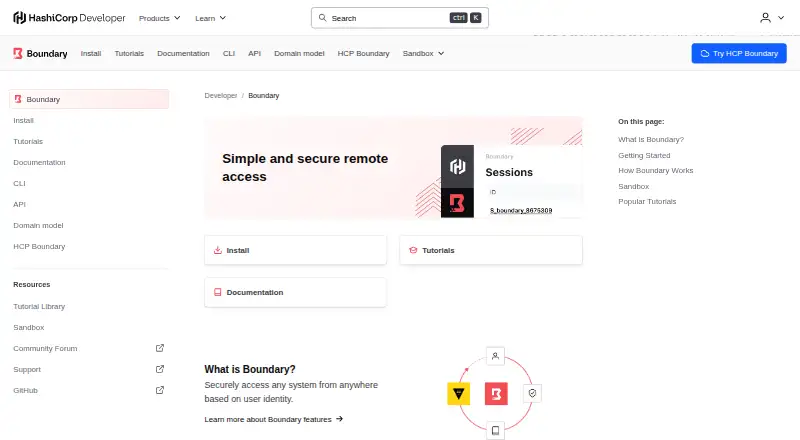
What Boundary is
Boundary provides identity-based, authenticated access to infrastructure without requiring users to connect directly to the underlying network. It supports just-in-time and least-privilege access, role-based authorization, and single sign-on through OIDC and LDAP. Users can reach TCP, SSH, RDP, HTTPS, RDS, Kubernetes, and database targets with familiar clients such as SSH tools, PuTTY, Remote Desktop, database clients, and browsers. Boundary can broker credentials and integrate with HashiCorp Vault for short-lived dynamic credentials and injection. Target discovery can be automated, with dynamic host catalogs for AWS, Azure, and GCP available in HCP Boundary.
Deployment options include managed HCP Boundary, optionally with customer-run workers, and self-managed Boundary Enterprise. The free Community Edition costs nothing. HCP Boundary Standard and Plus use usage-based billing, with monthly user rates depending on edition; Standard includes Vault credential injection and audit-log streaming, while Plus adds session recording and playback. Boundary supports Terraform, a REST API, CLI, and SDK for automation, and uses TLS or mutual TLS, granular scopes, and envelope encryption for stored sensitive data.
Who it suits
Boundary suits organizations that need controlled access to infrastructure targets without direct network access. It offers managed and self-managed deployment options, with Terraform, an API, CLI, and SDK for automation.
What it does well
- Free Community Edition costs nothing.
- Supports just-in-time and least-privilege access.
- Targets include SSH, RDP, Kubernetes, and databases.
- Vault integration can inject short-lived dynamic credentials.
- Terraform, REST API, CLI, and SDK support automation.
What to know first
- HCP Boundary pricing is usage-based and not listed.
- Enterprise is self-managed.
- Session recording and playback are listed for Plus.
Plans
| Plan | Billed and limits | Price |
|---|---|---|
| HCP Boundary Standard | first 1–5 users monthly; then $23.95833/user/month with Silver Support or $25.00000/user/month with Gold Support (6–20 users) · Boundary Community features · Vault dynamic credential injection · audit-log streaming · standard HashiCorp Cloud SLA | Free |
| Boundary Community Edition | Source-available CE; repository archived October 8, 2026 · no further releases, fixes, or security patches planned | Free |
| HCP Boundary Plus | first 1–5 users monthly; then $47.91667/user/month with Silver Support or $50.00000/user/month with Gold Support (6–20 users) · Standard features · session recording · standard HashiCorp Cloud SLA | Free |
| Boundary Enterprise | Self-managed deployment · full feature parity with HCP Boundary · commercial support | On request |
As developer.hashicorp.com lists them, read 15 Oct 2026. The maker's own page has the final word.
Getting started
- Open the Boundary website.
- Choose the free Community Edition or review HCP Boundary and Enterprise deployment options.
- For HCP Boundary, use the managed service, with customer-run workers if needed.
- Download Boundary for macOS, Windows, or Linux, or get a desktop client.
- Configure deployment with Terraform, the REST API, CLI, or SDK.
Boundary is infrastructure-access software for organizations that need to control privileged connections across cloud and self-managed environments. It is best suited to teams that can make use of identity-based permissions, credential brokering, and infrastructure automation. Its breadth is compelling, but HCP usage-based pricing and the split between editions make cost and feature planning essential.
Overview
Rather than placing users directly on an underlying network, Boundary authenticates them and grants access to infrastructure targets. Just-in-time and least-privilege access, role-based authorization, and single sign-on through OIDC or LDAP give administrators several ways to constrain connections. TLS or mutual TLS protects communications, while envelope encryption protects sensitive stored data.
Boundary covers TCP, SSH, RDP, HTTPS, RDS, Kubernetes, and database targets. Users can connect with existing tools such as SSH clients, PuTTY, Remote Desktop, database clients, and web browsers, which helps preserve established workflows. The trade-off is that Boundary is an access layer to configure and operate, not a replacement for those client tools.
Key features
Identity and credential controls
Boundary integrates with Okta, Microsoft Entra ID, Auth0, other OIDC-compatible identity providers, and LDAP. It can broker credentials and work with HashiCorp Vault to provide short-lived dynamic credentials and credential injection. This is useful for teams trying to reduce standing credentials, but the more sophisticated credential flow depends on Vault integration and edition choice.
Discovery, audit, and automation
HCP Boundary can discover targets automatically and use dynamic host catalogs for AWS, Azure, and GCP. Audit logs and streaming support oversight, while session recording and playback are a Plus-edition capability. Terraform support, a REST API, CLI, and SDK give teams options to automate deployment and configuration; that flexibility is most valuable where infrastructure is already managed programmatically.
Boundary offers both managed and self-managed deployment: HashiCorp operates HCP Boundary, with optional customer-run workers, while Boundary Enterprise is self-managed. The choice is meaningful for teams balancing operational control against running the service themselves.
Pricing
Boundary uses a freemium model. Boundary Community Edition costs free and provides Community Edition features, making it the starting point for teams that want to evaluate or use the community offering. HCP Boundary is also offered free to get started.
HCP Boundary Standard and Plus use usage-based billing, with a monthly rate per user that depends on edition; both have custom pricing. Standard includes dynamic credential injection through Vault and audit log streaming. Plus adds session recording. Teams that need playback should account for Plus rather than assume it comes with Standard.
Boundary Enterprise is self-managed, offers full feature parity with HCP Boundary, and has custom pricing. That may suit organizations that need to operate Boundary themselves, while Community Edition is the no-cost option with community features. No seat quota or trial duration is established for Boundary, so teams should confirm the applicable terms before budgeting a larger deployment.
Platforms
Boundary supports API, Linux, macOS, self-hosted, web, and Windows. Downloads include macOS, Windows, and Linux installers, as well as desktop clients. Its hybrid deployment model and support for both access methods give teams flexibility, while familiar client compatibility helps accommodate SSH, remote desktop, database, and browser workflows.
Who it's for
Boundary is a strong fit for infrastructure and security teams that need identity-scoped access to a mix of cloud and self-hosted targets, especially when they value credential brokering, target discovery, session oversight, and infrastructure-as-code workflows. Organizations that do not need this level of infrastructure access control, or that prioritize a simple per-seat budget, may prefer a more directly priced access product.
Pros and cons
Pros
- Broad target support: Covers common remote access protocols as well as Kubernetes and database targets, reducing the need to treat each target type as a separate access workflow.
- Flexible identity and credential controls: OIDC, LDAP, role-based authorization, Vault integration, and just-in-time access support more tightly scoped infrastructure access.
- Choice of operating model: Teams can use HashiCorp-managed HCP Boundary or run Enterprise themselves.
- Automation and auditing: Terraform, API, CLI, SDK, audit streaming, and Plus session playback support managed operational workflows.
Cons
- HCP costs require forecasting: Usage-based monthly pricing per user varies by edition, so teams cannot infer a fixed bill from a headline seat price.
- Important capabilities are edition-dependent: Session recording and playback require Plus, while Enterprise is a separate self-managed option with custom pricing.
- Operational flexibility brings choices to manage: Selecting between Community, HCP tiers, and Enterprise requires matching deployment and access requirements to each edition.
Alternatives
For a wider comparison, browse Zero Trust Network Access Software.
- Cloudflare Access is a reasonable alternative for teams seeking a freemium access product with a free plan capped at under 50 users.
- Twingate is worth considering when a team wants a free Starter plan capped at five users and 50 resources.
- Bowtie Private Access may suit a smaller team looking for a free Basic plan for up to three users.
- NetBird is an option for teams seeking a free plan capped at five users and 100 machines, including self-hosted platform support.
- AWS Verified Access is an alternative for teams considering a paid access product that offers its desktop connectivity client free of charge.
- Cloudflare Gateway offers a free plan for 50 users with up to 24 hours of standard log retention, a clearer fit when those caps suit the use case.
- Pomerium is another freemium option, with a Personal Free plan covering 10 users, 10 routes, five policies, and two service accounts.
- OpenVPN CloudConnexa is an alternative access product with a Starter plan that includes five seats.
Verdict
Choose Boundary if your team needs identity-based infrastructure access, credential brokering, and a choice between managed HCP and self-managed deployment. Its key advantage is the combination of scoped access with broad target support and automation; its main drawback is that usage-based HCP pricing and edition-specific controls demand careful planning. Look elsewhere if a fixed, immediately comparable per-seat price is the deciding factor.
Verdict
Boundary combines identity-based infrastructure access with credential brokering, target discovery, and audit capabilities. Compare the Community, HCP, and Enterprise deployment options against the access and session controls you need.
Questions
Is Boundary free?
The Community Edition is listed as free, and HCP Boundary is offered for free to get started.
What do HCP Boundary plans cost?
Standard and Plus use usage-based billing. The monthly rate per HCP Boundary user depends on the edition.
What is the difference between HCP Standard and Plus?
Standard includes Vault dynamic credential injection and audit log streaming. Plus adds session recording.
Can Boundary be self-managed?
Yes. Boundary Enterprise is self-managed and has full feature parity with HCP Boundary.
Which identity providers does Boundary support?
It supports Okta, Microsoft Entra ID, Auth0, other OIDC-compatible providers, and LDAP authentication.
Which platforms have Boundary downloads?
The installer page provides downloads for macOS, Windows, and Linux, as well as desktop clients.
Facts from Boundary's own pages
- Access controls
- Boundary supports just-in-time and least-privilege network access, role-based authorization, and single sign-on through OIDC and LDAP. · developer.hashicorp.com, 7 Oct 2026
- Access model
- It centralizes access control, applies role-based permissions, and creates auditable sessions while protecting credentials and network details. · developer.hashicorp.com, 15 Oct 2026
- API
- Boundary exposes a REST API with correlation IDs, rate limiting, filtering, pagination, and standard resource methods. · developer.hashicorp.com, 15 Oct 2026
- Authentication
- Supported authentication methods are password, OpenID Connect, and LDAP, with OIDC examples including Okta, Auth0, and Microsoft Entra ID. · developer.hashicorp.com, 15 Oct 2026
- Automation
- Boundary supports Terraform for automated deployment and configuration and provides a REST API, CLI, and SDK. · developer.hashicorp.com, 7 Oct 2026
- Cloud integrations
- Documented dynamic host catalogs cover AWS, Azure, and Google Cloud, and AWS catalogs can authenticate with IAM AssumeRole. · developer.hashicorp.com, 15 Oct 2026
- Community-edition status
- HashiCorp announced October 2026 that Community Edition is deprecated, archived, read-only, and will receive no new releases, fixes, or security patches. · discuss.hashicorp.com, 15 Oct 2026
- Company funding and ownership record
- Crunchbase lists HashiCorp as acquired by IBM and records 16 investors, including Geodesic Capital and an employee stock-option fund. · crunchbase.com, 15 Oct 2026
- Company profile
- LinkedIn lists HashiCorp as a public software-development company founded in 2012, headquartered in San Francisco, with 1,001–5,000 employees. · linkedin.com, 15 Oct 2026
- Compatible clients
- Users can connect through existing tools such as SSH clients, PuTTY, Remote Desktop, database clients, and web browsers. · developer.hashicorp.com, 7 Oct 2026
- Credential brokering
- Boundary can retrieve centrally stored credentials and return them to users during target connections. · developer.hashicorp.com, 15 Oct 2026
- Credential injection
- Boundary can inject credentials into sessions so users receive a passwordless connection and never see the secret. · developer.hashicorp.com, 15 Oct 2026
- Credential management
- Boundary can broker credentials and integrate with HashiCorp Vault for short-lived dynamic credentials and credential injection. · developer.hashicorp.com, 7 Oct 2026
- Deployment options
- HCP Boundary is managed by HashiCorp with optional customer-run workers, while Boundary Enterprise is self-managed. · developer.hashicorp.com, 7 Oct 2026
- Discovery
- Boundary automates target discovery and supports dynamic host catalogs for AWS, Azure, and GCP in HCP Boundary. · developer.hashicorp.com, 7 Oct 2026
- Documentation depth
- The documentation set covers CLI, API, domain model, HCP deployment, target connections, HCL configuration, permissions, data security, TLS connections, and filtering. · developer.hashicorp.com, 15 Oct 2026
- Dynamic discovery
- Terraform discovery and dynamic host catalogs can automatically onboard targets and track changing IP addresses without an agent. · developer.hashicorp.com, 15 Oct 2026
- Founded
- 2020 · developer.hashicorp.com, 28 Sept 2026
- Free access
- HashiCorp's Boundary product page says users can get started for free, and the developer site offers HCP Boundary for free. · hashicorp.com, 7 Oct 2026
- Headquarters
- San Francisco, California, United States · developer.hashicorp.com, 28 Sept 2026
- Identity integrations
- Boundary supports identity providers including Okta, Microsoft Entra ID, Auth0, and other OIDC-compatible providers, as well as LDAP authentication. · developer.hashicorp.com, 7 Oct 2026
- Install support
- Official installers and packages cover Linux distributions, macOS, Windows, FreeBSD, NetBSD, OpenBSD, Solaris, and Boundary Desktop packages for macOS, Windows, and Debian Linux. · docs.hashicorp.com, 15 Oct 2026
- Latest release
- Boundary 1.0.2 was released September 10, 2026 for HCP and Enterprise editions. · developer.hashicorp.com, 15 Oct 2026
- Licence
- The repository uses Business Source License 1.1 with IBM as licensor; each version changes to MPL 2.0 four years after publication. · github.com, 15 Oct 2026
Where Boundary stands on Freedom251
- Zero Trust Network Access Software#2 of 42
- SSH Server Software#3 of 34