Freedom251 › Business VPN Software
Twingate
by Twingate
What Twingate is
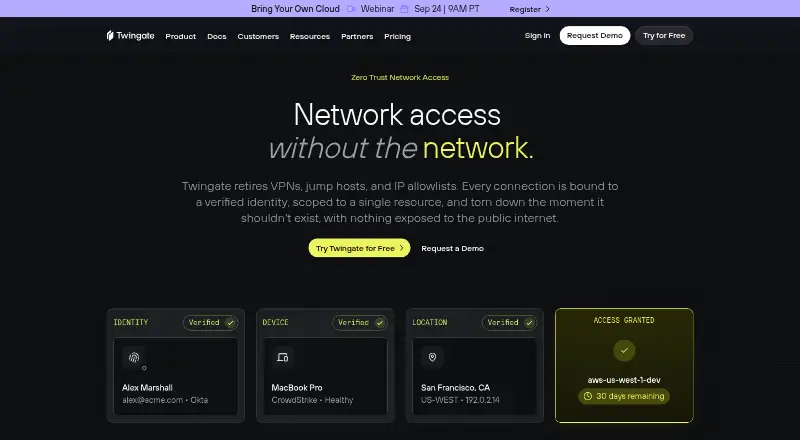
Twingate is a zero trust network access product that connects people to individual resources through verified identities. Its access policies can use authentication, device security, location, and time or usage controls at the resource, group, or network level. The product uses outbound-only connections with zero open inbound ports, and direct peer-to-peer tunnels connect users and resources without routing traffic through Twingate’s cloud. It can be deployed using Docker scripts, Terraform, Helm Charts, and other methods. Listed integrations include Okta, Google Workspace, Microsoft Azure Active Directory, OneLogin, and JumpCloud for identity workflows; Terraform, Kubernetes, GitHub, GitLab, and Pulumi for infrastructure and development; and device tools such as CrowdStrike, SentinelOne, Microsoft Intune, Kandji, Jamf, and 1Password Device Trust. Clients are available for macOS, Windows, Linux, iOS, and Android, with Android support also covering ChromeOS. Twingate offers a free Starter plan for up to five users and 50 resources. Paid options include Home at $15 a month, Teams at $5 per user per month, and Business at $10 per user per month. Twingate began building the product in 2019 and has a core team in Redwood City, California.
Who it suits
Twingate suits organizations that want identity-based access to individual resources, with policies that can account for device security, location, and timing. Its deployment methods and identity, infrastructure, and device integrations may fit teams managing access across different environments.
What it does well
- Free Starter plan supports up to five users and 50 resources
- Policies can apply at resource, group, or network level
- Direct peer-to-peer tunnels avoid routing traffic through its cloud
- Deployment options include Docker scripts, Terraform, and Helm Charts
- Clients cover macOS, Windows, Linux, iOS, and Android
What to know first
- Starter is limited to five users and 50 resources
- Clients older than 12 months cannot connect
- Home is for non-commercial use
- Enterprise pricing is not provided
Limits
Starter supports up to five users and 50 resources. Clients older than 12 months are unsupported and cannot connect to the service.
Plans
| Plan | Billed and limits | Price |
|---|---|---|
| Starter | Up to 5 users · Up to 50 Resources · macOS, Windows, Linux, iOS, Android and more · peer-to-peer connections · split tunneling · conditional access controls | Free |
| Home | per month · Up to 7 users · secure service accounts · exit networks · native device posture checks · MFA · non-commercial use | $15 a month |
| Teams | per user per month; yearly billing shown as 15% discount · Up to 100 users · Google Workspace SSO · SaaS application gating · device posture checks · MFA · automated least-privilege policies | $5 a month |
| Business | per user per month; yearly billing shown as 15% discount · Up to 500 users · IdP provisioning · Okta and Entra ID SSO · device and endpoint integrations · service accounts · JIT policies · exit networks · DNS filtering add-on | $10 a month |
| Enterprise | custom per user per month · Custom account sizes · custom MSA and SLA · invoice billing · geoblocking · static IP add-on · privileged access for Kubernetes, SSH, databases and web apps · priority support | On request |
As twingate.com lists them, read 21 Oct 2026. The maker's own page has the final word.
Getting started
- Visit the Twingate product website.
- Choose Starter or a paid plan based on users and requirements.
- Deploy using Docker scripts, Terraform, Helm Charts, or another method.
- Install a client for macOS, Windows, Linux, iOS, or Android.
- Connect identity, infrastructure, or device tools as needed.
Twingate is zero trust network access software for connecting people to private resources through verified identities and access policies. It suits organizations replacing broad VPN access with controls that can account for users, devices, location, and usage. Its free tier makes a small deployment accessible, while larger teams should weigh paid-plan limits and Enterprise’s custom pricing.
Overview
Twingate ties access to individual resources rather than treating entry to a network as permission to reach everything on it. Policies can be set at resource, group, or network level, combining authentication with device security, location, and time or usage conditions. That makes it a compelling fit for teams that want granular access rules; it is less suited to buyers seeking a simple, broadly scoped VPN replacement without policy administration.
Twingate says its architecture uses outbound-only connections with no open inbound ports, and direct peer-to-peer tunnels that avoid routing user-resource traffic through its cloud. Deployment options include Docker scripts, Terraform, and Helm Charts. Integrations span identity providers such as Okta, Google Workspace, Microsoft Azure Active Directory, OneLogin, and JumpCloud, plus infrastructure tools including Kubernetes, GitHub, GitLab, and Pulumi. Device-security integrations include CrowdStrike, SentinelOne, Intune, Kandji, Jamf, and 1Password Device Trust.
Access supports TCP, UDP, and ICMP, with agent-based clients and a hybrid deployment model. SIEM log export and session recording are supported. Twingate’s Trust Center provides compliance resources for DORA, GDPR, HIPAA, PCI DSS, and SOC 2; those resources will matter to organizations evaluating compliance requirements, but do not by themselves establish a buyer’s compliance.
Key features
- Conditional access: Combine identity, device posture, location, and time or usage conditions. This lets administrators tailor rules to specific resources or groups instead of relying on one network-wide permission.
- Device posture: Native checks are included on Home and Teams, while Business adds endpoint integrations. This gives smaller deployments a way to consider device condition and larger ones more integration choices.
- Peer-to-peer connections: Direct tunnels avoid sending traffic through Twingate’s cloud, according to the company. The outbound-only model also avoids open inbound ports.
- Client currency: Clients older than 12 months are unsupported and cannot connect. Organizations must keep endpoints current enough to stay within that window.
Pricing
Twingate uses a freemium model, with a 14-day trial and paid plans starting at $5/user/mo (annual). The plans differ in audience and capacity, so the cheapest option is not necessarily the right fit for every deployment.
- Starter — free: Up to 5 users and 50 resources, with peer-to-peer connections, split tunneling, and conditional access controls. It is a practical starting point for a small team, but the user and resource caps limit its reach.
- Home — $15 a month, billed monthly: Up to 7 users for non-commercial use, with secure service accounts, exit networks, and native device posture checks. Its personal-use restriction rules it out for a business team.
- Teams — $5 a month, billed per user: Up to 100 users, Google Workspace SSO, SaaS application gating, and native device posture checks. Yearly billing offers 15% off. This is the clearest fit for a growing team using Google Workspace, though it stops at 100 users.
- Business — $10 a month, billed per user: Up to 500 users, IdP user provisioning, endpoint integrations, usage-based and just-in-time access policies; DNS filtering is available as an add-on. Yearly billing offers 15% off. It suits larger organizations needing more policy and provisioning options, with DNS filtering carrying an extra cost.
- Enterprise — custom pricing: Custom account sizes, custom MSA and SLAs, privileged access for Kubernetes, SSH, databases, and web apps, plus priority support. This is the route for organizations needing tailored terms or those privileged-access capabilities, but the price requires a custom quote.
Pricing lists community and basic support, while Enterprise includes priority support and offers additional support options. Teams that need Enterprise terms or support should factor in a custom-priced plan rather than assume the per-user tiers will cover them.
Platforms
Clients are available for macOS, Windows, Linux, iOS, and Android; Android support also covers ChromeOS. The broader platform list includes web. The 12-month client support window is an operational constraint for organizations managing devices with slower update cycles.
Who it's for
Twingate is best for organizations that want resource-specific access controls, identity and device integrations, and options to deploy through common infrastructure tooling. Starter can serve a small team within its five-user and 50-resource limits; Teams and Business raise those ceilings to 100 and 500 users respectively. Home is for non-commercial use. Organizations with more than 500 users, custom agreements, or a need for Enterprise privileged access should explore custom pricing.
Pros and cons
- Pro: Policies can account for identity, device posture, location, and usage at several levels, allowing more targeted access than broad network permissions.
- Pro: Starter includes peer-to-peer connections and conditional access for up to five users and 50 resources, giving small teams a no-cost way to begin.
- Pro: Deployment and integration options cover infrastructure automation, identity, and device-security workflows, which can suit teams with established tooling.
- Con: Starter’s user and resource caps are low for a growing organization, making a paid tier necessary as access needs expand.
- Con: Home is restricted to non-commercial use, so its seven-user allowance does not make it a business tier.
- Con: Clients older than 12 months cannot connect, creating a firm maintenance requirement for managed fleets.
- Con: Enterprise has custom pricing, and Business charges separately for DNS filtering as an add-on.
Alternatives
Cloudflare One is worth considering for buyers who want a freemium option with a 50-user free plan and up to 24 hours of standard log retention.
OpenZiti is a better fit for teams seeking self-hosted, self-managed software under Apache 2.0 with community support.
Cloudflare Gateway offers a free plan for 50 users with up to 24 hours of standard log retention; compare it if those terms match your needs.
Dope Security CASB Neural is an alternative for buyers focused on web security features such as on-device SSL inspection, URL filtering, and cloud app controls, with native Mac and Windows clients.
Forcepoint Data Security Cloud has pricing available by request for buyers considering a broad platform across desktop, mobile, API, extension, and self-hosted environments.
NetFoundry is an option for buyers comparing managed dedicated-network infrastructure with an uptime SLA and 24×7 support, or a self-hosted plan.
Skyhigh Private Access is another paid option in this category.
Symantec IT Management Suite may suit buyers looking for licensable suite or component options, with pricing through a partner.
For broader category browsing, see Zero Trust Network Access Software, Security Service Edge Software, or Business VPN Software.
Verdict
Choose Twingate if your organization needs verified-identity access to individual resources and policy controls that can incorporate device posture, location, and usage. Starter is a useful small-team entry point, and Teams or Business extend capacity with more integrations and controls. Look elsewhere if client update constraints are impractical, if you need Enterprise features but cannot work with custom pricing, or if your deployment exceeds the plan limits.
Verdict
Choose Twingate if you need verified-identity access to individual resources and policy controls for authentication, devices, location, or usage. The free Starter plan covers up to five users and 50 resources; larger teams can consider paid plans. Teams requiring Enterprise pricing or clients older than 12 months should review those limits before choosing.
Questions
Is there a free plan?
Yes. Starter is free for up to five users and 50 resources.
What does Teams cost?
Teams costs $5 per user per month. Yearly billing offers 15% off.
Which platforms are supported?
Clients are available for macOS, Windows, Linux, iOS, and Android; Android support also covers ChromeOS.
How can Twingate be deployed?
Deployment methods include Docker scripts, Terraform, and Helm Charts.
Which identity integrations are listed?
They include Okta, Google Workspace, Microsoft Azure Active Directory, OneLogin, and JumpCloud.
Who makes Twingate?
Twingate is the maker. It began building the product in 2019 and has a core team in Redwood City, California.
Facts from Twingate's own pages
- Access policy
- Its security policies can combine authentication, device security, location, and time or usage controls at resource, group, or network level. · twingate.com, 29 Sept 2026
- Admin API
- The public Admin API is GraphQL at each tenant's /api/graphql/ endpoint and supports management of networks, connectors, resources, users, groups, devices, policies and service accounts. · twingate.com, 21 Oct 2026
- API authentication
- API tokens have read-only, read/write or read/write/provision permission levels and can be restricted to up to 10 IP or CIDR ranges. · twingate.com, 21 Oct 2026
- API limits
- The documented default API throttles are 60 read requests and 20 write requests per minute, with HTTP 429 responses when exceeded. · twingate.com, 21 Oct 2026
- Client platforms
- The client documentation lists macOS, Windows, Linux, iOS, and Android, with Android support also covering ChromeOS. · twingate.com, 29 Sept 2026
- Client support limit
- The client documentation says clients older than 12 months are unsupported and cannot connect to the Twingate service. · twingate.com, 29 Sept 2026
- Client support window
- Clients older than 12 months are unsupported and may be blocked from connecting to the service. · twingate.com, 21 Oct 2026
- Cloud integrations
- Cloud integrations include AWS, Google Cloud Platform, Microsoft Azure, DigitalOcean and Coder. · twingate.com, 21 Oct 2026
- Company
- Twingate says it began building the product in 2019 and is remote-first, with a core team in Redwood City, California. · twingate.com, 29 Sept 2026
- Company founding and headquarters
- Twingate says it was founded in 2019 and has its core headquarters in Redwood City, California. · twingate.com, 21 Oct 2026
- Company legal name
- Crunchbase identifies the legal name as Twingate Inc. · crunchbase.com, 21 Oct 2026
- Company size
- LinkedIn lists Twingate as privately held with 51–200 employees and 89 employee profiles. · linkedin.com, 21 Oct 2026
- Connections
- Twingate says direct peer-to-peer tunnels connect users and resources without routing traffic through its cloud. · twingate.com, 29 Sept 2026
- Connector deployment
- Connectors run behind the firewall as Docker containers or Linux systemd services, with deployment options for Kubernetes, Azure Container Instances, AWS ECS Fargate and AWS AMIs. · twingate.com, 21 Oct 2026
- Continuous policy checks
- Security Policies can require reauthentication, MFA, trusted devices, approved operating systems, geoblocking and usage limits. · twingate.com, 21 Oct 2026
- Deployment
- The product can be deployed using Docker scripts, Terraform, Helm Charts, and other methods. · twingate.com, 29 Sept 2026
- Device security integrations
- Device posture integrations include CrowdStrike, SentinelOne, Microsoft Intune, Kandji, Jamf, 1Password and Hexnode. · twingate.com, 21 Oct 2026
- Direct tunnels
- The service creates direct peer-to-peer tunnels when possible and uses relays when direct connectivity is unavailable. · twingate.com, 21 Oct 2026
- DNS and monitoring integrations
- Twingate lists NextDNS, Cloudflare, DNSFilter, Amazon S3, Datadog and PagerDuty integrations. · twingate.com, 21 Oct 2026
- Documentation depth
- The documentation site contains architecture explanations, deployment guides, cloud-provider and homelab guides, API references, security policies and use-case sections. · twingate.com, 21 Oct 2026
- Founded
- 2019 · twingate.com, 23 Sept 2026
- Free plan
- Yes · twingate.com, 20 Sept 2026
- Funding
- Twingate announced a $42 million Series B round led by BOND on April 14, 2022, with WndrCo, 8VC and SignalFire participating. · twingate.com, 21 Oct 2026
- Headquarters
- Redwood City, California, United States · twingate.com, 23 Sept 2026
Where Twingate stands on Freedom251
- Business VPN Software#12 of 94
- Security Service Edge Software#6 of 23
- Zero Trust Architecture Software#5 of 19
- Zero Trust Network Access Software#13 of 42
- Zero Trust Platforms#10 of 23
- Connectivity Solutions#11 of 23