Freedom251 › Security Service Edge Software
OpenZiti
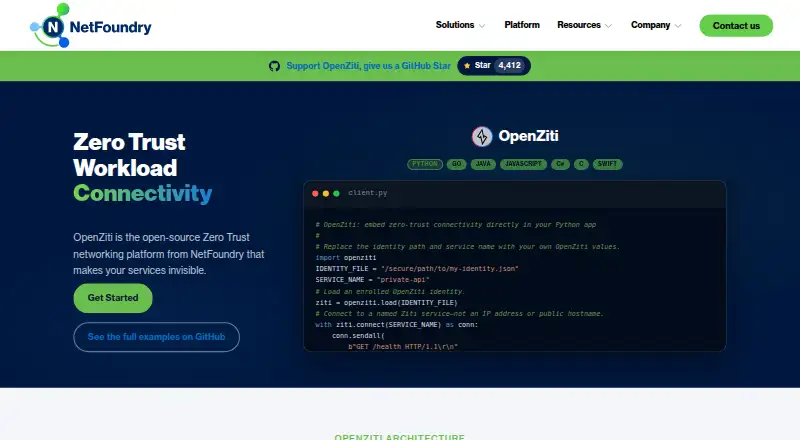
What OpenZiti is
OpenZiti is an open-source Zero Trust networking platform that makes services invisible and controls connections through identity. A controller manages identities, policies, and network state. Edge routers carry sessions over an encrypted mesh, using smart routing and automatic failover. Clients and services initiate outbound connections, so they do not need inbound listening ports or publicly reachable endpoints.
The platform describes certificate-based identities, mutual authentication, identity-based policy, and end-to-end encryption. Developers can use SDKs to add connectivity to applications written in Go, C, C#/.NET, Python, Node.js, Java/Kotlin, and Swift. Tunnelers connect existing applications without code changes on Linux, Windows, macOS, iOS, and Android. Its ecosystem also includes zrok for secure sharing, the visual Ziti Console, and AI gateways for MCP tool servers and LLM providers.
OpenZiti is available as a self-managed, self-hosted product under the Apache 2.0 license, with no license cost for production use and community support through Discourse, GitHub, and documentation. NetFoundry also offers hosted and self-hosted services. NetFoundry-Hosted lists a dedicated managed fabric, more than 100 points of presence, and a contractual uptime SLA of up to 99.95%. NetFoundry Self-Hosted lists FIPS-compliant cryptography, controls pre-mapped to NIST 800-53 and 800-207, and 24×7 enterprise support.
Who it suits
OpenZiti suits teams securing AI agents and APIs, replacing VPNs, connecting sites, or reaching OT and IoT devices. Developers can embed its connectivity in supported languages, while tunnelers connect existing applications across desktop and mobile platforms.
What it does well
- Free and open source under the Apache 2.0 license.
- Outbound-only connections avoid inbound listening ports and public endpoints.
- SDKs cover Go, C, C#/.NET, Python, Node.js, Java/Kotlin, and Swift.
- Tunnelers connect existing applications without code changes.
- Encrypted mesh sessions support smart routing and automatic failover.
- Hosted and self-hosted service options are available.
What to know first
- Self-managed OpenZiti uses community support.
- NetFoundry-Hosted's listed uptime SLA is up to 99.95%.
- The NetFoundry Self-Hosted plan is a licensed management suite.
Limits
The self-managed OpenZiti tier provides community support. NetFoundry-Hosted advertises a contractual uptime SLA of up to 99.95%.
Plans
| Plan | Billed and limits | Price |
|---|---|---|
| OpenZiti | Self-hosted and self-managed · Apache 2.0 · community support | Free |
| NetFoundry-Hosted | Dedicated managed fabric · 100+ points of presence · up to 99.95% SLA | On request |
| NetFoundry Self-Hosted | Licensed management suite · 24×7 enterprise support · self-hosted fabric | On request |
As netfoundry.io lists them, read 7 Oct 2026. The maker's own page has the final word.
Getting started
- Visit the OpenZiti website.
- Choose the self-managed OpenZiti tier or review NetFoundry's hosted and self-hosted offerings.
- For self-managed use, run OpenZiti as a self-hosted platform under Apache 2.0.
- Use an SDK to embed connectivity in a supported application, or use tunnelers for existing applications.
- Use community resources such as Discourse, GitHub, and documentation for the self-managed tier.
OpenZiti is an open-source Zero Trust networking platform that makes services invisible and grants access by identity. It is a strong fit for teams that can manage their own network fabric and want to connect applications, APIs, sites, or devices without opening inbound ports. Its central advantage is production use without license fees; the trade-off is community support for the self-managed tier.
Overview
A controller manages identities, policy, and network state, while edge routers carry sessions through an encrypted mesh with smart routing and automatic failover. Clients and services initiate outbound connections, so they need neither inbound listening ports nor publicly reachable endpoints. That approach suits teams trying to reduce direct exposure while connecting private services, though operating the fabric remains part of the job.
Security combines certificate-based identities, mutual authentication, identity-based policy, and end-to-end encryption. OpenZiti supports private-app access and device posture checks, and its Apache 2.0 license allows production use without a license charge.
Key features
Application connectivity
SDKs for Go, C, C#/.NET, Python, Node.js, Java/Kotlin, and Swift let development teams build connectivity into their own applications. Tunnelers connect existing applications without code changes across Linux, Windows, macOS, iOS, and Android. The SDK route fits teams that can change their software; tunnelers are useful when modifying existing applications is impractical.
Tools around the network
The ecosystem includes zrok for secure sharing, a visual Ziti Console, and AI gateways for MCP tool servers and LLM providers. These broaden its reach beyond basic service connectivity, particularly for teams securing AI agents and APIs.
Pricing
OpenZiti costs nothing. The self-hosted, self-managed plan includes the Apache 2.0 software and community support through Discourse, GitHub, and documentation. There is no license fee to run it in production, making it the straightforward choice for teams able to operate the fabric and work through community channels.
NetFoundry-Hosted has custom pricing for a dedicated managed fabric with 100+ points of presence and a contractual uptime SLA of up to 99.95%. It suits teams seeking managed operations. NetFoundry Self-Hosted also has custom pricing and pairs a self-hosted fabric with a licensed management suite and 24×7 enterprise support, for organizations that want their fabric on their own infrastructure but need a supported management offering.
Platforms
OpenZiti covers Android, iOS, Linux, macOS, Windows, web, API, and self-hosted environments. That range accommodates mobile and desktop clients as well as teams running their own infrastructure.
Who it's for
OpenZiti is aimed at teams replacing VPNs, connecting sites, securing AI agents and APIs, or reaching OT and IoT devices. Its outbound-only model and identity-based access are especially relevant when services should remain unreachable from public endpoints. Teams that need managed operations or 24×7 enterprise support should consider NetFoundry's hosted or self-hosted offerings instead.
Pros and cons
- Pros: Apache 2.0 licensing carries no production license cost; outbound-only connections avoid inbound listening ports and public endpoints; SDKs and tunnelers cover both new and existing applications.
- Cons: The free OpenZiti tier is self-managed and relies on community support, so teams seeking 24×7 enterprise support need a paid NetFoundry offering with custom pricing.
Alternatives
Security Service Edge Software is a useful category to browse when comparing tools in the broader security service edge space.
Twingate is worth considering for teams that want a freemium option with a free Starter plan capped at 5 users and 50 resources, plus a free trial.
Cloudflare One may suit teams looking for a free plan with a 50-user limit and up to 24 hours of standard log retention.
Cloudflare Gateway offers a free plan capped at 50 users, as well as a $7 a month Pay-as-you-go plan.
Dope Security CASB Neural is an alternative for teams focused on web and cloud app controls, with a plan that includes on-device SSL inspection, URL filtering, anti-malware, and Shadow IT discovery.
Forcepoint Data Security Cloud has pricing by request for teams considering a broader data security cloud platform.
NetFoundry is a paid option for teams seeking a dedicated managed network with managed infrastructure, an uptime SLA, and 24×7 support.
Skyhigh Private Access is another paid private access option.
Symantec IT Management Suite may fit teams looking for a licensable suite or individual components, with pricing available through a partner.
Verdict
Choose OpenZiti if your team can run its own fabric and wants identity-controlled connectivity without production license fees. Its outbound-only architecture, application integration options, and open license make a compelling combination for that audience. Look elsewhere if community support is not enough or you need managed operations: NetFoundry's hosted and self-hosted plans add those services at custom pricing.
Verdict
Choose OpenZiti if you want an open-source way to make services identity-accessible through outbound connections, or to embed connectivity in applications and tunnel existing ones. Teams that need managed operations or 24×7 enterprise support can look to NetFoundry's hosted or self-hosted offerings.
Questions
Is OpenZiti free?
Yes. OpenZiti is free and open source under Apache 2.0, with no license cost to run it in production.
Which platforms does it support?
The listed platforms are Android, iOS, Linux, macOS, web, Windows, API, and self-hosted. Tunnelers connect existing applications across Linux, Windows, macOS, iOS, and Android.
Can developers add OpenZiti connectivity to their own applications?
SDKs are listed for Go, C, C#/.NET, Python, Node.js, Java/Kotlin, and Swift.
What support comes with OpenZiti?
The self-managed tier has community support through Discourse, GitHub, and documentation. NetFoundry Self-Hosted includes 24×7 enterprise support.
What hosted options are available?
NetFoundry-Hosted lists a dedicated managed fabric, 100+ points of presence, and an uptime SLA of up to 99.95%. NetFoundry Self-Hosted lists a licensed management suite and a self-hosted fabric.
What compliance features are listed?
NetFoundry Self-Hosted offers FIPS-compliant cryptography and controls pre-mapped to NIST 800-53 and 800-207. NetFoundry-Hosted lists a SOC 2 Type II report.
Facts from OpenZiti's own pages
- App integration
- SDKs let developers embed connectivity in Go, C, C#/.NET, Python, Node.js, Java/Kotlin, and Swift applications. · netfoundry.io, 7 Oct 2026
- Architecture
- A controller manages identity, policy, and network state while edge routers carry sessions over an encrypted mesh with smart routing and automatic failover. · netfoundry.io, 7 Oct 2026
- Compliance
- NetFoundry Self-Hosted offers FIPS-compliant cryptography and controls pre-mapped to NIST 800-53 and 800-207; NetFoundry-Hosted lists a SOC 2 Type II report. · netfoundry.io, 7 Oct 2026
- Ecosystem
- The ecosystem includes the zrok secure sharing platform, a visual Ziti Console, and AI gateways for MCP tool servers and LLM providers. · netfoundry.io, 7 Oct 2026
- Existing applications
- Tunnelers connect existing applications without code changes across Linux, Windows, macOS, iOS, and Android. · netfoundry.io, 7 Oct 2026
- Headquarters
- Charlotte, North Carolina, United States · netfoundry.io, 28 Sept 2026
- Hosted service limits
- NetFoundry-Hosted advertises a contractual uptime SLA of up to 99.95%. · netfoundry.io, 7 Oct 2026
- Intended users
- The page presents OpenZiti for teams securing AI agents and APIs, replacing VPNs, connecting sites, and reaching OT and IoT devices. · netfoundry.io, 7 Oct 2026
- License
- OpenZiti is free and open source under Apache 2.0, with no license cost to run it in production. · netfoundry.io, 7 Oct 2026
- Outbound-only access
- Clients and services dial outbound only, so they need no inbound listening ports or publicly reachable endpoints. · netfoundry.io, 7 Oct 2026
- Security
- The page describes certificate-based identities, mutual authentication, identity-based policy, and end-to-end encryption for connections. · netfoundry.io, 7 Oct 2026
- Support
- The self-managed OpenZiti tier provides community support through Discourse, GitHub, and documentation, while NetFoundry Self-Hosted includes 24×7 enterprise support. · netfoundry.io, 7 Oct 2026
- What it does
- OpenZiti is an open-source Zero Trust networking platform that makes services invisible and authorizes connections by identity. · netfoundry.io, 7 Oct 2026
Where OpenZiti stands on Freedom251
- Security Service Edge Software#5 of 23