Freedom251 › Business VPN Software
NetFoundry
by NetFoundry
What NetFoundry is
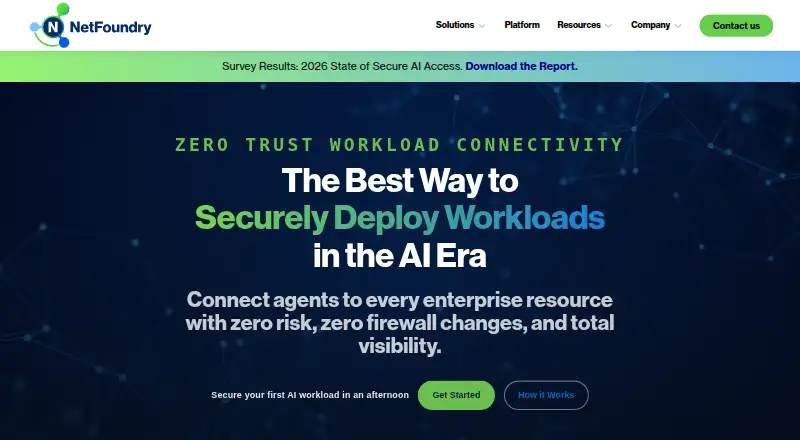
NetFoundry provides identity-first zero-trust connectivity for AI, API, and machine-to-machine workloads. Workloads connect outbound without open or listening ports, and identity plus least-privilege policy governs access. Each endpoint authenticates the other with mutual X.509 identity before a connection is established. The platform records authentication, authorization, and policy changes, can stream audit events, and exports connection, throughput, and health metrics.
NetFoundry supports external identity providers and documents SCIM for automated identity management. Its SDKs cover Go, C, .NET, Java, Node, and Swift. NetFoundry Cloud offers dedicated controllers and routers deployable on AWS, Azure, Google Cloud, and Oracle Cloud; Self-Hosted can run on customer-owned infrastructure, including on-premises and air-gapped environments. Described use cases include governing AI agent, model, and tool access, microsegmenting workloads, and connecting IT, OT, IoT, and APIs. Pricing is on request. Select and Premium support list platform availability SLAs of 99.5% and 99.95%, respectively, and some support packages may not be available in every region.
Who it suits
NetFoundry suits organizations connecting AI, API, and machine-to-machine workloads that need identity-controlled access. Its managed and customer-hosted deployment options also address on-premises and air-gapped environments.
What it does well
- Outbound connections avoid open or listening ports
- Uses mutual X.509 endpoint authentication
- Streams audit events and exports metrics
- Offers managed and self-hosted deployment options
- Documents support for TCP and UDP
What to know first
- Pricing is available on request
- Some support packages are unavailable in some regions
Plans
| Plan | Billed and limits | Price |
|---|---|---|
| OpenZiti | Self-hosted and self-managed · Apache 2.0 · community support | Free |
| NetFoundry Cloud | Dedicated network · managed infrastructure · uptime SLA · 24×7 support | On request |
| NetFoundry-Hosted | Dedicated OpenZiti fabric · managed PKI, upgrades, backups and monitoring · SLA up to 99.95% | On request |
| NetFoundry Self-Hosted | Licensed management suite · customer-owned infrastructure · 24×7 enterprise support | On request |
As netfoundry.io lists them, read 21 Oct 2026. The maker's own page has the final word.
Getting started
- Visit the NetFoundry website.
- Contact a representative to discuss pricing and support availability.
- Choose NetFoundry Cloud or NetFoundry Self-Hosted.
- For Cloud, select a deployment on AWS, Azure, Google Cloud, or Oracle Cloud.
- For Self-Hosted, use customer-owned infrastructure, including on-premises or air-gapped environments.
NetFoundry is an identity-first zero-trust connectivity platform for AI, API, and machine-to-machine workloads. It suits organizations joining services across public cloud, owned infrastructure, and isolated environments while enforcing least-privilege access. The main trade-off is a deployment that needs deliberate identity and policy administration, with pricing determined for each deployment.
Overview
NetFoundry is built around outbound workload connections rather than exposed listening ports. Identity determines which services can communicate, making the platform a strong candidate for microsegmentation and service-to-service controls across IT, OT, IoT, APIs, AI agents, models, and tools. Teams looking for a conventional user VPN or a quick, individually managed tunnel may find this workload-centric approach more involved than necessary.
Deployment can be managed by NetFoundry or operated by the customer. NetFoundry Cloud uses dedicated controllers and routers deployable on AWS, Azure, Google Cloud, and Oracle Cloud. NetFoundry Self-Hosted runs on customer-owned infrastructure, including on-premises and air-gapped environments. That range is valuable where data-location or isolation requirements rule out a single-cloud design.
Key features
Before a connection is made, mutual X.509 authentication verifies both endpoints. Access then follows identity and least-privilege policy, while workloads initiate connections outbound without open or listening ports. This can reduce the attack surface for distributed services, but it also means administrators must maintain trustworthy identities and precise policy relationships as the environment changes.
The platform records authentication, authorization, and policy changes. Audit events can be streamed, and connection, throughput, and health metrics can be exported; SIEM log export is supported. Device posture checks add another access signal. These capabilities give security and operations teams material for investigations and ongoing control rather than only a connectivity pipe.
NetFoundry connects to external identity providers and documents SCIM for automated identity management. SDKs for Go, C, .NET, Java, Node, and Swift help teams embed connectivity into applications written in common enterprise languages. TCP and UDP support covers both conventional application traffic and latency-sensitive or non-HTTP services.
Pricing
NetFoundry uses custom pricing, so buyers need a quote for the required deployment and support arrangement.
NetFoundry Cloud
This plan includes a dedicated network, managed infrastructure, an uptime SLA, and 24×7 support. It fits organizations that want NetFoundry to operate the core service while they apply workload and identity policy. The operational convenience comes with less infrastructure ownership and no published price for budgeting.
NetFoundry Self-Hosted
This option puts the infrastructure under the customer's management and supports on-premises, air-gapped, or cloud deployment, with 24×7 support. It is the better match for strict isolation, sovereignty, or existing platform-operations requirements. Customers take on the infrastructure responsibility, and its price is also custom.
Support packages include Select and Premium, with platform-availability SLAs of 99.5% and 99.95%, respectively. Some support packages are not offered in every region, so location should be confirmed before committing to a target SLA.
Platforms
NetFoundry lists Android, iOS, Linux, macOS, Windows, web, and API access, plus self-hosted deployment. Its hybrid deployment model and support for both access methods make it suitable for mixtures of managed services, private infrastructure, and application-integrated connections.
Who it's for
Security and platform teams governing AI agents, models, and tools will value identity-based authorization and auditable policy changes. Enterprises segmenting microservices, industrial systems, IoT fleets, or APIs can use the outbound model to avoid exposing inbound ports. It is also appropriate for organizations that need cloud portability or air-gapped operation.
NetFoundry is less compelling for a small team seeking a free or transparent-price network access product, since both plans require a quote and workload identity design. Buyers should also ensure their preferred support tier is offered in their region.
Pros and cons
- Pros: Mutual X.509 endpoint authentication establishes trust on both sides before connection.
- Pros: Outbound-only connectivity and least-privilege policy reduce reliance on exposed service ports.
- Pros: Audit streaming, SIEM export, metrics, posture checks, and SCIM documentation support security operations.
- Pros: Managed cloud and customer-controlled self-hosting cover public-cloud, on-premises, and air-gapped requirements.
- Cons: Custom pricing makes cost comparison and initial budgeting harder.
- Cons: Identity and policy administration is central to the design, adding governance work for teams without mature security operations.
- Cons: Support-package availability varies by region, which can affect the SLA a buyer can obtain.
Alternatives
Choose Twingate when a freemium service with a free Starter tier, up to five users and 50 resources, and peer-to-peer connections is a better starting point.
Cloudflare One is a fit for teams wanting a freemium platform with a free plan capped at 50 users and up to 24 hours of standard log retention.
Pick OpenZiti for free, Apache 2.0, self-hosted and self-managed deployment with community support, or its hosted option.
Cloudflare Gateway suits buyers seeking a forever-free tier for 50 users or a $7 a month pay-as-you-go plan.
Dope Security CASB Neural is aimed at secure web access and cloud-app controls, with native Mac and Windows coverage.
Forcepoint Data Security Cloud, Skyhigh Private Access, and Symantec IT Management Suite are alternatives with custom or partner-led pricing.
For broader category comparisons, see Security Service Edge Software, Zero Trust Network Access Software, and Business VPN Software.
Verdict
NetFoundry is a strong choice for organizations that need identity-controlled connectivity between workloads across cloud, private, and isolated environments, especially where auditability and least privilege are priorities. Choose it for deployment flexibility and endpoint-level trust; look elsewhere if you need simple consumer-style access, a free tier, or predictable published pricing.
Verdict
NetFoundry combines workload connectivity with endpoint identity, least-privilege policy, and audit visibility. Organizations should check regional support availability and request pricing for the deployment they need.
Questions
What does NetFoundry cost?
Pricing is on request.
What are the two deployment plans?
NetFoundry Cloud includes dedicated network, managed infrastructure, an uptime SLA, and 24×7 support. NetFoundry Self-Hosted uses customer-managed infrastructure and includes 24×7 support.
Which platforms are supported?
The listed platforms are Android, API, iOS, Linux, macOS, self-hosted, web, and Windows.
Can NetFoundry be self-hosted?
Yes. NetFoundry Self-Hosted can run on customer-owned infrastructure, including on-premises and air-gapped environments.
What support options are listed?
The support guide lists Select and Premium, with platform availability SLAs of 99.5% and 99.95%, respectively. Some support packages are not available in all regions.
Facts from NetFoundry's own pages
- Air-gapped deployment limit
- The deployment guide says offline installations currently support single-node K3s, with full Kubernetes support described as forthcoming. · netfoundry.io, 21 Oct 2026
- API conventions
- The documented REST APIs use JSON request and response bodies and authentication tokens delegated to an identity provider. · netfoundry.io, 21 Oct 2026
- Audit and visibility
- NetFoundry records authentication, authorization, and policy changes and can stream audit events and export connection, throughput, and health metrics. · netfoundry.io, 7 Oct 2026
- Changelog
- The self-hosted changelog lists version 2.0.1 dated October 2, 2026, with fixes including restored monitoring panels and improved handling of credentials in logs and support bundles. · netfoundry.io, 21 Oct 2026
- Cloud deployment
- NetFoundry Cloud describes dedicated controllers and routers deployable on AWS, Azure, Google Cloud, and Oracle Cloud. · netfoundry.io, 7 Oct 2026
- Cloud platforms
- The hosted fabric page lists points of presence across AWS, Azure, Google Cloud and Oracle Cloud Infrastructure. · netfoundry.io, 21 Oct 2026
- Commercial license
- NetFoundry describes its self-hosted management suite as licensed; the Apache 2.0 license claim applies to the OpenZiti project. · netfoundry.io, 21 Oct 2026
- Company headquarters
- G2 lists NetFoundry's headquarters as Charlotte, North Carolina, United States. · g2.com, 21 Oct 2026
- Company legal name
- The Google Play listing identifies the developer as NetFoundry Inc. · play.google.com, 21 Oct 2026
- Compliance
- The documentation page lists SOC 2 Type II reports and describes HIPAA eligibility, GDPR and CCPA data processing agreements, and framework guidance. · netfoundry.io, 7 Oct 2026
- Connection security
- OpenZiti assigns identities to users, devices, services and workloads and authorizes connections before creating a network path. · netfoundry.io, 21 Oct 2026
- Connectivity model
- Workloads connect outbound and have no open or listening ports, with access controlled by identity and least-privilege policy. · netfoundry.io, 7 Oct 2026
- Cryptography
- The self-hosted commercial package advertises FIPS-compliant cryptography and post-quantum-ready encryption. · netfoundry.io, 21 Oct 2026
- Developer API
- The NetFoundry REST API covers console operations such as creating networks, managing identities and services, configuring policies and automating workflows. · netfoundry.io, 21 Oct 2026
- Documentation depth
- The documentation includes API guides and references, integration instructions, identity and policy guides, deployment planning, upgrades and troubleshooting. · netfoundry.io, 21 Oct 2026
- Encrypted mesh
- OpenZiti uses edge routers in an encrypted mesh with smart routing and automatic failover. · netfoundry.io, 21 Oct 2026
- Encryption
- The platform authenticates both endpoints with mutual X.509 identity before a connection is established. · netfoundry.io, 7 Oct 2026
- Endpoint platforms
- The downloads page lists endpoint clients or tunnelers for Windows, macOS, Linux, iOS and Android, plus Docker-based tunneling. · netfoundry.io, 21 Oct 2026
- Founded
- G2 lists NetFoundry's founding year as 2019. · g2.com, 21 Oct 2026
- Funding and investors
- Crunchbase lists three investors, including Cisco Investments and SYN Ventures, and identifies the latest round as Series A; its displayed page obscures the round date and total funding amount. · crunchbase.com, 21 Oct 2026
- Headquarters
- Charlotte, North Carolina, United States · netfoundry.io, 28 Sept 2026
- Hosted deployment
- NetFoundry operates a dedicated OpenZiti fabric and manages its PKI, upgrades, backups and monitoring for hosted customers. · netfoundry.io, 21 Oct 2026
- Identity integrations
- The console supports SCIM provisioning integrations with Okta, Microsoft Entra ID and Google Workspace. · netfoundry.io, 21 Oct 2026
- Integrations
- The platform supports connections to external identity providers and documents SCIM for automated identity management. · netfoundry.io, 7 Oct 2026
Where NetFoundry stands on Freedom251
- Business VPN Software#13 of 94
- Security Service Edge Software#4 of 23
- Zero Trust Architecture Software#4 of 19
- Zero Trust Network Access Software#11 of 42
- Zero Trust Platforms#7 of 23