Freedom251 › Project Management Software

Planio
by Planio
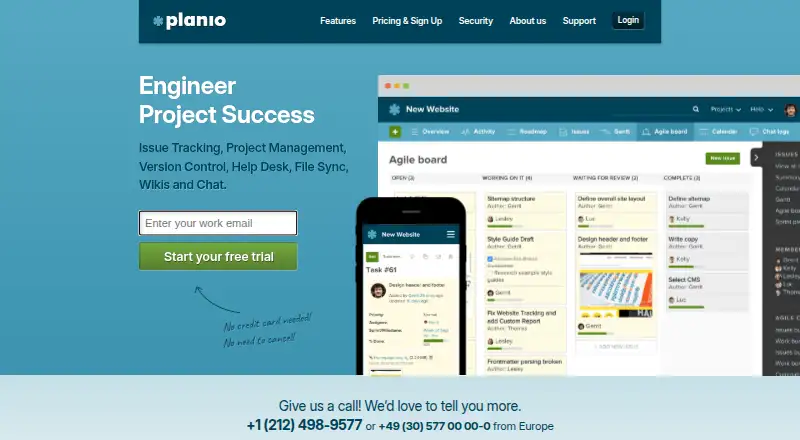
What Planio is
Planio is a hosted collaborative project-management service based on Redmine. Teams can manage issues with configurable fields for status, priority, assignee, dates, completion, time spent, and subtasks. Custom roles and permissions control which workflow steps participants can use. Planning options include agile project planning, roadmaps, milestones, and Gantt charts. Planio also includes a wiki, communication tools, Git and Subversion repository hosting, time tracking, file storage, Help Desk, team chat, search, and an email inbox. Documented integrations and add-ons include GitHub, Bitbucket, Google Chrome and Apps, Dropscan, and desktop repository clients. It provides Redmine REST API functionality and OAuth 2 integration, plus Android and iOS apps for project and task management; those apps are free for Planio users. The service is freemium and lists a free plan and a 30-day trial. Silver costs $25 a month billed month-to-month and allows three active projects, five active users, and 5 GB of storage. Higher listed plans cost up to $449 a month. Planio launched in 2009 and is based in Berlin, Germany.
Who it suits
Planio suits project managers, teams, and start-ups needing issue workflows, planning tools, and related collaboration features. Its mobile apps support project and task management for Planio users.
What it does well
- Custom roles and permissions shape issue workflows.
- Includes roadmaps, milestones, and Gantt charts.
- Android and iOS apps are free for Planio users.
- All plans include email and phone support.
What to know first
- Silver allows five active users and three active projects.
- Storage and active project and user limits vary by tier.
- Storage and Help Desk Pro cost extra on Silver and Gold.
- Enterprise may involve additional charges.
Limits
The free Bronze plan allows one project, two users, ten customers, and 1 GB of storage. The Silver plan costs $25 a month and allows three active projects, five active users, and 5 GB of storage; storage and Help Desk Pro are extra.
Plans
| Plan | Billed and limits | Price |
|---|---|---|
| Silver | month-to-month · 3 active Projects · 5 active Users · 5 GB Storage · Storage and Help Desk Pro available at extra cost | $25 a month |
| Gold | month-to-month · 7 active Projects · 10 active Users · 20 GB Storage · Storage and Help Desk Pro available at extra cost | $59 a month |
| Diamond | month-to-month · 15 active Projects · 20 active Users · 40 GB Storage · Planio Help Desk and Team Chat included · Storage Pro available at extra cost | $125 a month |
| Platinum | month-to-month · 40 active Projects · 45 active Users · 80 GB Storage · Planio Storage, Help Desk, and Team Chat Pro included | $249 a month |
| Enterprise | month-to-month · 100 Projects or more · 100 Users or more · 100 GB Storage or more · Custom branding, domain, and customizations possible · Additional charges may apply | $449 a month |
| Bronze | 1 project · 2 users · 10 customers · 1 GB storage | Free |
As plan.io lists them, read 2 Oct 2026. The maker's own page has the final word.
Getting started
- Open the Planio website.
- Choose the free plan or a paid tier based on project, user, and storage needs.
- Start the 30-day trial if you want to try a paid plan.
- Use Planio on the web, or install its iOS or Android app.
- Invite participants and set roles and workflow permissions.
Planio is hosted project-management software built on Redmine, combining structured issue tracking with agile and traditional planning, repositories, and team communication. It best suits project managers, development teams, and start-ups that need controlled workflows and several work tools in one service. The main trade-off is capacity: lower tiers impose tight project, user, and storage limits, while some collaboration services cost extra.
Overview
Planio makes configurable issues the center of project work. An issue can carry status, priority, assignee, dates, completion percentage, time spent, and subtasks, so teams can represent detailed processes rather than a basic to-do list. Custom roles and permissions control which workflow steps each participant can perform, a useful safeguard for teams with approvals or defined handoffs. Guest access is supported.
Planning covers agile projects and also roadmaps, milestones, and Gantt charts for more conventional schedules. The service bundles a wiki, communication tools, Git and Subversion repository hosting, time tracking, file storage, Help Desk, team chat, search, and an email inbox. This breadth can reduce the number of separate systems a team must coordinate, although storage and some service features depend on the selected tier.
Key features
Structured work and planning
Configurable fields and permission-controlled workflows fit teams that need consistency and accountability. WIP limits and custom card fields add practical controls for board-based work. Roadmaps, milestones, and Gantt charts make Planio suitable for both iterative delivery and longer projects with date-driven planning.
Development and collaboration tools
Git and Subversion hosting, time tracking, file storage, wiki pages, communication, chat, and an email inbox put technical and project context together. Integrations or add-ons are documented for GitHub, Bitbucket, Google Chrome and Google Apps, Dropscan, and desktop repository clients. The Redmine REST API and OAuth 2 support give teams options for connecting their own systems.
Mobile, support, and security
Free iOS and Android apps let Planio users manage projects and tasks away from a desktop. All plans include email and phone support, and existing data imports are free. Planio describes SSL and SSH access controls, firewalls, daily encrypted backups, email encryption, and PCI DSS compliance reviewed by Comodo. These provisions will matter to teams moving established project data into a hosted service.
Pricing
Planio is freemium, with a free plan and a 30-day trial. Paid subscriptions are billed month-to-month; active project and user counts and storage vary by tier, while issues and Git and Subversion repositories are unlimited.
- Bronze: custom pricing, with 1 project, 2 users, 10 customers, and 1 GB of storage. It is aimed at a very small operation and leaves little room for parallel work.
- Silver: $25.00 per month for 3 active projects, 5 active users, and 5 GB of storage. Storage and Help Desk Pro cost extra, so it fits compact teams that can stay within modest capacity.
- Gold: $59.00 per month for 7 active projects, 10 active users, and 20 GB. Storage and Help Desk Pro remain extra; this is the more workable tier for a growing small team.
- Diamond: $125.00 per month for 15 active projects, 20 active users, and 40 GB. Planio Help Desk and Team Chat are included, while Storage Pro is extra, making it suited to teams that need built-in service and chat.
- Platinum: $249.00 per month for 40 active projects, 45 active users, and 80 GB. Planio Storage, Help Desk, and Team Chat Pro are included for larger departments wanting fewer add-on charges.
- Enterprise: $449.00 per month for 100 projects or more, 100 users or more, and 100 GB or more. Custom branding, domain, and customizations are possible, with additional charges potentially applying.
The free option can validate a small deployment, but teams approaching its caps should compare upgrade costs with their expected project and storage growth before committing.
Platforms
Planio runs on the web and offers Android and iOS apps. An API, self-hosted option, and repository integrations support technical teams that need programmatic connections or development-oriented workflows.
Who it's for
Planio is a strong match for project managers and teams that want issue-level detail, permissioned workflows, agile boards, and Gantt-style planning in one hosted Redmine-based environment. Start-ups can use its broad toolset and mobile apps, while development groups benefit from Git, Subversion, API, and time tracking. It is less suitable for teams whose user count, project portfolio, or file volume will quickly exceed lower-tier limits, or for buyers seeking a simple board without administrative structure.
Pros and cons
Pros
- Deeply configurable work tracking: fields, subtasks, WIP limits, custom card fields, and permissioned workflows support defined processes.
- Wide planning range: agile planning sits alongside roadmaps, milestones, and Gantt charts.
- Broad built-in toolkit: repositories, wiki, time tracking, storage, Help Desk, chat, search, and email reduce tool sprawl.
- Developer access: Redmine REST API, OAuth 2, Git, and Subversion support integrations and technical workflows.
- Included human support: every plan has email and phone support, with free data imports.
Cons
- Small lower-tier quotas: Silver allows only 3 projects and 5 users, while storage starts at 5 GB.
- Add-on costs: Storage and Help Desk Pro are extra on Silver and Gold; Storage Pro is extra on Diamond.
- Higher tiers are a substantial commitment: Platinum is $249.00 per month and Enterprise is $449.00 per month.
- Feature packaging varies: Help Desk and Team Chat are not included until Diamond, limiting the all-in-one value of cheaper plans.
Alternatives
For a board-focused comparison, see Kanban Software; for broader project-tool options, see Project Management Software.
- PLANKA is a freemium alternative with a free self-hosted Community edition and a €36.00-per-month Pro Self-Hosted plan; choose it when self-hosting and a wider platform list matter more than Planio's hosted Redmine toolset.
- WeKan is free and open source-oriented, with a no-admin-access app or a $50.00-per-year cloud plan offering admin access and unlimited everything; choose it for a simpler Kanban deployment.
- Doska is a free MIT-licensed product with no features behind a paywall; choose it when zero-cost open-source access is the priority.
- MeisterTask offers a free tier with unlimited tasks and up to three projects; choose it for a lighter task-management model.
- Flow-e keeps its Team and Personal plans free; choose it when email-centered task boards are the main requirement.
- Jotform provides a free Starter plan with five forms and 100 monthly submissions; choose it for form-driven collection rather than project workflows.
- SwiftKanban has a free Team plan for 3 users and 2 boards; choose it for a smaller Kanban setup.
- Trello has a free plan supporting up to 10 collaborators and 10 boards per Workspace; choose it for straightforward visual boards with those limits.
Verdict
Choose Planio if your team needs configurable issue management, controlled workflows, agile and Gantt planning, and development repositories in one hosted service. Its breadth, API, mobile apps, and included phone and email support are the strongest reasons to adopt it. Look elsewhere if you need generous low-cost capacity, built-in Help Desk and chat on entry plans, or a simpler board with fewer administrative and pricing considerations.
Verdict
Planio combines issue management, planning, and team tools in a hosted Redmine-based service. Compare tier limits and any extra-cost services against the needs of your team.
Questions
Does Planio have a free plan?
Yes. Bronze is the free plan and lists one project, two users, ten customers, and 1 GB of storage.
How much does Planio cost?
Silver is $25 a month, billed month-to-month. Gold is $59 a month, Diamond $125 a month, Platinum $249 a month, and Enterprise $449 a month.
Is there a free trial?
Yes. Planio lists a 30-day trial.
What platforms does Planio support?
Planio lists Android, iOS, web, API, and self-hosted platforms.
Can guests access Planio?
Yes. Guest access is available.
What integrations does Planio document?
Its documented integrations or add-ons include GitHub, Bitbucket, Google Chrome and Apps, Dropscan, and desktop repository clients.
Facts from Planio's own pages
- API
- Planio provides Redmine REST API functionality and documents OAuth 2 integration. · plan.io, 2 Oct 2026
- Audience
- Planio recommends its service for project managers, teams, and start-ups. · plan.io, 2 Oct 2026
- Company history
- Planio says it launched in 2009 and was developed initially for LAUNCH, a web design agency. · plan.io, 2 Oct 2026
- Founded
- 2009 · plan.io, 28 Sept 2026
- Free plan
- Yes · plan.io, 20 Sept 2026
- Guest access
- Yes · plan.io, 20 Sept 2026
- Headquarters
- Berlin, Germany · plan.io, 28 Sept 2026
- Included tools
- The product feature list includes wiki, communication, Git and Subversion repository hosting, time tracking, file storage, Help Desk, team chat, search, and email inbox. · plan.io, 2 Oct 2026
- Integrations
- Planio documents integrations or add-ons including GitHub, Bitbucket, Google Chrome and Apps, Dropscan, and desktop repository clients. · plan.io, 2 Oct 2026
- Issue management
- Tasks can include configurable fields such as status, priority, assignee, dates, completion percentage, time spent, and subtasks. · plan.io, 2 Oct 2026
- Limits
- Paid plans are billed month-to-month; active project and user counts and storage vary by tier, while issues and Git and Subversion repositories are unlimited. · plan.io, 2 Oct 2026
- Mobile
- Planio offers iOS and Android apps for managing projects and tasks, and its FAQ says the apps are free for Planio users. · plan.io, 2 Oct 2026
- Planning
- Planio supports agile project planning as well as roadmaps, milestones, and Gantt charts for traditional project management. · plan.io, 2 Oct 2026
- Product
- Planio is a hosted collaborative project-management service based on Redmine. · plan.io, 2 Oct 2026
- Security
- Planio says it uses SSL and SSH access controls, firewalls, daily encrypted backups, email encryption, and PCI DSS compliance reviewed by Comodo. · plan.io, 2 Oct 2026
- Support
- All plans include support by email and phone, and the pricing page says existing data imports are free. · plan.io, 2 Oct 2026
- Workflows
- Customizable roles and permissions determine which issue workflow steps participants can take. · plan.io, 2 Oct 2026
Where Planio stands on Freedom251
- Project Management Software#51 of 188
- Project management tools#62 of 196
- Kanban Software#12 of 29