Freedom251 › Game Engine Software
Orx
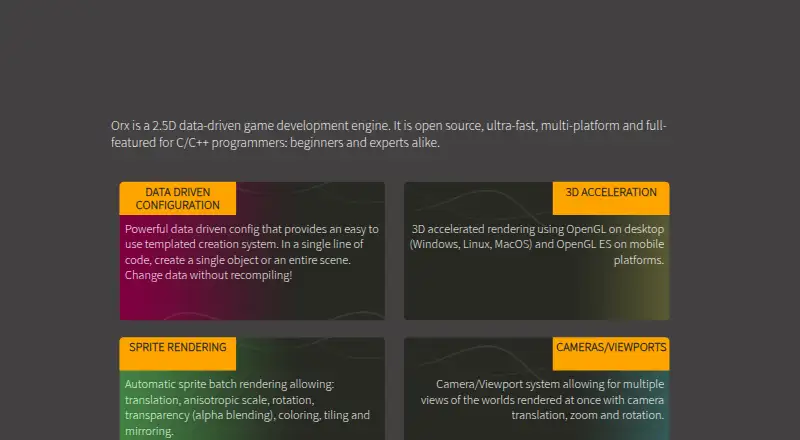
What Orx is
Orx is a free, open-source 2.5D game development engine for programmers working in C or C++. Its data-driven configuration uses templates to define objects and scenes, and changes can be made without recompiling. Rendering features include accelerated rendering, sprite batching, multiple cameras and viewports, custom shaders, off-screen rendering, and multiple render targets. The audio system supports 3D sound and music, recording, filters, and controls for volume, pitch, and stereo balance. Orx also includes collision handling, rigid-body physics with joints, and input support for keyboard, joystick, mouse, and touch. Data-driven animation graphs and event management cover clocks, effects, input, physics, shaders, sound, spawners, and timelines. For localization, it can select separate images, text, and sounds for multiple languages while the game runs. Its plugin architecture lets developers extend or customize the engine and port it to new platforms. Supported targets include Windows, Linux, macOS, Web/HTML5, Android, and iOS. The zlib license allows free use and modification in freeware and commercial projects. The learning wiki provides tutorials, examples, setup guides, beginner guides, and configuration information. Users can direct questions, feedback, or comments to the project’s Discord community or GitHub issue tracker.
Who it suits
Orx suits C and C++ programmers building 2.5D games who want a free engine with built-in rendering, audio, physics, input, animation, and localization systems. Its multi-platform targets and plugin architecture may also suit developers planning web, desktop, or mobile builds or extending the engine.
What it does well
- Free to use and modify under the zlib license.
- Configuration changes can be made without recompiling.
- Includes rendering, audio, physics, input, animation, and localization systems.
- Targets Windows, Linux, macOS, Web/HTML5, Android, and iOS.
- Learning wiki includes tutorials, examples, and setup guides.
What to know first
- Designed for programmers using C or C++.
- Multiplayer tools are not included.
Plans
| Plan | Billed and limits | Price |
|---|---|---|
| Orx | Free to use for any kind of project · freeware and commercial use permitted under zlib license | Free |
As orx-project.org lists them, read 7 Oct 2026. The maker's own page has the final word.
Getting started
- Visit the Orx project website.
- Use the learning wiki’s setup guides or beginner guides.
- Choose a supported target platform: Windows, Linux, macOS, Web/HTML5, Android, or iOS.
- Use the Discord community or GitHub issue tracker for questions or feedback.
Orx is a free, open-source 2.5D game engine for developers working in C or C++. It suits programmers who want configurable game systems and targets spanning desktop, web and mobile. Its integrated toolkit and permissive license make it a strong option for code-first projects; teams that need built-in multiplayer tools should look elsewhere.
Overview
Orx puts objects and scenes in templated configuration that developers can change without recompiling. That supports quicker content adjustments while keeping C or C++ at the center of development. It is best suited to programmers who are comfortable shaping a game through code and configuration.
The zlib license permits free use and modification in freeware and commercial projects. A plugin architecture lets developers extend the engine or port it to other platforms, which offers room to adapt Orx as a project evolves. The trade-off is that this flexibility is most useful to teams able to work directly with the engine and its plugins.
Key features
Orx combines accelerated rendering with sprite batching, multiple cameras and viewports, custom shaders, off-screen rendering and multiple render targets. These controls give developers options for building and tuning a 2.5D presentation within one engine. The value is clearest for teams that want rendering control in a C/C++ workflow.
Its audio system handles 3D sound and music, recording, filters, and volume, pitch and stereo balance. Collision handling and rigid-body physics with joints cover common simulation needs. An abstract input system spans keyboard, joystick, mouse and touch, so projects can address desktop and mobile input through the engine.
Localization can switch images, text and sounds for different languages on the fly. Data-driven animation graphs and event management cover clocks, effects, input, physics, shaders, sound, spawners and timelines. Together, these systems make Orx a broad foundation for projects that benefit from configuration-driven behavior; developers seeking built-in multiplayer support will need another solution for that part of their stack.
Pricing
Orx costs nothing. The free plan permits any kind of project, including freeware and commercial releases, under the zlib license. There is no free trial because the engine itself is free to use, and the plan has no stated seat or usage cap.
This straightforward model suits solo developers and teams that want to keep engine costs out of a project budget. Commercial use is permitted without a paid tier, while the engine's C/C++ and configuration-centered approach remains the main commitment users make.
Platforms
Orx targets Windows, Linux, macOS, Web/HTML5, Android and iOS. The maker's README identifies Emscripten for Web/HTML5 builds, and mobile export is supported. That reach gives developers options for taking a project across desktop, browser and mobile releases.
Who it's for
Orx is a good fit for C/C++ programmers building 2.5D games who want rendering, audio, physics, input, localization and event systems in a free engine. Its configurable objects and scenes are especially useful when developers want to adjust game content without recompiling. The learning wiki includes tutorials, examples, setup and beginner guides, while questions and feedback go through the Discord community and GitHub issue tracker.
It is a weaker fit for developers who want built-in multiplayer tools or prefer not to work directly with code and configuration.
Pros and cons
- Pro: Free for freeware and commercial projects under the zlib license, avoiding an engine fee across project types.
- Pro: Broad desktop, web and mobile targets, with input, localization and rendering systems suited to those platforms.
- Pro: Configuration changes can create or revise objects and scenes without recompiling.
- Con: C and C++ are the scripting languages, so Orx is aimed at developers prepared to work in that environment.
- Con: Multiplayer tools are not included, leaving networked game needs outside its built-in toolkit.
Alternatives
For another free engine, CRYENGINE is an option; its free use follows royalty-based licensing terms. Consider Cocos Creator if you want a full game engine editor and runtime available at no charge.
GameBench is a better fit when the task is game performance testing: its Pro trial provides 30 minutes of Pro testing and unlimited sessions for 28 days. For profiling, Tracy Profiler offers a free tool under a 3-clause BSD license, while Arm Performance Studio is a free suite of tools for profiling Arm CPU and GPU applications. GFXReconstruct provides free, open-source graphics API capture and replay tools. MicroProfile is an embeddable C++ profiler, and Optick is available free under the MIT License.
Browse Game Engine Software for more engine options, or Game Profiling Software for profiling tools.
Verdict
Choose Orx for a free, commercially usable C/C++ engine with data-driven configuration, integrated game systems and targets from desktop to mobile and web. It is a particularly sensible fit for programmers who value changing objects and scenes without recompiling. Look elsewhere if built-in multiplayer tools are essential or if a code-centered workflow is not what you want.
Verdict
Choose Orx if you want a free, open-source engine for C or C++ game development with broad platform targets and data-driven systems. Developers seeking built-in multiplayer tools should look elsewhere, as Orx does not include them.
Questions
Is Orx free?
Yes. Orx is free to use under the zlib license, including in freeware and commercial projects.
Is Orx open source?
Yes. Orx is open-source and can be modified under the zlib license.
Which programming languages does it support?
Orx is for C and C++ programmers.
Which platforms can games target?
Listed targets are Windows, Linux, macOS, Web/HTML5, Android, and iOS.
Does Orx include multiplayer tools?
No. Multiplayer tools are not included.
Where can I find learning resources or ask questions?
The learning wiki provides tutorials, examples, setup and beginner guides, and configuration information. The project directs questions and feedback to its Discord community and GitHub issue tracker.
Facts from Orx's own pages
- Animation and events
- It includes data-driven animation graphs and event management for clocks, effects, input, physics, shaders, sound, spawners and timelines. · orx-project.org, 7 Oct 2026
- Audio
- Its audio system supports 3D sound and music, recording, audio filters, and control of volume, pitch and stereo balance. · orx-project.org, 7 Oct 2026
- Configuration
- Its templated data-driven configuration can create objects or scenes and be changed without recompiling. · orx-project.org, 7 Oct 2026
- Extensibility
- A plugin-based architecture allows users to port Orx to new platforms and extend or customize it with their own plugins. · orx-project.org, 7 Oct 2026
- Free plan
- Yes · orx-project.org, 20 Sept 2026
- Input
- Its abstract input system supports keyboard, joystick, mouse and touch input. · orx-project.org, 7 Oct 2026
- Learning resources
- The maker's learning wiki provides tutorials, examples, setup guides, beginner guides and configuration syntax information. · orx-project.org, 7 Oct 2026
- License
- Orx is licensed under zlib and can be used or modified for free in freeware and commercial projects. · orx-project.org, 7 Oct 2026
- Localization
- Its localization system supports separate images, text and sounds for multiple languages with on-the-fly selection. · orx-project.org, 7 Oct 2026
- Mobile export
- Yes · orx-project.org, 20 Sept 2026
- Multiplayer tools
- No · orx-project.org, 20 Sept 2026
- Physics
- It includes collision handling and rigid-body physics with joints support. · orx-project.org, 7 Oct 2026
- Platforms
- The maker lists Windows, Linux, MacOS, iPhone/iPad and Android as development platforms. · orx-project.org, 7 Oct 2026
- Product
- Orx is an open-source, data-driven 2.5D game development engine for C/C++ programmers. · orx-project.org, 7 Oct 2026
- Rendering
- It supports accelerated rendering, sprite batching, multiple cameras and viewports, custom shaders, off-screen rendering and multiple render targets. · orx-project.org, 7 Oct 2026
- Scripting languages
- C,C++ · orx-project.org, 20 Sept 2026
- Source code model
- open_source · orx-project.org, 20 Sept 2026
- Support
- The project directs users with questions, feedback or comments to its Discord community and GitHub issue tracker. · github.com, 7 Oct 2026
- Target platforms
- Windows,Linux,macOS,Web/HTML5,Android,iOS · orx-project.org, 20 Sept 2026
- Web build
- The project README lists Web/HTML5 builds using Emscripten among supported platforms. · github.com, 7 Oct 2026
Where Orx stands on Freedom251
- Game Engine Software#37 of 92
- Game Profiling Software#12 of 25