Freedom251 › API Documentation Tools

Javadoc
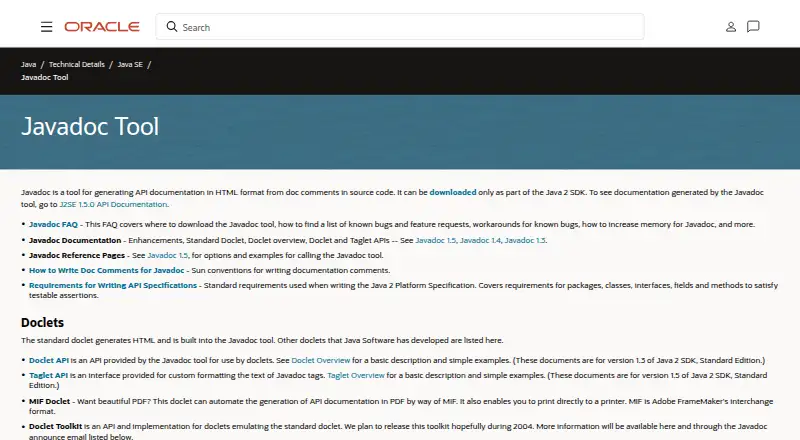
What Javadoc is
Javadoc generates HTML API documentation from Java source files and comes with the Java Development Kit (JDK). Its standard doclet creates pages describing public and protected Java types and members, including classes, interfaces, constructors, methods, and fields. It can process packages, individual source files, or both, and can include subpackages recursively. Developers can use alternate doclets to define the content and format of generated output, while taglets support custom tags in documentation comments. The standard doclet includes DocLint to help identify common comment problems, but DocLint does not verify conformance or correct errors. Oracle advises considering risks from output that is non-conformant or includes executable content such as JavaScript. Oracle lists JDK 25 downloads for Linux, macOS, and Windows. JDK 25 binaries are free under Oracle No-Fee Terms and Conditions through September 2028; later updates use the Java SE OTN License, which may require a fee for production use beyond limited free grants. Customers with active support contracts can direct technical questions and service requests to My Oracle Support.
Who it suits
Javadoc suits Java developers who need to generate API documentation from source files. It also offers alternate doclets and taglets for teams that need different output formats or custom documentation tags.
What it does well
- Included with the Java Development Kit
- Documents packages or individual source files
- Alternate doclets can define generated output
- Taglets support custom documentation tags
What to know first
- DocLint does not verify conformance or correct errors
- Executable content in output can pose risks
- Later JDK updates may require production-use fees
Limits
JDK 25 binaries are free under Oracle No-Fee Terms and Conditions through September 2028. Later updates fall under the Java SE OTN License, which may charge for production use beyond its limited free grants.
Plans
| Plan | Billed and limits | Price |
|---|---|---|
| Javadoc (included with JDK 25) | Included with the JDK · JDK 25 binaries are free under Oracle No-Fee Terms and Conditions through September 2028 | Free |
As oracle.com lists them, read 4 Oct 2026. The maker's own page has the final word.
Getting started
- Open the Javadoc website.
- Get the JDK for Linux, macOS, or Windows.
- Use the Javadoc tool installed with the JDK.
- Choose source files or packages to document and generate HTML output.
Overview
Javadoc is a Java API documentation generator for developers maintaining Java libraries or applications. It suits teams that want reference pages derived from source code and can adapt the output to their own conventions. Its chief strength is that it ships with the JDK; teams seeking an interactive, hosted API portal should look elsewhere.
Key features
The standard doclet creates HTML reference pages for public and protected Java types and members, including classes, interfaces, constructors, methods, and fields. It can process whole packages, individual source files, or both, and can include subpackages recursively. That flexibility makes it useful for generating either focused or broader reference material from a Java codebase.
For projects that need a different presentation, alternate doclets can define the generated content and format. Taglets support custom tags in documentation comments, while code samples are supported. Javadoc does not import OpenAPI specifications or offer an interactive API reference, so it is a reader-oriented documentation generator rather than a tool for exploring or trying API calls in a browser.
DocLint can flag common issues in documentation comments, but it does not establish full conformance or correct errors. Teams must still review and fix the source comments. Oracle also warns of risks from non-conformant output or output containing executable content such as JavaScript, making output review an important part of publishing documentation.
Pricing
Javadoc is installed with the Java Development Kit. The Javadoc (included with JDK 25) plan costs nothing, with JDK 25 binaries free under Oracle No-Fee Terms and Conditions through September 2028. That is a practical fit for teams already using the JDK who need the generator without a separate tool purchase.
The free terms have a boundary: subsequent JDK updates use the Java SE OTN License, which may require a fee for production use beyond its limited free grants. Teams planning to rely on later updates for production should account for that licensing change. Oracle also offers a 30-day trial, though no separate trial plan terms are given. Customers with active support contracts can direct technical questions and service requests to My Oracle Support.
Platforms
Oracle lists JDK 25 downloads for Linux, macOS, and Windows. Javadoc is installed with the JDK, so those are the stated operating-system options for obtaining it. The tool's self-hosted deployment model suits teams generating and managing documentation within their own development environment rather than relying on vendor-hosted output.
Who it's for
Javadoc is best for Java teams that want conventional API reference pages generated from source, especially when they need to cover packages and subpackages or tailor output with doclets and taglets. It is less appropriate when the priority is interactive API exploration, OpenAPI import, or automated correction of documentation defects.
Pros and cons
- Pro: Included with the JDK, so Java teams can generate API pages without acquiring a separate generator.
- Pro: Supports package-level and source-file inputs, recursive subpackages, alternate doclets, and custom tags, providing useful scope and presentation options.
- Con: DocLint only detects common comment problems; it does not validate full conformance or repair mistakes.
- Con: No OpenAPI import or interactive API reference, limiting its fit for teams building browser-based, exploratory API portals.
- Con: Oracle warns that non-conformant or executable output can pose risks, and later JDK updates may carry production licensing costs.
Alternatives
For a catalog of documentation options, browse API Documentation Tools; readers comparing adjacent software categories can also browse Profiling Software.
Choose VisualVM instead when you need a standalone Java troubleshooting tool rather than source-based API documentation; its free plan covers Windows, Linux, macOS, and Java 8–26. Grafana Cloud Application Observability is a different choice for application observability, with a free tier covering 2,232 host hours and a Pro plan priced at $0.03 a month, billed at $0.025 per host hour plus a $19 monthly platform fee.
Scalene is a free open-source Python profiler installed via pip or conda, while py-spy is a free MIT-licensed sampling profiler for Python programs. For another free profiling option, Parca has components available under the Apache 2 License. Pyroscope offers a free tier with 50 GB ingested per month and 14-day retention, plus a Pro plan at $19 a month. AMD Auto-Detect and Install Tool is a free Windows utility for supported AMD graphics or Ryzen systems. async-profiler is a free community open-source option for Linux and macOS.
Verdict
Choose Javadoc if your Java team wants source-derived API reference pages and the flexibility to customize generated output, with the generator included in the JDK. Look elsewhere if you need an interactive API portal, automatic comment repair, or certainty that future production JDK updates will remain free.
Verdict
Javadoc provides standard HTML documentation generation alongside options for custom output. Review output safety and the terms that apply to later JDK updates.
Questions
Is Javadoc free?
Javadoc is included with the JDK. JDK 25 binaries are free under Oracle No-Fee Terms and Conditions through September 2028; later updates use a license that may require a production-use fee beyond limited free grants.
Which operating systems are supported?
Oracle lists JDK 25 downloads for Linux, macOS, and Windows. Supported operating systems also include Linux, UNIX, and Windows.
Can it create an interactive API reference?
No. Javadoc is listed as not providing an interactive API reference.
Can it import OpenAPI?
No. OpenAPI import is not supported.
Can I customize the generated documentation?
Yes. Alternate doclets can define the content and format of output, and taglets support custom tags in documentation comments.
Where can customers get technical support?
Customers with active support contracts can use My Oracle Support for technical questions and service requests.
Facts from Javadoc's own pages
- Custom output
- Javadoc supports alternate doclets that define the content and format of generated output. · docs.oracle.com, 4 Oct 2026
- Custom tags
- Custom tags in documentation comments are supported through taglets. · docs.oracle.com, 4 Oct 2026
- Founded
- 1977 · oracle.com, 28 Sept 2026
- Headquarters
- Austin, Texas, USA · oracle.com, 28 Sept 2026
- Inputs
- Javadoc can document whole packages, individual Java source files, or both, and can recursively include subpackages. · docs.oracle.com, 4 Oct 2026
- JDK inclusion
- The Javadoc tool is installed with the Java Development Kit (JDK). · docs.oracle.com, 4 Oct 2026
- License limit
- Oracle says JDK 25 updates are free under NFTC through September 2028; subsequent updates use the Java SE OTN License, which may require a fee for production use beyond its limited free grants. · oracle.com, 4 Oct 2026
- Maker founding
- Oracle says it was founded in 1977. · investor.oracle.com, 4 Oct 2026
- Operating systems
- Oracle lists JDK 25 downloads for Linux, macOS, and Windows. · oracle.com, 4 Oct 2026
- Output safety
- Oracle advises users to be aware of problems that may arise from non-conformant output or output containing executable content such as JavaScript. · docs.oracle.com, 4 Oct 2026
- Purpose
- Javadoc generates HTML API documentation pages from Java source files. · docs.oracle.com, 4 Oct 2026
- Standard output
- The standard doclet generates HTML pages describing public and protected types and members, including classes, interfaces, constructors, methods, and fields. · docs.oracle.com, 4 Oct 2026
- Support
- Oracle directs customers with active support contracts to My Oracle Support for technical questions and service requests. · oracle.com, 4 Oct 2026
- Validation
- The standard doclet provides DocLint to help detect common problems in documentation comments, but does not validate their conformance or correct errors. · docs.oracle.com, 4 Oct 2026
Where Javadoc stands on Freedom251
- API Documentation Tools#3 of 27
- Profiling Software#6 of 29