Freedom251 › Knowledge base software
Fern
What Fern is
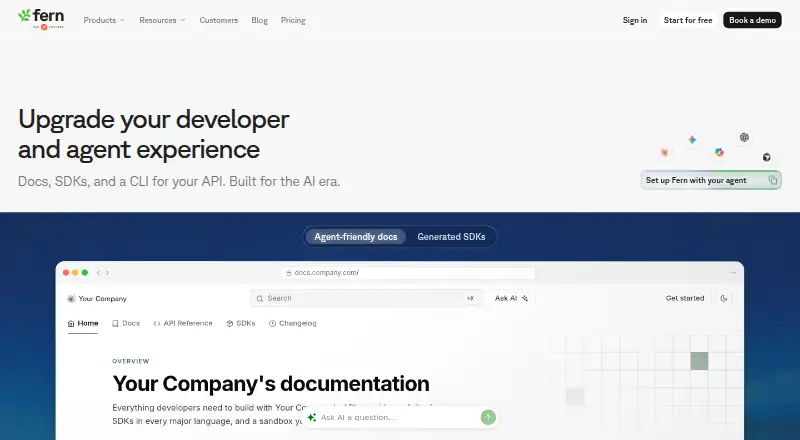
Fern Docs builds interactive documentation websites from Markdown and API specifications, and Fern also generates strongly typed client libraries. It can create API references from OpenAPI, AsyncAPI, gRPC, and other specifications. Documentation tools include an API Explorer, web editor, changelog pages, version and product switching, and localization. Generated SDKs include IDE support, schema validation, and idiomatic method names. Fern offers AI search, a writing agent, AI translations, and an MCP server. The Free plan includes one site, 10 team members, 1,000 pages, 250 AI credits monthly, and 2,000 page generations monthly. Documentation access can be managed with password protection, SSO, JWT, or OAuth, alongside role-based access control. Fern supports custom domains, version history, and content analytics; listed integrations include PostHog, Google Analytics, Segment, Mixpanel, FullStory, Intercom, Postman, and Context7. Its trust center lists SOC 2 Type II, GDPR, and CCPA. Self-hosting on dedicated infrastructure is an Enterprise capability, which also includes dedicated support and an uptime SLA.
Who it suits
Fern suits teams publishing API documentation and generating client libraries from API specifications. Its Free plan may suit smaller documentation projects, while organizations needing dedicated infrastructure, support, or an uptime SLA can consider Enterprise.
What it does well
- Generates API references from several specification formats.
- Includes interactive API Explorer.
- Free plan includes one site.
- Supports SSO, JWT, and OAuth access controls.
- Supports custom domains and version history.
What to know first
- Free plan is limited to one site.
- Free plan has 10 team members.
- Free plan includes 250 AI credits monthly.
- Self-hosting is an Enterprise capability.
Limits
The Free plan includes one site, 10 team members, 1,000 pages, 250 AI credits per month, and 2,000 page generations per month. Self-hosting on dedicated infrastructure is an Enterprise capability.
Plans
| Plan | Billed and limits | Price |
|---|---|---|
| Free | Free forever; $0/mo · 10 team members · 1,000 pages · 250 AI credits/month · 2,000 page generations/month · 1 site · custom domain/subpath · API Explorer · web editor · Ask Fern · Fern Agent · MCP server · version/product switching | Free |
| Enterprise | Tailored pricing terms · Everything in Free · SSO/SCIM/advanced RBAC · multiple repositories and docs instances · custom CSS/JavaScript/React · custom layouts · advanced analytics/data exports · dedicated infrastructure · self-hosting · uptime SLA · dedicated support | On request |
As buildwithfern.com lists them, read 14 Oct 2026. The maker's own page has the final word.
Getting started
- Visit the Fern website.
- Choose the Free plan or contact Fern about Enterprise.
- Use Markdown or API specifications to build documentation.
- Generate client libraries with Fern.
- Publish documentation using a custom domain if needed.
Fern is for teams building API documentation and client libraries in one workflow. It is a stronger fit for developer-facing products than for general-purpose internal knowledge bases. Its free tier makes it possible to start without a subscription, while the one-site cap may matter as a team grows.
Overview
Fern turns Markdown and API specifications into interactive documentation websites, and can generate strongly typed client libraries alongside them. That pairing is its central advantage: teams maintaining API references and SDKs can work from the same documentation platform. It is less compelling if the need is limited to recording everyday procedures or maintaining a broad, non-API knowledge base.
Key features
Fern generates API references from OpenAPI, AsyncAPI, gRPC, and other specifications. Documentation tools include an API Explorer, a web editor, changelog pages, version and product switching, and localization. Together, these give API teams options for presenting reference material across products and audiences, rather than relying on a static specification page.
Generated client libraries include IDE support, schema validation, and idiomatic method names, making Fern relevant to teams that want to support developers beyond the reference site itself. Its AI features include search, a writing agent, translations, and an MCP server. The Free plan's 250 AI credits per month set a finite allowance, so it is better suited to selective use than a credit-intensive workflow.
Integrations include PostHog, Google Analytics, Segment, Mixpanel, FullStory, Intercom, Postman, and Context7. Access controls include password protection, SSO, JWT, OAuth, and role-based access control. Fern's trust center identifies SOC 2 Type II, GDPR, and CCPA, and provides access requests for its SOC 2 report, penetration test summary, and information security policy.
Pricing
Fern's Free plan costs nothing, billed Free forever. It includes 10 team members, 1,000 pages, 250 AI credits per month, 2,000 page generations per month, and one site. That is a substantial starting allowance for a small team publishing a single documentation site, but page and generation caps and the one-site limit can constrain broader rollouts.
Enterprise has custom pricing. It adds SSO, SCIM, and advanced RBAC; support for multiple repositories and documentation instances; advanced analytics and data exports; dedicated infrastructure with self-hosting available; and an uptime SLA with dedicated support. This tier is the relevant option for organizations that need those controls or deployment flexibility, but its custom pricing makes costs less predictable than the Free plan.
Platforms
Fern supports API, web, Linux, macOS, Windows, and self-hosted environments. Its CLI generator compiles signed binaries for macOS, Linux, and Windows. Self-hosting is an Enterprise capability, so teams that require deployment on dedicated infrastructure need to budget for the higher tier.
Who it's for
Fern suits API teams that want interactive reference documentation and typed SDK generation under one roof, particularly when they need versioning, localization, analytics, or controlled access. A small team can begin on the Free plan, provided one site and its monthly allowances are enough. Teams that need self-hosting, multiple documentation instances, advanced data exports, or dedicated support should consider Enterprise. For teams focused mainly on general knowledge sharing, a less API-centered tool may be a better match.
Pros and cons
- Pros: Documentation and client library generation are combined, with support for OpenAPI, AsyncAPI, gRPC, and other specifications.
- Pros: The Free plan includes 10 team members and generous page and generation caps for starting a single site.
- Pros: Access controls span password protection, SSO, JWT, OAuth, and role-based access control.
- Cons: The Free plan is limited to one site, 1,000 pages, 2,000 page generations per month, and 250 AI credits per month.
- Cons: Self-hosting and several enterprise controls require a custom-priced Enterprise plan.
Alternatives
Mintlify is another documentation platform with a free Starter plan that includes five editor seats, a custom domain, web editor, authentication, MCP server, and API playground; it may suit teams whose seat needs fit that cap. Scribe offers a free Basic plan for capturing and sharing procedures across web apps, making it a possible alternative when the priority is shareable process documentation rather than API references and SDKs.
Tango may fit teams documenting browser workflows: its free plan includes five shared workflows, browser capture, sharing, and up to 10 users per workspace. AutomaDocs is an alternative for repository-centered documentation, with a free plan covering one repository, 50 AI chat messages per month, core doc generation, GitHub integration, and auto-sync on push.
Documentation.AI offers a free Starter plan with five editor seats, one documentation project, and 10,000 one-time AI credits, which may appeal to teams prioritizing that initial AI allowance. GitBook has a free plan for individuals with one free user, unlimited page views, and 10 GitBook Agent messages per week.
InkLoom offers unlimited pages on its free plan but allows one free user per project. CodeDocs AI offers a free plan for one repository and 10 pages per month, which may suit a smaller documentation project with modest page volume. For broader comparisons, see AI Documentation Generators, Technical Documentation Software, API Documentation Tools, Developer Documentation Software, Code Generators, and Knowledge base software.
Verdict
Choose Fern if your team needs interactive API documentation and strongly typed client libraries together, with a free plan that supports a single site and a small team. Look elsewhere if you need self-hosting without Enterprise, multiple sites on the free tier, or a tool centered on general-purpose knowledge sharing.
Verdict
Fern combines API documentation publishing with client library generation and offers a defined Free plan. Teams considering it should check the free-tier limits and note that self-hosting is reserved for Enterprise.
Questions
Is Fern free?
Yes. Its Free plan costs nothing, billed Free forever.
What does the Free plan include?
It includes one site, 10 team members, 1,000 pages, 250 AI credits per month, and 2,000 page generations per month.
Which API specifications does Fern support?
Fern Docs generates API references from OpenAPI, AsyncAPI, gRPC, and other specifications.
Can Fern documentation be self-hosted?
Self-hosting on dedicated infrastructure is listed as an Enterprise capability.
What access controls does Fern offer?
Documentation access can use password protection, SSO, JWT, or OAuth, with role-based access control.
Who makes Fern?
Fern identifies itself as Birch Solutions, Inc., a Postman company.
Facts from Fern's own pages
- Access control
- Fern supports documentation access through password protection, SSO, JWT, or OAuth, with role-based access control. · buildwithfern.com, 5 Oct 2026
- Accessibility
- Fern documents WCAG 2.1 AA contrast, keyboard navigation, and screen-reader support for documentation sites. · buildwithfern.com, 14 Oct 2026
- Acquisition continuity
- Fern said it would continue operating as an independent product after joining Postman, with its product, brand, and roadmap unchanged. · buildwithfern.com, 14 Oct 2026
- Acquisition news
- Postman announced its acquisition of Fern on January 8, 2026; Postman said Fern had a 25-person team and more than 200 customers at that time. · blog.postman.com, 14 Oct 2026
- AI features
- Ask Fern answers documentation questions with citations, while Fern Agent can propose documentation changes as pull requests. · buildwithfern.com, 14 Oct 2026
- AI tools
- Fern offers AI search, a writing agent, AI translations, an MCP server, and 250 AI credits on the Free plan. · buildwithfern.com, 5 Oct 2026
- API Explorer
- Published documentation can include an API Explorer that sends real requests with prefilled authentication. · buildwithfern.com, 14 Oct 2026
- API references
- Fern generates interactive API references from OpenAPI, AsyncAPI, gRPC, GraphQL, OpenRPC, and related specifications. · buildwithfern.com, 14 Oct 2026
- Publishing audience
- both · buildwithfern.com, 20 Sept 2026
- CLI platforms
- Fern says its CLI generator compiles signed binaries for macOS, Linux, and Windows. · buildwithfern.com, 5 Oct 2026
- CLI requirements
- The current CLI installation documentation requires Node.js 22 or newer and supports npm or Homebrew installation. · buildwithfern.com, 14 Oct 2026
- Company
- Fern identifies itself as Birch Solutions, Inc., a Postman company, and says it was born in Brooklyn, New York. · buildwithfern.com, 5 Oct 2026
- Company facts
- LinkedIn lists Fern as founded in 2022, headquartered in Brooklyn, New York, privately held, and employing 11–50 people. · linkedin.com, 14 Oct 2026
- Company identity
- Fern's legal entity is Birch Solutions, Inc., and its current parent is Postman. · marketing.postman-stage.com, 14 Oct 2026
- Compliance
- Fern's trust center lists SOC 2 Type II, GDPR, and CCPA, with a SOC 2 report and penetration-test summary available by request. · buildwithfern.com, 14 Oct 2026
- Content analytics
- Yes · buildwithfern.com, 20 Sept 2026
- Current CLI release
- The CLI changelog lists version 5.157.2 on October 14, 2026, including a fix for OpenAPI tag section naming. · buildwithfern.com, 14 Oct 2026
- Custom domain
- Yes · buildwithfern.com, 20 Sept 2026
- Custom integrations
- Enterprise customers can add unsupported analytics, support, session-recording, and tag-management tools through custom JavaScript. · buildwithfern.com, 14 Oct 2026
- Documentation
- Fern Docs builds interactive documentation websites from Markdown and API specifications. · buildwithfern.com, 5 Oct 2026
- Documentation authoring
- Docs can be edited through GitHub pull requests, an in-browser Fern Editor, an IDE, Slack, or Fern Agent. · site.buildwithfern.com, 14 Oct 2026
- Documentation features
- Docs features include an API Explorer, web editor, changelog pages, version and product switching, and localization. · buildwithfern.com, 5 Oct 2026
- Free plan
- Yes · buildwithfern.com, 20 Sept 2026
- Free plan limits
- The Free plan includes 10 team members, 1,000 pages, 250 AI credits per month, and 2,000 page generations per month. · buildwithfern.com, 5 Oct 2026
Where Fern stands on Freedom251
- Knowledge base software#1 of 138
- Code Generators#1 of 33
- AI Documentation Generators#1 of 28
- Technical Writing Platforms#1 of 27
- API Documentation Tools#1 of 27
- Developer Documentation Software#1 of 27
- API Generation Software#1 of 25
- Technical Documentation Software#2 of 37
- Api 1#2 of 25
- Api Docs#2 of 19