Freedom251 › AI Documentation Generators
AutomaDocs
What AutomaDocs is
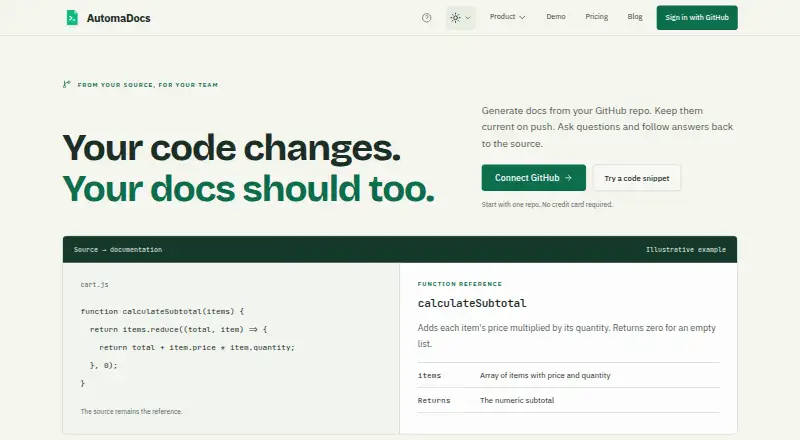
AutomaDocs creates and updates documentation for GitHub repositories as code changes are pushed. It can produce README files, API references, function notes, architecture overviews, and getting-started guides. Its AI chat answers plain-language questions about a codebase and cites relevant files and functions. JavaScript, TypeScript, and Python receive deep Tree-sitter parsing; Claude AI can analyze other languages directly. GitHub OAuth and webhooks connect repositories, and documentation can be used with Claude Code and Cursor through MCP. Users can edit generated pages, which the service says it preserves and merges with AI updates. Health scores measure the percentage of functions with documentation: 80% or more is green, while below 40% is red. The Free plan covers one repository and 50 AI chat messages per month. Pro costs $39 a month, billed Billed $470/year. Managed cloud is the default, with Docker Compose and setup scripts available for self-hosting. The listed outputs include hosted pages, Markdown export, and a REST API.
Who it suits
AutomaDocs describes itself for engineering managers and tech leads at small and mid-size product teams that ship in GitHub. It may suit teams seeking generated documentation alongside codebase questions and repository sync.
What it does well
- Updates documentation when code is pushed.
- Creates several documentation types, including API references.
- AI chat cites relevant files and functions.
- Self-hosting is supported through Docker Compose and scripts.
- Account deletion removes associated data immediately.
What to know first
- Free plan is limited to one repository.
- Free plan includes 50 AI chat messages monthly.
- Pro costs $39 a month, billed Billed $470/year.
- No 24/7 phone line, SLA, or account manager.
Limits
The free plan covers one repository and 50 AI chat messages per month. Pro is $39 a month, billed annually at $470 per year, and covers 20 repositories; the Team plan includes 10 seats and unlimited repositories.
Plans
| Plan | Billed and limits | Price |
|---|---|---|
| Free | 1 repository · 50 AI chat messages/month · core documentation generation · GitHub integration · auto-sync on push · self-serve help | Free |
| Team | Billed $1430/year · Unlimited repositories · 10 seats · custom documentation domains · SSO (SAML, OIDC) · API access · audit logs · unlimited AI chat | $119 a month |
| Pro | Billed $470/year · 20 repositories · unlimited AI chat · auto-sync · full API + MCP access · async account and billing email | $39 a month |
| Custom | Annual invoicing available · Volume or unusual procurement · same platform and features as Team · no custom SLAs · no dedicated representatives | On request |
As automadocs.com lists them, read 15 Oct 2026. The maker's own page has the final word.
Getting started
- Visit the AutomaDocs website.
- Choose managed cloud or use Docker Compose and setup scripts to self-host.
- Connect a GitHub repository through OAuth and webhooks.
- Choose the Free plan or a paid plan for the repository and chat capacity you need.
- Generate documentation and, if useful, connect Claude Code or Cursor through MCP.
AutomaDocs is a GitHub-connected documentation service that generates and updates technical pages as repositories change, then answers questions about the code behind them. It is aimed at engineering managers and tech leads in small and mid-size product teams that work in GitHub. The best reason to choose it is the combination of editable generated documentation and file-level code answers; the main cautions are its narrow free tier, annual paid billing, and managed-cloud default.
Overview
AutomaDocs links to GitHub with OAuth and webhooks, creates hosted documentation, and refreshes it after pushes. The output covers README files, API references, function notes, architecture overviews, and getting-started guides. Markdown export and a REST API make the resulting material usable outside the hosted site.
Its AI chat accepts plain-language questions about a codebase and cites the relevant files and functions. That makes it useful for onboarding, investigating unfamiliar code, and turning repository knowledge into documentation. JavaScript, TypeScript, and Python receive deep Tree-sitter parsing; Claude AI can analyze other languages directly.
Key features
Generated pages are editable, and AutomaDocs says it preserves and merges those edits when AI updates arrive. Teams can therefore correct terminology or add project-specific guidance without losing that work on the next code refresh. Documentation health scores report the percentage of functions with documentation: scores of 80% or higher are green, while scores below 40% are red. Those thresholds give managers a quick way to spot documentation gaps, although the score measures coverage rather than editorial quality.
Claude Code and Cursor can use the documentation through MCP, which suits developers who want repository context inside their existing coding tools. REST access and Markdown export also help teams incorporate pages into other workflows.
Security measures include TLS, application-level ownership checks, webhook signature validation, and rate limiting. Repository content is processed by Anthropic Claude and may be processed by OpenAI if Claude is temporarily unavailable; subprocessors do not use it to train AI models. Documentation and embeddings are removed within 24 hours after repository deletion, while account deletion removes associated data immediately. Self-hosting is supported with Docker Compose and setup scripts, but managed cloud is the default, and there is no claim of a specific third-party certification.
Pricing
Free — free: One repository, 50 AI chat messages per month, core documentation generation, GitHub integration, and automatic sync on push. It is a sensible way to assess the workflow or maintain a small personal repository, but the single-repository cap and chat quota rule out broader team use.
Pro — $39 a month, billed Billed $470/year: Up to 20 repositories, unlimited AI chat, automatic sync, and full API plus MCP access. This is the practical tier for an individual lead or a small engineering group managing several repositories. The annual commitment and lack of team seats make it less suitable when purchasing needs to follow monthly usage or when access must be shared across a larger group.
Team — $119 a month, billed Billed $1430/year: Unlimited repositories, 10 team seats, custom documentation domains, SSO with SAML or OIDC, API access with audit logs, and unlimited AI chat. It fits organizations that need centralized identity, governance, and many repositories. Teams needing more than 10 seats or unusual procurement move to Custom.
Custom — custom pricing: Annual invoicing is available for volume or unusual procurement. It has the same platform and features as Team, but no custom SLAs, so it does not add a contractual service-level guarantee.
Platforms
AutomaDocs is offered as a web service, API, and self-hosted deployment. Docker Compose and setup scripts support teams that need to run it themselves; hosted cloud remains the normal route. Its source connection is GitHub, and its outputs are hosted pages, Markdown, and REST API responses.
Who it's for
This is a strong fit for engineering managers and tech leads at small or mid-size product teams shipping through GitHub, especially where documentation changes frequently and developers need cited answers while working. It is less compelling for teams that require a broad free allowance, guaranteed support coverage, a third-party security certification, or a custom SLA.
Pros and cons
- Pros: Documentation refreshes from GitHub pushes, reducing manual upkeep.
- Pros: File- and function-cited chat is useful for code discovery and onboarding.
- Pros: Editable pages are merged with later AI updates, protecting human corrections.
- Pros: MCP, Markdown export, and a REST API extend use beyond the hosted pages.
- Cons: Free is limited to one repository and 50 chat messages monthly.
- Cons: Pro and Team prices are presented with annual billing, which limits flexibility for short-term use.
- Cons: Support is self-serve email, typically answered within a few business days, with no 24/7 phone line, SLA, or account manager.
- Cons: Managed cloud is the default, and the security position includes no specific third-party certification.
Alternatives
For a broader directory of this category, see AI Documentation Generators.
Choose Guidde instead when you need browser-based how-to video capture, voiceovers, and shareable links rather than repository documentation. DeepDoc is the better choice for a free, MIT-licensed, no-account, no-cloud workflow where you supply the LLM and pay its model costs. Pick Fern for a documentation platform with team members, page limits, AI credits, and page-generation quotas. Mintlify suits teams wanting a free starter with editor seats, custom domain, authentication, MCP server, and API playground. Scribe is oriented toward documenting actions in web apps, while Tango focuses on browser-captured workflows and sharing. Docframe is a lower-cost hosted publishing option with manual editing and paid AI credits. Documentation.AI fits teams seeking a free project with editor seats and one-time AI credits.
Verdict
Choose AutomaDocs if your team’s source of truth is GitHub and you want documentation that follows code changes while developers can ask cited questions about the repository. Look elsewhere if one repository and 50 monthly chats are too restrictive, or if your procurement requires 24/7 support, a custom SLA, or certified security assurances.
Verdict
AutomaDocs combines GitHub-synced documentation generation with codebase questions and editable pages. Check its repository and chat limits, data handling, and support arrangements against your team's needs.
Questions
Is there a free plan?
Yes. The Free plan costs nothing and includes one repository and 50 AI chat messages per month.
How much does Pro cost?
Pro is $39 a month, billed annually at $470 per year.
Which platforms does AutomaDocs support?
Its listed platforms are API, self-hosted and web. Managed cloud is the default, and Docker Compose and setup scripts support self-hosting.
Which source languages can it parse?
JavaScript, TypeScript and Python receive deep Tree-sitter parsing. Claude AI can analyze other languages directly.
Does it integrate with coding assistants?
Documentation can be used with Claude Code and Cursor through MCP. AutomaDocs also connects to GitHub through OAuth and webhooks.
How does it handle repository content?
The privacy policy says Anthropic Claude processes repository content, with OpenAI potentially used if Claude is temporarily unavailable. It says subprocessors do not use the content to train AI models.
Facts from AutomaDocs's own pages
- AI chat
- The chat answers plain-language repository questions using hybrid keyword and semantic retrieval and links to files and line numbers. · automadocs.com, 15 Oct 2026
- Authentication security
- Authentication uses GitHub OAuth, optional Google OAuth, JWTs, HTTP-only cookies, and CSRF protection. · automadocs.com, 15 Oct 2026
- Automatic synchronization
- GitHub webhooks trigger regeneration for changed files after pushes, typically completing in under two minutes. · automadocs.com, 15 Oct 2026
- Changelog update
- A March 2026 release fixed webhook auto-sync reliability and added weekly health-score email reports. · automadocs.com, 15 Oct 2026
- Code analysis
- Tree-sitter parsing combined with Claude analyzes code structure, signatures, relationships, and patterns. · automadocs.com, 15 Oct 2026
- Code questions
- Its AI chat answers plain-language questions about a codebase and cites the relevant files and functions. · automadocs.com, 3 Oct 2026
- Company founder
- AutomaDocs identifies Liz Stein as its founder and says she built it after repeatedly answering code questions in Slack. · automadocs.com, 15 Oct 2026
- Company headquarters
- No headquarters location is stated on the reviewed official AutomaDocs pages. · automadocs.com, 15 Oct 2026
- Compliance limitation
- AutomaDocs says it does not claim a specific third-party certification such as SOC 2 unless it publishes an attestation. · automadocs.com, 15 Oct 2026
- Data deletion
- The privacy policy says repository documentation and embeddings are removed within 24 hours after repository deletion, and account deletion removes associated data immediately. · automadocs.com, 3 Oct 2026
- Data handling
- The privacy policy says repository content is processed by Anthropic Claude, may be processed by OpenAI if Claude is temporarily unavailable, and is not used by subprocessors to train AI models. · automadocs.com, 3 Oct 2026
- Data processors
- Repository data is processed by Anthropic Claude, Pinecone, and sometimes OpenAI; the policy says subprocessors do not train models on customer code. · automadocs.com, 15 Oct 2026
- Deletion
- Repository documentation and embeddings are removed within 24 hours after repository deletion, while account deletion removes data immediately. · automadocs.com, 15 Oct 2026
- Developer surfaces
- AutomaDocs advertises a CLI, GitHub Action, MCP server, and integrations with Claude Code, Cursor, Windsurf, and VS Code. · automadocs.com, 15 Oct 2026
- Documentation types
- It can generate READMEs, API references, function notes, architecture overviews, and getting-started guides. · automadocs.com, 15 Oct 2026
- Editing
- Users can edit generated documentation pages. · automadocs.com, 15 Oct 2026
- Export
- Documentation can be exported as Markdown. · automadocs.com, 15 Oct 2026
- Founded year
- No formal company founding year is stated; the changelog records the product's public launch in January 2026. · automadocs.com, 15 Oct 2026
- GitHub integration
- GitHub OAuth and webhooks are supported, with an optional GitHub App for enhanced permissions. · automadocs.com, 15 Oct 2026
- Health scores
- Health scoring tracks documentation coverage, freshness, and completeness and can send weekly reports. · automadocs.com, 15 Oct 2026
- Human review guidance
- The feature documentation recommends treating generated pages as drafts and reviewing examples, edge cases, and naming before publication. · automadocs.com, 15 Oct 2026
- Independent architecture report
- A DEV Community article describes the system as Tree-sitter AST analysis, Claude generation, webhook synchronization, and RAG retrieval using BM25, Pinecone, and reciprocal-rank fusion. · dev.to, 15 Oct 2026
- Independent language limitation
- The DEV article says supporting more than 15 languages initially was overly ambitious and recommends focusing first on JavaScript, TypeScript, and Python. · dev.to, 15 Oct 2026
- Independent launch description
- A Reddit launch post describes AutomaDocs as generating always-current GitHub documentation and answering codebase questions with links back to source. · reddit.com, 15 Oct 2026
Where AutomaDocs stands on Freedom251
- AI Documentation Generators#3 of 28