Freedom251 › AI Documentation Generators

DeepDoc
What DeepDoc is
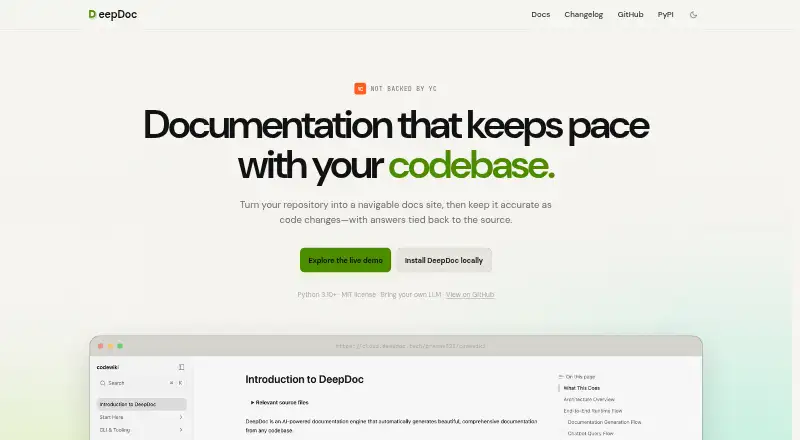
DeepDoc turns a code repository into a navigable documentation site, with an update command that regenerates pages affected by code changes. It scans source files, plans the documentation, generates pages, stages OpenAPI references when present, and builds the site. Documentation can be arranged into topics such as architecture, endpoints, integrations, and schemas. Its AI answers can cite source file paths and line ranges from the repository, helping readers trace answers to code.
Supported inputs include Python, TypeScript, JavaScript, Go, PHP, Vue, and OpenAPI or Swagger specifications. Output formats include Markdown, Mermaid diagrams, a static Next.js/Fumadocs site, and an interactive API reference. DeepDoc can also produce a MkDocs Material site with navigation and search, plus an optional AI chatbot widget. The maker provides it as a Python package installed with pip install deepdoc. It runs in a terminal without an account or cloud requirement, is MIT licensed, and requires Python 3.10 or later. You bring an LLM provider: generate and update call it, while init, serve, deploy, status, config, performance, and clean do not. LLM costs depend on the chosen model and documentation pages. The deploy command produces a static site for any host. DeepDoc is free, with no subscription plans listed.
Who it suits
DeepDoc turns code repositories into navigable documentation sites and regenerates pages affected by code changes. It runs in a terminal and requires users to provide their own LLM provider.
What it does well
- Supports Python, TypeScript, JavaScript, Go, PHP, Vue, and OpenAPI.
- AI answers cite repository file paths and line ranges.
- Update regenerates pages affected by code changes.
- Offers Markdown, Mermaid, static site, and API reference outputs.
- Runs without an account or cloud requirement.
What to know first
- Users must bring an LLM provider.
- Generate and update incur costs from the chosen model and documentation pages.
- Requires Python 3.10 or later.
Limits
DeepDoc has no subscription plan limits listed. Generation and update require an LLM provider, and their costs depend on the chosen model and documentation pages.
Plans
| Plan | Billed and limits | Price |
|---|---|---|
| DeepDoc | MIT licensed · no account · no cloud · generation uses your chosen LLM and its costs depend on the model and documentation pages | Free |
As deepdoc.tech lists them, read 7 Oct 2026. The maker's own page has the final word.
Getting started
- Install the Python package with pip install deepdoc.
- Use Python 3.10 or later.
- Provide an LLM provider for generate and update commands.
- Run DeepDoc in the terminal to scan source files and generate documentation.
- Use deploy to produce a static site for any host.
DeepDoc turns a code repository into a browsable documentation site, best suited to developers who want source-grounded explanations and are comfortable choosing an LLM provider. Its targeted regeneration and local workflow are compelling; the main trade-off is that generating and updating pages incurs model-dependent costs.
Overview
DeepDoc scans source files, plans and generates documentation, stages API references when present, then builds a site. It organizes pages around topics such as architecture, endpoints, integrations, and schemas, giving readers a useful structure for exploring a codebase. The optional AI chatbot can answer questions with citations to file paths and line ranges, so readers can trace explanations back to repository code rather than rely on unsupported assertions.
The documented site output includes navigation and search and can be published as a static site to any host. DeepDoc runs in the terminal without an account or cloud requirement, and its MIT license gives teams a permissive basis for using and adapting the tool. It requires Python 3.10 or later and a separately chosen LLM provider.
Key features
Repository documentation and updates
The pipeline scans source files, plans the documentation, generates pages, stages OpenAPI references when present, and builds the site. An update command regenerates pages affected by code changes. That is a practical advantage over rebuilding every page after a small edit, though updates are not automatic: someone must run the command to keep the docs current.
The homepage names Python, TypeScript, JavaScript, Go, PHP, Vue, and OpenAPI as supported; the broader source-type list also includes GraphQL and OpenAPI/Swagger specifications. API-spec support, interactive API references, Markdown, Mermaid diagrams, and static Next.js/Fumadocs output make DeepDoc relevant to teams documenting both implementation and interfaces. The source lists differ, so teams whose workflow depends on GraphQL should confirm their needs before adopting it.
Local operation and model costs
DeepDoc is a Python package installed with pip install deepdoc. The maker says commands for initialization, serving, deployment, status, configuration, performance, and cleanup do not call an LLM; generation and updates do. That separation lets teams perform routine site tasks without model charges, but total documentation costs depend on the provider, model, and number of pages, so there is no predictable subscription price to budget against.
Pricing
DeepDoc costs nothing. The free offering is MIT licensed and needs no account or cloud service, but it does not include an LLM: users bring their own provider and pay any associated usage costs for generation and updates. There is no free trial or subscription tier to compare; the practical limit is the chosen model's usage cost rather than a stated seat or page allowance.
This suits developers who want a no-cost software package and are willing to manage LLM setup and variable usage. It is less suitable for buyers seeking a fixed monthly bill or a bundled hosted service.
Platforms
DeepDoc is available for Linux, macOS, and Windows, with web and self-hosted listed as platforms. Its terminal-based workflow and static-site output suit teams able to publish the generated site on their own hosting.
Who it's for
DeepDoc is a strong fit for developers maintaining repositories who want documentation organized by technical topic, answers tied to source locations, and page-level updates after code changes. It also suits teams that prefer local operation and control over where the resulting static site is hosted. Teams wanting automatic synchronization, a managed LLM, or predictable bundled usage costs should look elsewhere.
Pros and cons
Pros
- Traceable AI answers: file-path and line-range citations help readers verify explanations against the code.
- Targeted regeneration: the update command focuses on pages affected by changes, avoiding a full regeneration for every edit.
- Flexible publishing: static output can be deployed to any host, without requiring a cloud account for DeepDoc.
- Permissive license: the MIT license and free package make it accessible to teams that want to adapt their documentation tooling.
Cons
- LLM setup is on the user: DeepDoc requires a provider, adding configuration and a separate cost to the workflow.
- Usage cost varies: generation and updates incur model-dependent charges, with no fixed subscription price.
- No automatic updates: keeping pages aligned with code requires running the update command.
Alternatives
AutomaDocs is worth considering for teams that want GitHub integration and automatic sync on push; its free plan is limited to one repository and 50 AI chat messages per month.
Fern is a better fit for teams wanting a quota-based hosted documentation workflow: its free plan includes 10 team members, 1,000 pages, 250 AI credits per month, 2,000 page generations per month, and one site.
Mintlify may suit teams looking for a platform-oriented option with a free Starter plan that includes five editor seats, a custom domain, web editor, authentication, MCP server, and API playground.
Documentation.AI is another option for teams seeking a hosted project with defined editor seats and a one-time AI credit allowance: its free Starter plan includes five seats, one project, and 10,000 credits.
Guidde focuses on creating how-to videos rather than repository documentation.
Scribe is an alternative for producing shareable documentation from web-app workflows.
Tango is an alternative for capturing and sharing browser workflows.
Docframe is an alternative for publishing documentation through a web service.
Browse more options in AI Documentation Generators.
Verdict
Choose DeepDoc if you maintain a code repository and want navigable, source-cited documentation that you can host yourself and update selectively. Its strongest case is the combination of repository-aware output, traceable answers, and local control under an MIT license. Look elsewhere if you need automatic sync, a managed model, or a predictable all-in-one price: DeepDoc leaves provider setup and generation costs to you.
Verdict
DeepDoc is a free, MIT-licensed tool to build navigable documentation from a code repository. It requires users to supply an LLM provider.
Questions
How much does DeepDoc cost?
DeepDoc is free, with no subscription plans listed. The maker says LLM costs depend on the selected model and documentation pages.
Does DeepDoc require an account or cloud service?
No. The maker describes it as a terminal tool that runs without an account or cloud requirement.
Which languages and specifications does it support?
Listed inputs include Python, TypeScript, JavaScript, Go, PHP, Vue, and OpenAPI or Swagger specifications.
What outputs can DeepDoc create?
Listed formats include Markdown, Mermaid diagrams, a static Next.js/Fumadocs site, and an interactive API reference. It can also build a MkDocs Material site.
Do I need to provide an LLM provider?
Yes. Generate and update use the provider you choose; other listed commands do not call an LLM.
What license does DeepDoc use?
The maker identifies DeepDoc as MIT licensed.
Facts from DeepDoc's own pages
- Company details
- The pages opened identify no headquarters or founding year; the homepage says DeepDoc is not backed by Y Combinator. · deepdoc.tech, 7 Oct 2026
- Deployment
- DeepDoc produces a static site that can be deployed to any host. · deepdoc.tech, 7 Oct 2026
- Documentation structure
- It groups documentation into topics such as architecture, endpoints, integrations, and schemas. · deepdoc.tech, 7 Oct 2026
- Generation pipeline
- DeepDoc scans source files, plans documentation, generates pages, stages OpenAPI references when present, and builds a site. · deepdoc.tech, 7 Oct 2026
- Hosted output
- The docs say deepdoc deploy produces a static site for any host. · deepdoc.tech, 7 Oct 2026
- Incremental updates
- The update command regenerates pages affected by code changes. · deepdoc.tech, 7 Oct 2026
- License
- The homepage identifies DeepDoc as MIT licensed. · deepdoc.tech, 7 Oct 2026
- License and runtime
- The homepage identifies DeepDoc as MIT licensed and requiring Python 3.10 or later. · deepdoc.tech, 7 Oct 2026
- LLM requirement
- DeepDoc requires users to bring their own LLM provider. · deepdoc.tech, 7 Oct 2026
- LLM setup
- DeepDoc requires users to bring their own LLM provider. · deepdoc.tech, 7 Oct 2026
- Local operation
- The maker says DeepDoc runs in the terminal with no account or cloud requirement. · deepdoc.tech, 7 Oct 2026
- Plans and pricing
- The maker's cost page describes usage-based LLM costs and provides no dollar estimates; it does not list subscription plans. · deepdoc.tech, 7 Oct 2026
- Pricing model
- The maker says generation and update call an LLM, while commands such as serve and deploy do not; it gives no dollar price because usage depends on the model and planned page count. · deepdoc.tech, 7 Oct 2026
- Product format
- The maker provides a Python package installed with pip install deepdoc. · deepdoc.tech, 7 Oct 2026
- Purpose
- DeepDoc turns a code repository into a navigable documentation site and keeps the docs current as code changes. · deepdoc.tech, 7 Oct 2026
- Site output
- DeepDoc generates a MkDocs Material site with navigation, search, and an optional AI chatbot widget. · deepdoc.tech, 7 Oct 2026
- Source-backed answers
- Its AI answers cite source file paths and line ranges from the codebase. · deepdoc.tech, 7 Oct 2026
- Source citations
- Its AI answers cite source file paths and line ranges from the repository. · deepdoc.tech, 7 Oct 2026
- Supported inputs
- The homepage lists Python, TypeScript, JavaScript, Go, PHP, Vue, and OpenAPI as supported. · deepdoc.tech, 7 Oct 2026
- Supported languages
- The homepage lists Python, TypeScript, JavaScript, Go, PHP, Vue, and OpenAPI as supported. · deepdoc.tech, 7 Oct 2026
- Usage costs
- The maker says init, serve, deploy, status, config, performance, and clean do not call an LLM; generate and update do, so costs depend on the chosen model and documentation pages. · deepdoc.tech, 7 Oct 2026
Where DeepDoc stands on Freedom251
- AI Documentation Generators#2 of 28