Freedom251 › API Documentation Tools

Apiary
What Apiary is
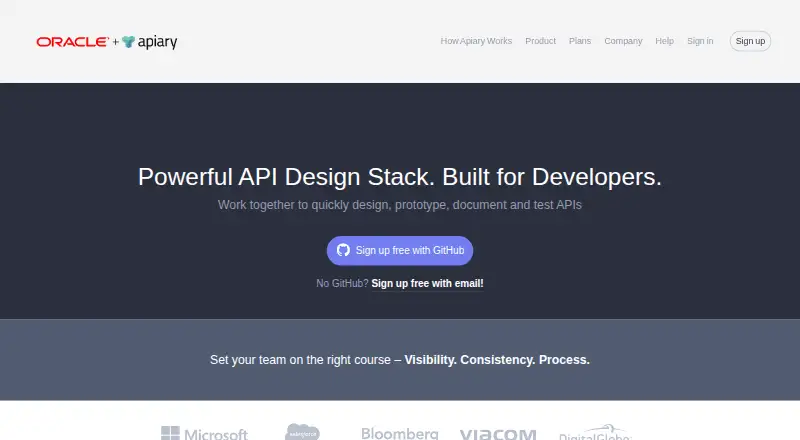
Apiary is a hosted web platform for designing, prototyping, documenting, and testing APIs. It supports API Blueprint and OpenAPI descriptions; its editor validates descriptions and displays a live preview. Publishing a description creates a mock server that returns the responses specified in that description. Automated tests compare actual API responses with expectations derived from the description. Teams can assign Admin, Editor, and Viewer roles to manage access to API documents. Apiary offers GitHub sync, with branch-based integration listed for Pro, and interactive documentation can be embedded in websites or internal portals on Standard and Pro. The free plan costs nothing and includes unlimited API projects, five participants per project, no team, and public projects. Standard and Pro are marked deprecated, and plan changes for current customers are handled by support request. Private API projects have a 50-viewer cap on Standard, which can be raised on custom Pro plans. The mock server allows 120 requests per minute by default, or 5,000 requests per minute with authentication. Pro includes priority support with guaranteed 24x7 response times from a dedicated team.
Who it suits
Apiary suits people designing and documenting APIs with API Blueprint or OpenAPI, and teams that want mock responses and automated checks tied to API descriptions. The free plan is limited to public projects without a team.
What it does well
- Editor validates descriptions and shows a live preview.
- Publishing creates a description-based mock server.
- Automated tests compare responses with expected results.
- Free plan allows unlimited API projects.
- Teams can assign document access roles.
What to know first
- Free projects are public and have no team.
- Free plan allows five participants per project.
- Standard and Pro plans are deprecated.
- Standard private projects cap viewers at 50.
Limits
The Free plan allows unlimited API projects, but each project has five participants, projects are public, and there is no team. The mock server allows 120 requests per minute by default, or 5,000 with authentication. Standard and Pro are deprecated; private-project viewer limits on Standard are 50, and custom Pro plans can raise that limit.
Plans
| Plan | Billed and limits | Price |
|---|---|---|
| Free | Unlimited API projects · 5 participants per project · no team · public projects | Free |
| Pro | Deprecated · custom collaborators · advanced GitHub integration · priority support | On request |
| Standard | Deprecated · 10 participants per project · private projects · team management | On request |
As apiary.io lists them, read 2 Oct 2026. The maker's own page has the final word.
Getting started
- Visit https://apiary.io/.
- Use the hosted web platform.
- Start with the Free plan at no cost.
- Create an API description in API Blueprint or OpenAPI.
- Publish the description to create a mock server.
Apiary is a hosted workspace for turning API descriptions into documentation, mock responses, and implementation checks. It suits developers and teams standardizing on API Blueprint or OpenAPI, especially when public projects are acceptable. Its connected design-to-testing workflow is useful, but private collaboration is tied to deprecated paid plans.
Overview
Apiary brings specification, reference material, prototyping, and verification into one web-based service. The editor validates descriptions as you write and shows a live preview, so the contract and the documentation stay closely aligned. Publishing a description automatically creates a mock server that returns the responses defined in that description. Automated tests then compare an API's actual responses with expectations generated from the same source.
The platform supports API Blueprint and OpenAPI (Swagger), including OpenAPI import. Interactive API references, code samples, and API versioning make the resulting contract more useful to developers consuming or maintaining an API. It is hosted rather than a desktop product, with API and web listed as its platforms.
Access is the important qualification. Free projects are public, there is no team, and each project allows five participants. That makes the free tier practical for public examples, prototypes, and individually maintained APIs, but a poor fit for a private product team unless it already has an established paid account.
Key features
Design and documentation
Instant validation and live preview support a design-first process: authors can catch description problems while editing and see how the reference will read. Interactive references and code samples turn the specification into something consumers can use, while versioning helps keep separate API contracts organized. Embedding interactive documentation in a website or internal portal is available on Standard and Pro, not Free.
Mocks and response checks
The generated mock server is valuable before a production endpoint is ready, because clients can work against responses declared in the contract. Its default allowance is 120 requests per minute, rising to 5,000 requests per minute with authentication. Automated comparison of live responses against description-derived expectations gives teams a direct way to detect drift between implementation and contract.
GitHub and team controls
GitHub synchronization connects API work with a repository workflow. Branch-based GitHub integration is identified as a Pro capability, so teams needing that arrangement should not assume the Free or Standard tiers provide it. Team administration can assign Admin, Editor, and Viewer roles and control document access, but team management is not part of Free.
Pricing
| Plan | Price | What it includes |
|---|---|---|
| Free | free | Unlimited API projects, five participants per project, public projects, and no team |
| Standard | Custom pricing | Deprecated; 10 participants per project, private projects, and team management |
| Pro | Custom pricing | Deprecated; custom collaborators, advanced GitHub integration, and priority support |
Free is the clear choice for public work and small groups that can live within five participants. Standard adds the privacy and administration a private team needs, but its deprecated status means current customers must request plan changes through support. Pro is aimed at organizations needing custom collaborator arrangements, advanced GitHub workflows, or priority support; its dedicated support team offers guaranteed 24x7 response times. Private projects on Standard cap viewers at 50, while custom Pro plans can raise that limit. Neither paid tier has a published price, so new buyers should confirm commercial terms and account eligibility before committing.
Platforms
Apiary is hosted and available through the web, with API listed as a platform. It is therefore suited to browser-based documentation and API workflows rather than a native desktop installation.
Who it's for
Choose Apiary when a team wants one contract to drive previews, interactive documentation, mocks, and automated response checks, and when API Blueprint or OpenAPI is already part of its process. It is particularly sensible for public APIs, educational prototypes, and organizations that already hold a supported Standard or Pro account.
Look elsewhere if private projects, predictable self-service pricing, or a new team workspace are non-negotiable. The public-only Free tier and deprecated paid plans add friction for a private team starting from scratch.
Pros and cons
- Pro: One description can produce a preview, interactive reference, mock server, and automated implementation checks, reducing the gap between design and delivery.
- Pro: API Blueprint and OpenAPI support, plus OpenAPI import, accommodates established specification workflows.
- Pro: Authenticated mock traffic can reach 5,000 requests per minute, useful for heavier prototype consumption.
- Con: Free projects are public, have no team, and permit only five participants, excluding many private collaboration scenarios.
- Con: Standard and Pro are deprecated, with plan changes handled through support and no published price for prospective customers.
- Con: Embedded documentation and branch-based GitHub integration require paid tiers.
Alternatives
For a broader comparison, see API Documentation Tools and API Testing Tools.
- Scalar is a freemium, multi-platform option with a free allowance of three APIs, one editor seat, and one SDK of up to 25 endpoints; choose it when those explicit limits and desktop or self-hosted platforms suit you better.
- Fern offers a free plan for 10 team members, 1,000 pages, and one site; it is a better fit when a larger documented site and team allowance matter.
- Javadoc is included with JDK 25 at no charge; choose it for Java documentation generated within that ecosystem.
- Swagger Codegen is open source and generates API clients, server stubs, and documentation from OpenAPI specifications.
- Doxygen is free and open source for Windows, Linux, and macOS documentation workflows.
- ApiNotes has a free public-only Starter plan for one API, with release changelog and subscriber limits, making it suitable for a smaller public API presence.
- Endrel provides a free-forever Sandbox with one workspace and three projects per workspace; consider it when that workspace model matches your needs.
- Mihari is a web service with a free personal-project plan centered on monitors, status pages, logs, dashboards, and documentation.
Verdict
Apiary is a strong choice for API-focused teams that want a specification to feed documentation, mocks, and automated response validation in one hosted workflow. Its main reason to choose it is that coherent contract-to-check pipeline. Its main reason to look elsewhere is the combination of public-only Free projects and deprecated, custom-priced paid tiers, which makes private adoption harder to plan.
Verdict
Apiary links API descriptions with mock responses, documentation, and automated response checks. The free plan has public projects and no team, while deprecated paid plans may require support to change.
Questions
Does Apiary have a free plan?
Yes. The Free plan costs nothing and includes unlimited API projects, five participants per project, no team, and public projects.
Which API description formats does Apiary support?
It supports API Blueprint and OpenAPI (Swagger), and OpenAPI import is available.
Can Apiary create a mock server?
Yes. Publishing an API description automatically creates a mock server that returns the responses defined in that description.
What are the Standard and Pro plans?
Both are deprecated. The listed Standard plan includes private projects and team management; Pro lists custom collaborators, advanced GitHub integration, and priority support. Plan changes for current customers are handled through support requests.
Does Apiary integrate with GitHub?
Yes, GitHub sync is available. Branch based GitHub integration is listed for Pro.
Can I embed API documentation?
Interactive documentation can be embedded in websites or internal portals on Standard and Pro.
Facts from Apiary's own pages
- Automated testing
- Automated testing compares an API’s actual responses with expectations generated from its API description. · help.apiary.io, 2 Oct 2026
- Description formats
- Apiary supports API Blueprint and OpenAPI (Swagger) API description formats. · apiary.io, 2 Oct 2026
- Editor
- The editor provides instant validation and a live preview for API descriptions. · help.apiary.io, 2 Oct 2026
- Embed documentation
- Apiary supports embedding interactive documentation in websites or internal portals on Standard and Pro plans. · apiary.io, 2 Oct 2026
- Integrations
- Apiary offers GitHub sync, with branch based GitHub integration available on Pro according to its help page. · help.apiary.io, 2 Oct 2026
- Mock server
- Publishing an API description automatically creates a mock server that returns responses defined in the description. · help.apiary.io, 2 Oct 2026
- Mock server limit
- The mock server allows 120 requests per minute by default and 5,000 requests per minute with authentication. · help.apiary.io, 2 Oct 2026
- Ownership
- Oracle announced its agreement to acquire Apiary in January 2017. · oracle.com, 2 Oct 2026
- Plan status
- The pricing table labels Standard and Pro as deprecated and says plan changes are handled by support request for current customers. · apiary.io, 2 Oct 2026
- Product purpose
- Apiary is a web based platform for designing, prototyping, documenting, and testing APIs. · apiary.io, 2 Oct 2026
- Support
- Pro includes priority support with guaranteed 24x7 response times from a dedicated support team. · apiary.io, 2 Oct 2026
- Team controls
- Teams can assign Admin, Editor, and Viewer roles and control access to API documents. · apiary.io, 2 Oct 2026
- Viewer limit
- Viewers of private API projects are capped at 50 on Standard, and the limit can be raised on custom Pro plans. · apiary.io, 2 Oct 2026
Where Apiary stands on Freedom251
- API Documentation Tools#4 of 27
- API Testing Tools#9 of 34