Freedom251 › API Generation Software
Swagger Codegen
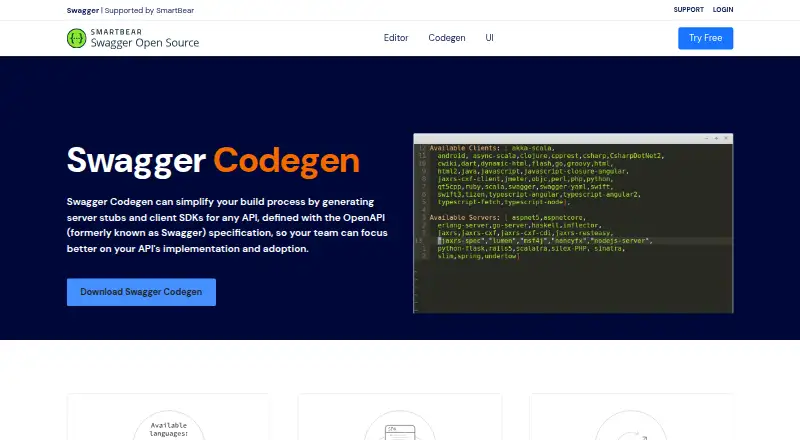
What Swagger Codegen is
Swagger Codegen generates API client libraries, server stubs, and documentation from OpenAPI specifications. Its template-driven engine parses OpenAPI or Swagger definitions, and Swagger says it can produce client SDKs in over 40 languages and boilerplate server code in over 20. Listed outputs and integrations include HTML and Confluence Wiki documentation, Apache2 configuration files, and JMeter. The project supports OpenAPI import, schema-to-code generation, custom templates, project scaffolding, code samples, and an interactive API reference. It is available as an open-source project on GitHub and through the integrated SwaggerHub platform. SwaggerHub can generate code in a selected language and push it to source-control repositories. The repository lists version 3.0.71 as compatible with OpenAPI 3.0 and earlier versions, while version 2.4.46 supports through OpenAPI 2.0. The project is free under the Apache-2.0 license. Its repository warns that untrusted API descriptions or Swagger files may cause code injection, so inputs should be reviewed before generation.
Who it suits
Swagger Codegen suits API teams that want to generate client or server code and documentation from OpenAPI descriptions. Its hosted SwaggerHub option may suit teams seeking code generation and source-control pushes in one workflow.
What it does well
- Generates client SDKs in over 40 languages.
- Generates server boilerplate in over 20 languages.
- Supports custom templates and project scaffolding.
- Free and licensed under Apache-2.0.
What to know first
- Untrusted API definitions may cause code injection.
- Version 2.4.46 supports through OpenAPI 2.0.
- Generated inputs should be reviewed before code generation.
Limits
Version 3.0.71 supports OpenAPI 3.0 and earlier listed versions; version 2.4.46 supports through OpenAPI 2.0. Generated targets depend on the listed client and server language options.
Plans
| Plan | Billed and limits | Price |
|---|---|---|
| Swagger Codegen | Open source; no price listed · Generates API clients, server stubs, and documentation from OpenAPI specifications | Free |
| Open-source Swagger Codegen | client SDK generation · server-stub generation · documentation generation · 20+ server languages · 40+ client languages | Free |
As swagger.io lists them, read 8 Oct 2026. The maker's own page has the final word.
Getting started
- Open the Swagger Codegen project on GitHub or use its integrated SwaggerHub option.
- Choose a Swagger Codegen version compatible with your OpenAPI specification.
- Review the OpenAPI or Swagger description before using it for generation.
- Select a target language and generate the client, server stub, or documentation.
- Use SwaggerHub to push generated code to a source-control repository if needed.
Swagger Codegen is an open-source generator for API teams that want to turn OpenAPI or Swagger definitions into code and documentation. Its broad language support makes it a strong fit for teams with varied technology stacks, provided they review input definitions before generation.
Overview
A template-driven engine parses API specifications and produces client SDKs, server stubs, and documentation. Swagger says it can generate client libraries in more than 40 languages and server boilerplate in more than 20. That range can reduce repetitive integration work across different stacks, but the generated output still needs to fit the team's chosen language and project conventions.
Specification compatibility depends on the project version: version 3.0.71 supports OpenAPI 3.0 and earlier listed versions, while 2.4.46 supports through OpenAPI 2.0. Matching the generator to the specification matters. The project also warns that untrusted API descriptions or Swagger files may cause code injection, so teams should review definitions before generating code.
Key features
- Client SDK and server stub generation: Generate integration libraries and server boilerplate from an API definition, which is useful when teams want to reduce implementation plumbing rather than write every starting point by hand.
- Documentation and other outputs: Outputs include HTML and Confluence Wiki documentation, as well as Apache2 configuration files and JMeter. This breadth can support more than code scaffolding, though teams should confirm that a particular generator suits their workflow.
- Flexible generation workflow: The project supports a CLI, custom templates, project scaffolding, and schema-to-code generation. These options suit teams that need control over generated structure; they also make specification review and generator selection important parts of the process.
- SwaggerHub integration: Swagger Codegen is available through the integrated SwaggerHub platform, where users can choose a language and push generated code to source-control repositories.
Pricing
Swagger Codegen is free and open source, with a published plan price of $0, billed Open source. Its Apache-2.0 license makes it a practical option for teams seeking a generator without a software subscription. No paid Codegen tier, seat allowance, quota, trial, or renewal term is stated.
The open-source project can be obtained from GitHub and is self-hosted. SwaggerHub is another way to use Codegen, but no separate price or plan terms are given for that integrated option.
Platforms
Swagger Codegen is listed for Linux, macOS, Windows, web, and self-hosted use. The GitHub project and CLI suit teams that want to run generation within their own development environment; SwaggerHub provides a hosted route.
Who it's for
It is best suited to API teams that need to produce client libraries, server starting points, or documentation from specifications, especially when they support several languages. Developers integrating with APIs may also benefit from generated SDKs. Teams should look elsewhere if they need code generation without reviewing definitions, or if a particular specification version or output is not supported by their chosen generator.
Pros and cons
- Pro: Broad client and server language coverage can serve teams working across heterogeneous stacks.
- Pro: The free, Apache-2.0-licensed project includes a CLI, custom templates, and multiple documentation and integration outputs.
- Con: Compatibility varies by project version, so teams must match the generator release to their OpenAPI specification.
- Con: Untrusted descriptions can cause code injection, making review of input definitions a necessary safeguard.
Alternatives
API Documentation Tools, Documentation Generators, and Code Generators offer broader directories for comparing tools by category.
- Scalar is a freemium alternative with a free tier for up to three APIs, one SDK of up to 25 endpoints, one editor seat, and 50 Agent Scalar credits. Consider it when those stated limits suit your API and SDK needs.
- Fern has a free plan for 10 team members, one site, and stated page and generation allowances. Choose it when those team and documentation limits match your needs.
- Javadoc is included with JDK 25, whose binaries are free under Oracle No-Fee Terms and Conditions through September 2028. Consider it when Javadoc is the relevant documentation tool for your work.
- Doxygen is free and open source under the GNU General Public License, with Windows, Linux, and macOS downloads. It is an alternative when those platforms and licensing terms fit your needs.
- Apiary offers a free plan with unlimited API projects and up to five participants per project, with public projects and no team. Consider it when those project and collaboration terms suit you.
- ApiNotes has a free Starter plan for one public API, a 10-release changelog, and up to 25 subscribers. It may suit readers who need those published API-notes limits.
- Endrel has a free Sandbox plan with one workspace, three projects per workspace, and four members per workspace. Its stated Sandbox limits are relevant when that workspace setup fits.
- Mihari has a free personal-project plan with 10 monitors and heartbeats, one status page, and email alerts. Consider it when those monitoring and status-page functions are the priority.
Verdict
Choose Swagger Codegen if your team wants a free, open-source way to generate API clients, server stubs, and documentation across many languages. Its main advantage is the breadth of outputs and customization; its main reason to look elsewhere is the need to verify compatibility and carefully review definitions before generation.
Verdict
Swagger Codegen can turn API specifications into client libraries, server stubs, and documentation, with both GitHub and SwaggerHub availability. Review untrusted definitions before generating code.
Questions
How much does Swagger Codegen cost?
It is free and open source. The listed plan is free.
Which OpenAPI versions does it support?
The repository lists version 3.0.71 as compatible with OpenAPI 3.0 and earlier listed versions. Version 2.4.46 supports through OpenAPI 2.0.
What can it generate?
It generates API client libraries, server stubs, and documentation. Listed outputs also include HTML and Confluence Wiki documentation, Apache2 configuration files, and JMeter.
Where can I use Swagger Codegen?
The project is available from GitHub and through the integrated SwaggerHub platform. Listed platforms include Linux, macOS, Windows, web, and self-hosted.
Can SwaggerHub publish generated code to source control?
Yes. SwaggerHub can generate code in a chosen language and push it to source-control repositories.
What license does the project use?
The public GitHub repository identifies the license as Apache-2.0.
Facts from Swagger Codegen's own pages
- Build integrations
- Official workflow guidance covers Maven, Gradle and GitHub integration, including a script that pushes generated SDKs to GitHub. · swagger.io, 15 Oct 2026
- Client generation
- The product generates client SDKs in more than 40 languages. · swagger.io, 15 Oct 2026
- Client languages
- Swagger says Codegen can generate client SDKs in over 40 languages. · swagger.io, 8 Oct 2026
- Command-line use
- The CLI can be built with Maven and run as a Java JAR to generate a selected language target from a supplied specification. · swagger.io, 15 Oct 2026
- Company
- Swagger is presented as supported by SmartBear, which says it was founded in 2003 and lists its global headquarters in Somerville, Massachusetts. · smartbear.com, 8 Oct 2026
- Current release activity
- The GitHub releases page shows version 3.0.82 changes including a Jackson update to 2.21.5 and a 3.0.82 snapshot bump. · github.com, 15 Oct 2026
- Customization
- Users can replace Mustache templates with their own directory and create custom generator modules using the meta command. · swagger.io, 15 Oct 2026
- Docker CLI
- A standalone Docker image can run the CLI without installing Java, using a mounted local volume for generated output. · swagger.io, 15 Oct 2026
- Documentation depth
- The documentation includes versioning, prerequisites, building, Docker, generators, workflow integration, validation and contribution guidance. · swagger.io, 15 Oct 2026
- Documentation generation
- Supported documentation outputs include HTML and Confluence Wiki. · swagger.io, 15 Oct 2026
- Download and hosted option
- The open-source project is available from GitHub, and Swagger Codegen is also available in the integrated SwaggerHub platform. · swagger.io, 8 Oct 2026
- Founded
- 2003 · swagger.io, 28 Sept 2026
- Generated-code ownership
- The project says generated code is supplied as-is, owned by the user and not automatically subject to the parent project license. · github.com, 15 Oct 2026
- Generation engine
- The project uses a template-driven engine to parse OpenAPI or Swagger definitions. · github.com, 8 Oct 2026
- Generators and integrations
- Listed outputs and integrations include HTML and Confluence Wiki documentation, Apache2 configuration files, and JMeter. · github.com, 8 Oct 2026
- Headquarters
- Somerville, Massachusetts, United States · swagger.io, 28 Sept 2026
- Installation
- Official installation options include downloading a JAR from Maven Central and installing through Homebrew. · swagger.io, 15 Oct 2026
- Intended users
- Swagger describes Codegen as a way for API teams to reduce implementation plumbing and help end developers integrate with APIs. · swagger.io, 8 Oct 2026
- License
- The Homebrew formula identifies Swagger Codegen as Apache-2.0 licensed. · formulae.brew.sh, 15 Oct 2026
- Limit: beginner complexity
- An independent review lists complexity for beginners as a disadvantage. · toolradar.com, 15 Oct 2026
- Limit: generated-code quality
- Developers on Reddit criticize generated code as sometimes awkward to consume, poor in quality or occasionally non-compiling depending on the generator. · reddit.com, 15 Oct 2026
- Limit: separate release maintenance
- A directory review says teams must choose between independently maintained 2.x and 3.x lines, adding version-maintenance overhead. · itechguides.com, 15 Oct 2026
- Local specifications
- Generation can use specification files stored locally instead of calling a remote API server. · swagger.io, 15 Oct 2026
- Maker company size
- LinkedIn lists SmartBear as a privately held software company with 501–1,000 employees and headquarters in Somerville, Massachusetts. · linkedin.com, 15 Oct 2026
Where Swagger Codegen stands on Freedom251
- API Generation Software#2 of 25
- Code Generators#3 of 33