Freedom251 › API Generation Software

Hasura
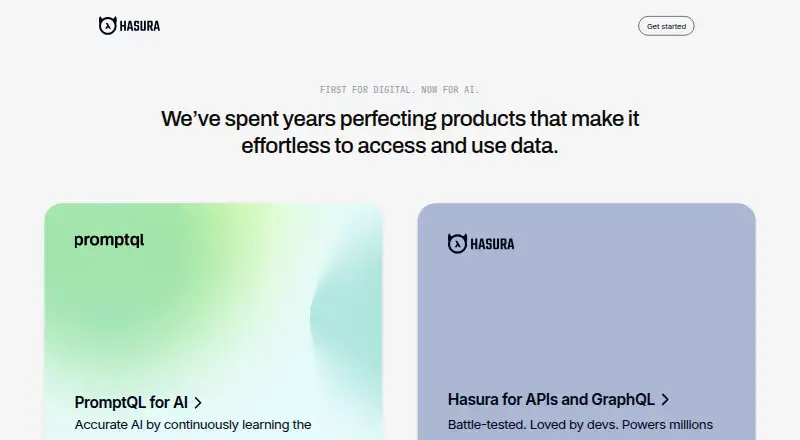
What Hasura is
Hasura generates data APIs over connected databases, so developers can expose data without writing handlers, schemas, or resolvers. Hasura Cloud plans include GraphQL APIs, RESTified endpoints, and GraphQL subscriptions. Listed data sources include Postgres-compatible databases, Microsoft SQL Server, BigQuery, Amazon Athena, Snowflake, MySQL, Oracle, MariaDB, MongoDB, and ClickHouse. APIs can be extended with remote schemas and joins, Actions, and event or scheduled triggers. Cloud authorization can connect to an authentication provider of the customer's choice and supports JWT controls through headers, cookies, or webhooks. Hasura Cloud is available on AWS, Google Cloud Platform, and Microsoft Azure Cloud. The Community Edition can be deployed from a Docker image, while Enterprise Edition can be deployed on-premises. Cloud integrations include GitHub for CI/CD and observability tools such as Datadog, New Relic, Azure Monitor, Prometheus, and OpenTelemetry. Listed security features include query allow lists, optional introspection disabling, security event logging, access controls, and DDoS monitoring. The Free plan allows up to three projects per account, three million API requests per month, and ten concurrent websocket connections. Enterprise pricing is custom.
Who it suits
Hasura suits developers building APIs over supported databases. The maker describes Professional as intended for low-scale production APIs and Enterprise for high-scale, mission-critical production APIs with security and compliance needs.
What it does well
- Generates APIs without requiring handlers, schemas, or resolvers.
- Supports a broad range of listed databases.
- Offers cloud hosting and self-hosted deployment options.
- Cloud plans include GraphQL and RESTified endpoints.
- Free plan allows up to three million API requests monthly.
What to know first
- Free plan is limited to three projects per account.
- Free plan allows ten concurrent websocket connections.
- Enterprise pricing is custom.
Limits
The Free plan allows up to three projects per account, three million API requests per month, and ten concurrent websocket connections. Its plan listing also states two databases per project and up to 100MB data passthrough per month.
Plans
| Plan | Billed and limits | Price |
|---|---|---|
| Free | Forever · 2 databases per project · up to 100MB data passthrough/month · up to 3M API requests/month | Free |
| Professional | Starts at $1.50/active hour · Unlimited databases per project · unlimited data passthrough at $0.13/GB · up to 6M API requests/month | $1.50 |
| Enterprise | Custom pricing · Unlimited databases · unlimited data passthrough · unlimited API requests/month | On request |
As hasura.io lists them, read 8 Oct 2026. The maker's own page has the final word.
Getting started
- Visit https://hasura.io/.
- Choose Hasura Cloud or a self-hosting route.
- For Cloud, select AWS, Google Cloud Platform, or Microsoft Azure Cloud.
- For Community Edition self-hosting, deploy the Docker image.
- Connect a supported database and choose a plan.
Hasura is a data API platform that generates GraphQL APIs over connected databases without requiring developers to write handlers, schemas, or resolvers. It suits teams building database-backed APIs that want cloud or self-managed deployment and room to extend APIs with other services. Its broad database support and flexible deployment are compelling, though the Free plan’s project and request caps and Professional’s hourly billing deserve close attention.
Overview
Hasura Cloud provides instant GraphQL APIs, RESTified endpoints, and GraphQL subscriptions. The engine connects to a wide range of databases, including Postgres-compatible systems, SQL Server, BigQuery, Athena, Snowflake, MySQL, Oracle, MariaDB, MongoDB, and ClickHouse. That breadth makes it a strong fit for teams serving data from more than one database type.
Teams can extend APIs with remote schemas and joins, Actions, and event or scheduled triggers. Authorization can use a customer-chosen authentication provider, with JWT controls delivered through headers, cookies, or webhooks. These options give developers ways to integrate existing identity and services rather than limiting an API to direct database access.
Key features
Cloud controls and integrations
Hasura Cloud runs on AWS, Google Cloud Platform, or Microsoft Azure Cloud. GitHub integration supports CI/CD, while observability integrations include Datadog, New Relic, Azure Monitor, Prometheus, and OpenTelemetry. Security features include query allow lists, optional disabling of GraphQL introspection, security event logging, access controls, and DDoS monitoring.
Hasura states that Cloud is SOC 2 Type II and HIPAA compliant, that its offerings are GDPR compliant, and that its information security management system supporting Hasura GraphQL Engine is ISO/IEC 27001:2013 certified. Teams evaluating a deployment should match those claims and controls to their own requirements.
Self-hosting
The Community Edition can be deployed manually with Docker, and Enterprise Edition can be deployed on-premises. This makes Hasura relevant to organizations that need to manage deployment themselves, as well as those choosing hosted Cloud; the operational choice is a meaningful part of the decision.
Pricing
Hasura uses a freemium model. The Free plan costs nothing, billed Forever. It allows up to three projects per account, two databases per project, 100MB of data passthrough per month, up to 3 million API requests per month, and 10 concurrent websocket connections. Community and email/ticketed support are included. This is a practical starting point, but the project, throughput, and connection ceilings may rule it out for larger or production workloads.
Professional is priced on request, billed starting at $1.50 per active hour. It includes unlimited databases per project, unlimited data passthrough at $0.13/GB, and up to 6 million API requests per month, plus expert technical support. Hasura positions it for low-scale production APIs. The active-hour starting charge and per-GB passthrough cost matter when estimating spend; the plan doubles the Free request allowance but does not remove the request cap.
Enterprise has custom pricing and includes unlimited databases, unlimited data passthrough, unlimited API requests per month, and 24x7 expert technical support with customizable SLAs. It is intended for high-scale, mission-critical production APIs with security and compliance needs. The published paid-from figure is 5 /mo, but the Enterprise plan itself is custom-priced.
Platforms
Hasura is listed for API, Linux, self-hosted, and web use. Its hybrid deployment model spans Hasura Cloud and self-managed options, and lifecycle management, access policies, API analytics, and an API catalog are supported capabilities.
Who it's for
Hasura is best suited to development teams that want to generate APIs over existing databases, particularly when they need multiple API styles, database choices, or deployment paths. Professional targets low-scale production, while Enterprise is aimed at teams running high-scale, mission-critical services. A small project can start on Free, but teams should check its request and websocket caps against expected use before relying on it.
Pros and cons
- Pro: Broad database support makes it useful when an API needs to span varied data stores.
- Pro: GraphQL, RESTified endpoints, subscriptions, and extension mechanisms cover more than direct database reads.
- Pro: Cloud, Docker-based Community Edition, and on-premises Enterprise provide distinct deployment choices.
- Con: Free limits projects, databases, monthly requests, passthrough, and concurrent websocket connections, so growing workloads may need an upgrade.
- Con: Professional combines an active-hour starting charge with per-GB passthrough pricing and a 6 million monthly request cap, making usage a cost and capacity consideration.
- Con: Enterprise uses custom pricing, so teams must obtain a quote to assess its cost.
Alternatives
For teams comparing options across the broader category, browse GraphQL Tools or API Management Software.
Altair GraphQL Client is a freemium option for those seeking a GraphQL client. Apollo Studio is another freemium alternative. Apollo Client is a free alternative. Ariadne is a free alternative. Graphene is a free, open-source Python library. GraphiQL is a free, MIT-licensed project distributed as a React package. GraphQL Hive is a free alternative with a Hobby plan. GraphQL.js is a free, MIT-licensed JavaScript library installable from npm.
Verdict
Choose Hasura if your team wants to generate and extend APIs across existing databases, with a choice between hosted cloud and self-managed deployment. Its strongest case is the combination of database breadth, API types, and deployment flexibility. Look elsewhere if the Free caps are too restrictive, or if Professional’s usage-based charges and request ceiling do not fit your workload.
Verdict
Hasura offers multiple API types, database connections, and deployment paths. The Free plan’s project and request limits, along with the different deployment options, are useful factors to weigh against your requirements.
Questions
Is Hasura free?
Yes. The Free plan is listed as free, billed Forever.
What does the Free plan include?
It allows up to three projects per account, three million API requests per month, and ten concurrent websocket connections. The plan listing also states two databases per project and up to 100MB data passthrough per month.
What are the paid plan prices?
Professional is priced on request, starts at $1.50 per active hour, and is described as up to 6M API requests per month. Enterprise uses custom pricing.
Can Hasura be self-hosted?
Yes. Community Edition can be deployed using its Docker image, and Enterprise Edition can be deployed on-premises.
Which platforms are listed?
The listed platforms are API, Linux, self-hosted, and web.
What databases does Hasura support?
The listed sources include Postgres-compatible databases, Microsoft SQL Server, BigQuery, Amazon Athena, Snowflake, MySQL, Oracle, MariaDB, MongoDB, and ClickHouse.
Facts from Hasura's own pages
- API types
- Hasura Cloud plans include instant GraphQL APIs, RESTified endpoints, and GraphQL subscriptions. · hasura.io, 8 Oct 2026
- Authorization
- Hasura Cloud authorization can integrate with an authentication provider of the customer's choice and supports JWT controls through headers, cookies, or webhooks. · hasura.io, 8 Oct 2026
- Cloud hosting
- Hasura Cloud is available on AWS, Google Cloud Platform, and Microsoft Azure Cloud. · hasura.io, 8 Oct 2026
- Company history
- Hasura's company page says the team raised over $135 million and identifies it as the team behind Hasura GraphQL Engine and Hasura Data Delivery Network. · promptql.io, 8 Oct 2026
- Compliance
- Hasura states that Hasura Cloud is SOC 2 Type II and HIPAA compliant and that its offerings are GDPR compliant; it also describes ISO/IEC 27001:2013 certification for its information security management system supporting Hasura GraphQL Engine. · hasura.io, 8 Oct 2026
- Data sources
- The documentation lists Postgres-compatible databases, Microsoft SQL Server, BigQuery, Amazon Athena, Snowflake, MySQL, Oracle, MariaDB, MongoDB, and ClickHouse as supported databases. · hasura.io, 8 Oct 2026
- Extending APIs
- Hasura supports remote schemas, remote joins, Actions, and event and scheduled triggers. · hasura.io, 8 Oct 2026
- Free plan limits
- The Free plan allows up to 3 projects per account, 3 million API requests per month, and 10 concurrent websocket connections. · hasura.io, 8 Oct 2026
- Integrations
- Hasura Cloud lists GitHub integration for CI/CD and observability integrations such as Datadog, New Relic, Azure Monitor, Prometheus, and OpenTelemetry. · hasura.io, 8 Oct 2026
- Intended use
- Hasura describes Professional as intended for low-scale production APIs and Enterprise as intended for high-scale, mission-critical production APIs with security and compliance needs. · hasura.io, 8 Oct 2026
- Product
- Hasura GraphQL Engine generates a data API over connected databases without requiring developers to write handlers, schemas, or resolvers. · hasura.io, 8 Oct 2026
- Security
- Hasura Cloud lists query allow lists, optional GraphQL introspection disabling, security event logging, access controls, and DDoS monitoring among its security features. · hasura.io, 8 Oct 2026
- Self-hosting
- The Hasura GraphQL Engine Community Edition can be deployed manually using its Docker image, and Hasura Enterprise Edition is deployable on-premises. · hasura.io, 8 Oct 2026
- Support
- The Cloud Free plan includes community and email/ticketed support, Professional includes expert technical support, and Enterprise includes 24x7 expert technical support with customizable SLAs. · hasura.io, 8 Oct 2026
Where Hasura stands on Freedom251
- API Generation Software#4 of 25
- API Management Software#7 of 38
- GraphQL Tools#7 of 32
- Databases And Backend#12 of 33