Apollo Studio
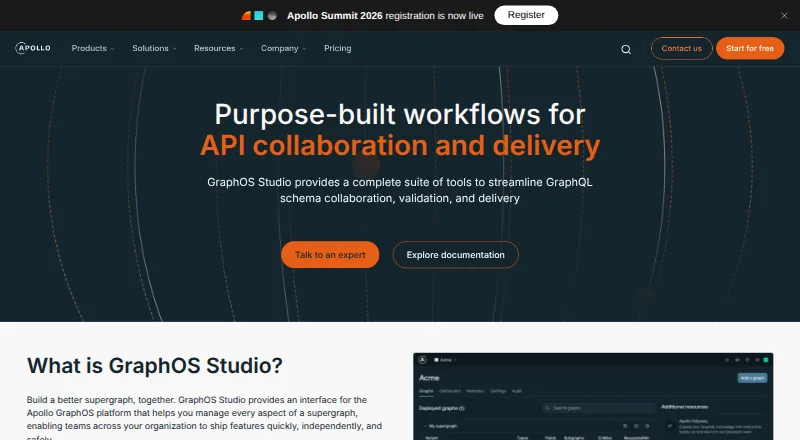
What Apollo Studio is
Apollo Studio is the interface for Apollo GraphOS, a platform for managing a supergraph and coordinating teams working on GraphQL services. In Studio Explorer, developers can create, run, and share GraphQL operations, with autocomplete and query linting. GraphOS keeps schemas and related metadata in a central registry, generates changelogs, and visualizes graphs. Teams can review schema proposals asynchronously and check them against past requests from registered clients for breaking changes. Composition, validation, and approvals can connect to existing CI/CD pipelines. Access controls include granular roles and separate permissions for discovering, reviewing, and publishing; teams can also make filtered graph variants for clients or partners. Studio tracks usage at field, client, and operation levels, with trends, request rates, errors, and service traces. It supports any GraphQL API, including Federation and Connectors. A Free plan is available; Developer is $5 a month, starting at $5 per million requests. The Free plan limits its self-hosted router to 60 requests per minute and retains checks and insights data for one day.
Who it suits
Apollo describes its Free plan for students or hobbyists, Developer for small production API teams, Standard for teams scaling across services, and Enterprise for companies with large GraphQL initiatives. It suits teams that need schema review, access controls, and GraphQL workflows connected to CI/CD.
What it does well
- Explorer supports shared operations, autocomplete, and query linting.
- Schema changes can be checked against registered clients’ past requests.
- Composition and approvals can integrate with CI/CD pipelines.
- Usage metrics include errors and service traces.
- OpenTelemetry can send metrics to a chosen APM tool.
What to know first
- Free self-hosted router is limited to 60 requests per minute.
- Free checks and insights data is retained for one day.
- Developer requires a credit card.
- Standard and Enterprise pricing is custom and unlisted.
Limits
The Free plan is limited to three developers, a self-hosted router rate of 60 requests per minute, and one day of checks and insights data retention. Developer supports up to 10 developers and retains data for seven days; it starts at $5 per million requests per month and requires a credit card.
Plans
| Plan | Billed and limits | Price |
|---|---|---|
| Free | Forever Free; no credit card required · Up to 3 developers · Router limited to 60 requests/minute · 1-day checks and insights retention · Community support | Free |
| Developer | Starting at $5 per million requests; billed monthly with automatic volume discounts · Up to 10 developers · 7-day checks and insights retention · Developer support 8×5 without SLA · $50 signup usage credit | $5 a month |
| Standard | Custom pricing; talk to sales · Up to 30 developers · 90-day checks and insights retention · Standard support 8×5 with SLA | On request |
| Enterprise | Custom pricing; talk to sales · Unlimited developers · 18-month checks and insights retention · Business support 24×7×365 with SLA · Premium support and professional services add-ons | On request |
As apollographql.com lists them, read 15 Oct 2026. The maker's own page has the final word.
Getting started
- Visit the Apollo GraphOS Studio website.
- The Free plan does not require a credit card.
- Use Studio Explorer to create, run, or share GraphQL operations.
- Connect schema composition, validation, and approvals to your CI/CD pipeline if needed.
- Use Rover CLI or the Platform API for schema checks, publishing, local testing, or custom automation.
Overview
Apollo Studio is the interface for managing GraphOS supergraphs and the teams that build them. It is best suited to GraphQL groups coordinating changes across services, with usage visibility and review controls alongside API work. Its main strength is linking schema governance to delivery; its free tier’s rate cap and short retention make it a constrained choice for sustained production use.
Key features
Studio Explorer lets developers create, run, and share GraphQL operations, with autocomplete and query linting. That covers everyday exploration, while the broader advantage is connecting operations to shared schema workflows rather than relying on an editor alone.
GraphOS centralizes schemas and metadata, generates changelogs, and visualizes graphs. Teams can review proposed schema changes asynchronously and validate them against past requests from registered clients, helping identify breaking changes before release. Composition, validation, and approvals can run through existing CI/CD pipelines, which suits teams that want governance in their delivery process.
Graph variants support granular discoverability, review, and publishing permissions, and filtered variants can be tailored for clients or partners. This gives teams useful control over access to a graph, though it is most relevant where several groups share responsibility for an API.
Usage metrics reach field, client, and operation levels, with trends, request volumes, rates, errors, and service traces. OpenTelemetry support lets platform teams send metrics to their chosen APM tool. Rover CLI supports publishing subgraph schemas, CI schema checks, and local supergraph testing; the Platform API enables custom automation. GraphOS supports any GraphQL API, including Federation and Connectors.
Apollo says graph operation result data does not reach an Apollo-managed service. Some tools have opt-in GraphOS reporting, while certain tools collect anonymous usage data by default.
Pricing
The Free plan costs nothing and is billed Forever Free, with no credit card required. It allows up to 3 developers, caps the self-hosted GraphOS Router at 60 requests per minute, retains checks and insights data for 1 day, and includes Community Support. It fits students and hobbyists, but the rate cap and brief retention limit its usefulness for production monitoring.
Developer costs $5 a month, billed monthly, starting at $5 per million requests. It supports up to 10 developers and 7 days of data retention, includes Developer Support 8×5 without an SLA, and offers $50 in usage credit when you sign up; a credit card is required. This is the more practical entry point for a small production API team, trading the free tier’s low barrier to entry for longer retention and a larger team allowance.
Standard has custom pricing and requires talking to sales. It includes up to 30 developers, 90 days of retention, and Standard Support 8×5 with an SLA, making it the stated fit for teams scaling across services. Enterprise also has custom pricing and requires talking to sales; it offers unlimited developers, 18 months of retention, and Business Support 24×7×365 with an SLA for large-scale GraphQL initiatives. Both higher tiers buy more retention and stronger support, but require a sales conversation.
Platforms
Apollo Studio lists API, Linux, macOS, self-hosted, web, and Windows platforms, with a hybrid deployment model. Contract validation, team collaboration, an API explorer, client code generation, and operation testing are supported. Server languages include TypeScript, JavaScript, Java, Kotlin, Python, C#, Go, Ruby, Rust, Elixir, PHP, and Scala.
Who it's for
Studio is strongest for teams managing a GraphQL supergraph across services, especially when they need schema review, CI checks, access controls, and operational insight in one workflow. Free suits students or hobbyists; Developer is aimed at small production API teams. Teams that need longer operational history or an SLA will need to consider Standard or Enterprise. Developers seeking only a query tool or a server-building library may find a narrower alternative more appropriate.
Pros and cons
- Pros: Schema proposals can be checked against requests from registered clients, giving teams a way to catch breaking changes before publishing.
- Pros: CI/CD integration, variant-level permissions, and filtered graph views support coordinated releases across teams and clients.
- Pros: Metrics span fields, clients, and operations, with traces and OpenTelemetry support for APM workflows.
- Cons: Free allows only 3 developers and limits the self-hosted router to 60 requests per minute, with just 1 day of checks and insights retention.
- Cons: Developer requires a credit card and its support has no SLA; Standard and Enterprise require custom pricing discussions.
Alternatives
For a broader shortlist, browse GraphQL Tools or API Design Tools.
Altair GraphQL Client is worth considering when a freemium client is the priority: its Basic plan allows up to 2 team members and 20 queries, with unlimited collections and history up to 10 revisions.
Apollo Client is a free option for teams looking for a client library rather than Studio’s schema-management interface.
GraphQL Hive may suit teams comparing free schema tooling; its Hobby plan includes 1M operations per month, 7-day usage-data retention, and unlimited seats, projects, organizations, schema pushes, and checks.
Hot Chocolate is a free, MIT-licensed option for building GraphQL APIs in commercial or private projects.
WunderGraph Cosmo offers a free Developer plan with one federated graph, 10M requests per month, 10 subgraphs, one team member, and 7-day retention.
gqlgen is a free Go library for building GraphQL servers. GraphQL Kotlin is an Apache License 2.0 option, and Strawberry GraphQL is an open-source, MIT-licensed Python library.
Verdict
Choose Apollo Studio if your team needs to govern a GraphQL supergraph through shared schema review, CI validation, permissions, and operation-level observability. Those connected workflows are its clearest reason to choose it. Look elsewhere if you need only a query editor or server library, or if the free plan’s 60-request-per-minute cap and 1-day retention cannot support your production needs.
Verdict
Apollo Studio brings GraphQL schema management, operation exploration, review controls, and observability into one interface. The Free plan has specific request-rate and retention limits; higher plans offer longer retention and different support levels.
Questions
Is Apollo Studio free?
Yes. Its Free plan is forever free and does not require a credit card. It supports up to three developers.
What does the Developer plan cost?
Developer starts at $5 per million requests, billed monthly. A credit card is required, and the plan includes $50 in usage credit when you sign up.
Which GraphQL APIs does GraphOS support?
The pricing page says GraphOS supports any GraphQL API, including GraphQL Federation and Connectors.
What are the Free plan limits?
The self-hosted GraphOS Router is limited to 60 requests per minute, and checks and insights data is retained for one day. The plan supports up to three developers.
Does graph operation result data go to Apollo?
Apollo states that graph operation result data never reaches an Apollo-managed service. Some tools have opt-in GraphOS reporting, and certain tools collect anonymous usage data by default.
What support is included?
Free includes Community Support. Developer includes 8×5 Developer Support without an SLA; Standard includes 8×5 support with an SLA, and Enterprise includes 24×7×365 Business Support with an SLA.
Facts from Apollo Studio's own pages
- Access controls
- Graph variants support granular roles and separate discoverability, review, and publishing permissions; filtered variants can be created for particular clients or partners. · apollographql.com, 29 Sept 2026
- Changelog news
- Apollo Federation 2.13 was released in January 2026 and Federation 2.15 in July 2026, with the latter moving composition to Rust and improving validation errors. · apollographql.com, 15 Oct 2026
- Chrome extension features
- Apollo Client Devtools adds an Explorer-like query tool, watched-query inspector, mutation inspector and cache inspector to Chrome developer tools. · chromewebstore.google.com, 15 Oct 2026
- CI/CD
- Composition, change validation, and approvals can be integrated into existing continuous integration and delivery pipelines. · apollographql.com, 29 Sept 2026
- Collaboration
- Studio provides graph visualization, a central subgraph registry and organization-based collaboration workflows. · apollographql.com, 15 Oct 2026
- Company founded year
- LinkedIn lists Apollo GraphQL as founded in 2016. · linkedin.com, 15 Oct 2026
- Company headquarters and size
- LinkedIn lists Apollo GraphQL headquarters in San Francisco and a company size of 201–500 employees. · linkedin.com, 15 Oct 2026
- Company legal name
- Crunchbase lists the legal name as Apollo Graph Inc. and identifies Geoff Schmidt, Matt DeBergalis and Nick Martin as founders. · crunchbase.com, 15 Oct 2026
- Connector requirements
- Apollo Connectors 0.4 requires at least Router 2.15.0, build pipeline 2.14.1 and Federation specification 2.14.1. · apollographql.com, 15 Oct 2026
- Current status
- Apollo's public status page reported all listed services, including Studio UI, schema checks and Insights, fully operational when opened. · status.apollographql.com, 15 Oct 2026
- Datadog limitation
- Apollo's Datadog forwarding integration is planned for deprecation and is restricted to legacy plans rather than Developer or Standard plans. · apollographql.com, 15 Oct 2026
- Data handling
- Apollo states that graph operation result data never reaches an Apollo-managed service, while some tools have opt-in GraphOS reporting and certain tools collect anonymous usage data by default. · apollographql.com, 29 Sept 2026
- Developer interfaces
- Rover CLI supports publishing subgraph schemas, running schema checks from CI, and testing a supergraph locally; the Platform API supports custom automation and tooling. · apollographql.com, 29 Sept 2026
- Documentation
- Apollo's documentation covers Studio, Explorer, security, access management, APIs, routing, observability, connectors and release lifecycles with configuration examples. · apollographql.com, 15 Oct 2026
- Explorer IDE
- Studio Explorer is a browser IDE for creating, running and managing queries, mutations and subscriptions, and it is free for GraphOS organizations. · apollographql.com, 15 Oct 2026
- For whom
- Apollo describes Free as for students or hobbyists, Developer as for small production API teams, Standard as for teams scaling across services, and Enterprise as for companies with large-scale GraphQL initiatives. · apollographql.com, 29 Sept 2026
- Founded
- 2016 · apollographql.com, 28 Sept 2026
- Free plan limit
- The Free plan's self-hosted GraphOS Router is limited to 60 requests per minute, and checks and insights data is retained for one day. · apollographql.com, 29 Sept 2026
- Funding news
- Apollo announced a $130 million Series D led by Insight Partners on August 17, 2021, at a valuation above $1.5 billion. · apollographql.com, 15 Oct 2026
- Headquarters
- San Francisco, California, United States · apollographql.com, 28 Sept 2026
- HQ news
- Apollo announced a new San Francisco headquarters at 201 California Street on December 2, 2025, while retaining a distributed-work model. · apollographql.com, 15 Oct 2026
- Integrations
- Studio integrations include Slack and Datadog, while performance alerts can notify Slack or PagerDuty. · apollographql.com, 15 Oct 2026
- Limit: AWS Marketplace complexity
- AWS Marketplace reviewers say federation concepts and router configuration take time to learn and may be excessive for small or simple API landscapes. · aws.amazon.com, 15 Oct 2026
- Limit: G2 learning curve and cache work
- G2 reviewers report a steep learning curve, difficulty maintaining or clearing the client cache and extra complexity for simple projects. · g2.com, 15 Oct 2026
Where Apollo Studio stands on Freedom251
- API Design Tools#2 of 26