
MockServer
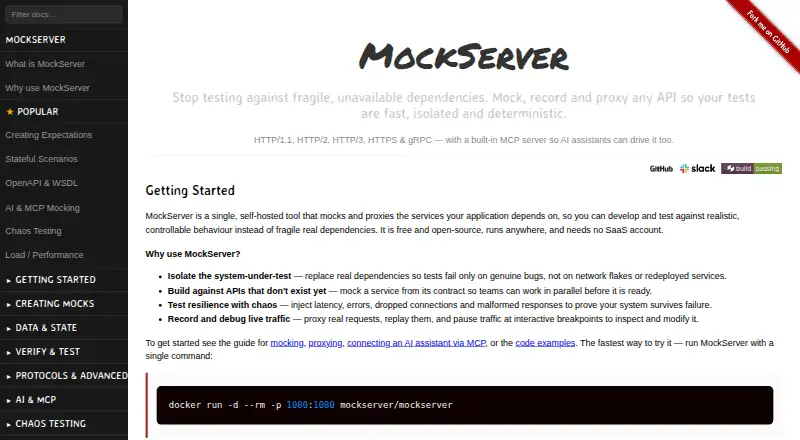
What MockServer is
MockServer is free, self-hosted software for mocking and proxying HTTP, HTTPS, and gRPC services in isolated, deterministic testing. It can act as a mock, a proxy, or a request-verification tool. Teams can generate mocks and validate traffic from OpenAPI or Swagger specifications, or import recorded traffic from browser HAR files and Postman collections. It can also mock AsyncAPI brokers such as Kafka, MQTT, and AMQP, plus OAuth2/OIDC providers. Chaos testing options inject latency, errors, dropped connections, or malformed responses into mocked or proxied traffic. Supported protocols include HTTP/1.1, HTTP/2, HTTPS, SOCKS, and experimental HTTP/3, which uses a separate UDP port. MockServer runs through Docker, a JAR, Helm/Kubernetes, Testcontainers, Homebrew, or a JVM-less binary bundle. Its dashboard shows live logs, expectations, and recorded traffic; shared environments can use Prometheus metrics and OpenTelemetry tracing. Control-plane requests can use mutual TLS, JWT, or both, but status and readiness probes remain reachable without authentication or authorization.
Who it suits
It suits developers and test teams that need self-hosted service virtualization, contract testing, or controlled failure scenarios. It also fits teams using the listed protocols, clients, and deployment methods.
What it does well
- Free, self-hosted deployment with no SaaS account
- Mocks and validates against OpenAPI or Swagger
- Imports HAR files and Postman collections
- Supports multiple official language clients
- Dashboard shows live logs and recorded traffic
What to know first
- Status and readiness probes need no authentication
- HTTP/3 support is experimental and uses a separate UDP port
Plans
| Plan | Billed and limits | Price |
|---|---|---|
| Free and open-source | self-hosted · no SaaS account | Free |
As mock-server.com lists them, read 1 Oct 2026. The maker's own page has the final word.
Getting started
- Visit the MockServer website.
- Choose a deployment route: Docker, executable JAR, Helm/Kubernetes, Testcontainers, Homebrew, or the JVM-less binary bundle.
- Use an official client, the CLI, or the REST API to configure mocks and proxies.
- Open the built-in web dashboard to view logs, expectations, and recorded traffic.
Overview
MockServer is a self-hosted testing tool that simulates services, forwards traffic and checks requests. It is best suited to engineering teams testing systems that span APIs, messaging and identity providers. Its wide protocol and deployment support is a strength, but it requires teams to operate and secure their own instance.
Key features
Mocking, proxying and request verification give MockServer a role both in isolated tests and in checking traffic as it passes through a system. Teams can generate mocks and validate traffic from OpenAPI or Swagger specifications, or import recorded traffic from browser HAR files and Postman collections. Those options make it easier to base tests on existing contracts and examples.
It supports HTTP/1.1, HTTP/2, HTTPS and SOCKS, with experimental HTTP/3 available on a separate UDP port. It also mocks gRPC services, AsyncAPI brokers such as Kafka, MQTT and AMQP, and OAuth2/OIDC providers. This breadth makes it a practical fit for systems with varied dependencies; HTTP/3 remains experimental, so it is not the obvious choice for a requirement that depends on established HTTP/3 support.
Chaos testing can inject latency, errors, dropped connections and malformed responses into mocked or proxied HTTP, gRPC and TCP traffic. That gives teams a way to exercise failure handling as well as successful exchanges. A built-in dashboard shows live logs, expectations and recorded traffic; Prometheus metrics and OpenTelemetry tracing support shared environments. Official clients for Java, JavaScript, Python, Ruby, Go, .NET, Rust and PHP sit alongside a CLI and REST API.
Deployment options include Docker, an executable JAR, Helm/Kubernetes, Testcontainers, Homebrew and a JVM-less binary bundle. Every instance also includes an MCP server at /mockserver/mcp for assistants including Claude Code, Cursor, Windsurf, Cline and OpenCode. Control-plane requests can use mutual TLS, JWT or both, with OIDC scopes or groups mapped to roles. However, the /mockserver/status and /mockserver/ready probes remain reachable without authentication or authorization, so operators should account for that exposure when configuring an instance. Velocity class loading is disabled by default, and JavaScript templates cannot resolve Java classes unless explicitly allowed.
Pricing
MockServer is free and open source: its self-hosted plan costs nothing and requires no SaaS account. It includes contract testing, service virtualization and test data management. The trade-off is that teams run the deployment themselves rather than buying a hosted service.
Platforms
MockServer is listed for API, Linux, macOS, Windows, web and self-hosted use. The range of packaging options—from containers and Kubernetes to a JVM-less bundle—makes it adaptable to different engineering environments, though it remains a self-hosted deployment.
Who it's for
Choose MockServer when tests need to cover multiple protocols, broker or identity-provider behavior, request verification, or deliberate failure conditions. Its broad client support and deployment choices also suit teams integrating it into varied stacks. It is less suitable for teams seeking a managed hosted service or unwilling to account for the unauthenticated health probes.
Pros and cons
- Pro: Mocks, proxying and verification work together across HTTP, gRPC, TCP and messaging scenarios, supporting more than basic API stubs.
- Pro: Contract imports, recorded traffic and chaos controls let teams build tests from existing material and probe failure behavior.
- Pro: Multiple deployment formats and official clients make it practical across different environments and languages.
- Con: Self-hosting means the team must manage deployment and configuration.
- Con: The health probes are unauthenticated and unauthorized, a security consideration for any reachable instance.
- Con: HTTP/3 is experimental and uses a separate UDP port.
Alternatives
For a broader API design and testing workflow with a free tier capped at four users, consider Apidog. Microcks is another free, open-source option for teams looking for a community-driven CNCF Incubating project.
Teams focused on GraphQL development may prefer Apollo Studio, whose free plan supports up to three developers but limits the router to 60 requests per minute and retains data for one day. For comparing OpenAPI definitions, oasdiff is the more targeted alternative: its engine, CLI and GitHub Action are open source under Apache 2.0.
Pact is an alternative to consider for open-source tooling. Postman offers an API client and core tools, specs and mock servers on its free plan, alongside native Git and Collection Runner. For defining APIs with a Microsoft-built, community-supported project, consider TypeSpec. WireMock may suit a smaller mock-API setup: its free plan allows one user, three mock APIs and 1,000 calls per month.
Explore API Design Tools, Service Virtualization Software, API Mocking Tools and Integration Testing Tools for more options.
Verdict
MockServer is a strong choice for teams that need a free, self-hosted environment to mock, proxy and verify varied services, with chaos testing and broad deployment support. Its main reason to choose it is the combination of protocol breadth and failure simulation; look elsewhere if you need a managed service or cannot accommodate the unauthenticated health probes.
Verdict
MockServer covers mocking, proxying, verification, and chaos testing across a broad set of protocols and deployment options. Its always-reachable health probes are a security detail to account for when configuring an instance.
Questions
How much does MockServer cost?
The Free and open-source plan is free for self-hosted use, with no SaaS account.
Does MockServer have a free plan?
Yes. Its plan is free and open-source, and it runs self-hosted.
Which protocols can MockServer handle?
It supports HTTP/1.1, HTTP/2, HTTPS, SOCKS, and experimental HTTP/3. HTTP/3 uses a separate UDP port.
Can MockServer validate API contracts?
Yes. Mocks can be generated and traffic validated from OpenAPI or Swagger specifications.
Can MockServer simulate messaging services?
Yes. It can mock AsyncAPI brokers including Kafka, MQTT, and AMQP.
Where is MockServer's source code hosted?
GitHub hosts its source code, feature requests, issues, pull requests, and releases.
Facts from MockServer's own pages
- AI integration
- Every instance includes an MCP server at /mockserver/mcp for assistants such as Claude Code, Cursor, Windsurf, Cline and OpenCode. · mock-server.com, 1 Oct 2026
- API contracts
- Mocks can be generated and traffic validated from OpenAPI or Swagger specifications. · mock-server.com, 1 Oct 2026
- Chaos testing
- It injects latency, error responses, dropped connections and malformed responses into mocked or proxied HTTP, gRPC and TCP traffic. · mock-server.com, 1 Oct 2026
- Client integrations
- Official clients are available for Java, JavaScript, Python, Ruby, Go, .NET, Rust and PHP, alongside the CLI and REST API. · mock-server.com, 1 Oct 2026
- Control-plane security
- Control-plane requests can be authenticated with mutual TLS, JWT or both, and authorization can map OIDC scopes or groups to roles. · mock-server.com, 1 Oct 2026
- Core roles
- It can act as a mock, proxy and request-verification tool. · mock-server.com, 1 Oct 2026
- Deployment
- It can run through Docker, an executable JAR, Helm/Kubernetes, Testcontainers, Homebrew or a JVM-less binary bundle. · mock-server.com, 1 Oct 2026
- Imports
- Recorded traffic can be imported from browser HAR files and Postman collections. · mock-server.com, 1 Oct 2026
- Messaging and identity
- It can mock gRPC services, AsyncAPI brokers including Kafka, MQTT and AMQP, and OAuth2/OIDC providers. · mock-server.com, 1 Oct 2026
- Observability
- A built-in web dashboard shows live logs, expectations and recorded traffic, while Prometheus metrics and OpenTelemetry tracing support shared environments. · mock-server.com, 1 Oct 2026
- Protocol support
- It supports HTTP/1.1, HTTP/2, HTTPS, SOCKS and experimental HTTP/3, with HTTP/3 using a separate UDP port. · mock-server.com, 1 Oct 2026
- Purpose
- MockServer mocks and proxies HTTP, HTTPS and gRPC services for fast, isolated and deterministic testing. · mock-server.com, 1 Oct 2026
- Security limitation
- The /mockserver/status and /mockserver/ready health probes are always reachable without authentication or authorization. · mock-server.com, 1 Oct 2026
- Source and support
- GitHub hosts the source code, feature requests, issues, pull requests and releases. · mock-server.com, 1 Oct 2026
- Template safety
- Velocity class loading is disabled by default and JavaScript templates cannot resolve Java classes unless explicitly allowed. · mock-server.com, 1 Oct 2026
Where MockServer stands on Freedom251
- API Design Tools#5 of 26
- API Mocking Tools#8 of 26
- Service Virtualization Software#8 of 21
- Integration Testing Tools#10 of 26