
Pact
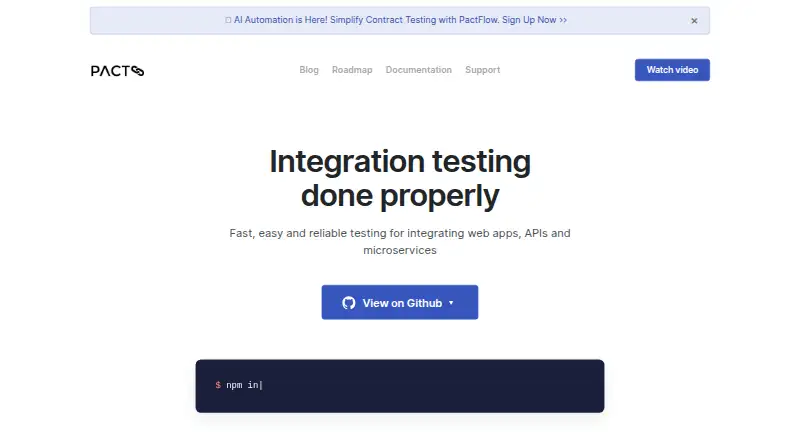
What Pact is
Pact is an open-source, code-first tool for testing HTTP and message integrations with contract tests. Automated consumer tests produce contracts describing specific interactions between consumer and provider applications. Teams can test each side in isolation against that shared understanding, without deploying the whole system. Pact implementations cover JavaScript, Java and JVM languages, .NET, Go, Python, Swift and Objective-C, Ruby, PHP and C++, with implementations also listed for Rust and Scala. Its CLI includes mock and stub servers, a provider verifier, a Broker client and a plugin CLI. The Pact Broker shares contracts and verification results, and its CI/CD workflows can check whether application versions are compatible for deployment. The verifier supports HTTP and asynchronous and synchronous messages; plugins include gRPC, Avro and CSV. Documentation includes recipes for tools and scenarios such as GraphQL, Cypress, Kafka and AWS Lambda. Pact is most useful when a team controls development of both consumer and provider applications. The free Broker is self-hosted, so its operator handles security, maintenance and upgrades.
Who it suits
Pact suits developers on teams that control both sides of an integration and want to check compatibility through contract tests. It is not intended for performance or load testing, provider functional testing, or APIs whose many consumers cannot maintain direct relationships with the provider team.
What it does well
- Tests consumer and provider applications in isolation
- Implementations cover more than ten languages
- Broker supports contract sharing and CI/CD compatibility checks
- Verifier supports HTTP and multiple message types
What to know first
- Free Pact Broker must be hosted and operated separately
- Self-hosting makes the operator responsible for security and upgrades
- Not intended for performance or load testing
- Not intended for provider functional testing
Limits
The free open-source tooling requires the Broker to be hosted and operated separately for shared contract workflows. PactFlow Starter includes two integrations; PactFlow Team includes 50 integrations. Team plans include a 14-day free trial.
Plans
| Plan | Billed and limits | Price |
|---|---|---|
| Pact open-source tooling | The official site presents Pact as open-source tooling and links to GitHub; it does not state a price. · Open-source contract testing tools · a Pact Broker must be hosted and operated separately for shared contract workflows | Free |
| PactFlow Starter | FREE · Unlimited users · 2 integrations · Bi-Directional Contract Testing | Free |
| PactFlow Team (yearly) | USD per month (billed yearly as $1,385) · 50 integrations · Community support · Bi-Directional Contract Testing · GitHub and Google Login · 14-day free trial | $115.42 a month |
| PactFlow Team (monthly) | USD per month · 50 integrations · Community support · Bi-Directional Contract Testing · GitHub and Google Login · 14-day free trial | $127 a month |
| PactFlow Enterprise | Contact Sales · Advanced user and security management · Dedicated support · SaaS or on-premise deployment | On request |
As pact.io lists them, read 4 Oct 2026. The maker's own page has the final word.
Getting started
- Visit the Pact website and choose the open-source tooling or a PactFlow plan.
- For shared contract workflows with the open-source tooling, host and operate a Pact Broker.
- Use an available Pact implementation for your programming language to generate contracts from consumer tests.
- Add contract verification to the consumer and provider workflow.
- Use Pact Broker CI/CD checks to assess whether application versions can be deployed together.
Pact is a code-first way to check whether HTTP and message integrations match the interactions applications expect. It suits developer-led teams that can coordinate consumer and provider changes. Its chief advantage is finding compatibility problems without deploying the whole system; it is the wrong tool for load testing or provider functional testing.
Overview
Automated consumer tests generate contracts that describe concrete interactions with provider applications. Pact lets each side be tested in isolation against that shared expectation, rather than requiring a complete integrated environment. This works best when the teams on both sides can maintain a direct development relationship; it is a poor fit for APIs with many consumers that cannot coordinate with the provider team.
Key features
The CLI includes mock and stub servers, a provider verifier, a Broker client and a plugin CLI. The verifier supports HTTP and synchronous or asynchronous messages, while plugins add protocols and formats including gRPC, Avro and CSV. Message testing is abstracted from the queue technology, with documented examples for ActiveMQ, RabbitMQ, SNS, SQS, Kafka and Kinesis. That breadth helps teams test varied integrations through a contract-based workflow, though Pact remains focused on compatibility rather than performance or provider behavior in general.
Consumer-driven contracts and verification results can be shared through the Pact Broker. Its CI/CD compatibility checks indicate whether application versions can be deployed together, helping teams catch unsafe combinations before release. The open-source Broker is self-hosted, however, so the team operating it owns security, maintenance and upgrades.
Implementations cover more than 10 languages, including JavaScript, Java and JVM languages, .NET, Go, Python, Swift and Objective-C, Ruby, PHP, C++, Rust and Scala. Documentation also provides recipes for GraphQL, Cypress, Jest, Mocha, Kafka, AWS Lambda and API Gateway. This gives developers multiple ways to fit contract checks into an existing stack, but adoption still depends on developer involvement in both consumer and provider workflows.
Pricing
The open-source Pact tooling costs nothing. It is the natural starting point for teams willing to run the Broker themselves; shared contract workflows still require hosting and operating that service.
PactFlow Starter costs nothing and includes unlimited users, two integrations and bi-directional contract testing. The two-integration cap makes it suitable for a small initial setup, but teams with more integrations need a paid plan.
PactFlow Team (yearly) costs $115.42 a month, billed yearly as $1,385. PactFlow Team (monthly) costs $127 a month. Both include 50 integrations, community support, bi-directional contract testing, GitHub and Google Login, and a 14-day free trial. The yearly option lowers the monthly rate in exchange for annual billing; the monthly option costs more but avoids that billing term. Neither plan lists dedicated support.
PactFlow Enterprise has custom pricing and includes advanced user and security management, dedicated support, and SaaS or on-premise deployment. PactFlow describes SAML single sign-on, role-based access management and SCIM provisioning as enterprise security capabilities; SSO, API tokens, audit trails and secrets are PactFlow premium features, not core Pact features. Teams needing those controls should distinguish the hosted PactFlow offering from the open-source tools.
Platforms
Pact is listed for API, Linux, macOS, Windows and self-hosted use. Its broad language support and CLI make it a developer-oriented choice rather than a general-purpose testing interface. PactFlow offers SaaS or on-premise deployment on Enterprise.
Who it's for
Choose Pact when developers own both ends of an integration and want to verify concrete consumer-provider expectations independently, especially across services that deploy on different schedules. Look elsewhere when the goal is load testing, provider functional testing, or contract management for a large consumer base without direct provider relationships.
Pros and cons
- Pro: Consumer-generated contracts and isolated verification can reveal integration mismatches before a full-system deployment is needed.
- Pro: The Broker's deployment compatibility checks fit CI/CD workflows where services change independently.
- Pro: Implementations across more than 10 languages and message support across queue technologies suit varied development stacks.
- Con: The free open-source Broker must be self-hosted, leaving security, upkeep and upgrades to its operator.
- Con: Pact depends on coordination between consumer and provider teams and does not replace load or provider functional testing.
- Con: PactFlow Starter is capped at two integrations, while the Team plans cap at 50.
Alternatives
Microcks is a free, open-source, community-driven CNCF Incubating project; consider it when that project model and its listed API, web and self-hosted platforms better fit your deployment needs.
oasdiff offers an open-source engine, CLI and GitHub Action under Apache 2.0; choose it when that specification-diffing toolchain is a closer match than Pact's consumer-provider contract workflow.
Specmatic covers OpenAPI, WSDL and MCP along with contract testing, API resilience testing and service virtualization; choose it when those protocol and testing areas are the priority.
Confluent Cloud offers managed Kafka clusters, autoscaling resources and more than 80 managed connectors on its Basic plan; choose it when managed Kafka infrastructure is the need rather than contract testing.
Karate combines REST, GraphQL and SOAP API testing with browser and desktop UI automation and Gatling performance testing; choose it when those broader test types matter more than Pact's contract-centered workflow.
Pact Broker is a separate listing for the self-hosted Broker and PactFlow Starter; consider it when the Broker itself is the focus.
Schemathesis generates tests from OpenAPI and GraphQL schemas; choose it when schema-generated API testing is the goal.
API Contract Tester offers a web-based free plan with 100 executions per month; consider it when a capped web service is preferable to developer-managed tooling.
Browse Contract Testing Tools, Integration Testing Tools, API Design Tools and API Testing Tools for more options by category.
Verdict
Pact is a strong choice for developer-led teams that control consumer and provider changes and need reliable deployment compatibility checks across HTTP and messaging integrations. Its open-source tooling keeps entry costs low, but the self-hosted Broker carries an operational burden, and teams seeking performance testing, provider functional testing or stronger managed security controls should look elsewhere or consider PactFlow.
Verdict
Pact focuses on contract-based integration checks, with tools for HTTP, messaging and deployment compatibility workflows. Its value is strongest when the same team controls both consumer and provider development; the free Broker requires self-hosting.
Questions
Is Pact free?
The open-source Pact tooling is free. PactFlow Starter is also free and includes unlimited users and two integrations.
What platforms does Pact support?
The listed platforms are API, Linux, macOS, self-hosted and Windows.
Is Pact open source?
Yes. The official site presents Pact as open-source tooling and links to GitHub.
Does Pact include a hosted Broker?
The open-source Pact Broker can be self-hosted and administered by the user. Its operator handles security, maintenance and upgrades.
What do PactFlow Team plans cost?
Team costs $115.42 a month when billed yearly as $1,385, or $127 a month when billed monthly. Both include a 14-day free trial.
What is Pact not intended for?
Pact documentation says it is not intended for performance or load testing, provider functional testing, or APIs whose many consumers cannot maintain direct relationships with the provider team.
Facts from Pact's own pages
- Broker
- The open-source Pact Broker shares contracts and verification results; it can be self-hosted and administered by the user. · docs.pact.io, 3 Oct 2026
- Broker role
- The Pact Broker shares consumer-driven contracts and verification results, and can report which application versions can be deployed safely together. · docs.pact.io, 4 Oct 2026
- CI/CD
- The Pact Broker supports CI/CD workflows, including compatibility checks that indicate whether application versions can be deployed together. · docs.pact.io, 3 Oct 2026
- CLI tools
- The Pact CLI includes mock and stub servers, a provider verifier, a broker client and a plugin CLI. · docs.pact.io, 4 Oct 2026
- How contracts work
- Pact contracts are generated by automated consumer tests and describe concrete interactions between consumer and provider applications. · docs.pact.io, 3 Oct 2026
- Integrations
- PactFlow's Bi-Directional Contract Testing integrates with OpenAPI and lists Cypress, Postman and Wiremock as tools for writing contracts. · pactflow.io, 4 Oct 2026
- Intended users
- PactFlow describes its service as supporting teams building microservices, messaging systems or cloud-native systems. · pactflow.io, 4 Oct 2026
- Languages
- The Pact site lists implementations for JavaScript, Java and JVM languages, .NET, Go, Python, Swift and Objective-C, Ruby, PHP, and C++. · pact.io, 3 Oct 2026
- Language support
- Pact implementations are available in more than 10 languages, including Java, Rust, JavaScript, .NET, Go, PHP, Python, Ruby, Swift/Objective-C, Scala and C++. · docs.pact.io, 4 Oct 2026
- Messaging
- Pact abstracts message testing from the queueing technology and documents examples involving ActiveMQ, RabbitMQ, SNS, SQS, Kafka, and Kinesis. · docs.pact.io, 3 Oct 2026
- Notable limit
- The free Pact Broker is self-hosted, so its operator is responsible for security, maintenance and upgrades. · docs.pact.io, 4 Oct 2026
- Not suitable for
- Pact documentation says it is not intended for performance or load testing, provider functional testing, or APIs whose many consumers cannot maintain direct relationships with the provider team. · docs.pact.io, 3 Oct 2026
- Platforms
- Pact CLI installation scripts support Linux, macOS and Windows on ARM64 and AMD64. · docs.pact.io, 4 Oct 2026
- Protocol support
- The Pact verifier supports HTTP, asynchronous and synchronous messages, and Pact plugins; plugins include support for gRPC, Avro and CSV. · docs.pact.io, 4 Oct 2026
- Purpose
- Pact is a code-first tool for testing HTTP and message integrations with contract tests. · docs.pact.io, 4 Oct 2026
- Security
- PactFlow says it encrypts data at rest with AES-256, enforces TLS 1.2 or higher, and stores data and backups in AWS Sydney. · pactflow.io, 4 Oct 2026
- Security administration
- PactFlow's Enterprise plan lists SAML single sign-on and role-based access management, and the security page describes SCIM support for automated user, group and role provisioning and deprovisioning. · pactflow.io, 4 Oct 2026
- Security distinction
- The Pact site describes SSO, API tokens, audit trails, and secrets as premium PactFlow features rather than core Pact features. · pact.io, 3 Oct 2026
- Support
- Pact's official site directs users to documentation, a Slack channel and partner support; PactFlow plans list email support for Team and dedicated account and customer care for Enterprise. · pact.io, 4 Oct 2026
- Testing model
- Pact contract tests check integrations in isolation against a shared understanding documented in a contract. · docs.pact.io, 4 Oct 2026
- Testing workflow
- Pact lets teams test consumer and provider applications in isolation without deploying the entire system. · docs.pact.io, 3 Oct 2026
Where Pact stands on Freedom251
- API Design Tools#10 of 26
- API Development Tools#13 of 32
- Contract Testing Tools#9 of 22
- API Testing Tools#14 of 34
- Integration Testing Tools#11 of 26