Freedom251 › Contract Testing Tools
Pact Broker
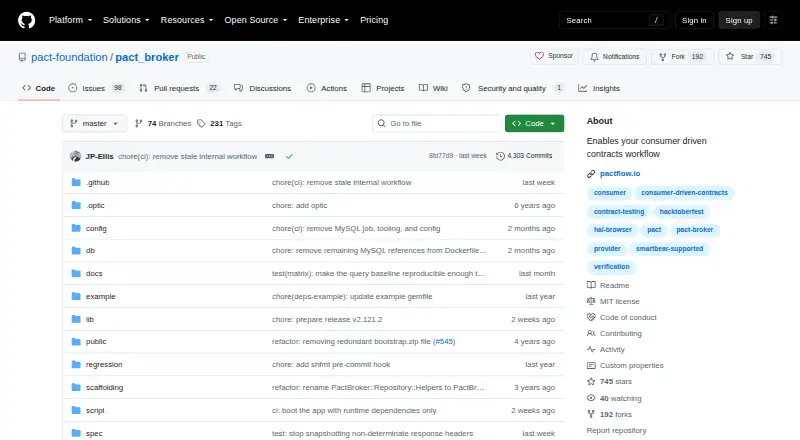
What Pact Broker is
Pact Broker is a contract registry for sharing consumer-driven contracts and verification results. It is optimized for Pact contracts and also accepts contracts that can be serialized as JSON. Its compatibility matrix helps teams identify consumer and provider versions that can safely be deployed together. In a typical CI workflow, consumer builds publish pacts, provider builds retrieve and verify them, and consumers can check with the can-i-deploy command before deployment. The broker includes a REST API, an embedded API browser, generated pact documentation, service network diagrams, verification results and status badges. Webhooks can trigger actions after contract changes, such as starting a provider build or notifying a Slack channel. Deployment documentation covers Docker, Terraform on AWS and PostgreSQL; SQLite is available for quick-start and CI use, but is not supported for long-term broker operation. Docker images support linux/amd64 and linux/arm64. The open-source self-hosted broker is free, but users manage hosting, operation, security, maintenance and upgrades. PactFlow also lists a free Starter plan and Team plans at $115.42 a month billed yearly or $127 a month billed monthly.
Who it suits
Pact Broker suits teams using consumer-driven contract testing in CI, particularly those that need to check compatibility before deployment. The self-hosted version fits teams prepared to operate and maintain their own broker.
What it does well
- Compatibility matrix checks deployable consumer-provider versions.
- REST API supports publishing and retrieving pacts.
- Webhooks can trigger actions when pacts change.
- Self-hosted broker is open-source and free.
- Docker images support linux/amd64 and linux/arm64.
What to know first
- Self-hosted users handle security, maintenance and upgrades.
- SQLite is not supported for long-term broker operation.
- Team plans cost $115.42 a month billed yearly or $127 a month billed monthly.
Limits
The free self-hosted broker requires users to provide hosting and handle operation, security, maintenance, and upgrades. SQLite is limited to quick-start and CI use and is not supported for long-term broker operation. PactFlow Starter includes two integrations; Team includes 50.
Plans
| Plan | Billed and limits | Price |
|---|---|---|
| Starter (PactFlow) | Unlimited users · 2 integrations · bi-directional contract testing | Free |
| Pact Broker (self-hosted) | Open-source broker · own hosting, operation, security, maintenance and upgrades | Free |
| Team (yearly, PactFlow) | USD per month (billed yearly as $1,385) · 50 integrations · community support · GitHub and Google login | $115.42 a month |
| Team (monthly, PactFlow) | USD per month · 50 integrations · community support · GitHub and Google login | $127 a month |
| Enterprise (PactFlow) | Contact Sales · SAML SSO · role-based access management · dedicated support · SaaS or on-premise deployment | On request |
As github.com lists them, read 30 Sept 2026. The maker's own page has the final word.
Getting started
- Open the Pact Broker project on GitHub.
- Choose self-hosted deployment or a PactFlow plan.
- For self-hosting, follow the documented Docker or Terraform on AWS deployment route.
- Configure PostgreSQL for broker operation; SQLite is documented for quick-start and CI use.
- Publish consumer pacts, retrieve and verify them in provider builds, then use can-i-deploy before deployment.
Pact Broker is a contract registry and CI companion for teams managing dependencies between service consumers and providers. It is best suited to organizations already adopting Pact and comfortable running infrastructure themselves. Choose it when deployment compatibility checks matter as much as storing contracts; choose a hosted plan when operations should not be your responsibility.
Overview
A normal workflow has consumer builds publish Pact contracts, provider builds retrieve and verify them, and consumers run can-i-deploy before release. The broker’s compatibility matrix maps consumer and provider versions, making unsafe pairings visible before they reach production. That turns contract testing into a release decision rather than a document repository.
Pact Broker is optimized for Pact’s HTTP and message interactions, while also accepting contracts that can be represented as JSON. It provides consumer and provider verification, a contract registry, GraphQL support, and a REST API for publishing and retrieving contracts. Teams can therefore integrate it into build automation instead of depending on manual uploads or a web-only workflow.
Key features
An embedded API browser, generated Pact documentation, service-network diagrams, verification results, and status badges make relationships and current contract state easier to inspect. Webhooks can react to pact changes by launching a provider build or sending a Slack notification, connecting a registry event to the next engineering action.
Docker deployment is documented alongside Terraform on AWS. PostgreSQL is suitable for a lasting installation, while SQLite is positioned for quick-start and CI use rather than long-term broker operation. Docker images target both linux/amd64 and linux/arm64. Configurable basic-auth users can receive read/write or read-only privileges. The Docker project reports bundler-audit, Trivy scans of published digests and weekly scans, and Renovate; these measures support maintenance but do not remove the team’s security duties.
Pricing
The free Starter (PactFlow) plan costs nothing and allows unlimited users, two integrations, and bi-directional contract testing. It is a sensible entry point for a small hosted setup, though two integrations can become restrictive as delivery pipelines multiply.
Pact Broker (self-hosted) is also free and includes the open-source broker. The trade-off is substantial: your organization supplies hosting, operations, security, maintenance, and upgrades. This is the economical option for teams with platform capacity, not a zero-effort service.
Team (yearly, PactFlow) costs $115.42 a month, billed yearly as $1,385, with 50 integrations, community support, and GitHub and Google login. Team (monthly, PactFlow) costs $127 a month, billed monthly, with the same 50 integrations and support and login options. The yearly term lowers the monthly rate but commits spending for the billing year. Enterprise (PactFlow) has custom pricing and adds SAML SSO, role-based access management, dedicated support, and SaaS or on-premise deployment.
Platforms
Pact Broker is available as an API, web application, Linux deployment, and self-hosted service. Docker’s multi-platform images cover linux/amd64 and linux/arm64, giving infrastructure teams practical options for those architectures.
Who it's for
It fits development and platform teams coordinating API changes across many consumers and providers, particularly those standardizing on Pact and embedding checks in CI. The REST API, webhooks, and command-line deployment gate suit automated pipelines. Teams without capacity to run databases, upgrades, authentication, and security controls should favor PactFlow instead of assuming the open-source price means no operational cost.
Pros and cons
- Pros: Compatibility checks and can-i-deploy connect verification directly to release safety.
- Pros: REST access, webhooks, diagrams, generated documentation, and status badges support both automation and review.
- Pros: MIT licensing and a zero-cost self-hosted option allow extensive control and customization.
- Cons: Self-hosting requires ongoing hosting, security, maintenance, and upgrades, with SQLite unsuitable for durable operation.
- Cons: The free PactFlow Starter tier is limited to two integrations, while Team pricing is materially higher once 50 integrations are needed.
Alternatives
See the Contract Testing Tools directory for broader comparisons. Choose Microcks instead if you want a 100% open-source, community-driven CNCF Incubating project across a wider range of platforms. oasdiff is a better fit for OpenAPI-focused breaking-change detection with an open-source CLI and GitHub Action. Pick Pact when you need the underlying open-source Pact tooling rather than a broker service. Specmatic suits teams working across OpenAPI, WSDL, or MCP with contract and resilience testing. Confluent Cloud is the alternative for managed Kafka infrastructure. Karate combines API testing with browser, desktop, and performance capabilities. Schemathesis focuses on generated tests from OpenAPI and GraphQL schemas. API Contract Tester is a web option with a free 100-execution monthly tier.
Verdict
Pact Broker is a strong choice for Pact-centered teams that need a registry, verification evidence, and a concrete pre-deployment compatibility gate. Its main reason to look elsewhere is operational ownership: if running the broker and its database is not desirable, PactFlow’s paid tiers or a different managed testing service will be a better fit.
Verdict
Pact Broker supports contract sharing and verification within CI workflows, with a compatibility check before deployment. The free self-hosted option puts hosting and ongoing operations on the user; PactFlow plans are also listed.
Questions
Is Pact Broker free?
Yes. The self-hosted open-source broker is listed as free. PactFlow Starter is also listed as free.
What does Pact Broker do?
It shares consumer-driven contracts and verification results, and provides a compatibility matrix to check which consumer and provider versions can safely deploy together.
Can I host Pact Broker myself?
Yes. Self-hosted deployment is supported, and the project documents Docker and Terraform on AWS. Users handle hosting, operation, security, maintenance, and upgrades.
What platforms and deployment options are listed?
Platforms include API, Linux, self-hosted, and web. Docker images are available for linux/amd64 and linux/arm64.
What are the PactFlow Team prices?
Team costs $115.42 a month when billed yearly as $1,385, or $127 a month when billed monthly.
What license does Pact Broker use?
The Pact Broker repository is published under the MIT license.
Facts from Pact Broker's own pages
- API availability
- The Pact Broker exposes a RESTful API for publishing and retrieving pacts. · github.com, 30 Sept 2026
- Authentication
- The Docker distribution supports configurable basic-auth users with read/write and read-only privileges. · github.com, 30 Sept 2026
- Automation
- Webhooks can trigger actions when pacts change, such as running a provider build or notifying a Slack channel. · github.com, 30 Sept 2026
- CI workflow
- Consumer builds publish pacts, provider builds retrieve and verify them, and consumers can use the can-i-deploy command to check before deployment. · github.com, 30 Sept 2026
- Core features
- Features include a REST API, embedded API browser, autogenerated pact documentation, service network diagrams, verification results, and status badges. · github.com, 30 Sept 2026
- Free trial
- PactFlow's Team plan offers a free 14-day trial, and its Starter plan is listed as free. · pactflow.io, 30 Sept 2026
- Headquarters
- Melbourne, Australia · github.com, 28 Sept 2026
- Integrations
- The project documents Docker deployment, Terraform on AWS, PostgreSQL, and SQLite for quick-start and CI use; SQLite is not supported for long-term broker operation. · github.com, 30 Sept 2026
- License
- The Pact Broker repository is published under the MIT license. · github.com, 30 Sept 2026
- Purpose
- Pact Broker shares consumer-driven contracts and verification results, and is optimized for Pact contracts while also accepting contracts serializable to JSON. · github.com, 30 Sept 2026
- Safe deployments
- It provides a compatibility matrix to identify consumer and provider versions that can safely be deployed together. · github.com, 30 Sept 2026
- Security scanning
- The Docker project says it uses bundler-audit, Trivy scans on published image digests and weekly, and Renovate. · github.com, 30 Sept 2026
- Support
- The project directs users to its wiki, GitHub issues, Stack Overflow with the pact-broker tag, and Pact Slack. · github.com, 30 Sept 2026
- Supported platforms
- The Docker project provides multi-platform images for linux/amd64 and linux/arm64. · github.com, 30 Sept 2026
Where Pact Broker stands on Freedom251
- Contract Testing Tools#10 of 22