Freedom251 › Integration Testing Tools

Citrus
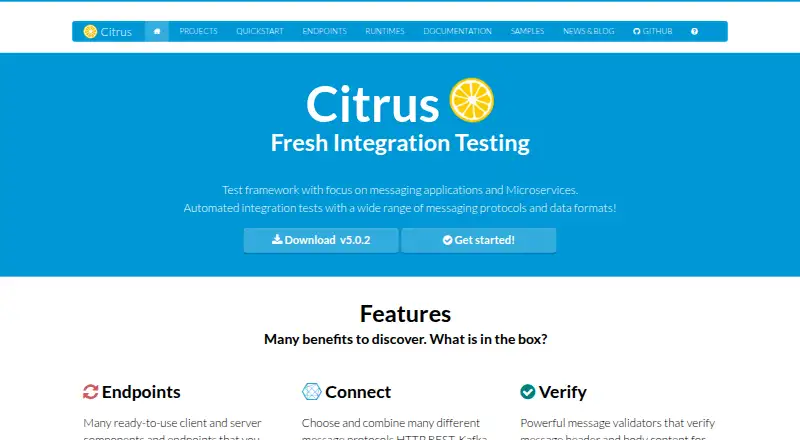
What Citrus is
Citrus is a test framework for automated integration testing of messaging applications and microservices, with a focus on enterprise integration scenarios. A test can operate as both client and server across supported messaging interfaces, then check the contents of messages. Endpoints include HTTP, Kafka, JMS, Apache Camel, mail, FTP/SFTP, OpenAPI, SOAP, Docker, Kubernetes, Knative, SQL, and SSH. Citrus validates JSON and XML payloads and elements, supports XML schema and DTD validation, and can check database data. Test cases can sequence messages and include loops, delays, retries, parallel sections, and timeouts. Tests can be authored in Java, XML, YAML, or Cucumber BDD feature format. The framework integrates with JUnit 5, Cucumber, JBang, Quarkus, Spring Boot, TestNG, and JUnit 4. Citrus runs on Linux; version 4.0 and later requires Java 17 or newer. Setup documentation describes adding modules as test-scoped Maven dependencies and also provides Gradle guidance. Citrus is free of charge under the Apache License 2.0, may be used to test commercial applications, and is listed as free. The project invites contributions, feature requests, and issue reports through its community repository.
Who it suits
Citrus suits teams building enterprise integration tests for messaging scenarios and microservices. It is especially relevant when tests need to exercise multiple interfaces and validate messages, schemas, or database data.
What it does well
- Tests can act as clients and servers on multiple interfaces.
- Supports a broad set of messaging and service endpoints.
- Validates JSON, XML, schemas, DTDs, and database data.
- Test cases support retries, delays, loops, and parallel sections.
- Apache License 2.0 permits use with commercial applications.
What to know first
- The listed platform is Linux.
- Version 4.0 and later requires Java 17 or newer.
Limits
Citrus 4.0 and later requires Java 17 or newer. The listed plan is free and includes the test automation framework under the Apache License 2.0.
Plans
| Plan | Billed and limits | Price |
|---|---|---|
| Citrus | Apache License 2.0 · test automation framework | Free |
As citrusframework.org lists them, read 9 Oct 2026. The maker's own page has the final word.
Getting started
- Review the download guide at https://citrusframework.org/.
- Add the required Citrus modules as test-scoped Maven dependencies, or consult the Gradle setup documentation.
- Use Java 17 or newer to run Citrus 4.0 and later.
- Write tests in Java, XML, YAML, or as Cucumber BDD features.
- Integrate Citrus with a supported runtime such as JUnit 5, Cucumber, JBang, Quarkus, Spring Boot, TestNG, or JUnit 4.
Verdict
Choose Citrus for Linux-based integration testing across messaging endpoints and microservices, particularly when message validation and flexible test logic matter. Look elsewhere if your environment cannot meet the Java 17-or-newer requirement for Citrus 4.0 and later.
Questions
How much does Citrus cost?
The Citrus plan is listed as free.
What license does Citrus use?
Citrus is published under the Apache License 2.0 and may be used to test commercial applications.
Which platform does Citrus support?
Citrus is listed for Linux.
What Java version does Citrus require?
Since version 4.0, Citrus requires Java 17 or newer.
Which protocols and endpoints does Citrus support?
Supported endpoints include HTTP, Kafka, JMS, Apache Camel, mail, FTP/SFTP, OpenAPI, SOAP, Docker, Kubernetes, Knative, SQL, and SSH.
How can Citrus be added to a project?
The download guide describes adding Citrus modules as test-scoped Maven dependencies and also lists Gradle setup documentation.
Facts from Citrus's own pages
- Build tools
- The download guide describes adding Citrus modules as test-scoped Maven dependencies and lists Gradle setup documentation. · citrusframework.org, 9 Oct 2026
- Founded
- 2006 · citrusframework.org, 23 Sept 2026
- Languages
- Tests can be written in Java, XML, YAML, or as Cucumber BDD features. · citrusframework.org, 9 Oct 2026
- License
- Citrus is published free of charge under Apache License 2.0 and may be used to test commercial applications. · citrusframework.org, 9 Oct 2026
- Protocols
- Supported endpoints include HTTP, Kafka, JMS, Apache Camel, mail, FTP/SFTP, OpenAPI, SOAP, Docker, Kubernetes, Knative, SQL, and SSH. · citrusframework.org, 9 Oct 2026
- Purpose
- Citrus is a test framework focused on messaging applications and microservices, for automated integration tests. · citrusframework.org, 9 Oct 2026
- Runtime requirement
- Since Citrus 4.0, the project requires Java 17 or newer to run. · citrusframework.org, 9 Oct 2026
- Runtimes
- Citrus integrates with JUnit 5, Cucumber, JBang, Quarkus, Spring Boot, TestNG, and JUnit 4. · citrusframework.org, 9 Oct 2026
- Support
- The project invites users to contribute, submit feature requests, and report issues through its community repository. · citrusframework.org, 9 Oct 2026
- Testing
- A test can act as both client and server on multiple messaging interfaces and validate message content. · citrusframework.org, 9 Oct 2026
- Test logic
- Test cases can sequence messages and use loops, delays, retries, parallel sections, and timeouts. · citrusframework.org, 9 Oct 2026
- Validation
- Citrus validates message payloads and elements in JSON and XML, supports XML schema and DTD validation, and can validate database data. · citrusframework.org, 9 Oct 2026
- Who it is for
- Citrus is presented for enterprise integration testing, including testing messaging scenarios and microservices. · citrusframework.org, 9 Oct 2026
Where Citrus stands on Freedom251
- Integration Testing Tools#12 of 26
- API Testing Tools#16 of 34
- Contract Testing Tools#11 of 22