
Apollo Client
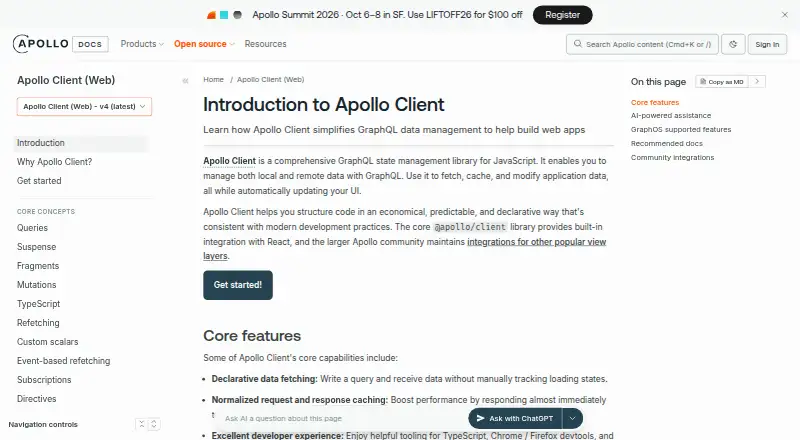
What Apollo Client is
Apollo Client is an open-source GraphQL state management library for JavaScript. It manages local and remote application data, fetches and caches it, and can modify data while updating the user interface. Developers can write queries without manually tracking loading states, and normalized caching lets cached queries respond almost immediately. The core @apollo/client library includes React integration, with support for hooks and Suspense. It can be adopted incrementally in JavaScript or TypeScript apps and works with any build setup and GraphQL API. Community integrations cover frameworks including Angular, Vue, Svelte, Solid.js, and Ember, as well as native iOS and Android. Apollo Client supports GraphOS Router features such as incremental delivery, GraphQL subscriptions, and persisted-query safelisting. Chrome and Firefox Devtools extensions provide GraphiQL and inspectors for watched queries, mutations, and cache. GraphOS Free includes one self-hosted router limited to 60 requests per minute and 1-day data retention. The separate Developer plan costs $5 a month, billed monthly, and includes up to 10 developers and 7-day data retention.
Who it suits
Apollo Client suits JavaScript or TypeScript developers building applications with GraphQL APIs, especially those using React. Teams using other frameworks or native mobile apps can also consider its listed community integrations.
What it does well
- Open-source library for GraphQL state management.
- Built-in React integration includes hooks and Suspense.
- Works with any build setup and GraphQL API.
- Devtools include query, mutation, and cache inspectors.
What to know first
- GraphOS Free router is limited to 60 requests per minute.
- GraphOS Free data retention is 1 day.
- Free plan supports up to 3 developers.
- Developer plan costs $5 a month.
Limits
The free GraphOS plan covers up to 3 developers, one self-hosted GraphOS Router limited to 60 requests per minute, 1-day data retention, and community support. The Developer plan is $5 a month, billed monthly, and allows up to 10 developers with 7-day data retention.
Plans
| Plan | Billed and limits | Price |
|---|---|---|
| Free | up to 3 developers · self-hosted GraphOS Router limited to 60 requests per minute · 1-day data retention · community support | Free |
| Developer | Billed monthly. Automatic volume discounts as your usage scales. · up to 10 developers · 7-day data retention · Developer Support (8×5, no SLA) · $50 usage credit when you sign up | $5 a month |
| Standard | Talk to sales · up to 30 developers · 90-day data retention · Standard Support (8×5, with SLA) | On request |
| Enterprise | Talk to sales · unlimited developers · 18-month data retention · Business Support (24×7×365, with SLA) | On request |
As apollographql.com lists them, read 1 Oct 2026. The maker's own page has the final word.
Getting started
- Open the Apollo Client documentation website.
- Add Apollo Client to a JavaScript or TypeScript application.
- Use the built-in React integration or a community integration for your framework.
- Use the free GraphOS tools or choose a GraphOS plan based on team size and support needs.
- Install the Chrome or Firefox Apollo Client Devtools extension if you need its inspectors.
Apollo Client is a JavaScript library for managing GraphQL data and keeping application interfaces up to date. It suits developers building GraphQL-backed apps, especially React teams that want fetching and caching in one client. The client is free and open source; GraphOS plans are a separate purchase for teams needing longer retention or support with an SLA.
Overview
Apollo Client brings remote and local data management together: it fetches, caches and modifies application data, then updates the UI automatically. That makes it a practical choice when an app repeatedly requests GraphQL data and needs its interface to reflect changes. It is less suitable if the need is simply to explore or test an API rather than manage data inside an application.
The core library is for JavaScript, with support for TypeScript apps as well. It can be introduced incrementally and works with any build setup and GraphQL API, so adopting it does not require a particular application scaffold.
Key features
Fetching and cache
Declarative queries return data without developers manually tracking loading states. Normalized request and response caching can make cached queries respond almost immediately, reducing repeated data-fetching work in the app. Those features are most useful where queries recur; a small project with little repeated GraphQL access may not need a dedicated client.
Framework and router support
The core @apollo/client package integrates with React, including hooks and Suspense. Community integrations extend to Angular, Vue, Svelte, Solid.js, Ember, Meteor, Apollo Elements web components, and native iOS and Android. This breadth gives teams outside React options, though those integrations are community-provided rather than part of the core React integration.
Apollo Client supports GraphOS Router features including incremental delivery with @defer, GraphQL subscriptions and persisted-query safelisting. Chrome and Firefox Devtools extensions provide GraphiQL plus inspectors for watched queries, mutations and the cache. Apollo also offers the Explorer IDE, schema registry, schema-usage insights and organization-based team collaboration for free.
Pricing
Apollo Client itself is free and open source. The paid plans below are for GraphOS tooling and operations, not a fee for using the client library.
| Plan | Price | Terms and limits |
|---|---|---|
| Free | free | Up to 3 developers, one self-hosted GraphOS Router limited to 60 requests per minute, 1-day data retention, and community support. |
| Developer | $5 a month | Billed monthly, with automatic volume discounts as usage scales; up to 10 developers, 7-day retention, Developer Support (8×5, no SLA), and $50 usage credit when you sign up. |
| Standard | Custom pricing | Talk to sales; up to 30 developers, 90-day retention, and Standard Support (8×5, with SLA). |
| Enterprise | Custom pricing | Talk to sales; unlimited developers, 18-month retention, and Business Support (24×7×365, with SLA). |
Free is adequate for a small team that can live with one-day retention and community support, but the 60-requests-per-minute Router cap may constrain operational use. Developer raises the developer ceiling and retention, adds weekday support without an SLA, and includes a $50 usage credit; it is the paid entry point for teams needing those upgrades, with monthly billing and usage-based discounts. Standard and Enterprise trade custom pricing for longer retention, larger or unlimited teams and support backed by an SLA. The client library remains free across these choices.
Platforms
Apollo Client is listed for web, API, Android, iOS and extension platforms. It has a hybrid deployment model, schema registry, API explorer and operation testing, but no client code generation. Apollo passed a SOC 2 Type II audit in May 2024 with no exceptions, is certified to ISO/IEC 27001:2022 as of October 10, 2024, and states compliance with NIST SP 800-171.
Who it's for
Choose Apollo Client if you are building a JavaScript or TypeScript GraphQL application and value declarative fetching, normalized caching and automatic UI updates, particularly with React. It also suits teams that want a path from a free client to GraphOS tooling as they need more retention, collaboration or contracted support. Look elsewhere if you need code generation or only a standalone API exploration tool.
Pros and cons
- Pro: Declarative queries and normalized caching reduce manual loading-state handling and can speed responses to cached queries.
- Pro: React support is built into the core library, while incremental adoption and community integrations extend its reach to other frameworks and native platforms.
- Pro: The client is free and open source, and Apollo provides several GraphOS tools at no cost.
- Con: The Free GraphOS Router is limited to 60 requests per minute, with only one-day retention and community support.
- Con: Developer Support has no SLA; SLA-backed Standard and Enterprise support require custom pricing.
- Con: Apollo Client does not provide client code generation.
Alternatives
For a broader directory, see GraphQL Tools. Choose Altair GraphQL Client if you want a GraphQL client with a free tier offering up to two team members, 20 queries and unlimited collections. Apollo Studio is an alternative for teams seeking GraphOS tooling, with a free plan for up to three developers, a 60-requests-per-minute Router limit and one-day retention. Choose Graphene for a free, open-source Python library installed with pip, or GraphiQL for a free MIT-licensed package for React applications. GraphQL Hive offers a free Hobby plan with 1M operations per month, seven-day usage-data retention and unlimited seats, projects and organizations. GraphQL.js is a free MIT-licensed JavaScript library installable from npm. Hot Chocolate is a free MIT-licensed option for commercial or private projects, while Lighthouse is a free PHP package for Laravel or Lumen projects.
Verdict
Apollo Client is a strong fit for developers building GraphQL applications who want fetching, normalized caching and UI updates in one free, adaptable library. Its main advantage is the combination of built-in React support and incremental adoption across app setups; its main caution is that useful GraphOS limits and support depend on a separate plan, with the free Router capped at 60 requests per minute and 1-day retention. Pick it for application-side GraphQL data management, not merely API exploration.
Verdict
Apollo Client offers data fetching, caching, and UI updates for JavaScript applications using GraphQL. Check the GraphOS Free plan’s request and retention limits, and distinguish the free client library from paid GraphOS plans.
Questions
Is Apollo Client free?
Apollo Client is open source and free. GraphOS also has a free plan at no cost.
What does the free GraphOS plan include?
It allows up to 3 developers, one self-hosted router limited to 60 requests per minute, 1-day data retention, and community support.
How much does the Developer plan cost?
It costs $5 a month, billed monthly, and includes up to 10 developers and 7-day data retention.
Which platforms and frameworks does it support?
Apollo Client is listed for Android, API, extension, iOS, and web. Community integrations include Angular, Vue, Svelte, Solid.js, Ember, Meteor, Apollo Elements web components, native iOS, and native Android.
Does Apollo Client include React support?
Yes. The core @apollo/client library has built-in React integration, including hooks and Suspense support.
What GraphOS tools are free?
Apollo lists the Explorer IDE, schema registry, schema-usage insights, and team collaboration through organizations as free GraphOS features.
Facts from Apollo Client's own pages
- Compatibility
- Apollo Client can be incrementally adopted in JavaScript or TypeScript apps and works with any build setup and GraphQL API. · apollographql.com, 1 Oct 2026
- Declarative fetching
- Apollo Client lets developers write a query and receive data without manually tracking loading states. · apollographql.com, 1 Oct 2026
- Developer tools
- Apollo Client Devtools are available as Chrome and Firefox extensions and provide GraphiQL, watched-query, mutation, and cache inspectors. · apollographql.com, 1 Oct 2026
- Founded
- 2016 · apollographql.com, 28 Sept 2026
- Free GraphOS tools
- Apollo says GraphOS features available to all users for free include the Explorer IDE, schema registry, schema-usage insights, and team collaboration via organizations. · apollographql.com, 1 Oct 2026
- Free-plan limit
- The GraphOS Free plan includes one self-hosted GraphOS Router limited to 60 requests per minute. · apollographql.com, 1 Oct 2026
- GraphOS features
- Apollo Client supports GraphOS Router features including @defer incremental delivery, GraphQL subscriptions, and persisted-query safelisting. · apollographql.com, 1 Oct 2026
- Headquarters
- San Francisco, California, United States · apollographql.com, 28 Sept 2026
- Integrations
- Community integrations include Angular, Vue, Svelte, Solid.js, Ember, Meteor, Apollo Elements web components, native iOS with Swift, and native Android with Java and Kotlin. · apollographql.com, 1 Oct 2026
- ISO certification
- Apollo GraphQL has been certified for ISO/IEC 27001:2022 as of October 10, 2024. · apollographql.com, 1 Oct 2026
- NIST compliance
- Apollo states that it is compliant with NIST SP 800-171 standards. · apollographql.com, 1 Oct 2026
- Normalized caching
- Apollo Client provides normalized request and response caching so cached queries can respond almost immediately. · apollographql.com, 1 Oct 2026
- Purpose
- Apollo Client is a GraphQL state management library for JavaScript that manages local and remote data, fetches, caches, and modifies application data, and automatically updates the UI. · apollographql.com, 1 Oct 2026
- React support
- The core @apollo/client library has built-in React integration and supports modern React features such as hooks and Suspense. · apollographql.com, 1 Oct 2026
- Security audit
- Apollo passed its SOC 2 Type II audit in May 2024 with no exceptions. · apollographql.com, 1 Oct 2026
- Support
- Apollo’s support offerings include community support for Free, Developer Support for Developer, Standard Support with SLA for Standard, and Business Support with SLA for Enterprise. · apollographql.com, 1 Oct 2026
Where Apollo Client stands on Freedom251
- GraphQL Tools#2 of 32