
Ariadne
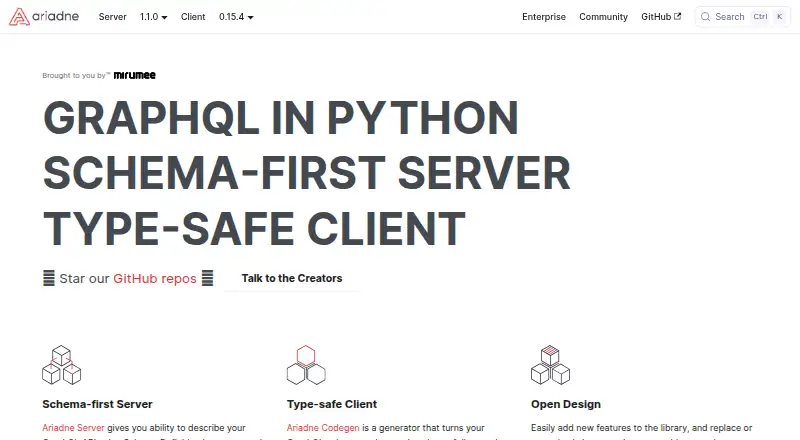
What Ariadne is
Ariadne is a free, open-source Python library for building GraphQL APIs with a schema-first approach. Developers define schemas in GraphQL Schema Definition Language (SDL) and connect fields to application logic with resolver functions. The server supports both asynchronous and synchronous query execution, and provides WSGI and ASGI apps for serving APIs. Ariadne is designed to interoperate with web frameworks, with a Django integration example on its site. Ariadne Codegen can generate a typed Python client and Pydantic models from a schema and operations; results from the generated client are validated against those models at runtime. An optional SQLAlchemy 2.0 integration supports synchronous sessions with WSGI and ASGI. AsyncSession is limited to ASGI and has a documented limitation involving sibling root fields. Ariadne implements the GraphQL multipart request specification for uploads; its default Upload scalar is write-only and accepts values passed through variables. The security documentation covers GraphQL risks such as denial-of-service attacks and credential leakage, with mitigation guidance. Ariadne is self-hosted and includes an API explorer, client code generation, and operation testing.
Who it suits
Ariadne suits Python developers building GraphQL APIs who want to define schemas first and connect fields to application logic. It also suits teams that need generated typed clients or WSGI and ASGI serving options.
What it does well
- Supports synchronous and asynchronous query execution.
- Provides both WSGI and ASGI apps.
- Codegen creates typed Python clients and Pydantic models.
- Free and open source.
What to know first
- SQLAlchemy AsyncSession support is ASGI-only.
- AsyncSession has a documented sibling-root-field limitation.
- The default Upload scalar is write-only.
Plans
| Plan | Billed and limits | Price |
|---|---|---|
| Ariadne | Open-source Python GraphQL server and client libraries | Free |
As ariadnegraphql.org lists them, read 8 Oct 2026. The maker's own page has the final word.
Getting started
- Visit the Ariadne website.
- Use the open-source Ariadne Python server and client libraries in a self-hosted deployment.
- Define the API schema with GraphQL SDL and connect fields to resolver functions.
- Choose synchronous or asynchronous execution and serve the API through WSGI or ASGI.
- Generate a typed Python client and Pydantic models with Ariadne Codegen if needed.
Overview
Ariadne is an open-source Python library for building GraphQL APIs from SDL schemas, with a companion client generator. It is a strong fit for Python teams that want schema-defined APIs and typed client code without adopting a hosted service.
Its combination of synchronous and asynchronous execution, WSGI and ASGI apps, and code generation makes it a flexible toolkit. The main cautions are specific: SQLAlchemy AsyncSession has an ASGI-only integration with a documented sibling-root-field limitation, and the default Upload scalar is write-only.
Key features
Teams define fields in GraphQL Schema Definition Language and connect them to application logic with resolver functions. Separating the schema contract from resolver implementation can help teams coordinate API shape without prescribing business logic. Support for both sync and async execution, plus WSGI and ASGI apps, gives Python projects options for serving the API.
Ariadne Codegen generates a typed Python client and Pydantic models from a schema and operations. Runtime validation of generated client results can expose mismatches as data enters client code. This is useful when a team wants generated types to be part of its development workflow, but does not remove the need to keep operations and schemas aligned.
The library interoperates with web frameworks, including a documented Django integration example. It also implements the GraphQL multipart request specification for uploads; the default Upload scalar is write-only and accepts values passed through variables, so applications needing other upload behavior should account for that constraint.
Optional SQLAlchemy 2.0 integration supports synchronous sessions under WSGI and ASGI. AsyncSession is limited to ASGI and has a documented limitation involving sibling root fields. That makes the integration less straightforward for applications relying on those query patterns. Ariadne's security documentation also addresses GraphQL risks such as denial-of-service attacks and credential leakage, with mitigation guidance; teams remain responsible for applying appropriate protections.
Pricing
Ariadne is free and open source. Its Ariadne plan costs nothing and includes open-source Python GraphQL server and client libraries. There is no free-trial distinction to weigh: the library is offered as a free plan, and deployment is self-hosted. This suits teams comfortable operating their own API infrastructure; it is not a hosted service plan.
Platforms
Ariadne is a Python server library for API, Linux, web, and self-hosted environments. It provides an API explorer, client code generation, and operation testing, making it more than a server implementation alone for teams building and working with GraphQL APIs.
Who it's for
Choose Ariadne if your team builds in Python, prefers SDL as the API contract, and wants synchronous or asynchronous server execution alongside a typed generated client. It is especially compelling when self-hosting is acceptable and client-side runtime model validation is valuable. Look elsewhere if you need a managed deployment or depend on SQLAlchemy AsyncSession behavior across sibling root fields.
Pros and cons
- Pros: SDL schemas and resolver functions keep the API contract distinct from application logic.
- Pros: Sync and async execution with WSGI and ASGI apps supports varied Python server setups.
- Pros: Codegen creates typed Python clients and Pydantic models, with runtime result validation.
- Cons: SQLAlchemy AsyncSession support is ASGI-only and has a sibling-root-field limitation.
- Cons: The default Upload scalar is write-only, which constrains upload handling.
- Cons: Self-hosted deployment means teams must run their own API infrastructure.
Alternatives
For a broader set of options, browse GraphQL Tools. If you need a client rather than a Python server library, Altair GraphQL Client offers a free plan with up to two team members and 20 queries on Basic, while its Pro plan is priced at 7.99 USD pe. Apollo Studio is another freemium option; its Free plan allows up to three developers, limits the router to 60 requests per minute, and retains data for one day.
Apollo Client is a free alternative for client work across Android, iOS, web, and extension platforms, with a three-developer cap and one-day data retention on its Free plan. Consider Hasura instead if its free hosted-style quotas suit your project: the Free plan allows two databases per project, 100MB data passthrough per month, and up to 3M API requests per month.
Graphene is another free, self-hosted Python library. GraphiQL is a free MIT-licensed project distributed as a package for React applications. GraphQL Hive offers a free Hobby plan with one million operations per month, seven-day usage data retention, and unlimited seats, projects, organizations, schema pushes, and ch. GraphQL.js is a free MIT-licensed JavaScript library installable from npm.
Verdict
Ariadne is a sound choice for Python teams that want an SDL-first GraphQL server, flexible sync or async serving, and typed client generation in one open-source toolkit. Its strongest reason to choose is that joined-up server-and-client workflow; its clearest reason to look elsewhere is the integration constraint around AsyncSession, alongside the need to self-host.
Verdict
Ariadne combines a schema-first Python GraphQL server with client generation and framework interoperability. Check its documented SQLAlchemy AsyncSession limitation if that integration is central to your setup.
Questions
How much does Ariadne cost?
The Ariadne plan is free, and the project is open source.
Is there a free plan or trial?
Ariadne is free. There is no free trial.
Which platforms does Ariadne support?
Its listed platforms are API, Linux, self-hosted, and web.
Is Ariadne self-hosted?
Yes. Its deployment model is self-hosted.
What does Ariadne Codegen do?
It generates a typed Python client and Pydantic models from a GraphQL schema and operations. Generated client results are validated against those models at runtime.
Who makes Ariadne?
The site credits Mirumee Software and Mirumee Labs. The listed headquarters is Wrocław, Poland.
Facts from Ariadne's own pages
- Async and sync
- The server supports asynchronous query execution and also offers synchronous execution. · ariadnegraphql.org, 8 Oct 2026
- Client validation
- Generated client results are validated against generated Pydantic models at runtime. · ariadnegraphql.org, 8 Oct 2026
- File uploads
- Ariadne implements the GraphQL multipart request specification, and its default Upload scalar is write-only and supports values passed through variables. · ariadnegraphql.org, 8 Oct 2026
- Headquarters
- Wrocław, Poland · ariadnegraphql.org, 28 Sept 2026
- Integrations
- The site describes interoperability with web frameworks and shows a Django integration example. · ariadnegraphql.org, 8 Oct 2026
- Maker
- The site credits Mirumee Software and Mirumee Labs; Mirumee's site gives its address as Wrocław, Poland and says it has championed open-source innovation for over 15 years. · mirumee.com, 8 Oct 2026
- Purpose
- Ariadne is a Python library for building GraphQL APIs with a schema-first approach. · ariadnegraphql.org, 8 Oct 2026
- Resolvers
- Ariadne connects schema fields to application business logic through resolver functions. · ariadnegraphql.org, 8 Oct 2026
- Security
- Ariadne's security documentation says GraphQL APIs can carry risks including denial-of-service attacks and credential leakage, and provides mitigation guidance. · ariadnegraphql.org, 8 Oct 2026
- Server interfaces
- Ariadne provides WSGI and ASGI apps for serving GraphQL APIs. · ariadnegraphql.org, 8 Oct 2026
- Server schema
- Developers define API schemas using GraphQL Schema Definition Language (SDL). · ariadnegraphql.org, 8 Oct 2026
- SQLAlchemy integration
- An optional SQLAlchemy 2.0 integration supports synchronous sessions under WSGI and ASGI, while AsyncSession is ASGI-only and has a documented limitation for sibling root fields. · ariadnegraphql.org, 8 Oct 2026
- Support
- The site lists a project email address for community contact: [email protected]. · ariadnegraphql.org, 8 Oct 2026
- Typed client
- Ariadne Codegen generates a typed Python client and Pydantic models from a GraphQL schema and operations. · ariadnegraphql.org, 8 Oct 2026
Where Ariadne stands on Freedom251
- GraphQL Tools#3 of 32