Freedom251 › API Documentation Tools

ApiNotes
What ApiNotes is
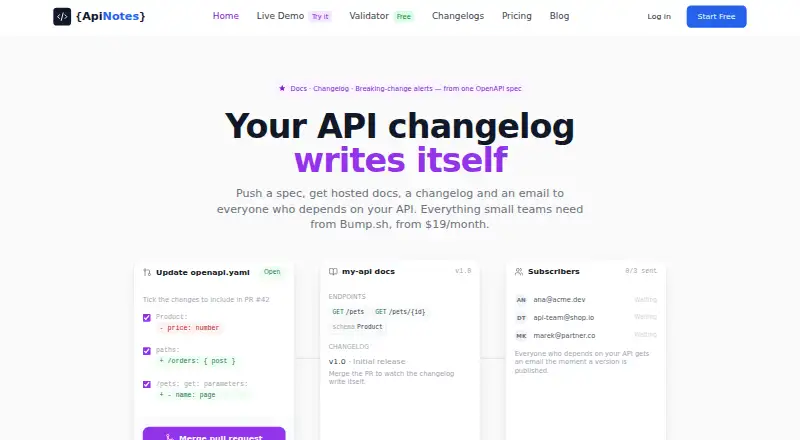
ApiNotes turns OpenAPI and Swagger specifications into hosted interactive API documentation and changelogs that flag breaking changes. It supports OpenAPI 3.0, 3.1, and 3.2, as well as Swagger 2.0, in YAML or JSON. Generated documentation can show endpoint parameters, response schemas, code examples in 10+ programming languages, and a Try-It-Now console. Users can paste, upload, or link a specification and publish the documentation on an ApiNotes subdomain. A GitHub Action can publish updated specifications on merge; the Team plan also lists pull request comments about breaking changes. The free Starter plan supports one public API, retains the last 10 changelog releases, and allows up to 25 subscribers and one team member. Team costs $19 a month and includes five APIs, private docs, full changelog history, unlimited subscribers, a custom domain, and five team members. Additional APIs are listed at £5/API. Team has a 14-day trial with no credit card required. Postman, Bruno, and Insomnia integrations are marked as coming soon.
Who it suits
ApiNotes suits developers who publish API references from OpenAPI or Swagger specifications and want changelog tracking. The free plan fits a single public API; teams needing private docs or more APIs can consider Team.
What it does well
- Supports OpenAPI 3.0, 3.1, 3.2, and Swagger 2.0.
- Generated docs include a Try-It-Now console.
- GitHub Action can publish updated specifications on merge.
- Team includes private documentation and a custom domain.
- Team trial lasts 14 days without a credit card.
What to know first
- Starter is limited to one public API.
- Starter retains only the last 10 changelog releases.
- Postman, Bruno, and Insomnia integrations are coming soon.
- Additional APIs are listed at £5/API.
Limits
Starter supports one public API, the last 10 changelog releases, up to 25 subscribers, and one team member. Team costs $19 a month and includes five APIs; additional APIs are listed at £5/API.
Plans
| Plan | Billed and limits | Price |
|---|---|---|
| Starter | 1 API (public only) · 10-release changelog · up to 25 subscribers · 1 team member · unlimited validator/diff tools | Free |
| Team | 5 APIs · full changelog history · unlimited subscribers · private docs · 25 guest readers · custom domain · 5 team members | $19 a month |
As apinotes.io lists them, read 30 Sept 2026. The maker's own page has the final word.
Getting started
- Visit https://www.apinotes.io/
- Paste, upload, or link an OpenAPI or Swagger specification
- Publish the documentation to an ApiNotes subdomain
- Use Starter for one public API, or choose Team for private docs and additional team features
- Optionally connect the GitHub Action to publish a revised specification on merge
ApiNotes is a hosted publisher for OpenAPI and Swagger-based API references, combining interactive documentation with an automatically generated change record. It is strongest for developers and small teams maintaining a specification in GitHub; organizations needing several private APIs or a longer history should budget for Team or consider a different platform.
Overview
ApiNotes converts an existing API specification into a hosted reference rather than asking a team to author documentation separately. You can paste, upload, or link a specification and publish it at an ApiNotes subdomain in under 60 seconds. The service supports OpenAPI 3.0, 3.1, 3.2, and Swagger 2.0 in YAML or JSON, covering the versions most specification-led projects are likely to maintain.
Its second role is change tracking. ApiNotes generates a changelog from specification revisions and calls out breaking changes, giving API consumers a more useful signal than a bare list of releases. Starter keeps only 10 releases, however, so the free tier is better for a small public API than for an archival record.
Key features
Generated references show endpoint parameters, response schemas, and code examples in more than 10 programming languages. The built-in Try-It-Now console lets readers exercise endpoints from the documentation, making the output more practical than static reference pages for developers learning an API or checking a request.
A GitHub Action can publish a revised specification when a change is merged. Team adds pull-request comments that identify breaking changes, putting compatibility warnings directly into a review workflow. That is a meaningful advantage for teams that treat the specification as a versioned source of truth. Postman, Bruno, and Insomnia imports are marked as coming soon, so they should not influence a current buying decision.
Validator and diff tools are unlimited on Starter, useful for checking a specification even when the free plan's publishing limits are restrictive. Uploaded specifications are stored for documentation hosting and versioning, while users retain intellectual-property rights to specifications, code, and generated documentation. Staff do not manually review uploads unless support troubleshooting is requested. If AI fixing tools are used, relevant portions are sent to OpenAI for formatting corrections and are not used to train public models. Deleting an account removes production data within 30 days; encrypted backups can retain residual data for up to 90 days.
Pricing
| Plan | Price | What you get |
|---|---|---|
| Starter | free | 1 public API, 10-release changelog, up to 25 subscribers, 1 team member, unlimited validator and diff tools |
| Team | $19 a month | 5 APIs, full changelog history, unlimited subscribers, private docs, 25 guest readers, custom domain, 5 team members |
Starter is a sensible way to publish one public API at no cost, but it excludes private documentation and limits both collaborators and historical context. Team's five-API allowance, private docs, custom domain, and five seats make it the practical choice for a small product group; extra APIs are listed at £5/API. Team includes a 14-day free trial with no credit card required. Custom plans are available by contacting ApiNotes, which is the route for requirements beyond these quotas.
Platforms
ApiNotes is web-based and hosted. Documentation is served from an ApiNotes subdomain unless Team's custom-domain option is used. The named infrastructure providers are AWS or DigitalOcean for hosting, MongoDB Atlas for the database, Lemon Squeezy for payments, and OpenAI for AI processing.
Who it's for
Choose ApiNotes if your team already maintains OpenAPI or Swagger files and wants publishable references, interactive examples, and breaking-change alerts without building a documentation pipeline. GitHub-centric teams gain the most from merge-triggered publishing and Team's pull-request comments. A solo developer with one public API can stay on Starter, provided 10 changelog releases and one seat are enough.
It is less suitable when you need many APIs on a free plan, a substantial self-hosted installation, or a documentation system not centered on OpenAPI and Swagger. Teams requiring private content, more than one contributor, or a durable release archive will quickly need Team or a custom arrangement.
Pros and cons
Pros
- Broad OpenAPI 3.0–3.2 and Swagger 2.0 support in YAML and JSON.
- Interactive references combine schemas, multilingual examples, and a Try-It-Now console.
- Automated changelogs and Team pull-request warnings make breaking changes easier to spot.
- Starter includes unlimited validator and diff tools and permits 25 subscribers.
- Users retain intellectual-property rights to uploaded and generated material.
Cons
- Starter supports only one public API, one team member, and the latest 10 releases.
- Private docs, unlimited subscribers, custom domains, and five seats require the 19.00 USD monthly Team plan.
- Postman, Bruno, and Insomnia integrations are not yet available.
- Account deletion can leave encrypted-backup remnants for up to 90 days.
Alternatives
Browse the API Documentation Tools list for broader comparisons.
Scalar is a better fit when you need desktop, API, self-hosted, and web options, with a free allowance of up to three APIs.
Fern suits teams wanting a free documentation site with 10 members, 1,000 pages, and monthly AI and generation quotas.
Javadoc is the straightforward choice for Java projects that want documentation included with JDK 25 at no software charge.
Swagger Codegen is preferable when generating API clients, server stubs, and documentation as open-source software matters more than hosted publishing.
Doxygen is a free, open-source option for Windows, Linux, and macOS documentation workflows.
Apiary fits public projects needing unlimited API projects and five participants per project.
Endrel is an alternative for teams seeking workspace-based API projects and environments.
Mihari is aimed at monitoring and status pages rather than specification-generated API references.
Verdict
ApiNotes is a strong choice for a specification-led developer or small GitHub team that wants interactive API references and automatic breaking-change communication in one hosted service. Start with Starter for a single public API; move to Team when private docs, multiple APIs, full history, or additional seats justify $19 a month. Look elsewhere if you need self-hosting, broad non-OpenAPI authoring, or integrations that are still upcoming.
Verdict
ApiNotes turns supported API specifications into hosted references with interactive features and breaking-change changelogs. Compare the Starter limits with Team’s $19 a month price and five-API allowance.
Questions
Is ApiNotes free?
Yes. Starter is free and includes one public API, the last 10 changelog releases, up to 25 subscribers, and one team member.
What does Team cost?
Team costs $19 a month and includes five APIs, full changelog history, unlimited subscribers, private documentation, a custom domain, and five team members.
Does Team have a free trial?
Yes. The Team plan includes a 14-day free trial, and no credit card is needed.
Which specifications can I import?
ApiNotes supports OpenAPI 3.0, 3.1, and 3.2, plus Swagger 2.0, in YAML or JSON.
Which platforms does ApiNotes support?
ApiNotes is listed for the web.
Are Postman, Bruno, or Insomnia integrations available?
Those integrations are marked “Coming soon.”
Facts from ApiNotes's own pages
- AI processing
- If users use the AI fixing tools, relevant specification portions are sent to OpenAI for formatting corrections and are not used to train public models. · apinotes.io, 30 Sept 2026
- Data deletion
- After account deletion, personal data and uploaded projects are deleted from production databases within 30 days, while encrypted backups may retain residual data for up to 90 days. · apinotes.io, 30 Sept 2026
- Data ownership
- The privacy policy says users retain full intellectual property rights to uploaded specifications, code, and generated documentation. · apinotes.io, 30 Sept 2026
- GitHub integration
- A GitHub Action can publish an updated specification on merge, and the Team plan lists PR comments showing breaking changes. · apinotes.io, 30 Sept 2026
- Interactive docs
- Generated docs include endpoint parameters, response schemas, code examples in 10+ programming languages, and a built-in Try-It-Now console. · apinotes.io, 30 Sept 2026
- Other import integrations
- Postman, Bruno, and Insomnia integrations are marked “Coming soon.” · apinotes.io, 30 Sept 2026
- Pricing limits
- Starter is limited to one public API and the last 10 changelog releases; Team includes five APIs, with additional APIs listed at £5/API. · apinotes.io, 30 Sept 2026
- Publishing workflow
- Users can paste, upload, or link a specification and publish documentation at an ApiNotes subdomain in under 60 seconds. · apinotes.io, 30 Sept 2026
- Service providers
- The privacy policy names AWS or DigitalOcean for hosting, Lemon Squeezy for payments, MongoDB Atlas for the database, and OpenAI for AI processing. · apinotes.io, 30 Sept 2026
- Specification access
- Uploaded specifications are stored for documentation hosting and versioning, and the policy says staff do not manually review them unless support troubleshooting is requested. · apinotes.io, 30 Sept 2026
- Support and custom plans
- The pricing page invites users who need a custom plan to contact ApiNotes. · apinotes.io, 30 Sept 2026
- Supported specifications
- The site lists full support for OpenAPI 3.0, 3.1, 3.2, and Swagger 2.0 specifications in YAML or JSON. · apinotes.io, 30 Sept 2026
- Team plan trial
- The Team plan includes a 14-day free trial and says no credit card is needed. · apinotes.io, 30 Sept 2026
- What it does
- ApiNotes turns OpenAPI or Swagger specifications into hosted interactive documentation and an automatically generated changelog with breaking-change alerts. · apinotes.io, 30 Sept 2026
Where ApiNotes stands on Freedom251
- API Documentation Tools#7 of 27