
Grist
by Grist
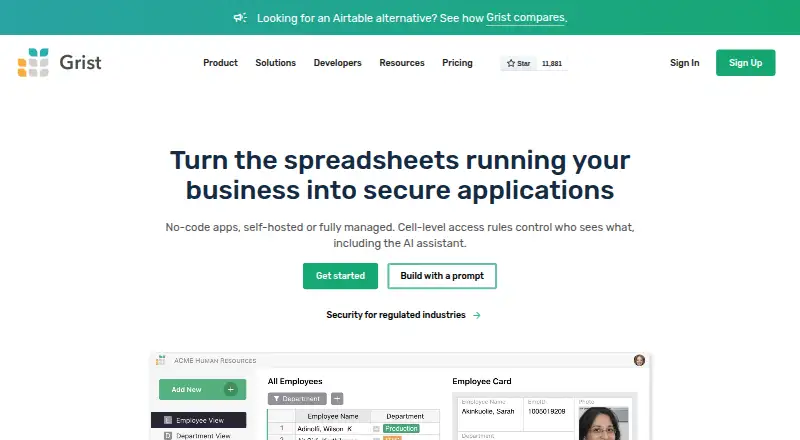
What Grist is
Grist combines spreadsheet and database capabilities for working with complex data. It organizes information relationally while letting users analyze and visualize it in a spreadsheet-style interface. Formulas can use Python or Excel-like functions, and pages can display tables, cards, forms, charts, calendars, and custom widgets. Granular access rules can govern visibility and editing for tables, columns, and records. Grist provides a REST API for reading and modifying documents, workspaces, and team sites, with integrations including Zapier, Integrately, Pabbly Connect, n8n, and Make. It can be used as hosted software, installed on customer infrastructure with Docker as a free open-source Community edition, or through a desktop application that needs neither internet access nor an online account. Documents are SQLite databases and can be exported as complete .grist files. Hosted Grist uses AWS infrastructure, HTTPS, encrypted storage and backups, and optional MFA; it has not undergone certification or auditing for SOC 2, ISO 27001, HIPAA, or GDPR compliance. Plans include a free tier, Pro at $8/user/mo annually, and a 30-day trial.
Who it suits
Grist suits people and teams who need to organize relational data while working with spreadsheet-style analysis, visualizations, and formulas. Its self-hosted and desktop options also suit users who prefer those deployment choices.
What it does well
- Supports Python and Excel-like formulas
- Offers tables, cards, forms, charts, and calendars
- Granular rules control visibility and editing
- Available as hosted, self-hosted, and desktop software
- Documents export as complete .grist files
What to know first
- Free plan limits documents to 5,000 records each
- Hosted product has not undergone listed compliance audits or certifications
- Business plan requires a minimum of 5 users
Limits
The free hosted plan allows up to 5,000 records per document, 30-day snapshot history, and 100 lifetime AI credits. Pro allows up to 100,000 records per document and 100 AI credits per month; Business allows up to 150,000 records per document and requires at least five users.
Plans
| Plan | Billed and limits | Price |
|---|---|---|
| Free | Unlimited documents · Up to 5,000 records/document · 30-day snapshot history · 100 lifetime AI credits | Free |
| Community edition | Free and open source · Hosted on your own server · Community support | Free |
| Grist Community edition | Free and open-source · Self-hosted · Community support · Custom domain · Custom branding | Free |
| Business | $288.00 per user per year (= $24.00 per user/month, billed annually) · Minimum 5 users · Up to 150,000 records/document · 5-year snapshot history · Automations · Priority email support · 30-day trial | $288 a year |
| Grist | monthly · Advanced admin controls · MCP server · AI Assistant · Automations · Custom SSO · Audit log streaming · Multiple team sites · Email notifications | $30 a month |
| Pro | $96.00 per user per year (= $8.00 per user/month, billed annually) · Up to 100,000 records/document · 3-year snapshot history · 100 AI credits/month · 30-day trial | $96 a year |
| Enterprise | Multi-server support · Pre-release security updates · Priority email support · Training workshop · Minimum 50 users | On request |
As getgrist.com lists them, read 30 Sept 2026. The maker's own page has the final word.
Getting started
- Open https://www.getgrist.com/ to use hosted Grist.
- Choose the free plan or a paid plan; Pro and Business list a 30-day trial.
- For self-hosting, install the Community edition on your infrastructure using Docker.
- For offline use, get the Grist desktop application based on Community edition.
Overview
Grist is a spreadsheet-and-database tool for teams that need structured records without giving up formula-driven analysis. It suits people building shared data workflows, especially when access rules, varied views, or self-hosting matter. Its flexibility is balanced by a 5,000-record-per-document ceiling on the free plan and a hosted service without major compliance certifications.
Key features
Structured data, spreadsheet analysis
Grist organizes information relationally and supports both Python formulas and Excel-like functions. That combination is useful when a flat spreadsheet no longer fits the work but users still want familiar calculations and analysis. Tables, cards, forms, charts, calendars, and custom widgets provide different ways to work with the same data; the app interface builder extends that flexibility for presenting it.
Permissions and connections
Granular rules can govern visibility and editing at the table, column, and record level, a meaningful advantage for shared documents with different access needs. A REST API can read and modify documents, workspaces, and team sites. Integrations through Zapier, Integrately, Pabbly Connect, n8n, and Make, along with workflow automation, help connect Grist to broader processes.
AI, portability, and security
The AI Assistant can answer questions about data, create or modify records, and help write formulas. Documents are SQLite databases and can be exported as complete .grist files, giving users a portable document format. Hosted Grist uses AWS infrastructure, encrypted S3 storage, HTTPS, optional MFA, and encrypted backups. It has not undergone certification or auditing for SOC 2, ISO 27001, HIPAA, or GDPR compliance, so organizations requiring those assurances should look elsewhere or assess self-hosting.
Grist can run on customer infrastructure with Docker, and its open-source Community edition supports self-hosting. A desktop application based on that edition works without an internet connection or online account. Community support is available through the forum and official Discord.
Pricing
The Free plan costs nothing and includes unlimited documents, up to 5,000 records per document, 30-day snapshot history, and 100 lifetime AI credits. It is a sensible way to start, but the record ceiling and finite AI allowance can constrain growing or AI-heavy work.
Pro costs $10 a month, billed monthly, and raises the cap to 100,000 records per document, with three-year snapshot history and 100 AI credits per month. It includes a 30-day trial. For individuals or smaller teams that have outgrown Free, the larger record allowance and longer history are the main reasons to upgrade.
Business costs $30 a month, billed monthly, with a minimum of five users. It allows up to 150,000 records per document and adds five-year snapshot history, automations, and priority email support; it also has a 30-day trial. The minimum seat count makes it a better fit for established teams than a small group seeking a modest upgrade.
Enterprise has custom pricing and includes dedicated servers plus advanced security and governance. The Community edition is free and open source, self-hosted, and supported by the community; a separate Community edition listing also includes a custom domain and custom branding. Those options trade hosted-plan conveniences for operating Grist on your own server.
A separate Grist plan costs $24 a year, billed annually, and includes advanced admin controls, an MCP server, AI Assistant, automations, custom SSO, audit log streaming, multiple team sites, and email notifications. The broad set of administration and team-site features may suit organizations prioritizing governance, but the plan's stated price term is notably different from the monthly hosted tiers.
Platforms
Grist supports API, Linux, macOS, self-hosted, web, and Windows. The desktop app's offline, no-account operation is particularly useful for people who need local access; hosted users instead get the managed AWS-backed environment.
Who it's for
Grist is strongest for people turning spreadsheet work into a structured, permissioned data application while retaining formulas and multiple ways to view records. It is less suitable for projects that exceed the Free plan's document limit without budget for an upgrade, or for hosted deployments that require audited compliance certifications.
Pros and cons
- Relational structure with familiar formulas: Python and Excel-like functions support complex work without limiting users to a flat-sheet model.
- Flexible data presentation: Tables, cards, forms, charts, calendars, and custom widgets can serve distinct tasks.
- Fine-grained access: Rules can target tables, columns, and individual records.
- Portable and deployable: SQLite-based .grist exports, Docker self-hosting, and an offline desktop app offer alternatives to a hosted account.
- Free-plan ceiling: Each document is capped at 5,000 records, which may prompt an upgrade as datasets grow.
- Hosted compliance gap: The service has not been certified or audited for SOC 2, ISO 27001, HIPAA, or GDPR compliance.
- Business seat minimum: At least five users are required, a poor fit for smaller teams needing Business features.
Alternatives
For a wider comparison, browse AI Spreadsheet Tools, No-Code Database Software, or Spreadsheet apps.
Consider Quadratic if its free plan and broader listed platform range—including Android and iOS—better match your device needs; it has no free trial. SheetFactorys may fit spreadsheet tasks centered on formula generation, data cleaning, and dashboards, though its free plan limits those activities and rows. Choose remio if you want a cross-device option for Windows, macOS, iOS, and Android with a free plan that provides 500 AI credits monthly.
Shortcut is worth considering for a web or extension-based tool with API access and a free weekly-credit allowance. Ajelix is another option for extension or web use. CleanSheet AI may suit web-based work where file, row, and AI-analysis quotas define the task. ExcelAI is a Windows and macOS alternative with a free request allowance, while GPTExcel offers web and API access and a free monthly credit allowance.
Verdict
Choose Grist when your work needs database-like relationships, spreadsheet formulas, flexible views, and precise permissions in one system, particularly if self-hosting or offline desktop use matters. Look elsewhere if hosted compliance certification is essential, or if your documents will outgrow the free record cap and the paid tiers do not fit your budget or team size.
Verdict
Grist offers relational data organization with spreadsheet-style analysis and several deployment options. The free plan caps each document at 5,000 records; Pro is listed at $8/user/mo with annual billing and a 30-day trial.
Questions
Is Grist free?
Yes. The hosted Free plan is 0.00 USD and includes unlimited documents, up to 5,000 records per document, 30-day snapshot history, and 100 lifetime AI credits. The Community edition is also free and open source.
What are the hosted plan prices?
The listed Free plan costs 0.00 USD. Pro is $10 a month, billed monthly, and Business is $30 a month, billed monthly. Enterprise has custom pricing.
Can I use Grist without hosting it online?
Yes. The Community edition can be self-hosted, and a desktop application works without internet access or an online account.
What platforms and deployment options does Grist offer?
The listed platforms are API, Linux, macOS, self-hosted, web, and Windows. Grist supports both hosted and self-hosted deployment.
Is Grist open source?
Yes. Grist Community edition is free and open source, and can be hosted on your own server.
What does the AI Assistant do?
It can answer questions about data, create or modify records, and help write formulas.
Facts from Grist's own pages
- Access control
- Grist provides granular access rules that can control visibility and editing for tables, columns, and records. · getgrist.com, 30 Sept 2026
- AI Assistant
- The AI Assistant can answer questions about data, create or modify records, and help write formulas. · support.getgrist.com, 30 Sept 2026
- API
- Grist provides a REST API for programmatically reading and modifying documents, workspaces, and team sites. · support.getgrist.com, 30 Sept 2026
- API access
- Yes · getgrist.com, 20 Sept 2026
- Compliance status
- The hosted Grist product has not undergone certification or auditing for SOC 2, ISO 27001, HIPAA, or GDPR compliance. · support.getgrist.com, 30 Sept 2026
- Desktop
- A Grist desktop application based on Grist Community edition is available and does not require internet access or an online account. · support.getgrist.com, 30 Sept 2026
- Formulas
- Grist supports Python formulas and Excel-like spreadsheet functions. · getgrist.com, 30 Sept 2026
- Founded
- 2014 · getgrist.com, 23 Sept 2026
- Free plan
- Yes · getgrist.com, 20 Sept 2026
- Headquarters
- New York City, United States · getgrist.com, 23 Sept 2026
- Hosted security
- Hosted Grist uses AWS infrastructure, encrypted AWS S3 storage, HTTPS, optional MFA, and encrypted backups. · support.getgrist.com, 30 Sept 2026
- Integrations
- Supported integrator services include Zapier, Integrately, Pabbly Connect, n8n, and Make. · support.getgrist.com, 30 Sept 2026
- Portability
- Grist documents are SQLite databases and can be exported as complete .grist files. · getgrist.com, 30 Sept 2026
- Product type
- Grist combines spreadsheet and database capabilities for complex data work. · support.getgrist.com, 30 Sept 2026
- Relational data
- Grist organizes data like a database or app while analyzing and visualizing it like a spreadsheet. · getgrist.com, 30 Sept 2026
- Self-hosting
- Grist can be installed on customer infrastructure using Docker and is available as a free open-source Community edition. · support.getgrist.com, 30 Sept 2026
- Paid from
- 8 · getgrist.com, 20 Sept 2026
- Support
- Grist provides community support through its forum and official Discord channel. · support.getgrist.com, 30 Sept 2026
- Views
- Grist supports tables, cards, forms, charts, calendars, and custom widgets on pages. · support.getgrist.com, 30 Sept 2026
Where Grist stands on Freedom251
- Spreadsheet apps#2 of 31
- No-Code Database Software#5 of 40
- AI Spreadsheet Tools#4 of 31