Freedom251 › HR Document Management Software
DutyDuke
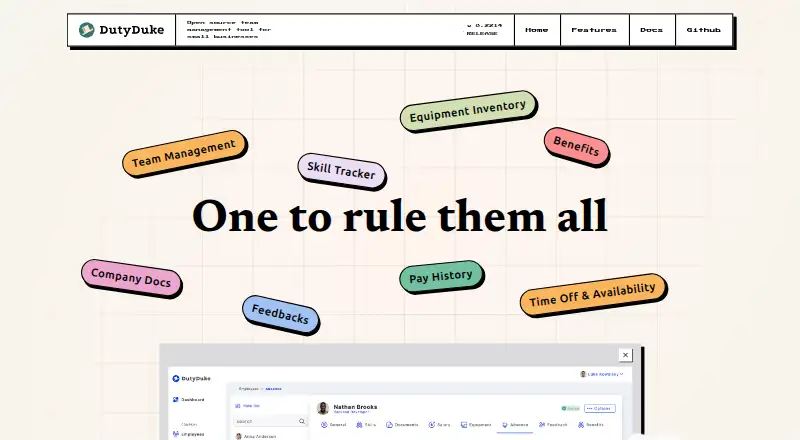
What DutyDuke is
DutyDuke is a free, open-source HR management platform for small and mid-sized companies, available on the web or self-hosted. Employee profiles can hold skills, education, employment history, documents, equipment, benefits, feedback, salary history and absence records. Leave tools include requests, approval workflows, a calendar view and iCal export. The platform also tracks company documents by version and deadline, and equipment by inventory and assignment. Other functions cover benefit plans, performance feedback sessions and PDF exports of employee profiles as CVs. It supports employee self-service, role-based permissions and API access. Email notifications use configurable SMTP, with production configurations able to point to providers such as Amazon SES, SendGrid or Mailgun. Documentation describes field-level encryption for sensitive information and JWT authentication. DutyDuke was created by Bitnoise, a Poland-based software house. A notable setup constraint is that users cannot self-register: an initial owner account must be created using a command-line script.
Who it suits
DutyDuke is intended for small and mid-sized companies managing employee records, leave, documents, equipment and benefits. It may suit teams comfortable with self-hosting or creating the first owner account through a command-line script.
What it does well
- Free and open-source.
- Available on the web or self-hosted.
- Supports leave approvals and iCal export.
- Tracks document versions and deadlines.
- Includes employee self-service and API access.
What to know first
- Self-registration is unavailable.
- Initial owner account requires a command-line script.
- Production SMTP should use TLS.
- Security keys and production passwords need careful configuration.
Limits
The free open-source plan is listed as free. Self-registration is unavailable, so the initial owner account must be created through a command-line script.
Plans
| Plan | Billed and limits | Price |
|---|---|---|
| Free open-source | Free to use, extend, and contribute on GitHub | Free |
As dutyduke.com lists them, read 2 Oct 2026. The maker's own page has the final word.
Getting started
- Visit https://dutyduke.com/.
- Choose web use or a self-hosted deployment.
- Create the initial owner account with the command-line script.
- Configure SMTP for email notifications, using a provider such as Amazon SES, SendGrid, or Mailgun if desired.
- Set unique JWT and encryption keys per environment, strong production passwords, and TLS for production SMTP.
DutyDuke is a free, open-source HR platform for small and mid-sized companies. It suits organizations that can host and configure their own software and want employee records, leave, documents and equipment in one place. Its broad HR toolkit is compelling; the command-line step to create the first owner account is a real barrier for teams without technical support.
Overview
Created by Poland-based software house Bitnoise, DutyDuke combines employee self-service, role-based permissions and API access. Because it can be extended and contributed to on GitHub, it offers flexibility without a subscription cost. That freedom shifts responsibility to the organization: it must host the system and complete an initial setup that does not offer self-registration.
For a smaller company able to manage that setup, DutyDuke can bring several routine HR workflows together. Organizations seeking a hosted service with a straightforward signup process should look elsewhere.
Key features
Employee records and self-service
Profiles can hold skills, education, employment history, documents, equipment, benefits, feedback, salary history and absences. This breadth gives HR a shared record across employee information and related resources, while PDF export can turn a profile into a CV. Employee self-service offers staff access, and role-based permissions let an organization structure access by role.
Leave, documents and equipment
Leave requests have approval workflows, a calendar view and iCal export, which helps teams coordinate absences and carry schedules into compatible calendars. Company documents include version and deadline tracking, useful for keeping document changes and due dates visible. Equipment inventory and assignment tracking extend the system beyond personnel records to assets assigned to employees.
Benefits, feedback and notifications
DutyDuke also supports benefit plans and performance feedback sessions. Email notifications use configurable SMTP; production setups can point to providers such as Amazon SES, SendGrid or Mailgun. This configuration flexibility suits organizations prepared to manage their own email delivery rather than expect a turnkey hosted setup.
Security and setup
Its documentation describes field-level encryption for sensitive data, JWT authentication and role-based access control. The maker advises using distinct JWT and encryption keys for each environment, strong production passwords and TLS for production SMTP. These controls are useful building blocks, but the guidance makes clear that secure deployment depends on careful configuration.
The main onboarding drawback is concrete: the first owner account must be created with a command-line script, and employees cannot self-register. An administrator comfortable with that step can establish the system; a company without command-line support may find the initial hurdle outweighs the savings.
Pricing
Free open-source
The Free open-source plan costs nothing. It is free to use, extend and contribute to on GitHub, and the platform includes employee self-service, role-based permissions and API access. There is no paid tier to compare against in the supplied plan lineup, so the trade-off is not a smaller feature allowance but the effort of hosting and configuring the software. That makes it a strong fit for technically capable teams prioritizing control and avoiding subscription charges, less so for buyers who want a managed service.
Platforms
DutyDuke is available as self-hosted software and on the web. Self-hosting aligns with its open-source flexibility, but organizations should account for the setup and configuration work it entails.
Who it's for
DutyDuke is best suited to small and mid-sized companies that want a broad HR record and workflow system, value the ability to extend open-source software, and have someone able to handle deployment and initial account creation. It is a weaker choice for teams that need self-registration or prefer a hosted product that minimizes technical setup.
Pros and cons
Pros
- Broad employee profiles: Skills, education, employment history, salary history, absences and related records can live together, with PDF CV export.
- Useful leave and document workflows: Approval flows, calendar and iCal support combine with document version and deadline tracking.
- Open-source with no subscription charge: The plan is free to use, extend and contribute to on GitHub.
- Configurable access and security foundations: Role-based controls, JWT authentication and field-level encryption are described, with production configuration guidance.
Cons
- Command-line owner creation: No self-registration means an administrator must use a script before the organization can begin onboarding users.
- Self-hosting responsibility: The flexibility of a self-hosted platform brings configuration and operational work that may not suit teams seeking a managed service.
Alternatives
For a broader set of document-management options, browse HR Document Management Software.
- IceHrm is worth considering if you want a free plan with a free trial, and employee profiles alongside attendance, payroll, documents, projects and timesheets.
- Zoho People has a free plan for 5 users, making it a natural alternative for a very small team that prefers a web or mobile product.
- SovoHR offers a free Starter plan for up to 1 employee and a free trial; it may fit a solo business looking for web-based HR basics.
- Efalia HR ECM is a paid alternative with self-hosted and web platforms, and pricing varies by company size, storage, users and features.
- oneDox is a paid self-hosted and web option with a personalized quote and a fixed monthly fee that does not change with user count.
- UKG Document Manager is a paid web option offered as an available capability within UKG Ready plans.
- Employment Hero is a paid web and mobile alternative without a free plan.
- Iron Mountain Digital HR Solution is another paid web option.
Verdict
Choose DutyDuke if your small or mid-sized organization wants a no-subscription, open-source home for employee records and everyday HR workflows, and has the technical capacity to host it and create the first owner account. Its breadth is the main reason to choose it; the setup burden and lack of self-registration are the main reasons to look elsewhere.
Verdict
DutyDuke brings employee records, leave workflows, document tracking and other HR functions into a free, open-source platform. Account setup requires creating the initial owner from the command line, so plan for that step before employees begin using it.
Questions
How much does DutyDuke cost?
Its Free open-source plan is listed as free.
Is DutyDuke open source?
Yes. The free plan is described as open source and available to use, extend, and contribute to on GitHub.
Can DutyDuke be self-hosted?
Yes. The listed platforms are web and self-hosted.
What does DutyDuke include for employee records and leave?
Profiles can contain skills, education, employment history, documents, equipment, benefits, feedback, salary history, and absence tracking. Leave features include requests, approval workflows, a calendar, and iCal export.
Who made DutyDuke?
DutyDuke was created by Bitnoise, which describes itself as a Poland-based software house. The project was founded in 2009 and is headquartered in Poznań, Poland.
Can users register themselves?
No. The initial owner account must be created through a command-line script.
Facts from DutyDuke's own pages
- Documents and equipment
- It includes company document management with version and deadline tracking, plus equipment inventory and assignment tracking. · dutyduke.com, 2 Oct 2026
- Employee management
- Employee profiles can include skills, education, employment history, documents, equipment, benefits, feedback, salary history, and absence tracking. · dutyduke.com, 2 Oct 2026
- Founded
- 2009 · dutyduke.com, 28 Sept 2026
- Headquarters
- Poznań, Poland · dutyduke.com, 28 Sept 2026
- Integrations
- Email notifications use configurable SMTP, and production configuration can point to providers such as Amazon SES, SendGrid, or Mailgun. · docs.dutyduke.com, 2 Oct 2026
- Maker
- DutyDuke was created by Bitnoise, which describes itself as a Poland-based software house. · dutyduke.com, 2 Oct 2026
- Notable limit
- Self-registration is unavailable; the initial owner account must be created through a command-line script. · docs.dutyduke.com, 2 Oct 2026
- Other HR features
- It supports benefit plans, performance feedback sessions, and PDF export of employee profiles as CVs. · docs.dutyduke.com, 2 Oct 2026
- Purpose
- DutyDuke is an open-source HR management platform for small and mid-sized companies. · docs.dutyduke.com, 2 Oct 2026
- Security
- The documentation describes field-level encryption for sensitive data, JWT authentication, and role-based access control. · docs.dutyduke.com, 2 Oct 2026
- Security configuration
- The maker advises using unique JWT and encryption keys per environment, strong production passwords, and TLS for production SMTP. · docs.dutyduke.com, 2 Oct 2026
- Support
- The maker invites users to contact Bitnoise at [email protected] with DutyDuke questions. · dutyduke.com, 2 Oct 2026
- Time off
- The app supports leave requests, approval workflows, a calendar view, and iCal export. · docs.dutyduke.com, 2 Oct 2026
Where DutyDuke stands on Freedom251
- HR Document Management Software#3 of 25