Freedom251 › Digital Asset Management Software
Cloudinary
by Cloudinary
What Cloudinary is
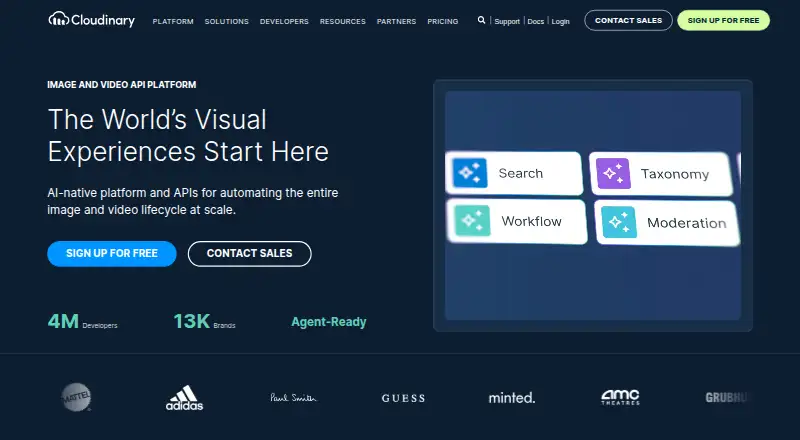
Cloudinary provides APIs for managing image and video assets, transforming media, and delivering optimized content. Its platform spans ingestion and storage, moderation, asset management, search, transformation, delivery, and workflow automation. Listed media capabilities include video transcoding, adaptive streaming, and CDN delivery. AI tools include smart cropping, optimization, vision, generative fill and restore, background replacement, and image generation. Cloudinary Assets adds AI agents for organizing, finding, moderating, and automating asset workflows. The Free plan includes an upload widget, API, search, MCP server access, and image and video features. It allows three users and one account, with 25 monthly credits; listed limits include 20 MB maximum file size and 225 GB bandwidth. Integrations include Contentful, AWS, Google Cloud, Shopify, Figma, WordPress, and Zapier. Cloudinary lists a free plan and Plus at $89/mo (annual).
Who it suits
It suits developers, teams, brands, and enterprises managing visual media and digital asset workflows. Developers can use its APIs, while enterprises can access listed security, compliance, and support options.
What it does well
- Free plan includes API, search, and upload widget.
- Supports image and video transformations and CDN delivery.
- AI tools include smart crop and generative fill.
- Integrations include Shopify, Figma, and WordPress.
What to know first
- Free plan is limited to 25 monthly credits.
- Maximum file size is 20 MB.
- Free plan bandwidth limit is 225 GB.
- Free plan support is through forums, tickets, and email.
Limits
The Free plan is listed with three users, one account, and 25 monthly credits, plus a 20 MB maximum file size and 225 GB bandwidth limit. Plus costs $99 per month with monthly billing or $89 per month with yearly billing, and includes three users, two accounts, and 225 monthly credits.
Plans
| Plan | Billed and limits | Price |
|---|---|---|
| Free | Free forever · 3 Users / 1 Account · 25 monthly credits | Free |
| Plus | $99 per month (monthly); $89 per month (yearly) · 3 Users / 2 Accounts · 225 monthly credits | On request |
| Advanced | $249 per month (monthly); $224 per month (yearly) · 5 Users / 3 Accounts · 600 monthly credits | $224 a month |
| Enterprise | Custom · Custom plan · enhanced features, security, support, and services | On request |
As cloudinary.com lists them, read 29 Sept 2026. The maker's own page has the final word.
Getting started
- Visit the Cloudinary website.
- Choose the Free plan or review the Plus and Advanced plans.
- Use the web platform, API, or extension.
- Start with the Free plan's upload widget, API, or search.
Cloudinary is a platform for managing, transforming, and delivering images and video through APIs and related tools. It suits developers and teams with substantial visual-media workflows; its breadth is a strength, but monthly credits and delivery caps make usage planning important.
Overview
Cloudinary covers the media lifecycle, from ingestion and storage through moderation, asset management, search, transformation, delivery, and workflow automation. That breadth can consolidate work that might otherwise span multiple tools, especially for organizations managing visual content across products or teams. The trade-off is that the plans impose monthly credit and user limits, so the right fit depends on both workflow complexity and scale.
Founded in 2012, Cloudinary describes its platform as AI-powered APIs for image and video management, transformation, and optimized delivery. It supports API, web, and extension access. Image transformations, private sharing, and custom domains are among the listed capabilities; the stated file-size limit is 20 MB.
Key features
Image and video transformations, video transcoding, adaptive streaming, and CDN delivery are included among Free plan features. For teams that need to prepare and serve media in multiple contexts, this combines processing and delivery in one platform. Cloudinary also lists smart crop, intelligent optimization, AI vision, generative fill and restore, background replacement, and image generation, extending its role beyond basic storage.
Cloudinary Assets adds digital asset management, with AI agents for organizing, finding, moderating, and automating across the asset lifecycle. The integrations directory includes Contentful, AWS, Google Cloud, Shopify, Figma, WordPress, and Zapier, useful connections for teams that want media workflows alongside existing content, commerce, or productivity systems.
The Free plan includes an upload widget, API, search, and access to MCP servers. Cloudinary supports access controls, single sign-on, multi-factor authentication, and least-privilege access, and conducts third-party penetration tests at least annually. Its Trust page identifies SOC 2 Type II certification and GDPR controls. AWS servers operate worldwide, with enterprise customers able to choose EEA data storage. Cloudinary says it is committed to 99.9% uptime and publishes service status and availability information.
Pricing
Cloudinary uses a freemium model and has no free trial. Free is free forever for three users and one account, with 25 monthly credits. It includes core media capabilities and support through forums, tickets, and email. The Free tier is a practical way to start, but its credit allowance and stated 225 GB bandwidth limit constrain how much ongoing processing and delivery it can support.
Plus costs $99 per month monthly or $89 per month yearly. It allows three users across two accounts and includes 225 monthly credits; expedited support is listed. The annual rate lowers the monthly price but requires an annual billing commitment. Advanced costs $249 per month monthly or $224 per month yearly, with five users, three accounts, and 600 monthly credits. It is the more suitable paid option when the smaller credit pool or Plus account allowance is insufficient, though its higher price is a meaningful step up.
Enterprise has custom pricing, contracts and invoicing, security and compliance review, enterprise SLAs and support, user management with SSO, and a provisioning API. It also lists a designated customer success manager and multi-CDN infrastructure. Those provisions suit organizations with formal operational and security requirements rather than teams seeking a fixed-price upgrade. The stated 225 GB bandwidth limit and 20 MB maximum file size are important to account for when sizing a workload.
Platforms
Cloudinary supports API, web, and extension platforms, with API access available on the Free plan. That mix makes it relevant to developers integrating media functions into products as well as teams working through web-based tools.
Who it's for
Cloudinary is best suited to developers, teams, brands, and enterprises that manage visual media at scale or need a connected set of ingestion, asset-management, transformation, and delivery workflows. The API access and processing features make it a stronger fit for media embedded in products than for someone who only needs a standalone mockup-making tool. Smaller teams can begin on Free, while organizations needing more credits, accounts, support, or enterprise controls can move to paid plans.
Pros and cons
- Pros: Covers the media lifecycle from ingestion through delivery, reducing the need to assemble separate tools for each stage.
- Pros: Free includes API access, search, an upload widget, image and video processing features, and 25 monthly credits, so teams can start without a paid commitment.
- Pros: Broad AI capabilities and asset-management features support more than simple file storage.
- Pros: Enterprise provisions include SSO and provisioning API, SLAs, security review, and a choice of EEA data storage.
- Cons: Free is limited to three users, one account, 25 monthly credits, and a 225 GB bandwidth limit, so it may not accommodate sustained high-volume use.
- Cons: Plus and Advanced have higher annual-commitment prices and defined user, account, and credit allowances; teams with fluctuating workloads should weigh those limits carefully.
- Cons: A 20 MB maximum file size may be restrictive for workflows involving larger source files.
Alternatives
For a focused mockup workflow, consider FlexClip, which has a free plan, no free trial, and support for Android, iOS, web, and Windows. LightX AI Mockup Generator is another option, with a free plan, a free trial, and apps for Android, iOS, web, and API access.
AIPostMockup has a free plan and web and API access. Mew Design AI Product Mockup Maker offers a free plan and free trial on web. Mockey AI has a free plan and Android and web platforms. Morphic offers a free plan on web, while Artboard Studio has a free plan and extension and web access. Custom Mockup Generator is a web-based option with a free plan and no free trial. These are alternatives to consider for mockup creation rather than a like-for-like choice based on the broader media lifecycle Cloudinary covers.
Browse AI Mockup Generators, Digital Asset Management Software, CDN Software, AI Reverse Image Search Tools, and Video Collage Maker Software for category options.
Verdict
Choose Cloudinary if your team needs developer-accessible tools for managing, processing, and delivering visual media across a broader workflow. Its lifecycle coverage, API access, and enterprise controls are the central reasons to consider it. Look elsewhere if you need only a focused mockup maker or if the plan credit, bandwidth, file-size, and seat limits do not match your workload.
Verdict
Cloudinary combines media lifecycle tools, APIs, and AI-assisted asset capabilities in one platform. The free tier has defined usage limits; paid options start at $89/mo (annual).
Questions
Is there a free plan?
Yes. Cloudinary lists a Free plan billed free forever, with three users, one account, and 25 monthly credits.
What do paid plans cost?
Plus is $99 per month with monthly billing or $89 per month with yearly billing. Advanced is $249 per month monthly or $224 per month yearly. Enterprise uses custom contracts and invoicing.
Which platforms does Cloudinary support?
The listed platforms are web, API, and extension.
What does the Free plan include?
It includes an upload widget, API, search, MCP server access, and listed image and video features such as transformations, video transcoding, adaptive streaming, and CDN delivery.
Which integrations are listed?
The integrations directory includes Contentful, AWS, Google Cloud, Shopify, Figma, WordPress, and Zapier.
What security and compliance details are listed?
Cloudinary lists access controls, single sign-on, multi-factor authentication, and least-privilege access. Its Trust page identifies SOC 2 Type II certification and GDPR controls.
Facts from Cloudinary's own pages
- AI capabilities
- Cloudinary lists smart crop, intelligent optimization, AI vision, generative fill, generative restore, background replacement, and image generation. · cloudinary.com, 29 Sept 2026
- API access
- Yes · cloudinary.com, 20 Sept 2026
- API and developer access
- Cloudinary says its Free plan includes an upload widget, API, search, and access to MCP servers. · cloudinary.com, 29 Sept 2026
- Asset management
- Cloudinary Assets is presented as digital asset management with AI agents for organizing, finding, moderating, and automating across the asset lifecycle. · cloudinary.com, 29 Sept 2026
- Compliance
- Cloudinary’s Trust page identifies SOC 2 Type II certification and GDPR controls. · cloudinary.com, 29 Sept 2026
- Enterprise features
- The Enterprise plan lists security and compliance review, multi-CDN infrastructure, enterprise SLAs and support, a designated customer success manager, and SSO and provisioning API. · cloudinary.com, 29 Sept 2026
- Founded
- 2012 · cloudinary.com, 28 Sept 2026
- Free plan
- Yes · cloudinary.com, 20 Sept 2026
- Hosting and data location
- Cloudinary says it uses AWS servers worldwide and offers enterprise customers the option to store data in the EEA. · cloudinary.com, 29 Sept 2026
- Image and video features
- The site lists image and video transformations, video transcoding, adaptive streaming, and CDN delivery among the Free plan features. · cloudinary.com, 29 Sept 2026
- Integrations
- The integrations directory lists connections including Contentful, AWS, Google Cloud, Shopify, Figma, WordPress, and Zapier. · cloudinary.com, 29 Sept 2026
- Intended users
- Cloudinary describes its users as developers, teams, brands, and enterprises managing visual media and digital asset workflows. · cloudinary.com, 29 Sept 2026
- Media lifecycle
- Its platform covers media ingestion and storage, moderation, asset management, search, transformation, delivery, and workflow automation. · cloudinary.com, 29 Sept 2026
- Product
- Cloudinary describes its platform as AI-powered APIs for image and video management, transformation, and optimized delivery at scale. · cloudinary.com, 29 Sept 2026
- Reliability
- Cloudinary says it is committed to maintaining 99.9% uptime and publishes service status and availability information. · cloudinary.com, 29 Sept 2026
- Security
- Cloudinary says it supports access controls, single sign-on, multi-factor authentication, and least-privilege access, and conducts third-party penetration tests at least annually. · cloudinary.com, 29 Sept 2026
- Paid from
- 89 · cloudinary.com, 20 Sept 2026
- Storage limit
- 225 · cloudinary.com, 20 Sept 2026
- Support
- The Free plan includes support through forums, tickets, and email, while Plus lists expedited support. · cloudinary.com, 29 Sept 2026
Where Cloudinary stands on Freedom251
- Digital Asset Management Software#5 of 151
- AI Mockup Generators#2 of 31
- AI Reverse Image Search Tools#3 of 31
- CDN services#4 of 35
- Image CDN services#3 of 26
- AI Mascot Generators#5 of 40
- CDN Software#5 of 33
- Video Collage Maker Software#4 of 22
- Visual Search Software#4 of 19
- Web Accelerator Software#4 of 14