Freedom251 › Monorepo Management Tools

bento
What bento is
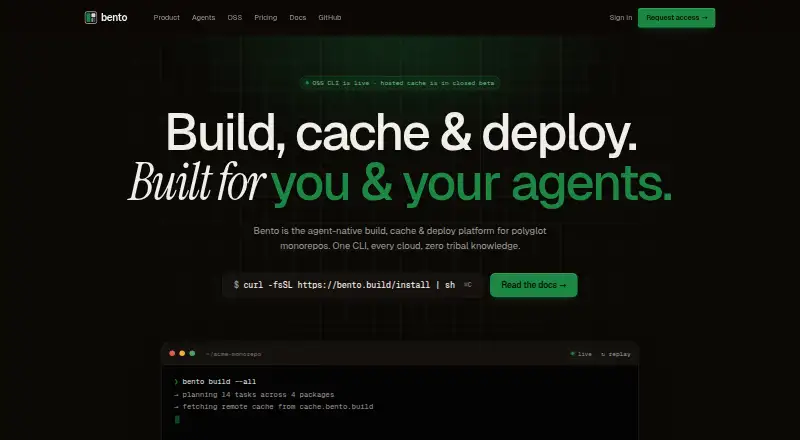
Bento is an open-source tool for coordinating software work across monorepos that use several programming languages and package ecosystems. It can plan, build, test, lint, deploy, and cache tasks, while its task graph tracks which builds are affected. Built-in adapters support Go, Rust, Python, Ruby, PHP, Maven, Gradle, npm, pnpm, yarn, Bun, and Deno. Its package-manager support also includes pip and uv.
Bento’s content-addressed cache offers local, GitHub Actions, and remote tiers. The remote cache can be hosted or self-hosted. For deployments, its guide describes integrations with Railway, Vercel, Cloudflare Pages, and Cloudflare Workers. Bento also includes an MCP server for agent clients including Claude Code, Cursor, Codex, OpenCode, Zed, and Windsurf.
Environment profiles hold aliases for secret-variable names rather than the secret values. The software supports Linux, macOS, Windows, and self-hosted setups. The hosted cache is in closed beta and requires access. Its Free plan costs nothing and includes 10 GB of storage with 14-day retention. Other published tiers are planned pricing, not active prices.
Who it suits
Bento suits teams coordinating builds and deployments across monorepos with multiple language ecosystems or package managers. It may also suit teams that want a local or self-hosted remote cache, or that use the listed coding-agent clients.
What it does well
- Task graph tracks affected builds.
- Supports a broad range of language ecosystems and package managers.
- Offers local, GitHub Actions, and remote cache tiers.
- Remote caching can be self-hosted.
- Includes deployment integrations and an MCP server for coding agents.
- Open source with a free plan.
What to know first
- Hosted cache is in closed beta and requires access.
- Free plan storage is limited to 10 GB with 14-day retention.
- Other published tiers have planned pricing rather than active prices.
Limits
The Free plan includes 10 GB stored and 14-day retention. When an organization exceeds its storage cap, new uploads stop while reads continue. The hosted cache requires access during its closed beta; other published tiers are planned rather than active prices.
Plans
| Plan | Billed and limits | Price |
|---|---|---|
| Free | 10 GB stored · 14-day retention | Free |
| Starter | 100 GB stored · 90-day retention · pricing is planned, not active | On request |
| Business | Custom storage · custom retention · quoted, not sold during beta | On request |
| Team | 500 GB stored · 1-year retention · pricing is planned, not active | On request |
As bento.build lists them, read 7 Oct 2026. The maker's own page has the final word.
Getting started
- Visit https://bento.build/.
- Use Bento on Linux, macOS, or Windows, or choose a self-hosted setup.
- Choose the Free plan, listed as free, or review the published storage and retention tiers.
- For hosted-cache use, obtain access to the closed beta.
- Select local, GitHub Actions, hosted remote, or self-hosted remote caching.
Bento is a polyglot monorepo orchestrator for coordinating build, test, lint, deployment, and cache work across language ecosystems. It suits teams that want task graphs and remote-cache options in one workflow, including the option to self-host. Its open-source Free plan is useful for modest cache needs; hosted caching is still in closed beta.
Overview
Bento brings task planning and caching to repositories that span multiple languages and package managers. Its content-addressed cache can operate locally, through GitHub Actions, or on a hosted or self-hosted remote tier, giving teams a choice between keeping cache infrastructure close to their own setup and seeking a managed route.
The task graph and affected-build support make it relevant to teams looking to coordinate monorepo work rather than simply manage packages. That breadth is also its main appeal: built-in adapters span compiled-language ecosystems and JavaScript runtimes, while deployment integrations extend the workflow to several hosting targets.
Key features
Task planning and caching
Bento plans builds, tests, linting, and deployments, with a task graph to express how work relates. Affected-build support pairs naturally with that graph: it is aimed at running relevant work in a monorepo, rather than treating every change as an isolated project. The content-addressed cache offers local, GitHub Actions, and remote tiers, so teams can choose a cache arrangement that fits their infrastructure.
Remote cache storage has practical caps. When an organization exceeds its storage limit, Bento stops accepting new uploads but continues serving reads. That preserves access to existing cache entries, but teams that rely on fresh uploads will need to stay within their quota.
Ecosystems and integrations
Built-in adapters cover Go, Rust, Python, Ruby, PHP, Maven, Gradle, npm, pnpm, yarn, Bun, and Deno. The package-manager support also includes pip and uv, making Bento a plausible fit for repositories that mix language ecosystems rather than standardize on one toolchain.
Deployment integrations are described for Railway, Vercel, Cloudflare Pages, and Cloudflare Workers. Bento also ships an MCP server for agent clients including Claude Code, Cursor, Codex, OpenCode, Zed, and Windsurf. These integrations broaden the workflows it can connect, though the core case remains coordinating monorepo tasks and caches.
Security and secrets
Hosted-cache requests use team-scoped JWTs signed with Ed25519; the cache worker verifies those tokens against the control plane's public keyset. Environment profiles keep aliases for secret-variable names rather than storing secret values. This separation is useful for teams that want profiles to refer to secrets without placing the values themselves in those profiles.
Pricing
Bento is open source, and its Free plan costs nothing. It includes 10 GB of stored cache with 14-day retention, a reasonable starting point for teams that can work within a modest storage allowance and short retention window.
The hosted cache is in closed beta and requires access. There is no billable usage during beta, so the published tiers should not be treated as active offers. Starter is planned at 100 GB stored with 90-day retention; Team is planned at 500 GB stored with one-year retention. Both have custom pricing rather than an active price. Business has custom storage and retention with quoted pricing, and is not sold during beta.
Those higher tiers offer longer retention and more or tailored storage, but teams cannot currently choose them as priced plans. The self-hosted remote-cache option may suit teams that need remote caching without relying on hosted-beta access.
Platforms
Bento supports Linux, macOS, and Windows, as well as self-hosted deployment. The combination of desktop operating-system support and self-hosting makes it relevant to teams with varied developer environments or a preference for operating their own remote cache.
Who it's for
Bento is best suited to teams coordinating a monorepo across several of its supported ecosystems, especially those that value task graphs, affected builds, and the ability to choose local, CI-based, hosted, or self-hosted caching. The Free plan offers a concrete way to start when 10 GB and 14-day retention are enough.
It is a less compelling fit for teams that require immediate access to a managed hosted cache: that service remains in closed beta. Teams with large or long-lived cache needs also need to account for the Free plan's storage and retention limits, and should not assume planned paid tiers can be purchased today.
Pros and cons
- Broad ecosystem coverage: adapters span Go, Rust, Python, Ruby, PHP, Java build tools, and multiple JavaScript runtimes and package managers, helping mixed-language monorepos share an orchestrator.
- Flexible cache deployment: local, GitHub Actions, hosted, and self-hosted remote options give teams more than one way to handle cache infrastructure.
- Useful free allowance: 10 GB of storage and 14-day retention provide a defined starting point without a paid plan.
- Hosted access is constrained: the hosted cache requires closed-beta access, limiting its usefulness for teams seeking a managed service now.
- Paid capacity is not yet purchasable: Starter and Team are planned pricing, while Business is quoted and not sold during beta, leaving teams without an active paid upgrade path.
- Free cache limits may bind: uploads stop at the storage cap, even though reads continue, which can hinder teams that need to keep adding cache entries.
Alternatives
Monorepo Management Tools is a useful starting point for comparing options across the category.
- Bazel is a free, open-source build and test tool from Google; choose it if that build-and-test focus is the better fit.
- Bit offers an open-source plan and free personal use through Bit Cloud; consider it if those are the priorities.
- Blaze has a free plan and supports Linux, macOS, and Windows; it is another option to consider.
- Bun is an open-source JavaScript runtime and toolkit; choose it when that role, rather than monorepo orchestration, is what you need.
- EvoMaster is free and open source, with no paid external services required; consider it if those terms matter most.
- FerrFlow is free and open source, MIT licensed, and distributed as a single Rust binary; it may suit readers seeking those characteristics.
- manypkg is a free, MIT-licensed CLI package; consider it as an alternative.
- mise is a free, MIT-licensed option for macOS, Linux, and Windows; consider it if that platform coverage and license fit your needs.
Verdict
Choose Bento if you need one orchestrator for monorepo tasks across its supported ecosystems and want task graphs alongside flexible caching, including self-hosting. Its strongest limitation is the hosted-cache beta: access is restricted, and the planned paid tiers are not active offers. If you need a managed cache immediately or need more than the Free plan's 10 GB and 14-day retention, look elsewhere for now.
Verdict
Choose Bento if you need to coordinate monorepo work across the listed ecosystems and want task graphs alongside local or remote caching. Its open-source Free plan includes 10 GB stored with 14-day retention. Teams needing the hosted cache must first have access, and its other published tiers do not have active prices.
Questions
Is Bento open source?
Yes. Bento is listed as open source.
How much does Bento cost?
The Free plan costs nothing. Starter, Business, and Team are published as planned pricing, not active prices.
What is included in the Free plan?
It includes 10 GB stored with 14-day retention.
Which platforms does Bento support?
Linux, macOS, Windows, and self-hosted setups.
Can I host the remote cache myself?
Yes. Bento supports a self-hosted remote cache tier.
Which coding-agent clients are listed?
Bento’s MCP server supports clients including Claude Code, Cursor, Codex, OpenCode, Zed, and Windsurf.
Facts from bento's own pages
- Caching
- Its content-addressed cache has local, GitHub Actions, and hosted or self-hosted remote tiers. · docs.bento.build, 7 Oct 2026
- Coding agents
- Bento ships an MCP server for agent clients including Claude Code, Cursor, Codex, OpenCode, Zed, and Windsurf. · docs.bento.build, 7 Oct 2026
- Deployment integrations
- The deployment guide describes integrations for Railway, Vercel, Cloudflare Pages, and Cloudflare Workers. · docs.bento.build, 7 Oct 2026
- Hosted cache availability
- The hosted cache is in closed beta, requires access, and has no billable usage during beta; published tiers are planned pricing rather than an active price list. · docs.bento.build, 7 Oct 2026
- Product
- Bento is a polyglot monorepo orchestrator that plans, builds, tests, lints, deploys, and caches work across multiple language ecosystems. · docs.bento.build, 7 Oct 2026
- Quota behavior
- When an organization exceeds its storage cap, new uploads stop while reads continue to be served. · docs.bento.build, 7 Oct 2026
- Secrets
- Bento environment profiles store secret-variable name aliases rather than secret values. · docs.bento.build, 7 Oct 2026
- Security
- Hosted-cache requests use team-scoped Ed25519-signed JWTs, and the cache worker verifies them using the control plane's public keyset. · docs.bento.build, 7 Oct 2026
- Self-hosted option
- Bento supports a hosted or self-hosted remote cache tier. · docs.bento.build, 7 Oct 2026
- Supported ecosystems
- Built-in adapters cover Go, Rust, Python, Ruby, PHP, Maven, Gradle, npm, pnpm, yarn, Bun, and Deno. · docs.bento.build, 7 Oct 2026
Where bento stands on Freedom251
- Monorepo Management Tools#3 of 33