Freedom251 › Monorepo Management Tools

Blaze
What Blaze is
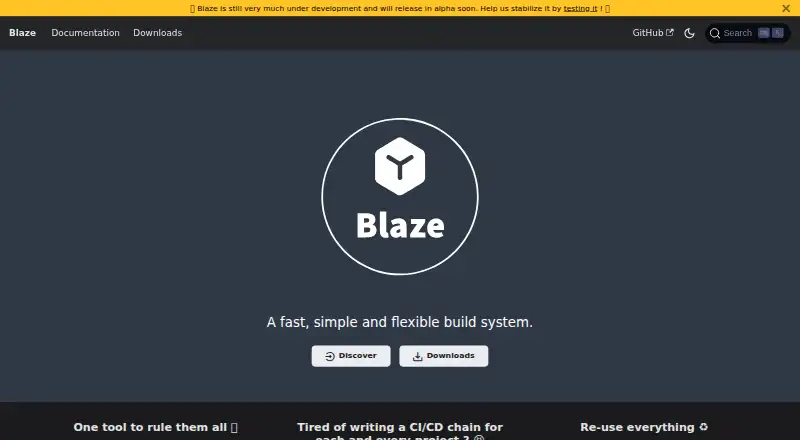
Blaze is a free build system aimed mainly at monorepos, with task running and productivity tooling as additional uses. It runs tasks across a repository, manages dependencies between projects, and supports parallel execution. A configurable local cache can reuse completed work. The task graph helps coordinate tasks, while the cache scope is local; remote caching is not included. Configuration supports JSON, YAML, and Jsonnet, including advanced templating, and a plugin system runs tasks through executors. Blaze says it works with any language or framework without changing application code. It does not manage application dependencies, analyze code, or track which technologies a project uses. Teams can keep integration and deployment processes in the monorepo and write them once for reuse. Linux, macOS, and Windows are supported, with prebuilt binaries for common platforms. Blaze is still under development, and its site invites contributors to help stabilize it ahead of an alpha release. Documentation points users to GitHub issues for bugs, and the site links to a Discord community. The Free plan costs nothing.
Who it suits
Blaze suits teams organizing task execution and dependencies in monorepos, particularly those seeking a local cache and configurable workflows. It may also suit contributors willing to work with software that is still under development.
What it does well
- Free to use.
- Runs tasks in parallel across a monorepo.
- Supports JSON, YAML, and Jsonnet configuration.
- Works with Linux, macOS, and Windows.
- Plugin system runs tasks through executors.
What to know first
- Still under development ahead of an alpha release.
- Cache scope is local; remote caching is not included.
- Does not manage application dependencies.
- Does not perform code analysis.
Limits
The Free plan has local cache scope and does not include remote caching. Affected builds and workspace boundaries are listed as unavailable.
Plans
| Plan | Billed and limits | Price |
|---|---|---|
| Free | Absolutely free to use | Free |
As blaze-monorepo.dev lists them, read 29 Sept 2026. The maker's own page has the final word.
Getting started
- Visit the Blaze website.
- Choose the installation guide for Linux, macOS, or Windows.
- Use a prebuilt binary if one is available for your platform.
- Configure tasks and dependencies with JSON, YAML, or Jsonnet.
- Use the GitHub issue tracker for bugs or visit the linked Discord community.
Blaze is a monorepo build system for teams that need to coordinate tasks and dependencies across projects without tying their setup to a particular language or framework. It is most compelling for teams that want configurable, local task execution; its under-development status and lack of remote caching make it a cautious choice for production workflows.
Overview
Blaze runs multiple tasks across a monorepo and manages dependencies between projects. It also supports general task running and productivity tooling, but its design is deliberately narrow: it does not manage application dependencies, analyze code, or track the technologies a project uses.
That separation can suit teams that want to define orchestration without handing a build system responsibility for application-level details. The tradeoff is that teams seeking dependency management or code-aware build decisions will need other tools alongside it.
Key features
Task execution and caching
Parallel task execution and dependency management can help coordinate work across a repository. Blaze’s configurable cache reuses completed work, but its cache scope is local and remote caching is unavailable. That makes it a fit for local workflows, not teams that depend on shared caching across machines or CI environments.
Configuration and plugins
Blaze accepts JSON, YAML, and Jsonnet configuration, including advanced templating, and uses a flexible plugin system to run tasks through executors. Teams can choose a configuration style and extend task execution rather than being restricted to one preset workflow. The flexibility is useful when a monorepo has varied tasks, though it also leaves teams to shape their own setup.
Technology-neutral workflows
Blaze says it supports any language or framework without affecting application code. Teams can keep integration and deployment processes in the monorepo and write them once for reuse. Its lack of code analysis and technology tracking, however, means it does not provide technology-aware project insights.
Pricing
Free: free. The plan is absolutely free to use and includes a task graph and local caching. It does not include affected builds, remote caching, or workspace boundaries. That makes the price straightforward for teams evaluating local task orchestration, while the missing capabilities may matter for larger or distributed build workflows.
Platforms
The installation guide supports Linux, macOS, and Windows, with prebuilt binaries for common platforms. That gives teams using any of those systems a supported installation path.
Who it's for
Blaze is best suited to teams working in monorepos that want configurable task coordination, dependency ordering, parallel execution, and reusable workflows without adopting a language-specific build approach. It is a weaker fit for teams that require remote caching, affected-build support, or a mature, stabilized release: Blaze remains under development, and its site invites contributors to help stabilize it ahead of an alpha release.
For support, the documentation points users to its GitHub issue tracker for bugs and issues, and the site links to a Discord community. Teams should weigh that community-oriented support model against their need for dependable production support.
Pros and cons
Pros
- Configurable task orchestration: parallel execution, dependency management, and JSON, YAML, or Jsonnet configuration cover a range of monorepo workflows.
- Local cache at no charge: completed work can be reused without a paid plan, useful for teams focused on local execution.
- Language-neutral approach: it does not manage application dependencies or alter application code, keeping its role focused on orchestration.
Cons
- No remote cache: teams cannot use Blaze’s cache as a shared resource across machines.
- No affected builds or workspace boundaries: those capabilities are absent from the free plan, limiting options for teams that need them.
- Still under development: its pre-alpha stabilization effort makes it a less certain choice for teams that need a settled production tool.
Alternatives
If Blaze’s development status or capability limits do not suit your workflow, consider these alternatives:
- Monorepo Management Tools is a directory for comparing tools in this category.
- Bazel is a free, open-source build and test tool identified by Google as its own build tool; choose it if that description better matches your needs.
- FerrFlow is a free, MIT-licensed single Rust binary; consider it if that packaging and license suit your preference.
- npm offers free public package publishing and public registry access for public package authors; choose it when package publishing is the need.
- Nx has a free Hobby plan with 50,000 monthly credits, five contributors, and ten concurrent CI connections; consider it if those stated allowances fit your workflow.
- Rush is a free, open-source JavaScript monorepo manager installable via npm; choose it if you want a JavaScript-focused monorepo manager.
- Turborepo offers Vercel Remote Cache free on all Vercel plans, with monthly upload allowances varying by plan; consider it if remote caching is a priority.
- Yarn is an open-source package manager with no paid plans or usage limits stated; choose it for package management rather than Blaze’s task orchestration focus.
- affected is MIT-licensed standalone CLI software; consider it if that form better fits your needs.
Verdict
Choose Blaze if you want a free, configurable way to coordinate tasks and dependencies in a monorepo, and local caching is enough. Its language-neutral orchestration is the clearest reason to consider it. Look elsewhere if you need remote caching, affected builds, workspace boundaries, or a more established development status.
Verdict
Blaze focuses on coordinating tasks and project dependencies in monorepos, with configurable workflows and a local cache. Its development status and lack of remote caching are important considerations for teams evaluating it.
Questions
How much does Blaze cost?
The Free plan costs nothing and is absolutely free to use.
Which operating systems does Blaze support?
Linux, macOS, and Windows are listed as supported, with prebuilt binaries for common platforms.
Does Blaze support remote caching?
No. The Free plan lists local cache scope and remote caching as unavailable.
Does Blaze manage application dependencies or analyze code?
No. Blaze does not manage application dependencies, perform code analysis, or track project technologies.
What configuration formats can I use?
Blaze supports JSON, YAML, and Jsonnet configuration, including advanced templating.
Is Blaze still in development?
Yes. The site says it is under development and invites people to help stabilize it ahead of an alpha release.
Facts from Blaze's own pages
- Cache
- Blaze has a fully configurable cache for reusing completed work. · blaze-monorepo.dev, 29 Sept 2026
- Configuration
- Blaze supports JSON, YAML, and Jsonnet configuration, including advanced templating features. · blaze-monorepo.dev, 29 Sept 2026
- Design choice
- Blaze does not manage application dependencies, perform code analysis, or track which technologies a project uses. · blaze-monorepo.dev, 29 Sept 2026
- Development status
- The site says Blaze is still under development and invites people to help stabilize it ahead of an alpha release. · blaze-monorepo.dev, 29 Sept 2026
- Parallel tasks
- Blaze supports parallelization and parallel task execution. · blaze-monorepo.dev, 29 Sept 2026
- Plugin system
- Blaze includes a flexible plugin system for running tasks through executors. · blaze-monorepo.dev, 29 Sept 2026
- Product
- Blaze is a build system intended mainly for monorepos, with general task running and productivity tooling as other uses. · blaze-monorepo.dev, 29 Sept 2026
- Purpose
- It runs multiple tasks across a monorepo and manages dependencies between projects. · blaze-monorepo.dev, 29 Sept 2026
- Support
- The documentation directs users to its GitHub issue tracker for issues and bugs, and the site links to a Discord community. · blaze-monorepo.dev, 29 Sept 2026
- Supported platforms
- The installation guide lists Linux, macOS, and Windows as supported platforms, with prebuilt binaries for common platforms. · blaze-monorepo.dev, 29 Sept 2026
- Technology agnostic
- Blaze says it supports any language or framework and does not affect application code. · blaze-monorepo.dev, 29 Sept 2026
- Workflow
- Blaze says teams can keep integration and deployment processes in the monorepo and write them once for reuse. · blaze-monorepo.dev, 29 Sept 2026
Where Blaze stands on Freedom251
- Monorepo Management Tools#8 of 33