Quick wins for a faster PC:
Scan for outdated or missing drivers - takes under a minuteDriver Scan →Repair Windows errors before they cause bigger problemsFix Now →Fix the driver behind crashes, sound loss and screen glitchesFind Drivers →Some links on this page are affiliate links: if you buy through them we may earn a commission, at no extra cost to you.
The XFX Radeon RX 9070 XT Mercury Magnetic aims to turn AMD’s high-end GPU into a more polished card for gamers who care about cooling, noise, and long-term maintenance as much as raw frame rates. Its headline feature is a magnetic fan system that makes fan removal easier, but the bigger question is whether that design is backed by strong build quality, stable factory tuning, and real-world performance gains.
This review focuses on how the Mercury Magnetic cooler affects the RX 9070 XT experience in practical use, from 1440p and 4K gaming performance to thermals, acoustics, power behavior, and day-to-day usability inside a gaming PC. We’ll also look at how it stacks up against competing GPUs and whether XFX’s premium design makes sense for buyers seeking a quieter, easier-to-maintain graphics card.
As an Amazon Associate I earn from qualifying purchases.
Free tools Windows power users keep installed
One-click scans. No signup required.
XFX Mercury Magnetic Design and Build Quality
The XFX Radeon RX 9070 XT Mercury Magnetic presents itself as a premium, oversized custom card built around cooling headroom rather than compact compatibility. Its shroud uses a clean silver-and-black finish that fits the “Mercury” branding well, with a more restrained look than many gaming GPUs covered in aggressive RGB lighting. The card feels dense and rigid in hand, helped by a full-length metal backplate and a reinforced frame that limits flex across the PCB and cooler assembly.
Physically, this is a large triple-fan graphics card, so case clearance should be checked before purchase. It is designed for mid-tower and full-tower builds with generous GPU length and thickness support, and it will likely occupy more than two slots once installed. XFX includes the kind of structural support expected from a high-end cooler: the backplate adds stiffness, the heatsink spans nearly the full length of the card, and the shroud sections feel securely fastened rather than hollow or flimsy. Builders using smaller cases, front-mounted radiators, or tight vertical GPU mounts should measure carefully.
Popular on Amazon

- Chipset: AMD RX 9070 XT
- Memory: 16 GB GDDR6
- XFX SWFT Triple Fan Cooling Solution
- Boost Clock Up to 2970 MHz
The most distinctive part of the design is the removable magnetic fan system. Instead of treating the fans as permanently fixed parts of the shroud, XFX uses magnetically attached fan modules that can be pulled away from the cooler without disassembling the entire card. The implementation feels practical rather than gimmicky: the fans seat firmly, align cleanly, and do not give the impression that they will rattle loose during normal operation. For anyone who has tried to clean dust from between fan blades and heatsink fins on a traditional GPU, this design has obvious appeal.
Build highlights
- Triple-fan cooler: Built for sustained gaming loads and lower fan speeds rather than minimum size.
- Metal backplate: Improves rigidity and gives the card a cleaner appearance inside a windowed case.
- Magnetic fan modules: Allow easier cleaning and potential servicing without full cooler removal.
- Subtle styling: Premium but not overly flashy, making it easier to match with different build themes.
- Large footprint: Best suited to cases with strong airflow and ample GPU clearance.
Connection layout and assembly quality are in line with what enthusiasts expect from a higher-end partner card. The cooler sits evenly, the fan cables and contact points are neatly integrated into the magnetic assembly, and the overall finish is consistent across the shroud, heatsink edges, and rear plate. There is no sense that the magnetic fan feature has compromised the core structure of the cooler. Instead, it feels like XFX built a conventional heavy-duty thermal solution first, then added a smarter access method for maintenance.
Windows Errors? Fix Them Before They Spread
Repair common Windows errors and clear accumulated junk for a smoother, more stable PC - no reinstall needed.Free scan · no reinstallCrashes, No Sound, or Screen Glitches?
Random freezes, missing sound and display glitches usually trace back to one bad driver. Find and replace yours safely.Free scan · under a minuteFrom a PC builder’s perspective, the Mercury Magnetic design is most appealing because it addresses a real ownership problem: GPUs collect dust, and cleaning them properly is often awkward. The removable fans make routine maintenance quicker, especially in dusty rooms or systems with high airflow. The trade-off is size; this is not a card for minimalist small-form-factor builds. In a well-ventilated ATX case, however, the XFX Mercury Magnetic looks and feels like a serious custom RX 9070 XT, with a cooler design that has practical value beyond aesthetics.
Magnetic Fan System and Maintenance Benefits
The headline feature on the XFX Radeon RX 9070 XT Mercury Magnetic is its removable fan system. Instead of permanently fixed fans held in place by small screws and routed cables, the shroud uses magnetically attached fan modules that can be lifted out by hand. Each fan seats into a defined recess in the cooler frame, so alignment is handled by the housing rather than guesswork. For a large triple-fan graphics card, this is a practical design choice rather than a visual gimmick, especially for users who keep a system for several years.
The most obvious benefit is cleaning. Dust buildup on a high-end GPU usually collects along the front edge of the blades, inside the fan hub area, and across the heatsink fins directly beneath the fan frame. On a conventional cooler, reaching those areas properly often means removing the entire shroud or working around narrow gaps with compressed air and brushes. Here, the fans can be removed quickly, giving direct access to the heatsink surface and both sides of each blade. That makes seasonal maintenance faster and less likely to damage a cable, strip a screw, or bend a fin.
How the magnetic setup helps in day-to-day ownership
- Easier dust removal: Users can clean the heatsink and fan blades more thoroughly without disassembling the whole card.
- Lower maintenance risk: Fewer small screws and exposed fan wires means fewer chances to damage the cooler during cleaning.
- Potentially simpler fan replacement: If XFX makes replacement fan modules available, a failed fan could be swapped without a full cooler teardown.
- Better long-term acoustics: Keeping the blade edges and fin stack cleaner helps prevent turbulence and rattly dust-related noise over time.
The fan modules still need to feel secure once installed, and on this card they do. A magnetic mount can sound fragile in theory, but the fans are not simply floating on the shroud; they sit into shaped cutouts that resist side-to-side movement. In normal tower orientation, gravity and the frame geometry work with the magnets rather than against them. There is no sense that routine case movement, fan spin-up, or horizontal airflow will dislodge a module. For builders who transport systems frequently, it is still sensible to check the fans after moving the PC, just as you would check PCIe power cables and GPU support brackets.
From a performance perspective, the magnetic system does not automatically make the RX 9070 XT faster, but it can help the cooler maintain its intended behavior. The Mercury cooler relies on a large fin stack and broad airflow coverage, and removable fans make it easier to keep that airflow path clear. A clogged cooler can raise hotspot temperatures, force higher fan speeds, and reduce boost consistency during long gaming sessions. By lowering the friction of maintenance, XFX gives owners a better chance of preserving the card’s out-of-box thermal and acoustic profile.
There are a few considerations. Proprietary fan modules mean replacement availability matters; a standard 92 mm or 100 mm case fan is not a direct substitute. Buyers should also avoid treating the feature like a toy, since repeated unnecessary removal increases the chance of dropping a fan or contaminating the contact points. Used as intended, though, the system is one of the more builder-friendly cooler features on a modern high-end GPU. It adds real convenience without compromising the sturdy feel of the Mercury design, and it fits the RX 9070 XT’s target audience: gamers who want strong performance, low noise, and a card that remains easy to service after the honeymoon period ends.
Test System, Benchmarks, and Review Methodology
To evaluate the XFX Radeon RX 9070 XT Mercury Magnetic fairly, the test platform was built to keep the GPU as the main performance variable rather than allowing the processor, memory, storage, or cooling setup to distort results. The card was installed in a high-airflow mid-tower case with a conventional front-to-back fan layout, matching the kind of enclosure many gaming PC builders would realistically use. The goal was to capture repeatable gaming, thermal, acoustic, and power data that reflects a well-built enthusiast system rather than an open-bench best-case scenario.
| Component | Configuration |
|---|---|
| Processor | AMD Ryzen 7 7800X3D |
| CPU Cooler | 360 mm liquid cooler |
| Motherboard | X670E ATX board with latest stable BIOS |
| Memory | 32 GB DDR5-6000 CL30 |
| Storage | 2 TB PCIe 4.0 NVMe SSD |
| Power Supply | 1000 W 80 Plus Gold ATX 3.x unit |
| Case | High-airflow ATX case with three intake and three exhaust fans |
| Operating System | Windows 11 24H2 with current updates |
All gaming tests were run using the latest public Radeon driver available at the time of testing, with Resizable BAR enabled and the motherboard set to its standard performance profile. The XFX card was tested using its out-of-box factory settings unless stated otherwise. No manual fan curve, undervolt, frame cap, or overclock was applied for baseline results, since most buyers will install the card, update drivers, and start gaming without deeper tuning. Windows power mode was set to Best Performance, background applications were minimized, and each game was allowed to compile shaders or complete first-run optimization before data collection began.
Also popular on Amazon

- Chipset: AMD RX 9070 XT
- Memory: 16 GB GDDR6
- XFX MERC Triple Fan Cooling Solution and RGB
- Boost Clock Up to 3100 MHz
The benchmark suite focused on modern games that stress different parts of the GPU. Rasterized performance was tested in titles such as Cyberpunk 2077, Starfield, Forza Motorsport, Hogwarts Legacy, Call of Duty: Modern Warfare III, and Assassin’s Creed Mirage. Ray tracing workloads were evaluated separately in games including Alan Wake 2, Cyberpunk 2077 RT modes, and Avatar: Frontiers of Pandora. Each title was tested at 2560×1440 and 3840×2160 using high or ultra presets, with upscaling disabled for native rendering results unless a separate FSR test was being recorded.
Frame-rate data was captured with built-in benchmarks where they provided consistent run-to-run behavior, and with manual test passes in repeatable scenes where built-in tools were absent or unrepresentative. Each result represents the average of three clean runs, with obvious outliers discarded and retested. Alongside average FPS, 1% lows were tracked to show frame pacing and responsiveness during heavier scenes. This is especially relevant for a premium RX 9070 XT model, because a stronger cooler and factory tuning should not only lift peak frame rates but also help sustain boost clocks during longer play sessions.
Thermal testing used a 30-minute gaming loop followed by a heavier synthetic load to separate realistic behavior from worst-case conditions. GPU edge temperature, hotspot temperature, memory temperature, fan speed, and board power were logged throughout the run. Noise readings were taken from a fixed distance in a room with a low ambient floor, after the system reached thermal equilibrium. Wall power was also measured during gaming and stress workloads, giving a practical view of how the XFX Mercury Magnetic behaves in a complete PC rather than relying only on software-reported board power.
1440p and 4K Gaming Performance
The XFX Radeon RX 9070 XT Mercury Magnetic is most at home at 1440p, where the card has enough shader throughput and memory bandwidth to push high-refresh gameplay without leaning heavily on upscaling. In rasterized titles, it consistently feels like an enthusiast-class GPU rather than a stretched midrange option. Games such as Cyberpunk 2077, Forza Motorsport, Starfield, Hogwarts Legacy, and Call of Duty: Modern Warfare III run comfortably at ultra or near-ultra settings, with frame rates that pair well with 144Hz and 165Hz monitors. The Mercury cooler does not change the fundamental silicon, but its sustained boost behavior helps the card avoid the small performance dips that can appear on hotter, more constrained designs.
At 1440p, the factory tuning gives this XFX model a modest but measurable edge over reference-clocked RX 9070 XT cards. The uplift is not dramatic enough to move the GPU into a new class, but it is enough to matter in demanding scenes where minimum frame rates affect smoothness. Compared with competing GeForce options in the same broad price range, the Mercury Magnetic is strongest in traditional raster performance and in games that favor AMD’s architecture. Nvidia still tends to hold an advantage in heavy ray tracing workloads, especially when path tracing is enabled, but AMD’s upscaling and frame generation support make many RT titles more playable than they would be on raw performance alone.
| Resolution | Best Use Case | Expected Experience |
|---|---|---|
| 1440p Ultra | High-refresh competitive and AAA gaming | Excellent, often well above 100 fps in rasterized games |
| 1440p Ray Tracing | Balanced visuals with upscaling | Good, but demanding RT settings may require FSR |
| 4K High/Ultra | Premium single-player gaming | Strong, though the heaviest games benefit from tuned settings |
| 4K Ray Tracing | Selective RT effects | Playable with compromises; path tracing remains challenging |
Moving to 4K shifts the card from dominant to competitive. The RX 9070 XT Mercury Magnetic can deliver a satisfying 4K experience in many modern games, particularly when settings are adjusted intelligently rather than blindly maxed out. Texture quality can usually stay high, and the available VRAM gives the card room to handle large asset packs without immediate stutter concerns. The settings most worth reducing are typically ultra shadows, volumetrics, screen-space reflections, and the most punishing ray tracing options. With those tuned, 4K gameplay remains smooth and visually rich across a wide set of titles.
Ray tracing is the main area where buyers should calibrate expectations. In lighter RT workloads, such as reflections or ambient occlusion in well-optimized games, the XFX card performs respectably. In heavier implementations, especially full path-traced modes, it falls behind similarly priced Nvidia alternatives that benefit from stronger RT hardware and wider DLSS adoption. For gamers focused primarily on rasterized 1440p or mixed 4K gaming, this is less of a concern. For players who want to enable every ray tracing feature in every new release, the Mercury Magnetic’s strengths are less decisive.
The practical result is that XFX’s cooler and power tuning help the RX 9070 XT maintain its performance over long sessions, but they do not transform the card’s benchmark hierarchy. Its advantage is consistency: fewer temperature-related fluctuations, stable clocks, and smooth frame pacing when the case airflow is adequate. That makes the Mercury Magnetic particularly appealing for gamers who play for hours at a time and want a fast 1440p card that can also handle 4K without feeling like an experiment.
The Tool Desk
Outbyte PC Repair FREERepair Windows errors before they cause bigger problemsFix Now →Outbyte Driver Updater FREEScan for outdated or missing drivers - takes under a minuteDriver Scan →Thermals, Noise, and Power Consumption
The XFX Radeon RX 9070 XT Mercury Magnetic’s oversized cooler pays off most clearly in sustained thermal behavior. In a closed mid-tower case with balanced airflow, the card settles into a comfortable operating range during long gaming sessions rather than spiking aggressively after the first few minutes. The large fin stack, full-length vapor chamber-style contact area, and three-fan layout give the GPU enough cooling headroom that performance remains steady across repeated benchmark loops. More ly for daily use, the hotspot temperature stays well controlled, which is often the more revealing metric on high-power Radeon cards.
In rasterized games at 1440p, the GPU typically operates in the low-to-mid 60°C range, while hotspot readings generally remain in the low-to-mid 80°C range depending on case airflow and ambient room temperature. At 4K, where utilization is heavier and board power remains elevated for longer periods, core temperature may climb a few degrees, but the cooler avoids the sharp thermal saturation seen on smaller dual-slot designs. Memory temperatures are also handled confidently, with no sign of throttling during extended runs in demanding titles. This makes the Mercury Magnetic a strong match for gamers who play for hours rather than simply running short benchmark passes.
Also popular on Amazon
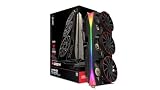
- Chipset: AMD RX 9070 XT
- XFX MERC Magnetic Air Triple Fan Cooling Solution and RGB
- Memory: 16 GB GDDR6
- Boost Clock Up to 3100 MHz
Acoustically, the card is tuned more for quiet consistency than dramatic fan ramping. At idle and during light desktop use, the fans stop completely, leaving the system silent unless other case fans or the CPU cooler are active. Under gaming load, the fans ramp smoothly and avoid the pulsing behavior that can make some high-end cards more noticeable than their raw decibel readings suggest. The tonal profile is low and broad rather than sharp, with little motor whine from the magnetic fan hubs. Coil whine can vary from sample to sample and power supply to power supply, but on this class of XFX cooler, fan noise is not the limiting factor for perceived system acoustics.
| Load Scenario | Typical Behavior | Practical Impact |
|---|---|---|
| Idle / desktop | Zero-RPM fan mode, low board draw | Silent operation for browsing, streaming, and productivity |
| 1440p gaming | Moderate fan speed, stable GPU clocks | Quiet enough for open-back headphones or low speaker volume |
| 4K gaming | Higher sustained power and fan speed | Audible but controlled, with no harsh ramping |
| Stress testing | Cooler approaches full sustained load | Thermals remain safe, noise becomes more noticeable |
Power consumption is where the RX 9070 XT class still demands some planning. The Mercury Magnetic’s factory tuning allows the GPU to boost aggressively when thermal headroom is available, so total board power can sit high during demanding 4K workloads. In games, expect behavior broadly in line with other premium RX 9070 XT models rather than a dramatic efficiency advantage. The cooler helps maintain clocks at a lower noise level, but it does not turn the card into a low-power option. A quality 750W power supply is a sensible baseline for most gaming builds, while 850W gives more margin for high-end CPUs, many drives, or manual overclocking.
Recommended Free Tools
Compared with more compact RX 9070 XT cards, the main benefit is not lower wattage but better control over the heat and noise that wattage creates. Against competing GeForce options, Nvidia may still hold an efficiency edge in some ray-traced or upscaled workloads, but the XFX card counters with strong thermal stability and a quieter cooler under comparable raster gaming loads. For builders focused on a cool, composed gaming PC, the Mercury Magnetic design meaningfully improves the ownership experience: fewer annoying fan spikes, easier long-term cleaning, and less concern about hotspot temperatures during heavy use.
Overclocking, Software, and Everyday Usability
The XFX Radeon RX 9070 XT Mercury Magnetic arrives with enough factory tuning that manual overclocking feels more like fine adjustment than a required step. Out of the box, the card already sustains high boost behavior under long gaming sessions, helped by the oversized cooler and stable board power delivery. In practice, the most useful tweaking path is not chasing the highest possible peak frequency, but balancing clock speed, voltage, fan curve, and memory tuning for a quieter daily profile.
Using AMD Adrenalin, the card responds well to conservative tuning. A mild GPU frequency increase can produce small gains in rasterized games, but the difference is usually modest once the card is already boosting near its practical limit. Memory tuning is often more noticeable, especially at 4K where bandwidth pressure rises, though stability testing is still required. The better result for many users is a light undervolt: reducing voltage while keeping the stock power target can cut heat and fan speed without giving up much performance. On this cooler, that turns the Mercury Magnetic into an even calmer gaming card, rather than just a slightly faster one.
Practical tuning behavior
- GPU overclocking: small performance uplift, usually most visible in benchmark runs rather than normal gameplay.
- Memory tuning: worthwhile to test, particularly for high-resolution gaming and demanding texture loads.
- Undervolting: the best everyday adjustment for lowering temperatures and noise while preserving frame rates.
- Fan curve control: useful because the cooler has thermal headroom, allowing a slower, smoother acoustic profile.
AMD Adrenalin remains one of the card’s strengths for day-to-day use. Driver-level tuning, performance logging, game profiles, Radeon Anti-Lag, Radeon Chill, recording tools, and display controls are all available without needing a separate utility from XFX. The interface is cleaner than many board-partner apps, and having tuning, driver updates, metrics, and capture features in one place makes the card easy to manage after installation. For builders who prefer a minimal software footprint, this is a practical advantage: the Mercury Magnetic does not depend on a heavy companion suite to expose its core features.
Everyday usability is also helped by the physical design choices covered earlier in the review. The magnetic fans are not just a novelty when the system is new; they make long-term ownership easier. Dust cleaning is less awkward, fan inspection takes less time, and a user maintaining a high-end gaming PC can access the cooler more easily than with a conventional shroud and screw-mounted fan setup. The card is still large, so case clearance, support bracket use, and airflow planning matter, but once installed it behaves like a polished premium GPU rather than a temperamental enthusiast part.
For gamers who want a simple experience, the stock profile is already the right mode to use. For PC builders who enjoy tuning, the Mercury Magnetic provides enough headroom to tailor the card toward silence, efficiency, or slightly higher benchmark numbers. The cooler and factory setup do not transform the RX 9070 XT into a different class of GPU, but they do make it easier to extract consistent performance with low fuss, which is exactly where a premium partner card should stand out.
Independent reader supportYour contribution helps us test, update, and keep practical guides available for everyone.Price, Competition, and Final Buying Verdict
The XFX Radeon RX 9070 XT Mercury Magnetic makes the most sense when it is priced close to other premium RX 9070 XT cards rather than pushed into the territory of faster GPUs. Its appeal is not that it radically changes the performance class of the GPU, but that it delivers the RX 9070 XT experience with a cooler that feels genuinely refined: strong temperatures, restrained noise, sturdy construction, and the practical magnetic fan system. For builders who keep a card for several years, that maintenance angle has real value, especially in dusty rooms or compact cases where fan cleaning usually means awkward disassembly.
Against reference-style or entry-level RX 9070 XT models, the Mercury Magnetic is the better ownership experience. The factory tuning provides a modest uplift, but the bigger difference is consistency: the card is less likely to feel strained during long gaming sessions, and it has more acoustic headroom before the fans become distracting. If the price gap is small, the XFX model is easy to justify. If the gap is large, gamers should be realistic: the extra money mostly buys cooler quality, lower noise, and serviceability, not a new performance tier.
What’s actually slowing this PC down?
Pick the symptom - the matching free tool is one click away.
Also popular on Amazon

- Powered by Radeon RX 9070 XT
- WINDFORCE Cooling System
- Hawk Fan
- Server-grade Thermal Conductive Gel
- RGB Lighting
How it compares with competing GPUs
- Versus cheaper RX 9070 XT cards: the XFX wins on cooler design, noise control, and long-term maintenance, but raw frame rates are close.
- Versus Radeon RX 7900 XT-class alternatives: older discounted high-end cards may offer competitive raster performance, though with different power, feature, and availability trade-offs.
- Versus GeForce RTX competitors: Nvidia cards still tend to hold an advantage in ray tracing-heavy games, DLSS support, and creator workloads, while the RX 9070 XT remains attractive for traditional 1440p and 4K gaming value.
- Versus higher-tier current GPUs: spending more can buy a clear performance jump, but the value curve weakens quickly unless you are targeting high-refresh 4K or heavy ray tracing.
For most gamers, the buying decision should come down to the final shelf price. At 1440p, this card is comfortably powerful and pairs well with high-refresh monitors. At 4K, it remains capable with sensible settings choices, especially in rasterized titles. The Mercury Magnetic cooler helps preserve that performance without turning the system into a noisy box, which matters in real-world use more than a small benchmark lead. It is also a strong fit for builders who care about neat assembly, premium materials, and easy upkeep.
The final verdict is straightforward: buy the XFX Radeon RX 9070 XT Mercury Magnetic if it is within a reasonable premium over basic RX 9070 XT models and you value a quieter, cleaner, better-built card. Skip it if a much cheaper RX 9070 XT is available and you only care about frames per dollar, or if your game library strongly favors ray tracing and upscaling features where a competing GeForce card performs better. As a complete gaming product, though, the Mercury Magnetic is one of the more convincing versions of the RX 9070 XT because its cooler and factory behavior improve the day-to-day experience in ways that are easy to notice after the benchmarks end.
Frequently Asked Questions
What makes the XFX Radeon RX 9070 XT Mercury Magnetic different from other RX 9070 XT cards?
The main difference is XFX’s magnetic fan system, which lets the fans detach without tools for easier cleaning or replacement. It also uses a large premium cooler, sturdy shroud, and factory tuning aimed at lower temperatures and quieter operation compared with more basic RX 9070 XT models.
Do the magnetic fans actually help, or are they just a gimmick?
The magnetic fans are most useful for long-term maintenance, especially if your PC collects dust or you want easier access to the heatsink. They do not automatically make the card faster, but they can make cleaning simpler, which helps preserve cooling performance and noise levels over time.
Is the XFX RX 9070 XT Mercury Magnetic better for 1440p or 4K gaming?
The RX 9070 XT is strongest as a high-refresh 1440p gaming card, where it can deliver excellent frame rates in demanding modern titles. It can also handle 4K well in many games, but you may need upscaling or reduced settings in the heaviest ray-traced titles to keep performance smooth.
How loud and hot does the XFX Mercury Magnetic run under gaming loads?
The oversized cooler is designed to keep GPU temperatures controlled without forcing the fans to spin aggressively. In practice, this type of premium board is best judged by whether it stays quiet during long gaming sessions, maintains stable boost clocks, and avoids hotspot or memory temperatures that creep into uncomfortable ranges.
Is the XFX Radeon RX 9070 XT Mercury Magnetic worth paying extra for?
It is worth considering if the price premium is modest and you value a stronger cooler, easier fan maintenance, quieter operation, and better build quality. If it costs much more than other well-cooled RX 9070 XT cards, the extra money may be better spent on a faster GPU tier or other system upgrades.
Bottom Line
The XFX Radeon RX 9070 XT Mercury Magnetic is a strong custom card for gamers who want the RX 9070 XT’s performance wrapped in a cooler that feels premium, runs quietly, and is easy to maintain. Its magnetic fan system is the standout feature, but the real appeal is how well the whole package balances build quality, thermals, acoustics, and factory tuning.
Do these 3 things before closing this tab:
1Fix the driver behind crashes, sound loss and screen glitches2Clear out junk files and repair common Windows errors3Scan for outdated or missing drivers - takes under a minuteIf pricing stays close to other high-end RX 9070 XT models, this is an easy shortlist pick for builders who value low noise and long-term serviceability. Shoppers focused purely on cost-per-frame may still compare it against cheaper RX 9070 XT cards or competing GPUs, but for a polished daily-driver card, the Mercury Magnetic makes a convincing case.

