The Tool Desk
Outbyte Driver Updater FREEFix the driver behind crashes, sound loss and screen glitchesFind Drivers →Outbyte PC Repair FREERepair Windows errors before they cause bigger problemsFix Now →Some links on this page are affiliate links: if you buy through them we may earn a commission, at no extra cost to you.
The Seagate SkyHawk AI 20TB HDD is built for surveillance systems that have moved beyond simple recording into continuous video capture, long retention windows, and AI-assisted analysis. With modern NVR and DVR deployments often handling dozens of high-resolution camera streams alongside metadata processing, object recognition, and event search, capacity and sustained workload endurance matter as much as peak transfer speed.
This 20TB model sits near the top of Seagate’s surveillance-focused lineup, targeting environments where uptime, write consistency, and drive health monitoring are central to system reliability. It is designed for 24/7 operation, multi-bay recorders, and AI-enabled video workloads that can place heavier demands on storage than conventional security recording alone.
As an Amazon Associate I earn from qualifying purchases.
For integrators, security teams, and businesses planning larger camera deployments, the SkyHawk AI 20TB offers a compelling blend of capacity, surveillance firmware, and endurance-focused design. Its value depends on whether the deployment needs AI workload support, extended retention, and purpose-built reliability rather than a lower-cost desktop or standard NAS hard drive.
Seagate SkyHawk AI 20TB Specifications
The Seagate SkyHawk AI 20TB is a 3.5-inch surveillance hard drive built for high-density NVR and DVR systems that need continuous recording, long retention windows, and support for AI-assisted video workloads. At 20TB, it sits near the top of Seagate’s surveillance HDD range, giving installers and system integrators a way to consolidate large camera deployments without immediately moving to more bays or tiered storage.
Popular on Amazon

- AI video applications with ImagePerfect AI firmware deliver superior image integrity for random read, 24×7 workloads
- Get scalable support for up to 16 AI streams while recording up to 64 HD video camera streams
- Seamlessly tackle data-intensive footage with SkyHawk AI’s workload rating of 550TB/year—that’s more than 3× higher than standard surveillance-optimized drives
- Benefit from improved total cost of ownership (TCO) with 1. 5M MTBF
- The available storage capacity may vary.
Like other drives in the SkyHawk AI family, this model is designed around 24/7 operation rather than occasional desktop use. It uses a SATA 6Gb/s interface for broad compatibility with surveillance appliances, security servers, and storage enclosures. The drive is typically specified with a 7200 RPM spindle speed and a large cache, commonly 256MB, to help absorb continuous multi-stream writes and reduce latency spikes when video analytics metadata, playback requests, or rebuild activity are happening at the same time.
| Specification | Seagate SkyHawk AI 20TB |
|---|---|
| Form factor | 3.5-inch internal HDD |
| Capacity | 20TB |
| Interface | SATA 6Gb/s |
| Drive class | Surveillance and AI-enabled NVR storage |
| Spindle speed | 7200 RPM class |
| Cache | 256MB class |
| Operation profile | 24/7 continuous recording |
| Workload rating | Up to 550TB per year |
| Supported bays | Designed for multi-bay NVR systems |
| Recording support | Multiple HD video streams plus AI workloads |
| Warranty class | Typically 5-year limited warranty |
The headline specification is the 550TB/year workload rating, which separates the SkyHawk AI line from mainstream surveillance drives that are often rated for lighter write patterns. This matters in systems where cameras record continuously at high bitrates, where footage is retained for weeks or months, or where AI services are indexing people, vehicles, license plates, objects, and motion events while the same array is still ingesting live video.
The drive is also positioned for larger camera counts than basic desktop or NAS hard drives. Seagate’s surveillance firmware is tuned for sustained sequential writes, stream prioritization, and error handling behavior suited to video capture. In practical terms, that means the drive is intended to keep recording stable video feeds instead of pausing aggressively for desktop-style recovery behavior that could interrupt footage. For an NVR handling dozens of 1080p, 4MP, 8MP, or 4K cameras, those firmware priorities are just as relevant as raw transfer rate.
Another specification to consider is platform support. The SkyHawk AI 20TB is aimed at professional recorders with enough bays, airflow, and power delivery to handle high-capacity 7200 RPM disks. It is best matched with NVRs and surveillance servers that support large SATA drives, hot-swap trays, RAID configurations, and health monitoring. Before deployment, administrators should confirm drive-size compatibility, firmware support, and whether the recorder can address 20TB volumes without artificial limits.
Overall, the specification sheet makes the SkyHawk AI 20TB more than a simple capacity upgrade. Its combination of 20TB density, SATA compatibility, 24/7 duty-cycle design, high annual workload rating, and surveillance-optimized firmware places it between standard surveillance HDDs and enterprise nearline drives. That balance is what makes it especially relevant for AI-enabled security environments where recording, retention, search, and analytics all compete for storage resources.
Design, Build Quality, and Surveillance-Focused Features
The Seagate SkyHawk AI 20TB follows the familiar 3.5-inch enterprise-style hard drive format, but its design priorities are tuned specifically for surveillance and edge video workloads rather than general desktop storage. Physically, it is built for standard NVR and DVR bays, with a SATA interface that makes it compatible with most professional surveillance recorders, JBOD shelves, and storage appliances. At 20TB, the drive targets deployments where long retention windows, high camera counts, and continuous recording matter more than raw random-access performance.
Free tools Windows power users keep installed
One-click scans. No signup required.
Build quality is aligned with always-on operation. The SkyHawk AI line is intended for 24/7 environments, and the 20TB model is designed to sit in densely populated enclosures where vibration, sustained heat, and uninterrupted writes are common. Seagate’s rotational vibration sensors are a major part of that design, helping the drive maintain consistent operation when mulle disks are installed in the same chassis. This is particularly relevant in 8-bay, 16-bay, or larger NVR systems, where vibration from neighboring drives can affect tracking accuracy and long-term reliability if not properly managed.
Surveillance-oriented firmware and workload handling
The defining feature of the SkyHawk AI family is its surveillance-optimized firmware. Seagate’s ImagePerfect AI firmware is built to prioritize smooth video recording and reduced frame loss under heavy, mixed workloads. In practical terms, the drive is not only expected to handle many incoming camera streams, but also simultaneous read activity from AI analytics engines, playback requests, and event searches. That makes it better suited to modern NVRs running object detection, facial recognition, license plate recognition, behavior analysis, or smart motion filtering than a conventional desktop HDD.
- High stream support: Designed for large multi-camera environments with continuous recording demands.
- AI workload support: Suited to systems that record video while also reading footage for real-time or near-real-time analytics.
- Multi-bay readiness: Rotational vibration sensors help stabilize performance in larger NVR chassis.
- Always-on operation: Built for continuous surveillance workloads rather than intermittent consumer use.
Another practical advantage is that the SkyHawk AI 20TB is designed for write-heavy environments. Surveillance storage is unusual because it spends much of its life ingesting sequential video streams, often overwriting older footage in a loop. A standard NAS or desktop drive can perform adequately in light camera setups, but it may not be optimized for constant video ingest with minimal interruption. The SkyHawk AI’s firmware behavior is intended to keep writes flowing predictably, even when the recorder is also searching archived footage or feeding clips to an analytics application.
The drive also benefits from Seagate’s Health Management features when used with compatible systems. SkyHawk Health Management can monitor environmental and operational conditions, giving administrators more visibility into drive status before failures become disruptive. In surveillance deployments, that kind of early warning is valuable because a failed disk can create retention gaps or reduce redundancy during active investigations. Combined with Rescue Data Recovery Services on many SkyHawk AI models, the overall package is designed not just around capacity, but around preserving video evidence in demanding real-world installations.
PC Slower Than It Used to Be?
A free scan shows the junk files, broken settings and background clutter dragging Windows down - then fixes them in one click.Free scan · Windows 10 & 11Outdated Drivers Are Slowing You Down
One free scan finds every outdated or missing driver and matches the right update for your exact hardware.Free scan · exact hardware matchPerformance for AI Video Analytics and Multi-Stream Recording
The Seagate SkyHawk AI 20TB is built for a workload that looks very different from a desktop or general NAS drive. In an NVR or DVR, the drive may be ingesting dozens of camera feeds continuously while also serving recorded clips for review, exporting evidence, and supporting AI analytics that scan footage for people, vehicles, license plates, or behavioral events. Its performance profile is therefore less about bursty application responsiveness and more about sustained sequential writes, predictable latency, and the ability to keep recording while other tasks are running.
With a 7,200 RPM spindle speed, large cache, SATA 6Gb/s interface, and surveillance-tuned firmware, the 20TB SkyHawk AI is well matched to high-resolution camera deployments. Seagate rates the SkyHawk AI family for up to 64 HD video streams and up to 32 AI streams, which gives integrators headroom for mixed environments where some cameras are simply archived while others are being actively analyzed. In practical terms, that makes the drive suitable for 4K and multi-megapixel IP camera systems, especially where footage retention targets stretch into weeks or months rather than days.
Recording and playback behavior
For multi-stream recording, the drive’s strength is sustained throughput. Continuous camera feeds are primarily sequential writes, and this is where a high-capacity CMR surveillance HDD is still more cost-effective than SSD storage. The SkyHawk AI 20TB can absorb constant video writes while simultaneously handling read requests from operators searching through timelines or pulling clips. In a busy security office, that means recording should continue without interruption while staff review prior incidents, provided the NVR platform, network, and RAID configuration are sized properly.
- Continuous ingest: suited to always-on recording from many IP cameras, including HD and 4K streams.
- AI-assisted review: supports workloads where analytics engines repeatedly access stored footage for object and event detection.
- Concurrent access: designed for write-heavy environments that also require playback, exports, and indexing.
- Large retention pools: 20TB capacity reduces the number of bays needed for long retention windows.
AI analytics add a more demanding read component than conventional surveillance recording. Instead of simply writing streams and occasionally playing back clips, the system may scan footage continuously or in scheduled batches. This creates a mixed read/write pattern, and that is where the SkyHawk AI model separates itself from standard surveillance drives. Compared with a basic SkyHawk drive, the AI variant is better suited to NVRs with GPU or CPU-based analytics that are running facial recognition, perimeter detection, queue monitoring, or metadata tagging alongside recording.
What’s actually slowing this PC down?
Pick the symptom - the matching free tool is one click away.
Performance expectations in real deployments
Performance will depend heavily on camera bitrate and recording mode. A deployment using 1080p H.265 cameras at modest bitrates places far less pressure on the drive than a site using numerous 4K cameras at high frame rates and low compression. Motion-based recording also changes the equation, although many commercial and municipal systems prefer continuous recording for compliance and evidentiary consistency. The SkyHawk AI 20TB is most compelling when the system is write-heavy but not write-only: warehouses, schools, casinos, transportation hubs, factories, and smart city installations all fit the drive’s intended workload.
| Scenario | Expected Fit | Storage Behavior |
|---|---|---|
| Small DVR with a few cameras | More capacity than necessary | Light continuous writes, occasional playback |
| Large NVR with many HD cameras | Strong fit | Sustained multi-stream recording |
| AI-enabled security platform | Very strong fit | Mixed recording, scanning, indexing, and playback |
| General enterprise database server | Not ideal | Random I/O latency matters more than surveillance tuning |
The drive should not be confused with an SSD or an enterprise performance HDD intended for heavy transactional workloads. Random I/O will still be limited by mechanical drive characteristics, and analytics performance ultimately depends on the NVR software, processor, accelerator hardware, and memory. Within its intended role, however, the SkyHawk AI 20TB offers the right balance: high sequential capacity, surveillance-aware firmware behavior, and endurance for simultaneous recording and analysis. For AI surveillance systems that need long retention without moving immediately to all-flash storage, it is a practical and scalable performance choice.
Reliability, Workload Rating, and Data Protection
The Seagate SkyHawk AI 20TB is built for surveillance systems that run continuously, not for occasional desktop storage. Its reliability profile is centered on 24/7 operation in NVR and DVR environments where drives are expected to absorb constant video writes while still serving read requests for playback, export, and AI analysis. The drive is rated for a 550TB per year workload, which places it well above standard desktop HDDs and conventional surveillance drives that are typically intended for lighter recording-only duty cycles.
That higher workload rating matters in AI-enabled deployments. A modern surveillance server may record dozens of high-resolution camera feeds, retain footage for weeks or months, and simultaneously run object detection, facial recognition, license plate recognition, or behavior analytics against stored video. These mixed read/write patterns are harder on a drive than basic sequential recording. The SkyHawk AI line is designed to support this usage model with firmware tuned for sustained streaming workloads and responsive access to archived footage.
Reliability characteristics that matter in NVR deployments
- 550TB/year workload rating: suitable for heavier write cycles and analytics workloads compared with entry surveillance HDDs.
- 24/7 operation: intended for always-on recording systems where downtime can mean lost evidence.
- High-capacity retention: 20TB allows longer storage windows before footage must be overwritten or offloaded.
- Multi-bay awareness: designed for use in surveillance appliances and storage servers where vibration and heat can affect long-term consistency.
- Rescue Data Recovery Services: included on many SkyHawk AI models, adding an extra layer of protection against accidental damage, corruption, or drive failure scenarios.
The 20TB capacity also changes the risk profile of a surveillance array. Each disk can hold a large amount of footage, so a single-drive failure has a bigger operational impact than it would in a smaller-capacity system. For that reason, the SkyHawk AI should ideally be deployed in RAID-protected NVRs, storage servers, or appliances with automated health monitoring. RAID 5, RAID 6, RAID 10, or erasure-coded storage can reduce the risk of footage loss, while hot-spare planning can shorten recovery time after a failure.
Seagate also includes health management features through supported surveillance platforms. SkyHawk Health Management, when integrated by the NVR vendor, can monitor drive parameters and environmental conditions to flag potential issues before they become outages. This is especially valuable in multi-drive enclosures installed in security rooms, retail back offices, warehouses, campuses, and transportation facilities where systems may run unattended for long periods.
Data protection is not only about the drive itself. Integrators should combine the SkyHawk AI 20TB with a broader retention and backup strategy. Critical footage may need to be replicated to another appliance, archived to object storage, or exported to secure evidence storage before automatic overwrite policies take effect. For regulated environments, retention schedules, access controls, audit trails, and encryption support at the system level are just as as disk endurance.
Overall, the SkyHawk AI 20TB offers the endurance and reliability profile expected from a high-capacity surveillance drive aimed at analytics-heavy installations. It is not a substitute for redundancy or backup, but it gives NVR builders a stronger foundation than desktop HDDs or lower-end surveillance models when the system must handle continuous recording, frequent review, and AI-assisted search at scale.
Do these 3 things before closing this tab:
1Clear out junk files and repair common Windows errors2Fix the driver behind crashes, sound loss and screen glitches3Repair Windows errors before they cause bigger problemsPower Consumption, Noise, and Thermal Behavior
The Seagate SkyHawk AI 20TB is built for environments where drives rarely get to rest. In an NVR or DVR chassis, it may spend nearly all day handling sequential camera writes while also serving recorded footage to users, indexing events, or supporting AI metadata operations. That makes power draw, acoustics, and heat output more than secondary concerns; they directly affect enclosure sizing, cooling strategy, long-term reliability, and operating cost.
As a 3.5-inch, 7,200 RPM helium-sealed hard drive, the SkyHawk AI 20TB is not designed to be the lowest-power disk in Seagate’s lineup. Its priority is sustained capacity and workload endurance. In practical terms, system builders should expect higher consumption than lower-capacity surveillance drives, especially during spin-up, heavy write activity, RAID rebuilds, or simultaneous playback from mulle clients. In a single-drive desktop test bed this may not seem dramatic, but in a 16-bay, 24-bay, or 32-bay recorder, multiplied spin-up current and continuous operating watts become a meaningful part of the power budget.
Also popular on Amazon
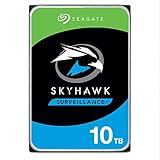
- ImagePerfect AI: Delivers zero dropped frames while supporting heavier workloads.
- Versatile Capabilities: Intelligently adapts to the scale of your AI environment, supporting up to 64 HD video streams and 32 AI streams.
- SkyHawk Health Management: Actively helps protect your surveillance storage by focusing on prevention, intervention, and recovery options. Includes RAID RapidRebuild—providing 3× faster volume rebuilds over traditional RAID rebuilds.
- Higher Reliability: Enterprise-class, with 2M hours MTBF and a 550TB/year workload rate for more than 3× that of standard surveillance HDDs.
- Recovery Services & Warranty: Five-year limited product warranty and three-year in-house Rescue Data Recovery Services included.
Power behavior in surveillance systems
For most deployments, the drive will spend the majority of its life in an active state rather than frequently entering idle or standby. Surveillance recording workloads are usually steady and predictable, with camera streams written continuously in blocks. This suits hard drives well, but it also means energy-saving settings should be applied carefully. Aggressive disk sleep policies can introduce delays when footage is requested, increase spin-up cycles, and interfere with always-on recording expectations. In enterprise NVRs, staggered spin-up support, adequate PSU headroom, and conservative RAID controller settings are more valuable than chasing minimal idle draw.
- Small NVRs: A 4-bay or 8-bay system can usually cool these drives effectively if the chassis has direct front-to-back airflow.
- Dense recorders: 16-bay and larger systems should account for cumulative heat and spin-up demand across all installed disks.
- Remote sites: Cabinets, closets, and wall-mounted enclosures need ventilation, not just enough physical space for the recorder.
Noise and vibration characteristics
The SkyHawk AI 20TB is quieter than many older high-capacity enterprise drives in terms of tonal harshness, but it is still a mechanical 7,200 RPM disk with audible seek activity. In a typical server room, security closet, or equipment rack, drive noise will be masked by fans and ambient HVAC. On a desk or in a small office, the combination of rotation hum, head movement, and enclosure resonance can be noticeable, particularly when mulle drives are installed in the same chassis.
Rotational vibration is also relevant. Surveillance systems often pack many disks close together, and vibration can affect latency consistency during simultaneous reads and writes. The SkyHawk AI family is intended for multi-bay deployments and includes firmware behavior suited to NVR workloads, but the chassis still matters. Tool-less plastic trays, thin metal bays, and poorly damped enclosures can amplify mechanical noise. A recorder with rigid drive carriers, vibration isolation, and balanced airflow will help the drive maintain more consistent behavior over long recording windows.
Thermal management expectations
Heat is the main environmental factor to watch with a 20TB surveillance drive. Helium-filled construction helps reduce internal drag compared with air-filled designs, but high platter density and 24/7 duty cycles still require consistent cooling. The ideal deployment keeps drive temperatures stable rather than allowing repeated hot-and-cold swings. Intake filters should be cleaned, fans should be monitored, and drive bays should not be packed into unventilated cabinets alongside PoE switches, UPS units, or other heat-producing equipment.
For best results, administrators should track SMART temperature readings through the NVR software or a storage management tool and set alerts before temperatures approach unsafe levels. In high-camera-count installations, it is worth testing thermals during peak conditions: full recording load, mulle playback sessions, AI event searches, and elevated room temperature. If the SkyHawk AI 20TB is kept in a well-ventilated chassis with predictable airflow, its power, acoustic, and thermal profile is appropriate for serious surveillance deployments, but it should be treated as a high-capacity infrastructure component rather than a casual desktop storage drive.
Independent reader supportYour contribution helps us test, update, and keep practical guides available for everyone.Best Use Cases and Deployment Considerations
The Seagate SkyHawk AI 20TB is best suited for surveillance systems where video retention, continuous write activity, and AI-assisted analysis matter more than desktop-style burst performance. Its capacity makes it a strong fit for NVR and DVR deployments that need to retain weeks or months of footage from mulle cameras, especially where higher-resolution feeds such as 4MP, 8MP, or 4K are being recorded continuously. In these environments, a single 20TB drive can reduce bay count pressure, simplify storage planning, and extend retention windows without immediately moving to a larger chassis or external expansion shelf.
Recommended Free Tools
The drive is particularly relevant for AI-enabled surveillance platforms that combine standard recording with metadata generation, facial recognition, object detection, license plate recognition, people counting, or behavioral analytics. These workloads are not just sequential writes; they can include simultaneous reads from archived footage while live camera streams continue to be written. For this reason, the SkyHawk AI line is a better match than a basic desktop HDD or entry surveillance drive when an NVR is expected to handle real-time analytics, retrospective search, and multi-user playback at the same time.
Ideal deployment scenarios
- Commercial security systems: Retail stores, warehouses, offices, schools, and hospitality sites that need long retention periods and 24/7 recording.
- AI NVR platforms: Systems running video analytics locally, including person, vehicle, face, or object detection across multiple channels.
- High-camera-count installations: Deployments with many HD or 4K cameras where sustained ingest performance and workload endurance are more valuable than peak transfer rates.
- Edge surveillance storage: Remote sites that need local recording before footage is selectively uploaded, reviewed, or archived elsewhere.
- RAID-based NVR storage pools: Multi-bay systems where 20TB drives can be combined for large usable capacity with redundancy.
Capacity planning should start with the number of cameras, resolution, frame rate, codec, bitrate, recording mode, and required retention period. For example, a site recording many 4K streams continuously at high bitrates can consume storage rapidly, while motion-triggered recording with H.265 compression can stretch the same 20TB much further. Buyers should avoid treating 20TB as a universal answer; the correct drive count depends on the recording profile and whether the NVR reserves space for database indexing, analytics metadata, snapshots, or system overhead.
Deployment also depends on the enclosure and cooling design. A high-capacity surveillance HDD should be installed in an NVR chassis with adequate airflow, secure drive mounting, and firmware support for large SATA drives. In compact fanless enclosures or poorly ventilated cabinets, thermal buildup can reduce long-term reliability, particularly during continuous recording and playback. For multi-drive systems, using matching SkyHawk AI drives across the array can make performance and maintenance more predictable, while RAID 5, RAID 6, or vendor-specific redundancy can help protect against single-drive failure.
The SkyHawk AI 20TB is less compelling for ordinary desktop storage, gaming PCs, or light home backup where its surveillance tuning and workload rating will not be fully used. It is also not a substitute for enterprise SSDs in analytics servers that require very high random I/O or low-latency database performance. Its strongest role is as dense, durable, always-on storage inside surveillance appliances that must record continuously, support analytics, and retain large volumes of video without frequent drive swaps or capacity upgrades.
Quick wins for a faster PC:
Repair Windows errors before they cause bigger problemsFix Now →Scan for outdated or missing drivers - takes under a minuteDriver Scan →Competitive Positioning and Final Verdict
The Seagate SkyHawk AI 20TB sits in a narrower and more demanding category than standard surveillance drives. It is not just a large-capacity HDD for recording camera feeds; it is built for NVRs that combine continuous write activity with AI-assisted video search, object recognition, metadata generation, and event indexing. That makes it a stronger fit than conventional desktop, NAS, or entry-level surveillance models when the system has dozens of cameras, long retention targets, and analytics workloads running on the same storage pool.
Against Seagate’s standard SkyHawk lineup, the SkyHawk AI 20TB is the higher-end choice for heavier deployments. Regular SkyHawk drives are well suited to smaller DVR/NVR installations where the primary job is sequential video recording. The AI model adds a higher workload rating, better support for mixed read/write activity, and firmware tuned for environments where recorded footage may be continuously analyzed after it is written. For users building a basic home or small business camera system, the added capability may be unnecessary. For commercial security, public-sector monitoring, transportation, warehousing, healthcare, education, or multi-site retail, the extra endurance and capacity are easier to justify.
Compared with WD Purple Pro drives, the SkyHawk AI 20TB competes directly in the premium surveillance tier. Both product families target high camera counts, analytics workloads, and 24/7 operation. The decision often comes down to platform preference, pricing, warranty support, and fleet consistency. If an existing NVR vendor validates one family over the other, that compatibility should carry more weight than small specification differences. In real deployments, firmware behavior, rebuild stability, vibration tolerance, and monitoring integration are often more valuable than peak transfer rates.
Enterprise nearline HDDs, such as Seagate Exos or WD Gold models, can also be tempting at this capacity because they offer strong endurance ratings and broad data center credibility. However, they are not always the most appropriate substitute in surveillance appliances. Enterprise drives are generally optimized for server and storage-array workloads, while the SkyHawk AI is tuned specifically for continuous video ingestion and camera stream handling. In an NVR, that surveillance-oriented firmware can be the more practical advantage, especially when dropped frames or delayed writes are unacceptable.
Where the SkyHawk AI 20TB makes the most sense
- Large NVR deployments with many HD or 4K cameras recording continuously.
- AI-enabled surveillance systems that perform frequent video searches, tagging, or analytics on stored footage.
- Long retention policies where 20TB per bay reduces the number of drives, chassis, or expansion shelves required.
- Business-critical security environments that need 24/7 operation, high workload tolerance, and surveillance-specific firmware behavior.
The main drawback is cost. A 20TB AI-class surveillance drive is overkill for light-duty camera systems, and smaller SkyHawk, IronWolf, or WD Purple models may deliver better value where capacity and analytics demands are modest. It is also still a mechanical drive, so random access performance cannot match SSD-based storage for intensive database or analytics workloads. For most surveillance systems, though, HDD capacity and cost per terabyte remain far more practical than all-flash storage.
Overall, the Seagate SkyHawk AI 20TB is a strong specialist drive for modern surveillance infrastructure. Its value is highest when capacity, endurance, and analytics-readiness matter at the same time. If the goal is dependable high-capacity recording in an AI-capable NVR or DVR environment, it is one of the most appropriate drives in Seagate’s portfolio and a credible alternative to the best premium surveillance HDDs on the market.
Frequently Asked Questions
Is the Seagate SkyHawk AI 20TB worth buying over a regular surveillance hard drive?
It is worth considering if your NVR handles AI video analytics, many camera streams, or long retention periods. Compared with standard surveillance drives, the SkyHawk AI line is built for heavier workloads and mixed read/write activity from recording plus analytics. For a small home DVR with only a few cameras, a lower-capacity SkyHawk or WD Purple drive may be more cost-effective.
How many cameras can the Seagate SkyHawk AI 20TB support?
Seagate rates SkyHawk AI drives for up to 64 HD camera streams and additional AI streams, depending on the NVR platform and workload. The actual number depends on camera resolution, frame rate, compression format, bitrate, and whether analytics are running continuously. For 4K cameras or high-bitrate recording, storage planning should be based on total daily write volume rather than camera count alone.
How long can a 20TB SkyHawk AI drive retain surveillance footage?
Retention time depends heavily on camera count, resolution, bitrate, frame rate, and recording mode. For example, a system recording several 1080p cameras at moderate bitrates may retain weeks or months of footage, while a large 4K multi-camera setup can consume 20TB much faster. Using H.265 compression, motion-based recording, and sensible frame rates can significantly extend retention.
Can the SkyHawk AI 20TB be used in a NAS or desktop PC?
It can work in a NAS or desktop PC if the system supports SATA hard drives of this capacity, but it is primarily tuned for surveillance workloads. Its firmware is optimized for continuous recording, multi-stream video, and NVR reliability rather than general desktop responsiveness. For NAS file storage, a Seagate IronWolf or IronWolf Pro is usually the better fit, while Exos is more appropriate for enterprise server workloads.
Is the Seagate SkyHawk AI 20TB noisy or power-hungry?
As a high-capacity 3.5-inch hard drive, it will be more audible than an SSD and can produce noticeable seek noise in quiet rooms. In an NVR closet, rack, or equipment cabinet, noise is usually less of a concern than airflow and vibration control. Power draw is reasonable for a 20TB surveillance-class HDD, but multi-drive deployments should still account for cooling, PSU capacity, and enclosure ventilation.
Bottom Line
The Seagate SkyHawk AI 20TB HDD is a strong fit for serious surveillance deployments that need long retention windows, continuous recording, and support for AI analytics workloads without stepping up to a full enterprise data-center drive. Its combination of high capacity, surveillance-tuned firmware, workload endurance, and NVR-focused reliability makes it especially compelling for multi-camera systems where uptime and video integrity matter.
If your setup involves AI-enabled NVRs, dense camera arrays, or extended archival requirements, the SkyHawk AI 20TB is worth prioritizing over standard desktop or basic surveillance drives. For smaller DVR/NVR installations with lighter workloads, a lower-capacity SkyHawk or similar surveillance HDD may be more cost-effective.

