Quick wins for a faster PC:
Scan for outdated or missing drivers - takes under a minuteDriver Scan →Clear out junk files and repair common Windows errorsFree Scan →Fix the driver behind crashes, sound loss and screen glitchesFind Drivers →Some links on this page are affiliate links: if you buy through them we may earn a commission, at no extra cost to you.
For a 3D-printed part that will spend years in direct sun and weather, ASA is the best-supported default of these three. Prusa Research and Polymaker specifically describe their ASA products as UV-stable or UV- and weather-resistant for outdoor use. PETG is a practical, generally easier-to-print choice for less demanding exposure when the part’s temperature and load remain within the exact filament’s limits. Standard ABS is usually the weakest choice for prolonged sun because Prusa says it lacks ASA’s UV resistance and can yellow and become more brittle outdoors.
These are selection guidelines, not guaranteed service-life predictions. The right filament also depends on the product formulation, the part’s hottest operating conditions, its geometry and load, color, installation, and whether your printer can manage the material reliably.
As an Amazon Associate I earn from qualifying purchases.
The Tool Desk
Outbyte PC Repair FREEClear out junk files and repair common Windows errorsFree Scan →Outbyte Driver Updater FREEFix the driver behind crashes, sound loss and screen glitchesFind Drivers →Which filament is best for outdoor 3D prints?
Choose ASA when direct sunlight and weather are the main concerns and your printer can handle its higher-temperature, more warp-prone printing requirements. Prusa Research describes Prusament ASA as UV stable and suitable for long-term outdoor use, while Polymaker markets its ASA as UV-resistant and outdoor-ready. Those statements make ASA the clearest starting point for an exposed part among PETG, ASA, and ABS.
For a less demanding outdoor part, PETG can be a reasonable compromise if its heat resistance is sufficient. Prusa describes Prusament PETG as suitable for indoor and outdoor use, low-warping, and printable without an enclosure. That can matter more than a theoretical material advantage when the printer is not set up for high-temperature, shrinkage-sensitive filaments.
#1 Best Overall
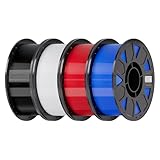
- Ender PETG Filament - combines the advantages of PLA and ABS, offering an eco-friendly, odorless, and user-friendly 3D printing experience. It features enhanced toughness that effectively resists cracking and warping, ensuring smooth and successful prints.
- Excellent Mechanical Properties - This PETG filament boasts high strength, impact resistance, and temperature resistance, with low shrinkage and high elongation at break. Printed models remain sturdy and durable even under repeated bending or stress.
- High Clarity & Glossy Finish - It delivers outstanding transparency and light transmission, making it perfect for visually detailed projects such as lampshades and display cases. The surface finishes with a smooth, glossy appearance.
- Reliable Printing & Compatibility - Dried, vacuum-sealed, and tangle-free, it minimizes clogging, bubbling, and snapping. With a precise diameter of 1.75mm (±0.02mm), it feeds smoothly and is compatible with most FDM printers on the market.
- Safe and Supported - Non-toxic and chemically resistant, Ender-PETG is safe for everyday use. Backed by Creality’s 12-month & 24 hours after-sales service. Note: Please place this product in a dry and ventilated environment, not in an environment of high temperature, sunny or humid conditions.
Choose ABS only when its particular mechanical or thermal properties suit the job and ultraviolet exposure is limited or otherwise managed. Prusa says ABS does not have ASA’s UV resistance and may yellow and become more brittle outdoors. The fact that ABS and ASA can show overlapping heat-deflection figures does not erase that difference in weather suitability.
The distinction is not that one polymer wins every test. ASA has the clearest manufacturer-backed outdoor and UV claims in the cited product information; PETG has a lower-warping printing profile; and ABS can still fit selected applications where sun exposure is controlled. The decision should start with the installation environment, then heat and load, and only afterward printing convenience.
What is the difference between PETG, ASA, and ABS outdoors?
The most important difference is how the materials balance weather exposure, heat performance, and printing effort. The figures below are examples from specific products and sources, not universal values for every spool.
| Decision factor | PETG | ASA | ABS |
|---|---|---|---|
| UV and weather suitability | Prusa describes Prusament PETG as suitable for indoor and outdoor use; the cited product page does not quantify its UV life. | Prusament describes its ASA as UV stable and suitable for long-term outdoor use; Polymaker describes its ASA as UV- and weather-resistant. | Prusa says ABS lacks ASA’s UV resistance and can yellow and become more brittle outdoors. |
| Example temperature-resistance or heat-deflection figures | Prusament PETG: 68 °C. LayerTune’s 20 September 2026 comparison lists 62–69 °C for the cited PETG products. | Prusament ASA: near 93 °C. LayerTune lists 92–100 °C for the cited ASA products. | LayerTune lists 84–100 °C for the cited ABS products. |
| Printing considerations in the cited guidance | Prusament is described as low-warping and not requiring an enclosure; PETG can string and adhere strongly to the print bed. | Prusa recommends high print temperatures and an enclosure or skirt to manage shrinkage; Polymaker recommends an enclosure for its product. | Temperature control is commonly needed, but exact settings and enclosure requirements vary by brand and printer. |
| Best fit among these choices | Less demanding outdoor use when easy printing matters and the part is not heat-stressed. | Direct sun and weather exposure when the printer can manage the material. | Jobs where the exact product’s mechanical or thermal properties suit the part and UV exposure is limited or managed. |
Heat figures are product-specific. LayerTune’s 20 September 2026 comparison cautions that heat-deflection temperature (HDT) must be read with its stated test load; comparing numbers measured under different loads can mislead. As its guidance puts it, “A figure without its load is half a figure.” That is editorial advice about interpreting datasheets, not a universal standards quotation, but it captures the practical pitfall: a temperature number without its test conditions is incomplete.
Is PETG or ASA better in the sun?
ASA has the stronger evidence for long-term direct-sun use. Prusament describes ASA as UV stable and suitable for long-term outdoor use, while Polymaker describes its ASA as UV- and weather-resistant for outdoor parts. Prusa’s PETG guidance supports outdoor use but does not give a quantified UV-life claim.
That difference matters when ultraviolet exposure is a central design condition rather than an incidental one. A shaded bracket, a part under a cover, or an item used outside only occasionally may place less emphasis on UV performance. For an exposed component expected to remain outdoors over time, ASA is the better-supported starting point.
PETG can still be the sensible choice when printer constraints dominate and the temperature and loading conditions are moderate. Its lower-warping behavior can make it easier to produce a dimensionally acceptable part, and an enclosure is not required in Prusa’s Prusament PETG guidance. The trade-off is that the cited page does not establish a quantified outdoor lifetime comparable to a field-year claim.
Do not read the comparison as a promise that every ASA print will outlast every PETG print. Exact formulation, color, geometry, exposure, load, and installation all affect the result. The manufacturer descriptions identify intended outdoor suitability; they do not guarantee a particular number of years in a specific climate.
Rank #2

- ①【PETG Filament 1.75mm】SUNLU PETG 3D Printer Filament combines the advantages of both PLA and ABS 3D printer filament, making 3D printing more convenient and easy.
- ②【Excellent Layer Adhesion】PETG filament offers excellent layer adhesion, reducing the risks of warping and ensuring smooth, strong prints with great structural integrity.
- ③【Enhanced Toughness】Known for its toughness, PETG outperforms many other filaments in durability, making it ideal for creating sturdy and resilient items that can withstand stress and use.
- ④ 【High Impact & Mechanical Strength】Stronger than standard PLA and easier to print than ABS. Our PETG filament provides excellent layer adhesion and impact resistance, preventing warping or cracking under stress. Perfect for printing functional parts, RC drone frames, or heavy-duty household tools.
- ⑤【Weather-Resistant for Outdoor Use】Engineered with robust UV and moisture resistance, SUNLU PETG maintains its structural integrity and color vibrancy over time. It is the ideal choice for outdoor planters, car accessories, and weatherproof garden fixtures that endure harsh sunlight or rain.
Does ABS filament hold up outdoors?
Standard ABS can be used outdoors in some circumstances, but it is not the strongest choice of these three for prolonged, unprotected sun exposure. Prusa says ABS does not have ASA’s UV resistance and may yellow and become more brittle outdoors. That warning addresses long-term ultraviolet exposure, not every possible sheltered installation.
ABS remains worth considering when a specific product’s mechanical or thermal properties are important and the part’s UV exposure is limited or managed. A covered location or an installation where direct sun is not the defining stress may change the material decision, but the exact product and conditions still need review.
Do not assume that ABS will have the same outdoor behavior as ASA just because their cited heat-deflection ranges overlap. Heat performance and UV suitability are separate selection questions. A part can tolerate a required temperature in a laboratory comparison and still be a poor choice for years of unprotected sunlight.
How should I compare heat resistance for an outdoor part?
Start with the hottest temperature the actual part is likely to experience, then consider whether it carries a load at that temperature. Compare that condition with the exact spool’s technical data, including the HDT test load where the value is reported. Do not treat a material name or a single generic temperature as a safe operating limit.
What the cited numbers say
- Prusa Research lists 68 °C as the temperature-resistance figure for Prusament PETG.
- Prusa Research lists near 93 °C for Prusament ASA.
- LayerTune’s 20 September 2026 comparison gives ranges for cited products: 62–69 °C for PETG, 92–100 °C for ASA, and 84–100 °C for ABS.
Those ranges show why it is unsafe to conclude that all ASA outperforms all ABS in heat, or that every PETG has the same heat capacity. Brand, formulation, test method, and test load matter. Use the technical information for the specific spool you plan to print, and make sure the comparison uses an appropriate and clearly stated load.
Why outdoor heat is not just a datasheet number
A part’s suitability depends on its real operating conditions, including whether it is loaded and how it is installed. A temperature-resistance or HDT figure is useful for comparing products under the stated test conditions; it does not by itself establish a guaranteed service temperature for a finished part.
For a loaded bracket, mount, clip, or enclosure component, ask two separate questions: what temperature can the material withstand in the stated test, and what happens when this particular geometry carries the intended load at that temperature? The cited figures answer only the first question at a product-comparison level. They do not remove the need to evaluate the finished design.
Sun exposure can also make the part’s real condition different from the surrounding air. The research-backed guidance does not supply a universal solar-heating correction or a single outdoor operating limit, so do not invent one from a PETG, ASA, or ABS label. Measure or estimate the hottest real condition and compare it with the exact product data.
Rank #3

- ①【PETG Filament 1.75mm】SUNLU PETG 3D Printer Filament combines the advantages of both PLA and ABS 3D printer filament, making 3D printing more convenient and easy.
- ②【Excellent Layer Adhesion】PETG filament offers excellent layer adhesion, reducing the risks of warping and ensuring smooth, strong prints with great structural integrity.
- ③【Enhanced Toughness】Known for its toughness, PETG outperforms many other filaments in durability, making it ideal for creating sturdy and resilient items that can withstand stress and use.
- ④【High Impact Strength】With its high impact resistance, PETG is perfect for printing parts that need to endure bumps and drops, ensuring long-lasting performance without cracks or breaks.
- ⑤【Robust Durability】PETG prints are robust and maintain their properties over time, making them suitable for both indoor and outdoor applications where weather resistance is a necessity.
Which material is easiest to print?
In the cited guidance, PETG is the lower-warping, more forgiving option: Prusa says Prusament PETG can be printed without an enclosure. ASA requires more attention to temperature and shrinkage, particularly for larger models. ABS settings and enclosure needs depend on the specific product and printer.
PETG
Prusa describes Prusament PETG as low-warping and suitable for printing without an enclosure. That makes it attractive for a first outdoor project or for a printer whose chamber is not designed for higher-temperature materials. The easier printing profile does not mean every aspect of a print will be effortless: PETG may string and can adhere strongly to the print bed.
Plan the print around those behaviors. A part that releases cleanly and keeps its intended dimensions is more useful than a theoretically tougher material that warps beyond use. At the same time, do not let easy printing substitute for checking UV exposure, heat, and load. PETG’s convenience is a practical advantage, not proof of a longer outdoor life.
ASA
ASA can warp, especially on large models. Prusa recommends high print temperatures and an enclosure or skirt to manage shrinkage, and Polymaker recommends an enclosure for its ASA product. These recommendations are product- and setup-related, so use the spool manufacturer’s instructions rather than assuming a single setting applies to every printer.
Before committing to a large functional part, confirm that the printer can maintain the required conditions and that the build environment can control shrinkage. A small test print can reveal whether the selected spool and setup hold dimensions acceptably, but the cited sources do not establish one universal test procedure or guarantee success without an enclosure.
ABS
The LayerTune comparison notes that ABS commonly needs temperature control, but requirements vary by material and brand. Confirm the settings for the exact spool and the capabilities of your printer before committing to a large or functional part.
Recommended Free Tools
Because ABS is less favored for prolonged unprotected sun, printing effort alone is not a reason to select it over ASA. Its case is strongest when the product’s specific mechanical or thermal properties suit the application and the UV environment is limited or managed.
What outdoor conditions should I identify first?
“Outdoor” covers more than one use case. Before choosing a spool, describe the installation rather than relying on the label alone.
Rank #4

- [Excellent PETG Filament]Our PETG combines the benefits of PLA and ABS to reach Eco-friendly and odorless performance. This PETG Filament is feature in good toughness to avoid cracking and warping, enbale excellent 3D printing.
- [Toughness-enhanced PETG] Our PETG filament choose durable and strong material that delivers excellent clarity, light transmission, and a glossy finish. It is recommended to use a printing temperature of 220-250°C and a base plate temperature of 70-80°C for better printing results.
- [Tangle-Free & Neatly Wound] We ensure that every PETG filament is tightly and neatly wrapped by utilizing full mechanical winding, which effectively minimizes tangles, filament snapping, and line breakage.
- [No Clogging & No Bubbles] Our filaments are thoroughly dried and carefully vacuum sealed to protect them from moisture and dust, which ensures that there will be no issues with clogging or bubbling during printing. Our PETG is designed to be perfectly compatible with the majority of 1.75mm FDM 3D printers, especially suitable for Creality 3D Printers!
- [High Precision & Consistent Performance]Our PETG filament boasts a diameter of 1.75mm, ensuring utmost accuracy with a tolerance of only +/- 0.03mm. With strict quality control and impeccable dimensional precision, our PETG filament guarantees a smooth and steady feeding during printing.
- Direct sun and weather: UV and weather resistance become primary requirements. ASA has the clearest support from Prusa and Polymaker.
- Outdoor but less demanding exposure: PETG may be practical if temperatures and loads remain within the selected product’s limits.
- Limited or managed UV: ABS can be considered when its particular properties fit and the exposure is controlled.
- Unknown exposure: Treat the part as potentially demanding until you can identify sun, weather, temperature, and load conditions.
This classification prevents a common mistake: treating “can be used outdoors” as a quantified lifetime promise. Prusa’s PETG description supports indoor and outdoor use, but it does not provide a common number of years. ASA’s UV-stable descriptions indicate intended long-term outdoor use, but still do not guarantee a specific result for every design.
How do I choose the right filament for my part?
Make the choice in this order: identify the actual exposure, check heat and loading needs, then confirm the printer can produce the material reliably. This prevents a convenient print from being mistaken for a suitable outdoor part.
PC Slower Than It Used to Be?
A free scan shows the junk files, broken settings and background clutter dragging Windows down - then fixes them in one click.Free scan · Windows 10 & 11Outdated Drivers Are Slowing You Down
One free scan finds every outdated or missing driver and matches the right update for your exact hardware.Free scan · exact hardware match- Describe the installation. Decide whether the part will receive direct sun and weather or will have less demanding exposure. If long-term direct exposure is the defining requirement, start with ASA.
- Estimate the hottest real operating temperature. Consider the part’s location and conditions, not just the ambient temperature where it is stored.
- Identify whether the part carries a load. A temperature-resistance figure without the relevant test load is not enough to judge a loaded part.
- Check the exact spool’s data. Use the manufacturer’s product information for that formulation, and compare HDT values only with their stated test loads.
- Match the filament to the printer. If the printer cannot manage ASA’s higher-temperature and shrinkage-control requirements, PETG may be the more practical choice when the exposure and heat conditions allow it.
- Reconsider ABS if the part will see prolonged sun. Use it only if its specific properties fit the application and UV exposure is limited or managed.
- Review the installation and design. Geometry, load, color, and installation conditions affect service life, so record them rather than assuming a material ranking applies unchanged.
- Validate the selected product. Check the spool’s instructions and technical information before printing the final part, especially when the design is large, loaded, or difficult to replace.
This process narrows the material choice, but it cannot predict a precise outdoor service life. Prusa’s and Polymaker’s product descriptions and LayerTune’s comparison support a selection framework, not one lifetime for PETG, ASA, and ABS.
What are the most common selection mistakes?
- Choosing by polymer name alone. Product-specific figures vary, so compare the exact spool rather than assuming every PETG, ASA, or ABS behaves identically.
- Using HDT as a guaranteed service temperature. HDT depends on the stated test load and is not automatically a field limit for a finished part.
- Ignoring UV because the part is mechanically strong. ABS and ASA can overlap in heat figures while differing in outdoor UV suitability.
- Assuming an enclosure is optional for every ASA setup. Prusa recommends an enclosure or skirt for shrinkage management, and Polymaker recommends an enclosure for its product.
- Assuming PETG’s easy print guarantees durability. Low warping and enclosure-free printing help production, but the selected product still must fit the heat, load, and exposure.
- Promising a number of years. No common outdoor lifetime figure is established for all three materials.
How long will an outdoor print last?
There is no supported universal lifespan for any of these materials in outdoor use, and Prusa, Polymaker, and LayerTune do not establish a comparable number of years for PETG, ASA, and ABS. A product-page description of UV resistance is useful evidence for material selection, not a field-life guarantee.
The outcome depends on the exact formulation, exposure, part geometry, color, load, and installation conditions. A small, lightly loaded part in a sheltered location is not equivalent to a large, loaded part in direct sun and weather. Because those variables differ from one use to another, do not turn a general material ranking into a promised service life for a particular printed part.
If failure would be consequential, design for inspection or replacement rather than assuming a fixed lifespan. The cited information does not provide a universal inspection interval, replacement schedule, or accelerated-weathering conversion, so any such schedule must come from the requirements of the actual application.
Do these 3 things before closing this tab:
1Fix the driver behind crashes, sound loss and screen glitches2Clear out junk files and repair common Windows errors3Scan for outdated or missing drivers - takes under a minuteWhat are the main trade-offs?
- Choose ASA when UV and weather resistance are the priority and your printer can manage its processing demands. Its cited product guidance also places its example heat-resistance figure near 93 °C, but verify the exact spool and test conditions.
- Choose PETG when the exposure is less demanding, temperatures and loads suit the selected product, and a lower-warping, enclosure-free print is valuable. Prusament’s cited example is 68 °C, while LayerTune’s cited PETG products range from 62–69 °C.
- Consider ABS selectively when the exact product’s other properties fit and prolonged UV exposure is limited or managed. LayerTune’s cited ABS products range from 84–100 °C, illustrating why exact product data matters.
ASA is the best-supported default for exposed outdoor use; it is not a universal answer for every printer or part. A material that cannot be printed successfully on the available setup is not a practical choice, and an easy-to-print filament is not automatically suitable for the part’s heat and exposure conditions.
Bottom line: PETG vs ASA vs ABS for outdoor 3D prints
For long-term direct sun and weather, start with ASA because Prusa Research and Polymaker explicitly identify UV and outdoor resistance. Use PETG when exposure is less demanding and its product-specific heat and load limits fit, especially when lower warping and no enclosure are important. Treat ABS as a selective option for limited or managed UV exposure, not as an automatic substitute for ASA. In every case, read the exact spool’s data, interpret HDT with its test load, and avoid promising a service life that the product information does not establish.
Best Value

- High Performance & Strength: PETG filament combines the strengths of PLA and ABS. It offers low shrinkage, high impact resistance, excellent temperature resistance, and high elongation at break, models can bend repeatedly and remain firm and sturdy
- High Transparent & Glossy: PETG has a high degree of transparency. The finished product has a fine surface with exquisite details. This makes PETG material ideal for making transparent parts and models, such as lampshades, display boxes, and more
- Non-toxic Material: Creality CR-PETG 3D printing filament has excellent wether resistance and chemical resistance, no odor, and non-toxic, green environmental protection
- Wide Compatible: CR-PETG filament is wildly used in FDM 3D printers on the market.Compatible with most popular 3D printers such as MK3, Creality Ender series/CR series, ELEGOO, Anycubic, and more
- Creality Support: Creality provides 12-month & 24 hours after-sales service. Note: Please place this product in a dry and ventilated environment, not in an environment of high temperature, sunny or humid conditions
Frequently Asked Questions
Are the temperature-resistance figures safe operating-temperature limits?
No. They are product figures used for material characterization or comparison, and an HDT value depends on its stated test load. Use the exact filament’s technical information alongside the part’s real temperature and loading conditions rather than treating the number as a guaranteed field limit.
Is ASA always better than PETG outdoors?
No. ASA has the stronger UV and weather evidence for long-term direct exposure, but PETG may be the more practical choice for less demanding exposure when the printer cannot manage ASA or when the exact PETG product meets the part’s temperature and load requirements.
What’s actually slowing this PC down?
Pick the symptom - the matching free tool is one click away.
Can I print ASA without an enclosure?
Prusa recommends an enclosure or skirt to manage shrinkage, and Polymaker recommends an enclosure for its ASA product. Whether a particular printer and part can be printed successfully without one is not established by those recommendations; check the filament maker’s instructions for your specific setup.
Does PETG work for outdoor parts?
Prusa describes Prusament PETG as suitable for indoor and outdoor use. The cited page does not provide a quantified UV-life claim, so PETG is best treated as a practical option for less demanding exposure when heat, load, and installation conditions fit the exact product.
Does ABS filament hold up in direct sun?
Prusa says ABS lacks ASA’s UV resistance and can yellow and become more brittle outdoors. Consider ABS for outdoor work only when its specific properties are important and prolonged UV exposure is limited or managed.
Why can ABS and ASA have similar heat figures but different outdoor recommendations?
Heat-deflection values and UV resistance describe different performance questions. LayerTune’s cited product ranges overlap in some cases, while Prusa specifically distinguishes ASA’s UV stability from ABS’s weaker outdoor UV behavior.
Free tools Windows power users keep installed
One-click scans. No signup required.
Does black filament last longer outdoors than another color?
The cited product pages and comparison do not provide a color-by-color outdoor durability result. Color is one of several factors that can affect service life, so do not infer a longer lifespan from color alone.
Is a manufacturer’s UV-resistant claim an independent durability test?
No. Prusa’s and Polymaker’s UV and weather descriptions are manufacturer claims about their own products, not a standardized, independent outdoor-lifetime result. They help identify intended use but do not establish a guaranteed lifespan.
How should I compare two filament brands?
Compare the exact products’ technical data, stated test methods, and HDT loads rather than comparing only PETG, ASA, or ABS labels. LayerTune’s 20 September 2026 comparison shows that figures vary across cited brands and warns that a temperature number without its load is incomplete.
What if my printer cannot handle ASA?
If the printer cannot manage ASA’s higher-temperature and shrinkage-control requirements, PETG may be a sensible compromise when direct exposure is less demanding and the selected product meets the part’s heat and load needs. Do not select ABS solely because it is also a high-temperature material; its UV suitability remains a separate concern.
The Bottom Line
For exposed, long-term outdoor parts, choose ASA when your printer can handle it. PETG is the easier compromise for moderate conditions, while ABS should be reserved for applications with limited or managed UV exposure. Always check the exact spool’s data and HDT test load.
Quick Recap
Product prices and availability are accurate as of the date/time indicated and are subject to change. Any price and availability information displayed on Amazon at the time of purchase will apply.

