Do these 3 things before closing this tab:
1Repair Windows errors before they cause bigger problems2Scan for outdated or missing drivers - takes under a minute3Clear out junk files and repair common Windows errorsSome links on this page are affiliate links: if you buy through them we may earn a commission, at no extra cost to you.
Hydropower is the stronger choice when a suitable river or reservoir can deliver dependable, dispatchable generation and storage for decades. Solar photovoltaic (PV) is usually easier to deploy in modules, available in more locations, and currently cheaper on a global average for new projects. The International Renewable Energy Agency (IRENA) reports 2024 global weighted-average levelized costs of electricity (LCOE) of USD 0.043 per kWh for new solar PV and USD 0.057 per kWh for new hydropower. Those averages do not decide an individual project: water availability, sunlight, transmission, permitting, financing, land, environmental effects, and the cost of flexibility can reverse the result.
Hydropower can produce electricity on demand, but drought and ecological impacts are serious constraints. Solar has no fuel combustion during operation and can be installed on roofs or in utility-scale fields, but it produces little or nothing at night and less during clouds. The best answer is often a portfolio in which solar supplies daytime energy and hydropower, storage, demand management, or transmission supplies flexibility.
As an Amazon Associate I earn from qualifying purchases.
Windows Errors? Fix Them Before They Spread
Repair common Windows errors and clear accumulated junk for a smoother, more stable PC - no reinstall needed.Free scan · no reinstallOutdated Drivers Are Slowing You Down
One free scan finds every outdated or missing driver and matches the right update for your exact hardware.Free scan · exact hardware matchWhat are the main pros and cons of hydropower?
Hydropower uses the energy of moving or falling water to turn turbines. A reservoir plant can hold water and release it when electricity is needed; a run-of-river plant has little storage and follows streamflow more closely. That distinction matters as much as the word “hydropower” itself.
Advantages of hydropower
- Dispatchable output and grid support. Reservoir units can ramp quickly, provide reserves, respond during outages, and help balance sudden changes in demand or other generators. The U.S. Department of Energy (DOE) describes hydropower as able to provide power to the grid immediately, while the Intergovernmental Panel on Climate Change (IPCC) notes that storage hydropower can compensate for rapid variations in load and supply.
- Very long operating life. DOE gives a typical hydropower lifespan of 65–85 years. Major civil works can therefore provide service over several generations when maintained and periodically refurbished.
- Low routine operating costs. The IPCC reports typical hydropower operation and maintenance costs of about 2–2.5% of investment per kW-year over lifetimes of roughly 40–80 years. Water is not purchased as fuel, although operators still face staffing, maintenance, sediment, environmental-flow, and refurbishment costs.
- Several public services from one project. A dam may also support irrigation, municipal water supply, flood control, navigation, recreation, and drought management. These benefits can be important in a regional infrastructure decision, but they do not eliminate the project’s environmental or social trade-offs.
- Low-carbon generation during operation. Hydropower generally has low lifecycle greenhouse-gas emissions compared with fossil generation. Reservoirs can emit methane and carbon dioxide when flooded organic matter decomposes, so the result varies by site and reservoir design.
Disadvantages of hydropower
- Strict site and water requirements. A viable project needs adequate flow, elevation change, geology, transmission access, legal water rights, and governance that can withstand competing uses. Run-of-river and small-storage plants are especially exposed to seasonal flow changes and drought.
- Large, slow and capital-intensive construction. Tunnels, dams, powerhouse works, roads, transmission, environmental review, licensing, and community consultation can take many years. Cost overruns and financing charges become significant risks when schedules slip.
- River and biodiversity disruption. Dams can block fish migration, fragment habitat, alter water temperature and chemistry, change the timing and amount of flow, trap sediment, and inundate natural or agricultural land. Mitigation such as fish passage and environmental-flow releases can reduce but not necessarily remove these effects.
- Displacement and cultural impacts. Reservoirs may require people to relocate and can affect culturally important, archaeological, or sacred sites. Opposition or unresolved benefit-sharing disputes can delay or stop a project.
- Drought and climate exposure. A reservoir provides flexibility only while enough water remains. Persistent drought, changing snowmelt, heat, evaporation, and competing agricultural or urban demand can reduce both energy production and the value of storage.
- Site-specific reservoir emissions. Greenhouse-gas releases from flooded vegetation and soils are highly variable. A claim that every hydropower project is automatically emissions-free is inaccurate.
Is hydropower better than solar power?
Neither technology is universally better. Hydropower is usually better for firm capacity, fast balancing, and long-duration or seasonal storage where a suitable, accepted site already exists. Solar is usually better for modular construction, distributed generation, and adding capacity quickly where sunlight, land or rooftops, and grid connections are available.
#1 Best Overall

- [Ideally Output of 9.36KWH] The power of 9.36KWh per day under 4 hours full sunshine by the 2340W solar panel system, very suitable for home, shed, cabin, farm or other energy backup, and it will provide enough power for portable ac, air condition, TV, refrigerator, coffee maker, microwave and other AC 240V (split-phase)devices.
- [Inverter Parallel Supportable] 10KW max continuous output.Parallel up to 6 unitsfor 60kw output power,120V/240V AC output to meet the power needs of your home's high-power appliances,and come with wifi module.The off-grid inverter has passed UL 1741 certification, and the product meets high industry standards in terms of safety, performance, and market access.
- [Real-time Battery Monitoring] ECO-WORTHY 48V(51.2V) Server Rack Battery supports CAN/RS485 for seamless communication,you can also easily monitor your battery’s status through the mobile app, which supports both Bluetooth and WiFi connections. .UL1973 | UL9540A | CEC- Completed comprehensive testing by Intertek and has officially earned two key North American safety certifications.And has met the standards set by the California Energy Commission,The outstanding performance of ECO-WORTHY products in design, electrical safety, and thermal runaway management, effectively ensuring the safety of your energy storage projects.
- [N-Type 18BB High-Efficiency Solar Cells]The newly upgraded 195W N-Type solar panel measures 58.86×26.18×1.18 inches and achieves a high conversion efficiency of 25%. Its 18 busbar design enhances conductivity, while double-sided generation delivers up to 100Wh of additional energy daily. With IP68 waterproof rating, tempered glass, and corrosion-resistant materials, it ensures a 30-year lifespan.
- [Segmented Charing/Discharging]3 output modes: mains priority and, battery priority, PV priority; uninterrupted power supply. Available in 4 charging modes: Only Solar, Mains Priority, Solar Priority and Mains & Solar hybrid charging. Set a flexible time period for mains charging/discharging according to the local mains condition, and help you save the mains.
| Decision factor | Hydropower | Solar PV |
|---|---|---|
| Primary resource | River flow, elevation, reservoir volume, geology, and water rights | Solar irradiance, orientation, shading, temperature, and usable roof or land |
| Output pattern | Reservoir plants can be scheduled; run-of-river output follows streamflow | Daytime production varies with clouds, season, shading, and system design; no production after sunset |
| Flexibility | Reservoir turbines can ramp and provide reserves; storage duration depends on water and reservoir rules | PV itself is not dispatchable; batteries, pumped hydro, demand shifting, transmission, or firm generation add flexibility |
| 2024 global weighted-average LCOE for new projects | USD 0.057/kWh, IRENA | USD 0.043/kWh, IRENA |
| Typical physical life | DOE: 65–85 years for hydropower facilities | Depends on modules, inverters, mounting, degradation, and replacements; no single figure is established here |
| Routine O&M | IPCC: about 2–2.5% of investment per kW-year over 40–80 years | Varies with cleaning, vegetation control, inverter replacement, monitoring, and site conditions |
| Construction profile | Large civil works and lengthy licensing; often difficult to build incrementally | Modular arrays can be expanded in stages, subject to land, interconnection, and permitting |
| Main environmental concerns | River fragmentation, fish passage, sediment, inundation, reservoir emissions, and displacement | Manufacturing materials and energy, land or rooftop use, mining, recycling, and grid-integration impacts |
| Best scale examples | Regional, utility, and some community systems; micro-hydro where flow and head are reliable | Household rooftops, commercial sites, community systems, and utility-scale arrays |
Nameplate capacity alone is a poor comparison. A 100-MW reservoir plant and a 100-MW solar array deliver electricity at different times and require different amounts of storage, transmission, and backup. Compare annual energy, peak contribution, flexibility, and system costs at the same location.
Which is cheaper: hydropower or solar?
On the global average for newly commissioned projects, solar is cheaper: IRENA’s 2024 weighted-average LCOE is USD 0.043/kWh for solar PV versus USD 0.057/kWh for hydropower. LCOE is an average cost of generating electricity over a project’s life; it is not a household bill, a guaranteed bid price, or the full cost of making a grid reliable.
Hydropower can be economically attractive when an existing dam, transmission line, and water-management system can be upgraded. A new dam may have high upfront civil-works costs but spread them over a 65–85-year physical life. Solar can have a lower initial project cost and be built in stages, yet a high-solar system may need batteries, network upgrades, curtailment management, or firm generation. Those additions can materially raise the delivered cost of electricity at the hours customers need it.
Project finance also changes the answer. Interest rates, construction risk, tax treatment, land prices, interconnection queues, module and turbine supply, insurance, reservoir rules, drought insurance, and expected degradation all affect the result. Do not apply the two global averages to a specific household, island, watershed, or utility without a location-specific model.
Which renewable source is more reliable?
Reliability has several meanings: producing energy across a year, meeting a short peak, recovering from an outage, and supplying electricity during a prolonged weather event. Reservoir hydropower generally has the strongest operational flexibility, while solar’s output is predictable by time of day but unavailable after sunset and reduced by clouds.
Rank #2

- System Components:Delivers up to 10kW power output with 120V/240V single-phase split-phase support, making it suitable for smoothly running common household appliances. The system includes 5 × 590W solar panels with a total PV capacity of 2950W, capable of generating up to 11.8 kWh per day under optimal conditions, along with one 48V 314Ah portable LiFePO₄ battery offering 16.1 kWh of energy storage. Complete with necessary cables, this all-in-one solar solution is designed for convenient setup and reliable home power support.
- Upgraded Integrated Battery:ECO-WORTHY 48V 314Ah lithium battery combines advanced safety, high capacity, and smart system compatibility. It features a PACE 200A Battery Management System with multi-layer protection and dual breakers for reliable circuit safety. With a 16.076 kWh energy capacity and support for up to 15 units in parallel (up to 241 kWh), it delivers scalable and dependable power. A 7-inch full-color display, along with Bluetooth, Wi-Fi, and PC connectivity, enables convenient real-time monitoring. Designed to work seamlessly with mainstream inverters via RS485 and CAN communication, the battery also includes built-in wheels and handles for easy installation and mobility
- Keep Home Running 10kW:ECO-WORTHY 10kW AIO solar charge inverter features 48V DC pure sine wave output with 120V or 120V/240V split-phase support, delivering 10,000W continuous power and up to 20,000W peak output. Equipped with dual MPPT controllers, up to 200A battery charging, built-in WiFi monitoring, multiple charging and output modes, time-slot energy management, and comprehensive protection functions, it is compatible with AGM, Gel, Flooded, and lithium batteries, supports battery-free operation, and allows parallel connection of up to six units
- High Power Solar Panel:590W Mono-crystalline Solar Panel (Black). Low power loss in cell connection compared to conventional modules. Improved shading tolerance. Lower internal current, lower hot spot temperature. Heat-strengthened glass minimizes micro-crack impact.
- Shipping Notice: Due to its large size and weight, the 5pcs 590W solar panel/1pc 48V 314Ah battery is securely packed and shipped on a pallet using a truck to ensure safe transportation. Please ensure your delivery address can accommodate truck deliveries.
Where hydropower has an advantage
A reservoir operator can hold water during low-demand periods and release it during evening peaks or emergencies. Turbines can provide frequency response, spinning reserve, black-start capability in some systems, and rapid balancing. The reservoir’s useful duration is limited by its storage volume, inflows, environmental-flow obligations, irrigation releases, flood-control rules, and drought conditions.
Where solar needs support
DOE warns that “after sunset or on cloudy days, there may be little solar production but plenty of demand for power.” Batteries can shift midday energy into evening hours; pumped hydro can shift energy over longer periods; demand response can move flexible loads; and transmission can share output across regions. Forecasting, distribution upgrades, and curtailment controls become more important as PV supplies a larger share of electricity.
Why run-of-river is different
Run-of-river projects may have lower inundation than large reservoirs, but they cannot dispatch water freely. Seasonal low flows and drought can reduce generation precisely when other resources are stressed. A fair reliability comparison must identify the hydropower design instead of treating every plant as a firm, reservoir-backed resource.
What are the environmental impacts of dams versus solar panels?
Both technologies have impacts across construction, operation, materials, and retirement. The relevant question is not whether either is impact-free, but which design causes fewer unacceptable effects at the proposed site and how those effects can be mitigated.
Dams and rivers
- Reservoir flooding can remove forests, farms, wetlands, or habitat and may release methane and carbon dioxide from decomposing organic matter.
- Barriers can prevent fish migration and isolate populations. Altered flow, temperature, chemistry, and sediment transport can reshape downstream ecosystems.
- People may be displaced, and archaeological or culturally significant places may be inundated.
- Environmental-flow releases, sediment management, fish passage, revised reservoir operations, and benefit-sharing can reduce damage, but they require monitoring and enforcement.
Solar modules and sites
- PV produces no fuel-combustion emissions during operation, but manufacturing uses energy, mined materials, chemicals, and industrial water. Lifecycle impacts are concentrated largely in manufacturing and upstream supply chains.
- Utility-scale arrays can convert or fragment habitat and compete with agriculture, conservation, or scenic uses. Rooftops and parking can reduce new land demand; agrivoltaic designs may share land with crops or grazing where local conditions permit.
- Inverters, racking, cables, and modules require replacement or eventual recycling. Project owners should specify collection, recycling, and financial responsibility before construction.
- Large PV concentrations can require new substations, transmission, road access, and vegetation management. Those infrastructure impacts belong in the project assessment.
Lifecycle-emissions comparisons depend on reservoir characteristics, manufacturing electricity, equipment choices, transport, land-use change, and the system boundary. A single universal number would conceal those differences.
Recommended Free Tools
Rank #3

- System Components:Delivers up to 10kW power output with 120V/240V single-phase split-phase support, making it suitable for smoothly running common household appliances. The system includes 18 × 590W solar panels with a total PV capacity of 10620W, capable of generating up to 39.36 kWh per day under optimal conditions, along with two 48V 314Ah portable LiFePO₄ battery offering 32.2 kWh of energy storage. Complete with necessary cables, this all-in-one solar solution is designed for convenient setup and reliable home power support.
- Upgraded Integrated Battery:ECO-WORTHY 48V 314Ah lithium battery combines advanced safety, high capacity, and smart system compatibility. It features a PACE 200A Battery Management System with multi-layer protection and dual breakers for reliable circuit safety. With a 16.076 kWh energy capacity and support for up to 15 units in parallel (up to 241 kWh), it delivers scalable and dependable power. A 7-inch full-color display, along with Bluetooth, Wi-Fi, and PC connectivity, enables convenient real-time monitoring. Designed to work seamlessly with mainstream inverters via RS485 and CAN communication, the battery also includes built-in wheels and handles for easy installation and mobility.
- Keep Home Running 10kW:ECO-WORTHY 10kW AIO solar charge inverter features 48V DC pure sine wave output with 120V or 120V/240V split-phase support, delivering 10,000W continuous power and up to 20,000W peak output. Equipped with dual MPPT controllers, up to 200A battery charging, built-in WiFi monitoring, multiple charging and output modes, time-slot energy management, and comprehensive protection functions, it is compatible with AGM, Gel, Flooded, and lithium batteries, supports battery-free operation, and allows parallel connection of up to six units.
- High Power Solar Panel:590W Mono-crystalline Solar Panel (Black). Low power loss in cell connection compared to conventional modules. Improved shading tolerance. Lower internal current, lower hot spot temperature. Heat-strengthened glass minimizes micro-crack impact. [Professional Installation Required]To ensure safety and optimal performance, it is recommended to hire a professional installer. We provide online technical guidance (inquiries are welcome), but installation by non-professional electricians or novices is not recommended, as it may cause safety hazards and a loss of system performance.
- Shipping Notice: Due to its large size and weight, the 18pcs 590W solar panel/2pcs 48V 314Ah battery is securely packed and shipped on a pallet using a truck to ensure safe transportation. Please ensure your delivery address can accommodate truck deliveries.
Can hydropower replace solar at night?
Hydropower can supply electricity at night, including electricity that solar generated earlier if the system uses pumped storage. Conventional hydropower does not “store solar power” automatically: it stores water, and its nighttime output depends on reservoir rules, inflows, available head, and competing water demands.
How pumped-storage hydropower works
During low-demand periods, pumps move water to an upper reservoir. When demand rises, water flows back through turbines. DOE describes pumped storage as a well-tested technology, but suitable terrain, reservoirs, large initial capital, lengthy permits, and long implementation times can limit where it is practical. Pumped storage consumes more electricity pumping than it later returns, so its value comes from shifting energy and providing capacity and grid services, not creating energy.
How batteries differ
Batteries can often be installed faster and near solar projects or loads. They have their own cost, degradation, mineral-supply, safety, and recycling considerations. The appropriate duration, cycling schedule, replacement plan, and fire-safety design must be evaluated for the location rather than assumed from a generic battery size.
How should a household, business, or utility choose?
Use the following sequence to avoid selecting a technology from its headline price alone.
- Define the service. Decide whether the priority is lowest daytime energy cost, evening peak supply, backup during outages, seasonal water management, emissions reduction, local generation, or several objectives.
- Screen the resource. For hydropower, measure flow duration, head, sediment, flood risk, drought history, environmental releases, and competing water uses. For solar, model irradiance, orientation, shading, temperature, soiling, snow, degradation, and available roof or land.
- Check the grid connection. Identify nearby substations, hosting capacity, transmission limits, distribution upgrades, congestion, curtailment rules, and the value of power at different hours.
- Map permits and affected communities. Include water rights, environmental review, fish and wildlife requirements, land-use approvals, cultural resources, construction access, relocation risk, and consultation. A technically attractive project that cannot obtain social or legal approval is not a viable project.
- Model the full system cost. Include generation, financing, construction risk, O&M, replacements, transmission, storage, backup, decommissioning, insurance, and expected curtailment. Compare delivered electricity and capacity value, not only LCOE or nameplate megawatts.
- Test climate and outage scenarios. Examine drought years, heat waves, cloudy periods, floods, wildfire smoke, equipment failures, and transmission outages. Confirm how many hours of firm supply remain under each case.
- Evaluate alternatives and combinations. Compare a new dam with rehabilitation of an existing one, rooftop or brownfield solar with a greenfield array, batteries with pumped storage, demand response, transmission, and a hydro-plus-solar portfolio.
- Set accountability requirements. Specify environmental-flow targets, fish passage, sediment plans, land restoration, community benefits, labor and safety standards, module or battery recycling, and transparent performance reporting.
When does hydropower make the most sense?
Prioritize hydropower when a high-quality site is already identified or permitted, dependable water and elevation are available, the grid values rapid balancing or long-duration storage, and ecological and community impacts can be mitigated and accepted. Upgrading an existing facility may avoid some new inundation and transmission work, although it still requires engineering, licensing, and environmental review.
Rank #4
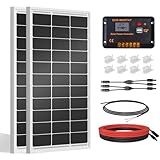
- [Wide Application]: Daily Output 800wh/day under 4 hours full sunshine condition. Perfect for RV, Caravan, Marine, Camper, Electric scooter, Golf Carts, Power wheels, Trolling motor, Tool trailer, Backup power supply for cabin shed home etc.
- [Excellent Performance]: ECO-WORTHY solar panels use high-performance monocrystalline solar cells, which can provide up to 21.5% higher efficiency sufficient light conditions.size:35.2*23.1.37in
- [Durable]: Corrosion-resistant aluminum alloy frame, so that the panel can be used for decades, and can withstand strong wind (2400Pa) and snow load (5400Pa), with a long service life. Ip65 rated junction box provides complete protection.:
- [Complete and Easy]: The back of the pre-drilled and plug-and-play cables allow quick installation, the kit can be connected in series (24V) or parallel (12V) if you need. What you will get: 2 pcs 100W mono solar panel + 2 set of Z mounting brackets + 30A solar controller + 1 pair of 16.4ft 10 awg solar cables + 1 pair of 2-in-1 connectors + 1 pair of 4.92ft tray cable.
- [Support]: 1 year with 24/7 tech support, if any problems or questions about the product,please do not hesitate to let us know through Amazon or call ECO-WORHTY hotline for solution.
Be cautious when the project depends on optimistic inflows, would flood irreplaceable habitat, requires large-scale relocation, or faces unresolved water conflicts. A small plant is not automatically low-impact or drought-proof; its footprint and risk depend on the river and design.
Independent reader supportYour contribution helps us test, update, and keep practical guides available for everyone.When does solar make the most sense?
Prioritize solar PV when modular or rapid deployment, distributed generation, or a lower current average generation cost matters; sunlight is strong and predictable enough; and rooftops, parking areas, degraded land, or responsibly sited fields are available. Solar can reduce daytime fuel use and transmission losses when located near loads, but interconnection capacity and local permitting still determine the schedule.
Plan flexibility from the start if evening demand is important. Options include batteries, pumped storage, demand response, time-of-use pricing, larger regional interconnection, and complementary dispatchable generation. A PV project without a plan for its highest-value hours may produce inexpensive energy that the grid cannot always use.
What’s actually slowing this PC down?
Pick the symptom - the matching free tool is one click away.
Why combine hydropower and solar?
A combined portfolio can use solar for daytime energy while reservoirs provide balancing, reserves, and seasonal shifting. In a wet season, solar may allow operators to conserve water for later; in a dry season, solar can reduce daytime withdrawals from the reservoir. The benefit depends on transmission, reservoir operating rules, environmental releases, and the ability to avoid curtailing solar.
Model the combination as one system. Include correlated weather and hydrology, drought restrictions, storage losses, line congestion, and the cost of new controls or substations. The strongest portfolio may include solar, existing hydropower, batteries, efficiency, and transmission rather than a choice between two isolated generators.
Best Value

- COMPLETE OFF GRID SOLAR SYSTEM KIT – 2340W of Clean Power ECO-WORTHY 5KW off grid solar system complete kit includes 12pcs 195W mono solar panels (2340W total), 1pc 48V 5KW off-grid inverter, and 1pc 48V 100AH Cubix lithium battery.Equipped with necessary cables and brackets.
- 12PCS 195W MONO N-Type SOLAR PANELS – High Efficiency & Durable Each 195W monocrystalline solar panel delivers reliable output and is built for roof, ground, or shed mounting. The 2340W solar panel roof kit is ideal for off grid cabins, RVs, homes, and backup power systems.
- 5KW 48V OFF-GRID INVERTER – Stable Power for Off-Grid The 48V 5KW off-grid inverter converts DC power from your solar panels and battery into usable AC electricity. Perfect for powering lights, appliances, TVs, fridges, and other essentials during outages or off-grid living.
- 48V 100AH Cubix LiFePO4 LITHIUM BATTERY – Long-Lasting Storage The 51.2V 100AH server rack LiFePO4 lithium battery offers deep-cycle storage, high safety, and a long lifespan. It stores solar energy for night use and works seamlessly with the included 5KW inverter for whole house storage.
- ECO-WORTHY SOLAR PANEL KIT – Easy Setup & Reliable Support This eco worthy solar panel kit is designed for DIY installation with clear wiring and mounting. Whether you search for solar system, solar kits off grid with battery and inverter, or ecoworthy 5k kit, this complete set is a solid off-grid energy solution.
What common mistakes should decision-makers avoid?
- Comparing only headline LCOE. Add capacity, flexibility, transmission, storage, financing, and environmental-compliance costs.
- Calling all hydropower dispatchable. Run-of-river plants and drought-stressed reservoirs cannot provide the same service as large storage projects.
- Calling solar unreliable without defining the service. PV is highly predictable over short horizons, but it needs another resource for night-time and extended low-sun periods.
- Ignoring water’s competing uses. Irrigation, drinking water, flood control, navigation, recreation, and ecosystem flows can limit electricity operations.
- Treating environmental mitigation as automatic. Fish passage, resettlement, land restoration, recycling, and community benefits require funded plans, enforcement, and long-term monitoring.
- Using a global average as a local quote. The IRENA figures are weighted global averages for new projects commissioned in 2024, not guaranteed prices for a specific country or customer.
- Comparing nameplate capacity instead of useful output. Evaluate hourly and seasonal energy, peak contribution, outage performance, and curtailment under realistic weather and hydrology.
Frequently Asked Questions
Does hydropower emit greenhouse gases?
Hydropower usually has low lifecycle emissions compared with fossil generation, but reservoirs can release methane and carbon dioxide as flooded organic matter decomposes. Emissions vary substantially with reservoir location, age, vegetation, climate, and operating conditions, so a site assessment is needed.
Can solar panels work during a power outage?
A standard grid-tied solar system normally shuts off when the grid fails for worker safety. Solar can provide outage power only when paired with correctly configured batteries, inverters, controls, and often a critical-load panel or other approved islanding equipment.
Is a run-of-river plant environmentally harmless?
No. It may avoid the largest reservoir inundation, but diversion structures and altered flows can still affect fish passage, sediment, temperature, and downstream habitat. Its electricity output can also fall sharply during low-flow periods.
How long does a solar project take to build compared with a dam?
Solar arrays are modular and can often be constructed in phases, but the actual schedule depends on interconnection, land-use approval, equipment supply, and local permitting. A new dam typically faces much longer civil works, licensing, environmental review, and community-consultation timelines; no universal construction duration applies.
Quick Recap
Product prices and availability are accurate as of the date/time indicated and are subject to change. Any price and availability information displayed on Amazon at the time of purchase will apply.

