The Tool Desk
Outbyte PC Repair FREEClear out junk files and repair common Windows errorsFree Scan →Outbyte Driver Updater FREEFix the driver behind crashes, sound loss and screen glitchesFind Drivers →Some links on this page are affiliate links: if you buy through them we may earn a commission, at no extra cost to you.
You can explore a DNA string with Hugging Face’s multimolecule/dnabert2 by tokenizing the sequence, running the DNABERT-2 model, and using either its contextual hidden states or its masked-token predictions. The model produces 768-dimensional representations for sequence analysis and can rank candidate tokens for a masked region. It is not a clinical interpreter: an embedding is a numerical feature, and a fill-mask result is a learned sequence likelihood, not proof of function, pathogenicity, or biological mechanism.
This guide shows a reproducible Python workflow, explains what the tensors mean, handles the model’s 512-token context limit, and places DNABERT-2 in context with other DNA foundation models.
As an Amazon Associate I earn from qualifying purchases.
What’s actually slowing this PC down?
Pick the symptom - the matching free tool is one click away.
What is DNABERT-2, and what can it do with a DNA sequence?
DNABERT-2 is a BERT-style language model trained on genome sequences from multiple species with a masked-language-modeling objective. In practical terms, it learns patterns in nucleotide context by hiding part of a training sequence and predicting what belongs there. You can reuse that learned representation in two ways: extract embeddings for analysis or ask the model to score candidates at a masked position.
The Hugging Face checkpoint used in this workflow is multimolecule/dnabert2. The original project also identifies a checkpoint named zhihan1996/DNABERT-2-117M; use the identifier required by the library and model card you are following rather than assuming all checkpoints expose identical interfaces.
#1 Best Overall

- Hands-On DNA Model Kit: Build color-coded double helix that teaches DNA structure through assembly. Interlocking pieces guide learners to match base-pairing A-T and G-C, making related Genetics concepts visible for middle school, high school, and primer college biology lessons, tutoring, and homeschool labs
- Classroom-Ready Teaching Aid With Stand: Finished model stands 13 in / 33 cm tall for desk demos and display. Use the included base to present helix upright during lectures, lab stations, and study sessions, or as a science fair visual that supports clear explanations of replication, base pairing, and nucleotides
- Accurate Double Helix Visualization: The twisted ladder design shows two backbones and paired rungs, helping learners see how strands align, split, and reconnect at the center of base-pairing. Teachers can demonstrate DNA replication steps, while students practice labeling nucleotides, complementary pairing rules, and gene basics for quizzes, exams, and STEM club projects
- Snap-Fit Parts, Built for Reuse: Durable plastic components click together securely and pull apart for repeat demonstrations without special tools. Lightweight pieces pack into a backpack/lab cart for classrooms, tutoring centers, and science night events. Use this molecular model kit to rebuild and compare structures during hands-on biology activities
- For Classroom, Home Study & Decor: Works as biology decor for labs, offices, and classrooms while supporting visual and kinesthetic learning styles. Recommended for ages 12+ and suitable for middle school through university primer Genetics. A practical gift for teachers, tutors, students, and science fair teams needing a reusable DNA model kit with stand
The cited model configuration has 12 transformer layers, a 768-wide hidden state, 12 attention heads, about 117.07 million parameters, and a maximum of 512 tokens. A 2025 Nature Communications benchmark reports pretraining on genomes from 135 species, including the human reference genome, and describes 768-dimensional embeddings. Those figures describe the cited implementation and benchmark, not every future DNABERT-2 derivative.
What does an embedding represent?
An embedding is a vector of numbers that summarizes sequence context in the model’s learned feature space. Tokens in similar contexts can produce representations that are close under a metric such as cosine similarity, making embeddings useful as inputs to visualization, clustering, retrieval, or a separately trained classifier. The vector itself does not contain a human-readable statement such as “this region is an enhancer.” Any biological interpretation comes from the analysis or labeled task you build on top of it.
Do these 3 things before closing this tab:
1Fix the driver behind crashes, sound loss and screen glitches2Repair Windows errors before they cause bigger problems3Scan for outdated or missing drivers - takes under a minuteWhat does the project claim about benchmark performance?
The official MAGICS Lab repository says DNABERT-2 achieves state-of-the-art performance on 28 tasks in the Genome Understanding Evaluation (GUE) benchmark. Treat that as the repository’s benchmark claim for the reported evaluation, not as a timeless ranking across every dataset, species, or later model. GUE’s 28 tasks are evidence that the representation can support many downstream evaluations; they do not turn an arbitrary prediction on your sequence into a validated biological result.
How do I install the Python packages?
The shortest supported setup in the model-card workflow is:
pip install multimolecule transformers torchThe multimolecule import registers the model classes used by the checkpoint. Install the packages in the same Python environment in which you will run the notebook or script. Hosted notebook environments such as Google Colab and Kaggle can reduce local setup work, but you still need to record the package versions and the exact model identifier so another person can reproduce the run.
How do I turn a DNA string into DNABERT-2 embeddings?
Load the tokenizer and model, encode the sequence, and pass the resulting tensors to the model. The following is the compact feature-extraction workflow documented for the checkpoint:
Recommended Free Tools
Rank #2

- Intuitive teaching tools to improve learning effects: This DNA double helix structure model is designed for middle school biology and high school courses, and can intuitively display the complexity of genes and molecular structures. Through assembly of the model, students can have a deeper understanding of the basic structure of DNA and its role in the transmission of information, and enhance classroom interactivity and participation
- High-precision restoration, realistic details: The model is made of plastic materials, and each component is carefully designed to accurately simulate the molecular structure, helping students to quickly identify each part and establish a clear visual memory
- Flexible combination, cultivate hands-on ability: Provide a variety of detachable and recombinable components to encourage students to build the DNA double helix structure by themselves. This process not only deepens the understanding of knowledge points, but also effectively exercises students spatial thinking ability and hands-on practical skills, which is classroom teaching demonstrations and research projects
- Safe and reliable: The sturdy and design allows the model to be reused between multiple semesters, reducing resource waste, and is also convenient for school or family preservation and management. It is an ideal educational investment, both practical and educational
- DNA double helix structure model kit, it is made of plastic material, reliable and safe, easy to assemble and disassemble. Professional DNA double helix structure model makes your easy understanding of terminology, it is a nice science educational teaching instrument toy
import multimolecule  # registers the model classes
from multimolecule import DnaBert2Model
from transformers import AutoTokenizer

model_id = 'multimolecule/dnabert2'
tokenizer = AutoTokenizer.from_pretrained(model_id)
model = DnaBert2Model.from_pretrained(model_id)

sequence = 'ATCGATCGATCGATCG'
inputs = tokenizer(sequence, return_tensors='pt')
outputs = model(**inputs)
per_token_embeddings = outputs.last_hidden_state
sequence_embedding = per_token_embeddings.mean(dim=1)

print(per_token_embeddings.shape)
print(sequence_embedding.shape)
inputs contains the token IDs and attention information expected by the transformer. outputs.last_hidden_state is a tensor with one contextual vector per token. For a single sequence, its conceptual shape is [batch, token_count, 768]; the exact token count depends on tokenization and any special tokens added by the tokenizer. Mean pooling across the token dimension creates one 768-value vector for the sequence, which is convenient for a baseline but is an analysis choice rather than a special diagnosis supplied by the model.
How can I pool without averaging padding?
When processing a batch, sequences may be padded to the same length. Padding should not contribute to a sequence representation. Use the attention mask to average only real tokens:
import torch

model.eval()
with torch.no_grad():
    outputs = model(**inputs)

hidden = outputs.last_hidden_state
mask = inputs['attention_mask'].unsqueeze(-1).to(hidden.dtype)
masked_hidden = hidden * mask
sequence_embedding = masked_hidden.sum(dim=1) / mask.sum(dim=1).clamp_min(1)
print(sequence_embedding.shape)
This produces a fixed-size vector for each input in the batch. Keep the pooling rule constant when comparing sequences; changing from mean pooling to a first-token vector or a task-specific pooling head changes the meaning of the comparison.
What should I save for a reproducible analysis?
Save the original sequence, model identifier, tokenizer identifier, package versions, tokenization settings, pooling rule, and the resulting tensor. Also record whether special tokens were included and how long-sequence windows were formed. Without those details, two embedding files with the same 768 columns may not be directly comparable.
Quick wins for a faster PC:
Scan for outdated or missing drivers - takes under a minuteDriver Scan →Repair Windows errors before they cause bigger problemsFix Now →How do I fill in a masked nucleotide region?
DNABERT-2 can score candidate tokens at a masked position through the Transformers fill-mask pipeline:
from transformers import pipeline

predictor = pipeline('fill-mask', model='multimolecule/dnabert2')
print(predictor('ATCG<mask>TGCA'))
The returned records rank candidate tokens and include scores. They express the model’s learned likelihood given the surrounding context. A high score means that the candidate fits patterns present in the training distribution; it does not establish that the nucleotide is functional, conserved, expressed, benign, or pathogenic.
Rank #3

- Visualize the Double Helix: Transform abstract biological concepts into a tangible 3D reality. This DNA model kit vividly demonstrates the double helix structure, making it an essential teaching aid for middle and high school biology classes or genetics lessons
- Interactive Learning Experience: Designed with flexible joints, the assembled model can be twisted and rotated to show the iconic spiral shape of DNA. This hands-on interaction helps students and kids grasp the molecular structure and base pairing rules (A-T, C-G) more effectively
- Engaging STEM Assembly Toy: Exercise manual dexterity and logical thinking while building. The kit comes with detachable parts that are easy to connect, offering a fun and educational DIY activity that sparks curiosity in chemistry and life sciences
- Color-Coded for Clarity: Featuring distinct colors for different components (sugar, phosphate, nitrogenous bases), this scientific model allows for easy identification and memorization of DNA parts. It serves as a clear visual guide for homework, science fairs, or home study
- Complete Kit with Storage: Made from lightweight and sturdy plastic materials, the set includes all necessary components organized in a convenient box. Ideal for classroom demonstrations, laboratory displays, or as an enlightening gift for young aspiring scientists
Why can a prediction be longer than one nucleotide?
DNABERT-2 uses byte-pair encoding (BPE), not a fixed one-letter vocabulary. A token can therefore represent a multi-base substring. Read the returned token text exactly and map it back to the sequence using the tokenizer’s conventions; do not assume that every result corresponds to one of A, C, G, or T. If your experiment requires single-base substitutions, construct candidates explicitly and compare their scores under a controlled scoring procedure rather than treating a fill-mask token as a guaranteed one-base answer.
How should I test a masked prediction?
- Use the same sequence orientation, reference build, and masking position for every candidate.
- Inspect several top-ranked candidates instead of reporting only the first result.
- Repeat the experiment with biologically justified surrounding windows to see whether the ranking is stable.
- Keep model scores separate from experimental evidence, conservation tracks, functional assays, and clinical databases.
What does the 512-token limit mean for a long locus?
The cited multimolecule specification lists a 512-token maximum. A DNA segment longer than that must be divided into windows, analyzed with a model that supports a longer context, or handled by a downstream method designed for long sequences. Because BPE tokens represent variable-length substrings, 512 tokens is not necessarily 512 nucleotides.
How do I window a long sequence?
- Choose a window size that stays below the checkpoint’s token limit after tokenization, including any special tokens.
- Tokenize with truncation disabled while you validate lengths. If a window exceeds the limit, shorten it rather than silently discarding sequence.
- Use overlap when a feature near a boundary needs context from both sides. Record the window size and overlap in your analysis metadata.
- Extract an embedding for each window and pool or compare them with a stated rule. For a locus-level vector, document whether you averaged windows, selected a central window, or used a separate downstream model.
- For masked prediction, place the masked region away from an artificial boundary whenever possible and report the window coordinates.
Windowing changes the context available to the model, so embeddings from windows of different lengths or positions should not be interpreted as interchangeable without checking the effect of that design choice.
How is DNABERT-2 different from the original DNABERT?
Both models use transformer-style contextual attention over DNA, but their input representation and positional handling differ.
| Design choice | Original DNABERT | DNABERT-2 |
|---|---|---|
| Tokenization | Fixed k-mer tokenization | Byte-pair encoding (BPE) |
| Position information | Learned positional embeddings | Attention with Linear Biases (ALiBi) |
| Scope emphasized by the project | Contextual DNA representations | Multi-species foundation model and downstream genome tasks |
BPE allows the vocabulary to be learned from recurring sequence fragments rather than fixing one k-mer size for every input. ALiBi supplies a distance-dependent attention bias instead of a learned position-embedding table. These changes are why it is more accurate to describe DNABERT-2 as a redesigned, multi-species DNA foundation model than as ordinary BERT with the letters replaced.
How does DNABERT-2 compare with other DNA foundation models?
Model choice depends on the task, species coverage, context length, tokenization, and available compute. A 2025 benchmark compared DNABERT-2 with Nucleotide Transformer v2, HyenaDNA, Caduceus, and GROVER. The following distinctions come from that comparison and the cited model descriptions.
Free tools Windows power users keep installed
One-click scans. No signup required.
Rank #4

- √Principle: In a double-stranded DNA molecule, A=T, G=C. That is: A + G = T + C or A + C = T + G;
- √Interlocking pieces connect to form the double helix shape and show how molecules split at the center of the base pairs
- √Completed model measures 33cm [13"] high
- √Make learning come alive and build creativity with this hands-on and interactive science kit!
- √Note: Recommended for ages 14+
| Axis | DNABERT-2 | Nucleotide Transformer v2 | HyenaDNA and other long-context alternatives |
|---|---|---|---|
| Tokenization or resolution | BPE tokens | 6-mer tokens | HyenaDNA operates at single-nucleotide resolution; other models are checkpoint-specific |
| Training scope reported in the benchmark | 135 species, including the human reference genome | 850 species | Varies by model and checkpoint |
| Typical output/use | 768-dimensional contextual embeddings, fill-mask prediction, and feature extraction | Model-specific embeddings and downstream predictions | Model-specific embeddings and downstream predictions |
| Practical context in the cited implementation | 512 tokens | Varies by checkpoint; verify its model card | Varies by checkpoint; verify its model card |
The larger species count reported for Nucleotide Transformer v2 does not automatically make it better for every organism or task. A model trained on broad diversity may provide useful priors, while a model with a suitable context mechanism may be preferable for long regulatory regions. Compare models on the same held-out data, preprocessing, metric, and compute budget rather than selecting by parameter count alone.
Independent reader supportYour contribution helps us test, update, and keep practical guides available for everyone.How should I use embeddings for real analysis?
Start with embeddings as features, then validate the downstream question independently. A sensible workflow is:
- Define the unit of analysis. Decide whether one example is a fixed-length window, a gene region, an allele-specific sequence, or another explicitly defined object.
- Normalize preprocessing. Use the same alphabet policy, orientation, reference build, window length, and masking policy for every example.
- Extract representations. Keep per-token vectors if position matters; use a documented pooling operation for one-vector analyses.
- Explore structure. Visualize or cluster vectors to generate hypotheses, but avoid treating visual separation as proof of biological categories.
- Train and test downstream models. If you train a classifier or regressor, split data by an appropriate biological unit to prevent near-duplicate sequences from leaking between training and test sets.
- Stress-test the result. Check performance across species, sequence lengths, GC-content ranges, and chromosome or locus groups relevant to the intended use.
- Interpret cautiously. Use attribution or perturbation methods as investigative tools, then seek independent biological validation.
Mean pooling is often a useful baseline because it is simple and reproducible. It can also erase positional information, so a task involving motifs, boundaries, or allele locations may require per-token features or a purpose-built downstream architecture.
What can go wrong, and how do I fix it?
The import fails or the model class is unavailable
Make sure multimolecule is installed in the active environment and imported before constructing DnaBert2Model. The import registers the model classes used by the workflow. If you are using a different checkpoint, follow that checkpoint’s documented class and tokenizer rather than mixing identifiers from separate examples.
The tensor shape is not what I expected
Print the tokenizer output and inspect the number of tokens, special tokens, and batch dimensions. BPE makes token counts different from nucleotide counts. For batched inputs, verify that your pooling uses the attention mask so padding does not enter the mean.
Long inputs are truncated or rejected
Check tokenized length before inference and enforce a windowing policy below 512 tokens for the cited implementation. Do not rely on silent truncation: it can remove the very motif or variant you intended to analyze. Record window coordinates and overlap so downstream results remain interpretable.
Best Value
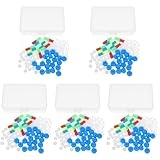
- Package includes five setsthe package list includes 5 x set of dna teaching model, providing multiple units for classroom rotation, group activities, or shared learning environments
- Package includes five setsthe package list includes 5 x set of dna teaching model, providing multiple units for classroom rotation, group activities, or shared learning environments
- Package includes five setsthe package list includes 5 x set of dna teaching model, providing multiple units for classroom rotation, group activities, or shared learning environments
- Package includes five setsthe package list includes 5 x set of dna teaching model, providing multiple units for classroom rotation, group activities, or shared learning environments
- Package includes five setsthe package list includes 5 x set of dna teaching model, providing multiple units for classroom rotation, group activities, or shared learning environments
The fill-mask output seems biologically implausible
Confirm that the mask token is in the format expected by the tokenizer and that the surrounding sequence uses the intended orientation and alphabet. Then inspect multiple candidates and test sensitivity to the surrounding context. The output is a statistical sequence prior, not an experimental assay, so an unexpected ranking is a reason to investigate preprocessing and model limitations rather than to declare a biological anomaly.
Similar sequences have different embeddings
Check whether special tokens, padding, window boundaries, or pooling differ. Also check whether one sequence was reverse-complemented and the other was not. If the difference remains, evaluate it on a controlled set of sequence edits before attributing it to a biological signal.
What are the practical limits of this workflow?
DNABERT-2 gives you a compact way to turn sequence context into numerical features, but it does not remove the need for experimental design. The model’s training distribution, tokenization, context limit, and checkpoint version affect every output. Species absent or underrepresented in training may be represented less reliably, and a broad multi-species prior can encode correlations that do not transfer to a particular genome or assay.
Use the model for hypothesis generation, similarity analysis, or as one component in a validated machine-learning pipeline. For clinical, diagnostic, or therapeutic decisions, require task-specific validation and appropriate expert and regulatory review; a generic embedding or fill-mask score is not sufficient evidence.
Frequently Asked Questions
Is 512 tokens the same as 512 DNA bases?
No. DNABERT-2 uses byte-pair encoding, so one token can represent a variable-length nucleotide substring. Always inspect the tokenizer’s output and measure the token count before applying the 512-token limit.
Can I compare embeddings from different DNABERT-2 checkpoints?
Only with care. Different checkpoints may use different vocabularies, configurations, or training data, so their vector coordinates are not automatically aligned. Keep comparisons within one fixed checkpoint unless you build and validate a method for aligning representations.
Do I need labeled examples to extract an embedding?
No. Tokenization and hidden-state extraction are unsupervised inference steps. Labeled examples become necessary when you train or evaluate a downstream classifier, regressor, or other task-specific predictor.
How can I make a masked prediction reproducible?
Store the exact checkpoint, tokenizer, input sequence, mask location, package versions, and the full ranked output rather than only the top token. Re-running with the same metadata lets you distinguish a model change from a preprocessing change.
Quick Recap
Product prices and availability are accurate as of the date/time indicated and are subject to change. Any price and availability information displayed on Amazon at the time of purchase will apply.

