Recommended Free Tools
Some links on this page are affiliate links: if you buy through them we may earn a commission, at no extra cost to you.
Converting a CD player to AUX is straightforward when you match an audio output on the player to an audio input on the stereo. For the common case—a 3.5 mm headphone or LINE OUT jack on the CD player and a 3.5 mm AUX IN jack on the receiver—use a stereo 3.5 mm male-to-male cable, select AUX, start the disc, and raise the volume gradually.
AUX means “auxiliary input”; it does not describe one universal plug. Your equipment may instead use left/right RCA, optical, or coaxial digital connections. A car may require a rear-input adapter, cassette adapter, FM transmitter, or Bluetooth transmitter. This guide shows how to identify the right path without forcing an output into another output or buying a cable that cannot carry the signal.
As an Amazon Associate I earn from qualifying purchases.
Free tools Windows power users keep installed
One-click scans. No signup required.
What does AUX mean on a CD player or stereo?
AUX is a source label for an auxiliary audio input. It describes the direction and purpose of the connection, not a specific connector shape. A stereo may label a 3.5 mm socket AUX IN, while another uses RCA jacks under AUX, LINE IN, or an input name such as CD. Some receivers also accept digital optical or coaxial signals, but those are not analog 3.5 mm AUX connections.
The signal must travel from the CD player’s output to the receiving system’s input. A headphone jack, LINE OUT, or AUDIO OUT is an output. AUX IN, LINE IN, and a receiver’s analog input are inputs. Two outputs cannot receive one another, and two inputs cannot create a source-to-destination path. Philips documents using a portable player’s LINE OUT/headphone socket with a Hi-Fi system, while Yamaha’s receiver instructions show a portable player connected to a front AUX input (Philips portable CD-player manual; Yamaha audio-connection instructions).
Popular on Amazon

- Never Let a Dead Battery Ruin Your Drive. The LISEN 4 in 1 Retractable Car Charger delivers reliable power for your entire journey. Compatible with standard 12V cigarette lighter sockets, it keeps phones, tablets, and devices charged during daily commutes, road trips, and long drives — the perfect practical gift for dads, truck drivers, and anyone who lives on the road.
- Daily Driver Essential: Always Ready When You Need It. Featuring two retractable cables ( USB C & Old iPhone Charging Cable ) that extend up to 31.5 inches and dual USB ports, this charger solves cable clutter while charging up to 4 devices simultaneously. Ideal for busy fathers, commuters, and families who want a tidy car and never worry about low battery again.
- Deliver full-speed PD fast charging for iPhone 18 Pro Max & iPhone 18 Pro Max & iPhone 18 Pro right inside your car. The built-in 45W PD USB-C port hits the peak charging speed for these latest iPhone models, juicing up your phone to 50% power in just 15 minutes while you drive.(Note: Maximum 45W PD output is available under 24V vehicle power supply. When used with standard 12V car sockets, the peak output is limited to 36W.)
- Standard 12V Power Solution: Designed as a dedicated USB power supply for charging devices. Note: Does NOT support CarPlay, Bluetooth, or data transfer. Compatible with most phones, tablets, and small electronics. This retractable charger is a core car organization tool, keeping your vehicle tidy. Not compatible with Micro-USB devices.
- Clutter-Free Tech Organization: Featuring dual USB ports and retractable cables, the LISEN 4 in 1 charger provides a clean car storage solution. Perfect for truck enthusiasts or as a thoughtful gift for drivers, it supports fast USB-C charging for devices like the iPhone 18Pro & iPhone 18 ProMax. Keep your vehicle organized while ensuring efficient power delivery for all your tech on the road.
Which cable matches each CD-player output and AUX input?
Look at both devices before purchasing anything. Match the connector and signal type at each end; a cable’s physical fit alone does not prove that the connection is electrically compatible.
| CD-player output | Receiving-system input | What you need | Important qualification |
|---|---|---|---|
| 3.5 mm headphone or LINE OUT | 3.5 mm AUX IN or LINE IN | Stereo 3.5 mm male-to-male cable | Set the player to a low or moderate level first if the headphone output has its own volume control. |
| 3.5 mm headphone or LINE OUT | Left/right RCA line input | 3.5 mm-to-dual-RCA stereo cable | Connect the plugs to matching left and right inputs; do not use PHONO. |
| Left/right RCA line output | Left/right RCA line input | Stereo RCA cable | Match white/black (left) and red (right) connections as labeled. |
| Optical digital output | Optical digital input | Matching optical cable | Both devices must support the same digital connection; this is not an analog AUX path. |
| Coaxial digital output | Coaxial digital input | Matching digital coaxial cable | Use a designated digital input, not an analog RCA input. |
Receiver documentation distinguishes analog stereo, optical, and coaxial connections and shows how each is assigned to an appropriate input (Yamaha’s connection guide; Denon HEOS Link manual). An optical cable does not carry analog audio into a 3.5 mm AUX socket, and a 3.5 mm cable cannot substitute for an optical or coaxial link.
The Tool Desk
Outbyte Driver Updater FREEFix the driver behind crashes, sound loss and screen glitchesFind Drivers →Outbyte PC Repair FREERepair Windows errors before they cause bigger problemsFix Now →How do I connect a 3.5 mm CD player to a 3.5 mm AUX input?
This is the simplest setup for a portable CD player, powered speaker, desktop stereo, or car stereo with a front AUX jack.
- Find the player’s output. Look for a headphone symbol, LINE OUT, or AUDIO OUT. A jack labeled LINE IN is an input and is not the connection you want.
- Find the receiver’s input. Look for AUX IN, LINE IN, or a front-panel AUX socket. If the labeling is unclear, consult the exact model’s manual rather than guessing.
- Use a stereo cable. Insert one 3.5 mm plug into the CD player and the other into the receiving system. A stereo cable has the contacts needed for left and right channels; a mono lead can produce one-channel or otherwise incorrect results.
- Lower the receiving system’s volume. Stop playback if the disc is running, then make the connection. Yamaha advises lowering volume and stopping playback before making a front AUX connection.
- Select the source. Turn on the receiver and choose AUX, LINE, or the input name assigned to that socket.
- Start the CD and raise volume slowly. Begin with the CD player’s volume low or moderate when using a headphone output. Increase the receiver’s volume gradually, then make small adjustments at the player if necessary.
A dedicated LINE OUT may have a fixed level, while a headphone output normally follows the player’s volume control. In either case, the receiver should provide the main listening-volume adjustment. Philips specifically instructs users to adjust both the connected equipment and the CD player when using its LINE OUT/headphone connection (Philips manual).
How do I connect RCA outputs to a receiver?
Component CD players commonly provide red and white (or red and black) analog RCA outputs. Use a stereo RCA cable from the player’s L and R outputs to a receiver’s matching L and R line input, such as AUX, LINE, or an unused CD input.
- Identify the CD player’s analog output pair, usually marked AUDIO OUT, LINE OUT, L, and R.
- Choose an available analog line input on the receiver. Confirm in the manual which label corresponds to that input.
- Connect left to left and right to right. Color matching helps, but rely on the printed L/R labels when colors differ.
- Select that named input on the receiver and start playback.
Do not connect a CD player’s line-level output to PHONO. A phono input is designed for the much lower-level signal and equalization of a turntable cartridge; using it for a CD player can produce excessive level or incorrect tonal balance. If the receiver has no free RCA line input, use another compatible input or an appropriate converter rather than forcing the plug into PHONO.
Do these 3 things before closing this tab:
1Clear out junk files and repair common Windows errors2Fix the driver behind crashes, sound loss and screen glitches3Repair Windows errors before they cause bigger problemsA portable player with a 3.5 mm output can feed an RCA line input through a 3.5 mm-to-dual-RCA stereo cable. The 3.5 mm plug goes to the player, and the two RCA plugs go to the receiver’s left and right analog inputs. The Denon and Yamaha manuals provide examples of connecting portable headphone outputs and analog stereo sources to line inputs (Denon HEOS Link manual; Yamaha instructions).
Also popular on Amazon

- ✅【Designed for Magsafe】 - The most fashionable iphone car mount in 2026 Magsafe is designed for iPhone 18 Pro Max/17/16/15/14/13/12 Pro Max Mini and official Magsafe cases and other magnetic phone cases and can be fixed directly to these phones without the need to affix metal plates. All Android Phones Will Work: Metal rings are provided; they fit cases and other phones without magsafe. Based on Unique Grandmaster Design (Protected by US Design Patent No. US D1,112,194 S)
- ✅【STRONG MAGNETIC MagSafe Car Mount】 - This powerful magnetic phone holder can create a powerful attraction that firmly supports your device while allowing you to drive without distraction. it easily and securely holds your phone through bumps, sharp turns or even sudden stops, no worrying of dropping your phone.
- ✅【SUPER STICK FORCE】 - VHB Dash Mounted Holders adhesive provides strong stick force between the dashboard and the car phone holder, which can firmly stick to any plane in the car, fix your device, adapt to a variety of road conditions such as sudden braking, speed bump, and rugged mountain road.
- ✅【SAFE DRIVING VIEW】 - Mini-size, not taking up space, it is placed in the dashboard without blocking the view at all, and does not need to look down at the device to ensure your safe driving. Cell Phone Car Mount is suitable for most cars, pickups, SUV, taxi; It is the best assistant for Uber and Lyft drivers
- ✅【360° FREE ROTATION】 - With an adjustable swivel ball joint, you can rotate your smartphone or device at your own will, providing the best viewing angle. Quickly pick and place with one hand, free your hands and make calls and GPS navigation more convenient
When should I use optical or coaxial digital audio?
Use optical or coaxial when the CD player has that digital output and the receiver has the corresponding digital input. The receiver’s digital-to-analog converter then handles the conversion. Select the receiver input assigned to OPTICAL or COAXIAL, not its analog AUX source.
Optical and coaxial are separate connection types. An optical output requires an optical input and optical cable; a coaxial output requires a coaxial digital input and suitable digital cable. A receiver may offer both, but the input must be configured for the socket you used. The Yamaha documentation maps these digital connections separately from analog stereo inputs (Yamaha audio-connection guide).
If your receiving device only has a 3.5 mm analog AUX input, a digital output cannot be connected directly with a passive cable. You would need an active digital-to-analog converter with the correct input and an analog output, which is a different setup from a simple AUX cable.
How can I connect a portable CD player to a car stereo?
First check the car stereo’s exact model and available equipment. A front AUX jack is easiest; a rear input, cassette deck, or FM receiver may provide alternatives when there is no front socket. Rear connections can require a model-specific adapter, so verify the head unit before buying or removing trim.
Car stereo with a front AUX jack
- Park safely and lower the car stereo volume.
- Connect the portable player’s headphone or LINE OUT to the car’s AUX IN with a stereo 3.5 mm cable.
- Select AUX on the head unit.
- Start the disc and increase volume gradually.
Secure the player and cable so neither moves under braking and the cord cannot interfere with steering, pedals, the gear selector, or other controls. Philips’ manual includes the same driving-safety caution for positioning the player and cord (Philips in-car connection guidance).
Car stereo with a rear AUX or line input
Some head units expose AUX through a rear connector rather than a dashboard jack. The required adapter may be specific to the stereo’s model, connector, and firmware. Confirm the manual’s pinout and source-selection procedure; a generic adapter that physically fits may still be wired for a different accessory.
Car stereo with a cassette deck
A cassette adapter with a 3.5 mm audio lead can carry the portable player’s headphone or LINE OUT signal into a cassette-equipped stereo. Insert the cassette adapter, plug its lead into the CD player, and select the cassette source. Philips states that when the radio has a LINE IN socket, using that input is preferable to the cassette-adapter route (Philips portable CD-player manual).
What’s actually slowing this PC down?
Pick the symptom - the matching free tool is one click away.
Also popular on Amazon

- High Quality Material: The coaster is made of environmentally friendly silicone, safe, non-toxic and odorless. Soft with toughness, easily embedded in the cup holder. Very durable, wear-resistant, long service life. High temperature resistance, can withstand 100 ℃ high temperature water cups.
- Wide Compatibility: The coaster has a diameter of 3.15 inches and a height of 1.18 inches, which is widely used in most vehicles, such as SUV, sedan, MPV, etc., as long as the size fits your car cup holder.
- Protection Function: Our car cup holder coaster has a carry handle design and a stand-up ring edge on its edge to effectively prevent food crumbs, drinks and water from leaking out and preventing the car cup holder from getting dirty.Meanwhile,Thickened design effectively prevents the cup holder from being scratched by the cup when driving on bumpy roads and eliminates the annoying thumping sound, making your journey more enjoyable.
- Easy to Use and Clean: With embedded installation, you just need to put it flat on the car cupholder. It is also very quick to remove, there is a small bump on the coaster, pinch it and you can easily remove the coaster. It is very easy to clean, rinse with water or wipe with a wet towel (be careful not to clean with sharp tools).
- 100% Satisfaction: Our products have quality assurance, if you have questions or are not satisfied after receiving the product, don't worry, please contact us as soon as possible, we provide after-sales service.
Car stereo with neither AUX nor cassette
An FM transmitter can work when the head unit receives FM and a usable, interference-free frequency is available. Follow the transmitter’s own frequency and power instructions; performance depends on the local radio environment and the car stereo. This is a wireless rebroadcast, not a direct AUX connection.
Can I play a CD player through Bluetooth?
Yes, but a wired AUX cable does not add Bluetooth. You need a Bluetooth transmitter connected to an audio output on the CD player and a Bluetooth receiver—such as a compatible speaker or headphones—to receive the signal.
- Check whether the CD player provides a 3.5 mm headphone/LINE OUT, RCA output, or another output supported by the transmitter.
- Choose a transmitter whose input matches that output, using the correct cable or adapter.
- Power the transmitter and put it into pairing mode.
- Put the Bluetooth speaker, headphones, or car receiver into pairing mode and complete pairing according to both manuals.
- Start the CD and set source and volume levels conservatively before increasing them.
Bluetooth introduces an additional powered device and a wireless link, so it is more involved than a matching analog cable. The transmitter must accept the CD player’s output type, and the destination must receive Bluetooth audio; a Bluetooth-only speaker cannot receive a bare headphone cable. Compatibility and pairing considerations are outlined in this Bluetooth CD-streaming guide (iTechGuides’ Bluetooth setup walkthrough).
Can a USB port be used as AUX?
Not automatically. A USB socket may be intended for charging, storage devices, firmware updates, or digital audio, and its behavior varies by model. Do not plug a 3.5 mm audio cable into a USB port with a passive adapter and assume it will work. Read the car stereo or receiver manual to confirm whether the USB port accepts audio and which formats or devices it supports.
If the USB input expects digital files, it may not accept a live analog signal from a CD player. A purpose-built interface could be required, but that is model-specific and no longer a simple AUX conversion.
Why is there no sound after I connect the cable?
Most silent setups fail because the wrong source is selected, the disc is not playing, or the cable is connected to an input or output of the wrong direction. Work through this order:
- Verify playback. Confirm the CD is inserted, recognized, and actually playing rather than paused or stopped.
- Check the source selection. Select AUX, LINE, the specific RCA input, OPTICAL, or COAXIAL that matches the socket in use. Selecting CD or radio will not necessarily monitor the external jack.
- Reseat both plugs. Push each connector fully home. A partially inserted 3.5 mm plug can lose one or both channels.
- Trace the signal direction. The cable must leave the CD player’s headphone/LINE OUT and enter the stereo’s AUX/LINE IN. Do not use the player’s LINE IN or a receiver output.
- Try a known-good input and cable. If the receiver has another analog line input, test it with the same cable. A different cable can reveal a broken conductor or loose plug.
- Check mute and volume. Unmute the receiver, raise its volume slightly, and set the player’s headphone volume above minimum but below a level that causes distortion.
For optical or coaxial connections, confirm that the receiver is set to the corresponding digital input and that the CD player’s digital output is enabled if its manual provides an output setting. For a car’s rear input, verify that the exact adapter is supported by the head unit.
Also popular on Amazon
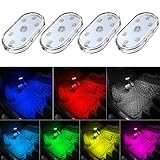
- 7 Colors Car Light: The led interior car lights are built-in 6 RGB LED lamp beads, which can be changed 7 different colors by touching, such as white, red, green, blue, yellow, pink purple, ice blue. The colors are bright and vivid, but not dazzling.Attention: Please charge before use.
- Touch Switch Design: Our led lights for car interior features touch control, one-key perspective lighting. Long touch to turn on/off, touch once to change the colors.
- Easy to Use: Stick the the iron plate in one place with double-sided tape, then put the light on it to complete the installation and fixation. Due to magnetic design, quickly install and remove, you also can attach the interior car lights to other metals.
- Portable & USB Rechargeable: Compact size, easy to carry, does not take up space. The wireless car led lights interior is charged by the USB cable, only need takes 40 minutes to fully charge the lights at a time, and keep lighting for about 2 hours.
- Wide Application: LED touch lights can be installed in dark places, such as storage boxes, armrest boxes, seat corners, etc. It's also suitable for bedside lights, wardrobe lights, reading lights, backpack lights, place it anywhere in the room, any dark place can be illuminated by it.
What if the sound is too quiet, distorted, or only on one side?
Too-quiet audio usually means the source’s headphone volume is near minimum, the receiver is monitoring the wrong input, or the cable is not making full contact. Raise the player a little at a time while keeping the receiver at a comfortable level.
Distortion usually means the player’s headphone output is too high for the receiving input. Lower the player and use the receiver’s volume control for normal listening. Avoid turning both devices fully up; that increases the chance of clipping and makes troubleshooting harder.
One-channel sound points to a seating, cable, or left/right connection problem. For RCA, verify that both plugs are attached to the same input pair and that the player’s balance control is centered. For 3.5 mm, make sure the cable is stereo and fully inserted rather than a mono or incompatible headset accessory.
Independent reader supportYour contribution helps us test, update, and keep practical guides available for everyone.How do I power a portable CD player in a car?
Audio wiring and power wiring are separate. The AUX cable carries sound; it does not establish the player’s power requirements. Use batteries or a vehicle power adapter only when its voltage, polarity, connector, and current requirements match the exact player model.
Do not generalize one manufacturer’s adapter specification to another player. Philips’ manual gives a particular 4.5-volt converter recommendation for its own model and warns that unsuitable products may damage that set; treat that as model-specific guidance, not a universal car-power rule (Philips power-supply instructions). If the player’s label or manual does not state the required polarity and voltage, do not guess.
Quick wins for a faster PC:
Repair Windows errors before they cause bigger problemsFix Now →Scan for outdated or missing drivers - takes under a minuteDriver Scan →Which connection should I choose?
Choose the simplest path that matches the hardware you already have:
- Both devices have 3.5 mm analog audio: use a stereo 3.5 mm cable. This has the fewest compatibility steps.
- Receiver has RCA line input: use a stereo RCA cable from RCA output, or a 3.5 mm-to-dual-RCA cable from a portable player.
- Both devices have matching optical or coaxial ports: use the corresponding digital connection and select its digital source.
- Car has a rear-only input: obtain the adapter specified for the exact head-unit model.
- Car has a cassette deck: a cassette adapter is an option; use a true LINE IN instead when available.
- Car has no AUX or cassette: consider an FM transmitter if FM reception and a usable frequency are available.
- Destination is Bluetooth-only: add a Bluetooth transmitter whose input matches the CD player’s output.
Every additional adapter or wireless hop adds another compatibility and power requirement. If a direct analog cable fits an output and a corresponding input, it is normally the most straightforward arrangement.
Also popular on Amazon

- Creative DIY Mode: Choose from 16 million available colors or customize car led light effects to your liking in DIY mode via Govee Home app. Make your car stand out in unique style with creative freedom and outdoor decorations.
- Dynamic Music Mode: Built-in mic helps interior car lights sync with any music type. Liven up your road trips, weekend getaways or evening commute with colors that dance vibrantly to your favorite songs.
- Smart App Control: Manage the colors and brightness of car lights or choose music mode by one simple tap with Govee Home app. Enjoy a comfortable and vibrant driving experience with convenient control.
- 2 Lines Design: 2 lines design connect the 4 car led strip lights, attaching the inside car lights easily to any car model without worrying about exposed wiring or an untidy look.
- Simple Installation: Before you install, make sure the installation surface is clean and dry. Then attach the led lights for car to your vehicle with adhesive and support clips. Rubber tubing outside protects lights from water spills.
What should I check before buying a cable or adapter?
- Read the labels on both devices and identify output versus input.
- Confirm the connector shape: 3.5 mm, RCA, optical, or coaxial.
- For a 3.5 mm connection, specify stereo male-to-male rather than a microphone-only or mono lead.
- For RCA, confirm that the receiver input is a line input, not PHONO.
- For digital, verify that both ends use the same optical or coaxial standard.
- For a car’s rear connection, record the exact head-unit model and consult its manual before ordering an adapter.
- For Bluetooth, match the transmitter’s input to the CD player and the destination’s Bluetooth receiving capability.
- For vehicle power, verify voltage, polarity, plug size, and current requirements from the CD player’s documentation.
Connector photos and product names can be misleading, so the printed labels and model manual should decide. Yamaha and Denon both organize their connection guidance by signal type and input assignment, which is a useful way to check a proposed setup before plugging it in (Yamaha manual; Denon manual).
How we assembled this guide
The connection choices here are organized around the facts that determine whether a setup will work: the CD player’s output type, the receiving system’s input type, whether a cable alone is sufficient, the car’s available AUX/cassette/FM equipment, and model-specific adapter and power requirements. Manufacturer manuals were used for connector and operating instructions, with car and Bluetooth alternatives qualified where compatibility depends on the exact equipment.
Crashes, No Sound, or Screen Glitches?
Random freezes, missing sound and display glitches usually trace back to one bad driver. Find and replace yours safely.Free scan · under a minuteWindows Errors? Fix Them Before They Spread
Repair common Windows errors and clear accumulated junk for a smoother, more stable PC - no reinstall needed.Free scan · no reinstallBottom line: match output to input, then select the correct source
For most portable players and stereos, connect the 3.5 mm headphone or LINE OUT to AUX IN with a stereo 3.5 mm cable. For RCA, optical, or coaxial equipment, use the matching cable and corresponding input. In a car, check for a front or model-specific rear AUX first; use a cassette adapter, FM transmitter, or Bluetooth transmitter only when the car’s hardware calls for it. Lower volume before connecting, select the input you actually used, and follow the exact manuals for adapters and power.
Frequently Asked Questions
Can I leave the CD player’s headphone volume at maximum when using AUX?
It is safer to begin low or moderate and increase gradually. A headphone output that is too high can overload a line input and cause harsh distortion; use the receiver’s volume control for normal listening once a clean level is established.
Does an AUX cable recharge a portable CD player?
No. AUX is an audio path, not a power connection. Keep using batteries or an adapter that matches the player’s specified voltage, polarity, connector, and current requirements.
Why does my car show an AUX label but still produce silence?
The socket may be a rear input that needs a vehicle-specific adapter, or the head unit may require an input-activation setting. Check the exact stereo manual and confirm that the source selector is monitoring that input rather than radio, CD, or another source.
Can I connect a CD player directly to a Bluetooth speaker with a cable?
Only if the speaker also has a compatible analog input. For a Bluetooth-only speaker, connect a separate Bluetooth transmitter to the CD player’s output and pair the speaker as the receiving device.

