Recommended Free Tools
Some links on this page are affiliate links: if you buy through them we may earn a commission, at no extra cost to you.
Advanced substrates and high-density interconnects can help AI servers move data between compute dies and high-bandwidth memory (HBM) faster, with less energy per bit. They do this by shortening electrical paths and fitting more parallel connections into a compact package. That can keep accelerator engines supplied with data, but it does not guarantee a particular server speedup: heat, power delivery, manufacturing yield, reliability and workload all affect the result.
What do advanced substrates and high-density interconnects do?
An AI accelerator’s compute units are useful only when data can reach them fast enough. Advanced packaging tackles this challenge inside the chip package: it places logic dies and memory close together and connects them with dense wiring. A substrate or interposer acts as the routing layer between those components, while die-to-die interconnects carry signals from one die to another.
As an Amazon Associate I earn from qualifying purchases.
Do these 3 things before closing this tab:
1Fix the driver behind crashes, sound loss and screen glitches2Repair Windows errors before they cause bigger problems3Scan for outdated or missing drivers - takes under a minuteIn a conventional system, data may have to travel farther across a board or between separate components. Shorter package-level routes can reduce parasitic resistance and capacitance, which makes high-speed signals easier to manage. More connections in parallel can also raise the amount of data exchanged at once. The practical goal is not simply to pack in more wires; it is to deliver useful bandwidth with acceptable latency, power use, signal quality and temperature.
These technologies enable heterogeneous packages, where different dies—such as compute chiplets and HBM stacks—can be assembled together. They are therefore part of a larger performance system, not a standalone speed feature. The accelerator, memory configuration, package, cooling and server interconnect all contribute to the result.
#1 Best Overall
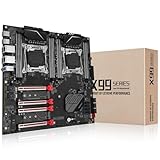
- Intel dual CPU sockets: This C612 server chip motherboard is designed with dual CPU sockets, which can support Intel Core i7 5th/6th generation processors and Xeon E5 V3/V4 series processors on LGA 2011-3 socket. (Note: If only one CPU is installed, please install it in the right slot, and the graphics card needs to be installed in the bottom two slots.)
- DDR4 4-channel memory slot: The memory slot of the LGA 2011-3 motherboard is designed with four channels, which can install 8 memory. It supports effective frequencies of 2133/2400MHz, and the maximum capacity is 256GB. (Non-ECC memory is not compatible when using E5 V4 series processors)
- PCIe 3.0 protocol standard: Equipped with 4 PCIe 3.0 X16 graphics card slots (with steel case). The transfer rate can reach 15.754 GB/s using one graphics card, and the performance can be improved by at least 50% by using two graphics cards. Equipped with dual M.2 hard disk slots, it can achieve fast reading even if multiple programs are running
- Stable power supply: use 24+8+8pin standard power supply interface (need to use a dedicated power supply for dual server motherboards), 12 (CPU) + 4 (memory) + 1 (C612 chip) phase power supply. Precise modularization provides good heat dissipation and makes the program run more stably
- Strong expandability: The X99 motherboard is equipped with multiple expansion interfaces to ensure that the motherboard has more room for improvement. These include 4*USB 3.0 ports, 4*USB 2.0 ports, 10*SATA 3.0 ports, 4*3pin sys fan, 2*4pin CPU fan. Besides, dual network ports allow your computer to do more things
How can an interposer or substrate improve AI performance?
A silicon interposer or fine-line redistribution-layer (RDL) substrate provides dense routing between compute dies and HBM. The shorter, more numerous connections can increase the memory bandwidth available near the accelerator and reduce the time and energy needed to move each bit. That can help matrix engines spend less time waiting for data, particularly when a workload can use the bandwidth.
Silicon interposers and RDL routing
TSMC describes its CoWoS platform as integrating multiple system-on-chips (SoCs) and HBM stacks on a silicon interposer for HPC and AI products. Its CoWoS-S approach uses a silicon interposer with high-density interconnects and embedded deep-trench capacitors. CoWoS-R instead uses an RDL interposer; TSMC specifies a minimum pitch of 4μm and describes signal- and power-integrity features. These are platform capabilities, not independent measurements of an end-to-end AI-server speed increase.
Routing density matters because more parallel links can connect the compute and memory components without requiring a larger or less efficient layout. A well-designed power-distribution network and embedded capacitance can also help stabilize voltage when workloads cause rapid changes in power demand. TSMC’s HPC packaging information says larger interposers can accommodate more advanced nodes and HBM, while enhanced routing and shielding support signal integrity and memory bandwidth.
There are limits to what a substrate specification tells you. Minimum routing pitch is not the same thing as sustained application bandwidth. Actual throughput depends on the full design: the number and configuration of links, the memory stacks, the accelerator, signal margins, power delivery and operating temperature.
Why proximity to HBM matters
HBM places vertically stacked memory dies close to the compute die. This shortens the path for memory traffic compared with sending every request to more distant memory, while the package’s interconnects provide many connections to move data in parallel. SK hynix identifies high-speed die stacking, logic-memory proximity and dense vertical connections as important directions for advanced memory packaging. Samsung describes HBM-capable 3D packaging that uses micro-bump chip-on-wafer (CoW) assembly and through-silicon vias (TSVs), with higher bandwidth and lower latency among its stated goals.
Rank #2

- Rigorously Tested for Perfect Performance Every product is 100% tested before shipping to ensure stable operation and flawless performance, so you can start using it immediately without any concerns.
Capacity and bandwidth are related but distinct. HBM capacity affects how much model state and other data can remain close to the accelerator; bandwidth affects how quickly data can move. The package must deliver the memory’s potential bandwidth reliably, and a system still needs enough capacity for its workload. A high-bandwidth package does not, by itself, establish how large a model can run or how quickly a particular server will complete a task.
Do high-density die-to-die links reduce latency and power?
They can reduce the distance and energy involved in moving data between dies, and they can provide more bandwidth in a given package area. The realized benefit depends on the link design and the workload; the pitch figure alone is not a latency or power benchmark.
TSMC says its SoIC die-stacking technology starts at a bond pitch below 10μm. The company attributes higher bandwidth, improved power and signal integrity, and lower power consumption to the short die-to-die connections. TSMC also states that 3nm SoIC stacking entered volume production in 2025. These facts describe a manufacturing capability and availability milestone, not proof that every AI server using such packaging achieves a particular performance gain.
High-density links are only one level of the data path. Inside the package, short die-to-die connections can serve communication between chiplets. At board or rack boundaries, other links determine how accelerators communicate with one another. For example, Molex describes its Impress co-packaged copper system for AI data centers as supporting data rates up to 224Gbps using PAM-4 signaling. That figure is a supported link data rate, not a server-wide data-transfer rate or a measure of application performance.
This distinction matters in distributed AI workloads. A server can have very fast communication between compute and HBM yet be limited when sharing data across accelerators. Conversely, strong scale-up links do not solve an HBM bottleneck inside each accelerator. Package-level and system-level interconnects need to be evaluated separately, then considered together for the intended workload.
PC Slower Than It Used to Be?
A free scan shows the junk files, broken settings and background clutter dragging Windows down - then fixes them in one click.Free scan · Windows 10 & 11Outdated Drivers Are Slowing You Down
One free scan finds every outdated or missing driver and matches the right update for your exact hardware.Free scan · exact hardware matchRank #3

- AMD socket sTR5 supports up to 96-core CPUs: Ready for AMD Ryzen Threadripper PRO 9000 & 7000 WX-Series Processors and AMD Ryzen Threadripper 9000 & 7000 Series Processors.
- Ready for Advanced AI PC: Designed for the future of AI computing, with the power and connectivity needed for demanding AI applications
- CPU and memory overclocking: Support for up to 1TB ECC R-DIMM DDR5 memory modules (1DPC)
- Robust Power & Thermal Design: 20 power stages with two 8-pin power connectors for the CPU, massive VRM cooling, chipset and M.2 heatsinks, and M.2 thermal pad.
- Ultrafast Connectivity: Three PCIe 5.0 x16 slots, one PCIe 4.0 x16 slot, two USB4 (40Gbps) ports, 10 Gb & 2.5 Gb LAN ports, four M.2 slots, front USB 20Gbps Type-C ports, and SlimSAS NVMe support.
What performance gains should a buyer or designer expect?
The sound expectation is improved potential for bandwidth, latency and energy efficiency—not a guaranteed percentage improvement in model training or inference. The cited technology information establishes packaging capabilities and design goals; it does not provide an independent end-to-end AI-server benchmark showing a specific percentage gain.
Performance improves only if the workload can use the added bandwidth or lower-latency path. If an application is limited by compute throughput, software, memory capacity, cooling or communication outside the package, adding denser internal links may have little effect on its overall runtime. The value can be greater for workloads that move large volumes of data between compute and memory, but that still must be confirmed on the actual accelerator and server configuration.
Power use also needs a system-level reading. A more efficient bit movement path can reduce energy per bit, while adding more links and operating them at higher speeds can increase total package power. The relevant question is whether the design delivers more useful work within the server’s power and thermal limits, not whether one link has a favorable isolated specification.
What tradeoffs can erase the benefit?
Greater density concentrates electrical, thermal and mechanical demands in a smaller area. As package bandwidth rises, cooling, power delivery, warpage, yield and testing become first-order constraints rather than secondary details.
The Tool Desk
Outbyte Driver Updater FREEFix the driver behind crashes, sound loss and screen glitchesFind Drivers →Outbyte PC Repair FREEClear out junk files and repair common Windows errorsFree Scan →Thermals and throttling
Dense logic and stacked HBM concentrate heat and can restrict cooling paths. If the package or server cannot remove heat effectively, the accelerator may throttle, reducing its sustained performance. A design’s peak bandwidth is less useful if it cannot be maintained at the temperature reached during the target workload. ASE says its FOCoS-Bridge approach uses TSVs to shorten delivery paths, increase I/O density and enhance thermal dissipation; ASE announced the technology on May 28, 2025. That stated design goal does not replace system-level thermal measurements.
Rank #4

- Ready for advanced AI PCs: Designed for the future of AI computing, with the power and connectivity needed for demanding AI applications
- Intel LGA1851 socket: Ready for Intel Core Ultra 9, 7, and 5 desktop processors
- Robust performance: 16+2+1+2 teamed power stages, ProCool II power connectors, high-quality alloy chokes and durable capacitors
- Future-proofed connectivity: Thunderbolt 4, 10Gb & 2.5Gb Ethernet, two PCIe 5.0 PCIe slots with full support for next-gen graphics cards, one PCIe 5.0 M.2 and three PCIe 4.0 M.2 slots and a USB 20Gbps front-panel header
- Exclusive AI and overclocking technologies: AI Overclocking, AI Cooling II, AI Advisor and NPU boost
Signal integrity and power integrity
More links and faster signal edges can increase crosstalk, simultaneous-switching noise and sensitivity to voltage transients. Grounding, shielding, decoupling and low-loss routing help preserve signal margins and stable power. TSMC describes grounding and shielding features for CoWoS-R, while ASE identifies TSV-based paths as a way to improve I/O density and power delivery. Buyers should look for measured behavior under sustained load, not infer error-free operation from a routing-pitch specification.
Mechanical stress, yield and test
Large interposers, different coefficients of thermal expansion (CTE), and molding or underfill steps can contribute to warpage and stress on C4 package joints. TSMC describes RDL and underfill as buffers for CTE mismatch, but the assembled package still needs qualification for its intended operating conditions.
Multi-die packages also increase manufacturing and inspection demands. Dies need to be known-good before assembly, and alignment, bonding, inspection and chiplet-level testing affect the chance that a finished package works reliably. Intel identifies manufacturability and effective testing as active research areas. Yield and test coverage can affect both cost and the number of packages available, even if the architecture has attractive bandwidth.
Cost and supply
Large interposers, HBM and advanced bonding require specialized capacity and can raise package cost. The relevant comparison is not bandwidth alone: a design that improves data movement can still be a poor choice if yield, availability, reliability or total cost of ownership make it unsuitable. Supply availability and an upgrade path matter particularly for organizations planning infrastructure over multiple deployment cycles.
Independent reader supportYour contribution helps us test, update, and keep practical guides available for everyone.Which AI-server package metrics should you compare?
Compare complete, workload-relevant results rather than a single pitch or peak-rate number. Ask vendors to identify the configuration, measurement conditions and whether a value is sustained or theoretical.
Best Value
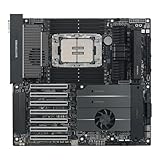
- Ready for Advanced AI PC: Designed for the future of AI computing, with the power and connectivity needed for demanding AI applications
- Intel LGA 4710-2 socket: Ready for Intel Xeon? 600 Processors for Workstation
- CPU and memory overclocking: The performance of ECC R-DIMM DDR5 memory (1DPC) is further enhanced by the exclusive NitroPath DRAM technology
- Ultrafast connectivity: 7 PCIe 5.0 x16 slots, Dual Intel E610-XAT2 10Gb LAN, 4 M.2, MCIO, 2 SlimSAS, and USB4? and USB 20Gbps Type-C
- Server-grade IPMI remote management: Hardware and software-level with a dedicated LAN port link to AST2600 BMC controller, plus a real-time monitoring and management software – ASUS Control Center Express
| Metric | Why it matters | What to verify |
|---|---|---|
| Sustained HBM bandwidth and capacity | Indicates how much nearby memory is available and how consistently it can feed compute. | Measure under the target workload and memory configuration, not just a peak specification. |
| Die-to-die bandwidth and latency | Shows how efficiently chiplets exchange data within a package. | Confirm the actual link configuration and performance under load. |
| Scale-up and scale-out bandwidth and latency | Captures communication between accelerators within a system and across systems. | Separate package links from board, rack and network links. |
| Energy per bit and total power | Shows the energy cost of communication and its effect on server power budgets. | Compare at useful sustained throughput, including accelerator and server power. |
| Signal and power integrity | Weak margins, droop or errors can undermine stable high-speed operation. | Request margin, droop and error-rate evidence under relevant operating conditions. |
| Thermal resistance and throttle headroom | Determines whether performance can be sustained without thermal limits intervening. | Check cooling requirements and performance during sustained workloads. |
| Package area, yield and test coverage | Large, complex packages can increase production risk and constrain supply. | Ask about inspection, qualification, known-good-die strategy and yield where available. |
| Field reliability, total cost and upgrade path | Connects package capability to deployment risk and long-term value. | Evaluate the full server cost and availability, not only package-level bandwidth. |
Use the target application to prioritize the list. A memory-bound workload makes sustained HBM performance especially relevant; a distributed workload also makes accelerator-to-accelerator communication important. In either case, thermal headroom, system power and reliability determine whether nominal capabilities translate into dependable performance.
How should you interpret the headline specifications?
Keep each number tied to what it actually describes. TSMC’s 4μm figure is CoWoS-R’s stated minimum RDL pitch; its below-10μm figure is the starting bond pitch cited for SoIC. Neither number states the bandwidth of a complete package. Molex’s up-to-224Gbps PAM-4 figure describes a supported data rate for its co-packaged copper system, not a server’s total throughput.
Likewise, a technology launch or production milestone establishes that a process or packaging approach has reached a stated stage; it does not establish broad availability for every product or a benchmark result. TSMC’s 2025 SoIC volume-production statement concerns 3nm SoIC stacking. ASE’s FOCoS-Bridge announcement is dated May 28, 2025. Product configurations, capacity and deployment schedules are specific to vendors and platforms, so verify them for the server being considered.
The most meaningful comparison combines architecture claims with measured, sustained behavior on the target workload. A package can create the conditions for faster data movement; only a system-level evaluation shows whether that capability changes the outcome that matters to the operator.
Frequently Asked Questions
Does a 224Gbps interconnect mean the server transfers 224 gigabytes per second?
No. Gbps means gigabits per second, while GB/s means gigabytes per second; the units are different. The stated figure is also a supported link data rate, not a promise of application-level throughput after system configuration and workload effects.
Does a smaller interconnect pitch always mean lower latency?
Not by itself. Pitch describes spacing in the interconnect, while latency depends on the complete signaling path, protocol and system design; compare measured latency for the actual configuration.
Free tools Windows power users keep installed
One-click scans. No signup required.
Can an AI server use a high-bandwidth package without HBM?
A high-density package can connect dies in different ways, but the cited packaging examples specifically discuss proximity to HBM as a way to provide high-bandwidth memory access. Whether a server uses HBM is a platform design choice, and package bandwidth alone does not establish the memory type or capacity.
What does PAM-4 mean in a high-speed interconnect specification?
PAM-4 is a signaling format that represents data using four signal levels. Its mention identifies how the link carries signals; it does not, on its own, specify the server’s usable bandwidth or workload performance.
Quick Recap
Product prices and availability are accurate as of the date/time indicated and are subject to change. Any price and availability information displayed on Amazon at the time of purchase will apply.

