Quick wins for a faster PC:
Scan for outdated or missing drivers - takes under a minuteDriver Scan →Clear out junk files and repair common Windows errorsFree Scan →Fix the driver behind crashes, sound loss and screen glitchesFind Drivers →Some links on this page are affiliate links: if you buy through them we may earn a commission, at no extra cost to you.
Yes, a 3D-printed drone airframe can fly, but only when the printed structure is engineered as an aircraft component rather than treated as a decorative shell. A reliable workflow starts with mission and propulsion requirements, then uses parametric CAD, measured material properties, structural and aerodynamic analysis, controlled printing, dimensional inspection, static tests, propulsion tests, and progressively more demanding flight trials. Recent studies have flown printed multirotors in indoor and outdoor hover tests and autonomous waypoint missions, while other work has validated topology-optimized printed structures against finite-element predictions. The practical choice is usually FDM with PLA or PETG for accessible prototypes, SLS PA12 for complex lightweight parts, or continuous-fiber reinforcement when rotor arms and landing gear need a higher stiffness-to-weight ratio.
What is the complete workflow for a 3D-printed drone?
Designing and manufacturing a flyable printed drone is an iterative loop: define the aircraft, model adjustable parts, measure the real printed material, analyze and optimize the structure, print controlled specimens and components, inspect them, then qualify the integrated aircraft in stages. Skipping the measurement and test stages is the main reason a CAD model that looks sound fails in the air.
As an Amazon Associate I earn from qualifying purchases.
- Set requirements: mission, payload, take-off mass, rotor count, propeller diameter, battery, operating environment and acceptable risk.
- Build a parametric model: make arms, interfaces, landing gear, battery rails and electronics mounts replaceable or resizable.
- Characterize the printed material: measure coupons in the intended print orientations instead of copying bulk-filament data sheets.
- Analyze and optimize: combine finite-element analysis, topology optimization and preliminary aerodynamic analysis.
- Select process and material: match FDM, SLS or continuous-fiber fabrication to the required strength, accuracy, complexity and production volume.
- Print and inspect: control orientation, layer thickness, infill, temperature, speed, drying or powder preparation and post-processing; then verify dimensions, mass and defects.
- Qualify the aircraft: run static and propulsion tests, calibrate electronics, perform restrained and hover tests, and only then attempt outdoor autonomous missions.
How do you set requirements before drawing the airframe?
Start with numbers that determine every downstream decision. Specify the payload and take-off mass, endurance target, rotor count, propeller diameter, battery voltage and capacity, operating temperature, ultraviolet exposure, wind and acceptable failure consequences. The 2026 modular multirotor study worked with platforms about 300–600 mm in diameter and 1–3 kg take-off masses. It characterized propulsion kits and batteries before locking the airframe dimensions.
Match the frame to propulsion
Propeller diameter controls arm spacing, motor torque, battery demand and the clearance between rotors. That study evaluated three propulsion classes built around 6.5-inch, 9.5-inch and 10-inch propellers. Treat those as system choices, not interchangeable accessories: changing propeller class changes thrust, vibration, current draw and the loads transmitted into each arm.
#1 Best Overall
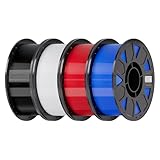
- Ender PETG Filament - combines the advantages of PLA and ABS, offering an eco-friendly, odorless, and user-friendly 3D printing experience. It features enhanced toughness that effectively resists cracking and warping, ensuring smooth and successful prints.
- Excellent Mechanical Properties - This PETG filament boasts high strength, impact resistance, and temperature resistance, with low shrinkage and high elongation at break. Printed models remain sturdy and durable even under repeated bending or stress.
- High Clarity & Glossy Finish - It delivers outstanding transparency and light transmission, making it perfect for visually detailed projects such as lampshades and display cases. The surface finishes with a smooth, glossy appearance.
- Reliable Printing & Compatibility - Dried, vacuum-sealed, and tangle-free, it minimizes clogging, bubbling, and snapping. With a precise diameter of 1.75mm (±0.02mm), it feeds smoothly and is compatible with most FDM printers on the market.
- Safe and Supported - Non-toxic and chemically resistant, Ender-PETG is safe for everyday use. Backed by Creality’s 12-month & 24 hours after-sales service. Note: Please place this product in a dry and ventilated environment, not in an environment of high temperature, sunny or humid conditions.
Define interfaces and service needs
Reserve mounting patterns and cable paths for motors, electronic speed controllers, the flight controller, GPS, telemetry, sensors and the battery. Include access for replacing a broken arm or battery without dismantling the entire center body. A modular interface also lets one frame accept different propulsion kits while preserving the tested center section.
How is a drone airframe modeled parametrically?
Parametric CAD turns the frame into a family of related parts instead of a one-off mesh. Set variables for arm length, tube or beam section, motor-hole pattern, body width, landing-gear height, battery-rail spacing and propeller clearance. When the payload or propulsion kit changes, regenerate the geometry and rerun the analysis rather than remodeling manually.
Recommended Free Tools
Design the load paths first
Motor thrust and torque enter at the motor mount, travel through the arm and center interfaces, and close through the body. Make those interfaces mechanically positive with broad bearing surfaces, fasteners or captured features; do not rely on a thin layer-bonded tab in a direction that peels the layers apart. Keep the flight controller and inertial sensors on a stiff, well-supported platform so frame flex does not become control noise.
Build in modular electrical and battery interfaces
The modular-airframe work integrated mechanical and electrical plug-in interfaces and battery rails. This arrangement shortens reconfiguration time, protects wiring during repeated assembly and allows a damaged module to be replaced independently. It also creates repeatable datum surfaces for dimensional inspection.
Why must printed material be characterized instead of copied from a data sheet?
Filament or powder data describe a raw material, while a printed part is an anisotropic laminate whose strength depends on layer direction, bead bonding, voids, temperature history and post-processing. Measure coupons made with the same machine, settings, orientation and material planned for the flight article.
Measure the properties that drive the design
- Tensile behavior: obtain strength, strain and stiffness in the principal print directions.
- Bending behavior: reveal how an arm or landing leg behaves under the combined bending and vibration loads it will see.
- Density and mass: compare actual printed mass with slicer estimates, including supports and inserts.
- Environmental response: check heat, ultraviolet exposure and moisture where the aircraft will operate.
A topology-optimized micro-drone study measured PA12 properties, included anisotropy in its model and checked finite-element predictions against bending tests before printing the optimized structure. That validation step is more informative than assuming an isotropic material card.
Rank #2

- ①【PETG Filament 1.75mm】SUNLU PETG 3D Printer Filament combines the advantages of both PLA and ABS 3D printer filament, making 3D printing more convenient and easy.
- ②【Excellent Layer Adhesion】PETG filament offers excellent layer adhesion, reducing the risks of warping and ensuring smooth, strong prints with great structural integrity.
- ③【Enhanced Toughness】Known for its toughness, PETG outperforms many other filaments in durability, making it ideal for creating sturdy and resilient items that can withstand stress and use.
- ④ 【High Impact & Mechanical Strength】Stronger than standard PLA and easier to print than ABS. Our PETG filament provides excellent layer adhesion and impact resistance, preventing warping or cracking under stress. Perfect for printing functional parts, RC drone frames, or heavy-duty household tools.
- ⑤【Weather-Resistant for Outdoor Use】Engineered with robust UV and moisture resistance, SUNLU PETG maintains its structural integrity and color vibrancy over time. It is the ideal choice for outdoor planters, car accessories, and weatherproof garden fixtures that endure harsh sunlight or rain.
How are structure and aerodynamics optimized?
Use finite-element analysis to identify stress, deflection and vibration-sensitive regions, then remove material only where the load path permits it. Topology optimization can create organic-looking ribs and trusses, but the result still has to be printable, inspectable and repairable. Add minimum wall thicknesses, radii and support rules before converting the optimized shape into production CAD.
Keep stiffness as well as strength
An arm that survives a static load but flexes under propeller excitation can degrade flight-controller performance. Set deflection limits for motor mounts and the sensor deck, check fastener-bearing stresses and evaluate the weakest layer orientation. Recheck the design after adding holes, battery rails and cable openings; those features often interrupt the most efficient load paths.
Use aerodynamic analysis at the aircraft level
Printed multirotor frames usually prioritize low mass and clean rotor flow, while fixed-wing printed aircraft also require wing and fuselage analysis. In a 2020 FDM aircraft study, preliminary aerodynamic analysis and flight tests supported a reported maximum lift-to-drag ratio of 14.67 at a 4° angle of attack and 20 m/s cruise airspeed. That figure belongs to that aircraft and test condition; it is not a universal value for printed drones.
Which 3D-printing process and filament are best?
There is no single best material. Choose according to load, environment, geometry, equipment and the amount of evidence you can generate for the finished part.
| Process or material | Where it fits | Advantages | Limitations to manage |
|---|---|---|---|
| PLA with FDM | Accessible prototypes and dimension-critical parts | Easy to print; showed the best dimensional consistency among the tested PLA, PETG and ABS configurations in a 2026 FFF comparison | Heat and environmental resistance must be assessed for the operating site |
| PETG with FDM | Outdoor prototype airframes | Practical balance of printability and toughness; selected for the final outdoor prototype in the 2026 modular study because UV resistance supports durability | Still requires controlled settings, orientation and inspection; dimensional behavior differs from PLA |
| ABS with FDM | Applications needing ABS characteristics and controlled shop conditions | Can be used for frames when process control is adequate | The cited comparison found pronounced warping and positive slicer mass-prediction bias, increasing enclosure and calibration demands |
| PA12 with SLS | Complex, lightweight integrated structures | Supports intricate geometry without conventional FDM support structures; validated in a topology-optimized micro-drone study | Anisotropy and actual powder-process properties still need characterization and load testing |
| Continuous-fiber composite printing | Highly loaded arms and landing gear | Continuous fiberglass or carbon reinforcement improves stiffness and strength-to-weight | Requires specialized equipment, longer production time and higher expense |
For a first outdoor multirotor, PETG FDM is a defensible baseline when its measured stiffness and temperature range meet the mission. Use PLA where dimensional consistency and rapid iteration matter more than heat or weather exposure. Move to PA12 or continuous-fiber reinforcement when analysis and tests show that a conventional printed section cannot meet deflection or strength targets.
How should the parts be prepared and printed?
Print settings are part of the design specification. Record the machine, nozzle or tool, material batch, drying or powder-preparation procedure, layer thickness, extrusion temperature, speed, infill, wall count, orientation and post-processing.
Rank #3

- ①【PETG Filament 1.75mm】SUNLU PETG 3D Printer Filament combines the advantages of both PLA and ABS 3D printer filament, making 3D printing more convenient and easy.
- ②【Excellent Layer Adhesion】PETG filament offers excellent layer adhesion, reducing the risks of warping and ensuring smooth, strong prints with great structural integrity.
- ③【Enhanced Toughness】Known for its toughness, PETG outperforms many other filaments in durability, making it ideal for creating sturdy and resilient items that can withstand stress and use.
- ④【High Impact Strength】With its high impact resistance, PETG is perfect for printing parts that need to endure bumps and drops, ensuring long-lasting performance without cracks or breaks.
- ⑤【Robust Durability】PETG prints are robust and maintain their properties over time, making them suitable for both indoor and outdoor applications where weather resistance is a necessity.
- Orient for the load: place continuous beads along the dominant tensile and bending paths; avoid making a critical arm depend on interlayer adhesion in peel.
- Set manufacturing limits in CAD: apply minimum walls, radii, hole clearances, support angles and access for fasteners.
- Condition the material: dry moisture-sensitive filament and follow the powder-preparation requirements of the SLS process.
- Print qualification coupons first: use the same orientation and settings as the flight parts, not a generic calibration cube.
- Control the build: monitor bed adhesion, warping, extrusion consistency, chamber temperature where applicable and fiber placement in reinforced parts.
- Post-process consistently: remove supports, clean powder, install inserts and finish interfaces using a documented method.
The modular study used ordinary FDM equipment with a dedicated slicing workflow for PLA and PETG parts, and a separate continuous-fiber system with its own planning software for reinforced components. The important lesson is process separation: a reinforced arm cannot be qualified by assuming it behaves like an FDM arm printed on a different machine.
How do you inspect and test a printed drone before flight?
Qualification should progress from cheap, isolated checks to expensive, integrated tests. Record actual results and acceptance limits for every stage.
Windows Errors? Fix Them Before They Spread
Repair common Windows errors and clear accumulated junk for a smoother, more stable PC - no reinstall needed.Free scan · no reinstallCrashes, No Sound, or Screen Glitches?
Random freezes, missing sound and display glitches usually trace back to one bad driver. Find and replace yours safely.Free scan · under a minute| Stage | What to measure | Why it matters |
|---|---|---|
| Material coupons | Tensile, bending, stiffness, density and environmental exposure as applicable | Provides material values for analysis and reveals orientation-dependent weakness |
| Dimensional inspection | Motor-hole pattern, arm spacing, propeller clearance, battery rails, interface flatness and critical wall dimensions | Prevents misalignment, vibration and assembly loads caused by out-of-tolerance parts |
| Mass check | Weigh each part and the assembled airframe; compare with slicer estimates | Confirms take-off mass, center of gravity and battery margin |
| Visual defect check | Warping, cracks, voids, delamination, poor fiber placement, damaged inserts and unsupported surfaces | Catches obvious failure initiators before loading |
| Static load or bending test | Apply representative arm, landing-gear and body loads; measure deflection and permanent set | Checks the load path and validates finite-element predictions |
| Propulsion-stand test | Motor, ESC, propeller, current, voltage, thrust and vibration over the intended operating range | Confirms that the selected propulsion kit delivers the required thrust without excessive heating or resonance |
| Subsystem calibration | Inertial sensors, ESCs, compass, GPS, telemetry and failsafes | Separates control-system errors from structural problems |
| Restrained and hover tests | Low-power spin, restrained thrust, brief lift-off and controlled hover | Provides a reversible path to uncover vibration, flex and control faults |
| Outdoor mission test | Manual handling, position hold, return-to-home and waypoint operation in a defined area | Demonstrates integrated performance in the intended environment |
A 2026 FFF comparison found material-dependent differences that a slicer preview cannot reveal: PLA was the most dimensionally consistent in its tested configurations, PETG was intermediate, and ABS showed pronounced warping and a positive bias in predicted mass. Measure the actual part rather than accepting the software estimate.
How is the printed airframe integrated and flight-tested?
Install motors, ESCs, propellers, battery, flight controller, GPS, telemetry and other sensors only after the frame passes static inspection. Check the center of gravity with the flight battery fitted, secure wiring against propellers and verify that no sensor mount can move relative to the frame.
- Perform continuity, polarity and insulation checks with propellers removed.
- Calibrate inertial sensors and ESCs on a level, vibration-free surface.
- Run each motor at low power, listening and looking for resonance, arm flex or fastener movement.
- Use a restrained thrust test before the first free lift; stop if current, temperature, vibration or deflection exceeds the predefined limit.
- Conduct a short hover in a controlled area, then inspect every arm, interface and fastener.
- Expand to outdoor hover, manual handling and position-hold tests before attempting autonomous waypoints.
- Log flight data and retune PID gains only after mechanical problems are corrected; tuning cannot compensate for a cracked or excessively flexible arm.
The modular-airframe study reported indoor and outdoor hover tests followed by outdoor autonomous waypoint flights. That sequence is useful because it demonstrates both basic airworthiness and integrated navigation without treating one successful lift-off as full qualification.
What does “qualified” mean for a 3D-printed drone?
A prototype that completes a flight is not automatically qualified for repeated operation, commercial service or a regulated aviation role. Qualification requires evidence that the material, process and inspection method produce repeatable parts for the intended environment and risk level.
Free tools Windows power users keep installed
One-click scans. No signup required.
Rank #4

- [Excellent PETG Filament]Our PETG combines the benefits of PLA and ABS to reach Eco-friendly and odorless performance. This PETG Filament is feature in good toughness to avoid cracking and warping, enbale excellent 3D printing.
- [Toughness-enhanced PETG] Our PETG filament choose durable and strong material that delivers excellent clarity, light transmission, and a glossy finish. It is recommended to use a printing temperature of 220-250°C and a base plate temperature of 70-80°C for better printing results.
- [Tangle-Free & Neatly Wound] We ensure that every PETG filament is tightly and neatly wrapped by utilizing full mechanical winding, which effectively minimizes tangles, filament snapping, and line breakage.
- [No Clogging & No Bubbles] Our filaments are thoroughly dried and carefully vacuum sealed to protect them from moisture and dust, which ensures that there will be no issues with clogging or bubbling during printing. Our PETG is designed to be perfectly compatible with the majority of 1.75mm FDM 3D printers, especially suitable for Creality 3D Printers!
- [High Precision & Consistent Performance]Our PETG filament boasts a diameter of 1.75mm, ensuring utmost accuracy with a tolerance of only +/- 0.03mm. With strict quality control and impeccable dimensional precision, our PETG filament guarantees a smooth and steady feeding during printing.
The National Institute of Standards and Technology notes that extensive empirical qualification can require many thousands of tests, millions of dollars and 5–15 years. For smaller drone programs, the realistic objective is a bounded, documented qualification plan rather than a claim of universal material certification.
Choose an evidence path
- Statistical-based qualification: extensive testing establishes performance distributions and failure probabilities.
- Equivalence-based qualification: moderate testing demonstrates that a new material or process is equivalent to an already qualified one.
- Model-based qualification: computer models demonstrate performance and are verified with a smaller, targeted test set.
For production beyond prototypes, add process repeatability, metrology, batch and material traceability, controlled design revisions and the aviation rules applicable to the aircraft’s jurisdiction and operation.
Independent reader supportYour contribution helps us test, update, and keep practical guides available for everyone.What are the most common failure modes and fixes?
Warped or misaligned arms
Reduce thermal gradients, improve bed and enclosure control where appropriate, revisit orientation and inspect motor-hole spacing after cooling. Do not force a warped arm into alignment with fasteners; that stores stress in the frame.
Unexpectedly heavy airframe
Weigh the printed parts, supports, inserts, wiring and hardware separately. A slicer can underpredict mass when infill, purge material or process-specific reinforcement is not represented accurately.
The Tool Desk
Outbyte PC Repair FREEClear out junk files and repair common Windows errorsFree Scan →Outbyte Driver Updater FREEFix the driver behind crashes, sound loss and screen glitchesFind Drivers →Cracks or layer separation
Move critical loads into the bead direction, improve temperature and interlayer bonding, increase wall or rib thickness and remove sharp internal corners. Re-run coupon tests after changing settings; a visual improvement is not proof of strength.
Excessive vibration
Balance propellers, check motor mounts and fasteners, inspect arm stiffness and isolate the flight controller only after the primary structure is sound. Vibration can come from a flexible printed arm, not only from the propulsion hardware.
Best Value

- High Performance & Strength: PETG filament combines the strengths of PLA and ABS. It offers low shrinkage, high impact resistance, excellent temperature resistance, and high elongation at break, models can bend repeatedly and remain firm and sturdy
- High Transparent & Glossy: PETG has a high degree of transparency. The finished product has a fine surface with exquisite details. This makes PETG material ideal for making transparent parts and models, such as lampshades, display boxes, and more
- Non-toxic Material: Creality CR-PETG 3D printing filament has excellent wether resistance and chemical resistance, no odor, and non-toxic, green environmental protection
- Wide Compatible: CR-PETG filament is wildly used in FDM 3D printers on the market.Compatible with most popular 3D printers such as MK3, Creality Ender series/CR series, ELEGOO, Anycubic, and more
- Creality Support: Creality provides 12-month & 24 hours after-sales service. Note: Please place this product in a dry and ventilated environment, not in an environment of high temperature, sunny or humid conditions
Control instability
Confirm sensor calibration, center of gravity and ESC behavior, then retune PID gains. If instability follows a payload or propulsion change, regenerate the parametric model and repeat structural and propulsion checks rather than masking the change in software.
Is a 3D-printed drone practical beyond prototypes?
It is practical when the design benefits from rapid iteration, integrated geometry, low-volume customization or replaceable modules. FDM keeps equipment and material costs accessible; SLS can consolidate complex parts; continuous-fiber printing can reserve expensive reinforcement for the few components that carry the highest loads.
The trade-off is that every process needs its own calibration, inspection and traceability. A frame that is inexpensive to print can become expensive to qualify if dimensional variation, moisture, warping or inconsistent fiber placement forces repeated tests. Design for repair and modular replacement often delivers more operational value than optimizing for the absolute minimum mass.
What should you compare when selecting a printed drone design?
- Structural mass, stiffness and measured deflection under representative loads.
- Dimensional accuracy at motor, arm, battery and electronics interfaces.
- Resistance to ultraviolet light, heat and moisture for the intended environment.
- Print time, post-processing effort, equipment requirements and material cost.
- Repairability, modularity and compatibility with the selected propulsion kits.
- Repeatability, metrology, traceability and the quality of static, propulsion and flight-test evidence.
The strongest design is not simply the lightest one. It is the one whose measured parts, interfaces and flight behavior remain inside known limits when printed again and operated in the conditions that matter.
Frequently Asked Questions
Can I use ordinary hobby FDM settings for a drone frame?
Only for early, low-risk prototypes. Critical parts need documented orientation, temperature, layer thickness, infill and wall settings, followed by coupons and static tests made with those exact settings.
How much safety margin should a printed drone arm have?
The available data does not establish one universal factor because margin depends on material anisotropy, vibration, impact risk and the applicable aircraft rules. Set an explicit load and deflection limit, then verify it with measured coupons and component tests.
Should the battery be part of the printed structure?
The battery should be retained by a replaceable rail or tray that is included in the load analysis, while the cell itself remains removable for inspection and charging. Modular rails used in recent work make configuration changes and maintenance easier.
Does topology optimization automatically produce printable parts?
No. The optimized result must be converted into geometry that meets minimum walls, support, tool-access and inspection limits, then validated with the anisotropic properties of the chosen process.
Quick Recap
Product prices and availability are accurate as of the date/time indicated and are subject to change. Any price and availability information displayed on Amazon at the time of purchase will apply.

