The Tool Desk
Outbyte PC Repair FREEClear out junk files and repair common Windows errorsFree Scan →Outbyte Driver Updater FREEScan for outdated or missing drivers - takes under a minuteDriver Scan →Some links on this page are affiliate links: if you buy through them we may earn a commission, at no extra cost to you.
For most space missions, the best answer is a hybrid architecture: process time-critical, bandwidth-heavy and safety-related data onboard, then send selected products to Earth for storage, fleet coordination, model training and compute-intensive analysis. Put more intelligence on the spacecraft when communications are intermittent, decisions must happen during a contact gap or raw sensor output exceeds downlink capacity. Keep more work in an Earth-based cloud when the mission can tolerate delay and needs large, frequently updated models or broad cross-mission analytics.
What “edge AI versus cloud” means in a space mission
“Edge AI” means running an inference model or decision algorithm on a computer aboard the spacecraft, close to the sensor that produces the data. The spacecraft may classify an image, detect an object, identify an instrument anomaly, compress a scene or decide which observations deserve a high-priority downlink.
As an Amazon Associate I earn from qualifying purchases.
“Earth-based cloud processing” means transmitting raw or lightly processed data through a ground station and running software in terrestrial data-center infrastructure. Cloud systems can store the mission archive, execute large analytics jobs, coordinate many spacecraft and retrain models using data from several sources.
The choice is not a contest between two mutually exclusive products. It is an allocation problem: each function is placed where its latency, bandwidth, compute, reliability and operational requirements can be met over the mission’s life.
#1 Best Overall

- All-in-One AI Learning Lab Powered by Raspberry Pi & Multi-LLMs. Turn Raspberry Pi (5 / 4B / 3B+ / 3B / Zero 2W) into a complete AI learning lab with support for multi-LLMs like ChatGPT, Gemini, Grok, DeepSeek, Qwen, Doubao, and Ollama. Includes Pan-Tilt HAT,10-axis (10DOF) module, camera, and high-quality components. Learn AI through guided video lessons created with educator Paul McWhorter. (Raspberry Pi not included)
- Build Fun Multi-Modal AI Projects with Voice, Vision & Sensors. Combine sensors, breadboard circuits, Multi-LLMs, voice recognition, and camera vision to create engaging multi-modal AI projects. Learn STT and TTS through hands-on programming, turning abstract AI concepts into interactive projects you can see, hear, and control—perfect for AI beginners
- AI Vision Tracking with YOLO, OpenCV, MediaPipe & Pan-Tilt HAT. Create intelligent vision projects using OpenCV and MediaPipe to detect and track objects, colors, and human movements. The Pan-Tilt HAT allows your projects to actively follow targets, helping learners understand how AI vision and motion work together in real systems
- Fusion HAT+ Power System with Voice AI Interaction. The Fusion HAT+ provides power, safe shutdown, and simplified hardware control via a unified Python library. With the Fusion HAT+ featuring a built-in speaker and microphone, easily build AI voice interaction projects by combining Multi-LLMs with sensors and electronic components
- Step-by-Step Learning with Video Lessons & Technical Support. Includes a structured, project-based curriculum with clear documentation, sample code, and video tutorials created with Paul McWhorter. Backed by responsive technical support and an active community, this kit helps beginners confidently progress from Python basics to AI and interactive projects
Why space missions make compute placement difficult
Contact is intermittent rather than continuous
A spacecraft may collect data for hours but have only scheduled ground-station passes or relay opportunities in which to transmit it. If a detector sees a short-lived event immediately after a pass, a ground system cannot respond until the next usable link. An onboard detector can flag the event, preserve the relevant context and continue operating through the gap.
Downlink capacity is a hard design limit
Imaging instruments, hyperspectral sensors, radar and scientific payloads can produce more bits than the communications subsystem can return to Earth. Sending every pixel forces the mission to discard observations, extend contact time or add expensive communications capability. Filtering, cropping, ranking and compression before transmission can turn an unmanageable stream into a useful product set.
Recommended Free Tools
Propagation delay matters more outside low Earth orbit
ESA’s 2024 AI for Space report identifies time delay, no connectivity and low bandwidth as core space-AI challenges. For Mars missions, the report describes possible one-way communication delays of three to 22 minutes. A rover or spacecraft cannot wait for a round trip to Earth before handling a hazard, stabilizing itself or selecting the next observation.
Spacecraft resources are finite
Every processor competes for electrical power, mass, volume, thermal dissipation and fault-tolerance margin. A terrestrial accelerator can be replaced or scaled out; a flight computer must survive launch, radiation and years of operation with limited physical access. More onboard capability can solve a communications problem while creating a power, cooling or verification problem.
Where onboard edge AI is the better choice
Immediate event detection
An onboard model can classify data as soon as the sensor produces it. Typical examples include detecting a transient science event, identifying a cloud-free image, recognizing an object of interest or spotting an instrument state that requires protective action. The spacecraft can attach a priority label and preserve the surrounding frames instead of downlinking a complete, unfiltered stream.
Operation during communication gaps
Local inference allows the mission to continue when a relay is unavailable, a ground station is out of view or a link is degraded. ESA describes autonomy as the response to communication delay and missing connectivity. Local decisions do not eliminate the need for operators; they keep the spacecraft safe and productive until commands or confirmation arrive.
Data reduction before transmission
Onboard software can remove blank scenes, crop to a detected target, combine measurements, compress imagery or send a low-resolution preview followed by selected full-resolution products. The Australian Space Agency describes Spiral Blue’s SE-1 edge computer processing raw images immediately, compressing and enhancing them, and running custom algorithms for object detection, cropping and image selection.
Rank #2
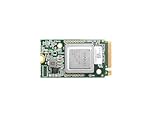
- ✅Powered by 26 Tera-Operations Per Second (TOPS) Hailo-8 AI Processor. 2.5W typical power consumption
- ✅Scalable, enabling simultaneous processing of multi-streams & multi-models
- ✅Enabling real-time, low latency and high-efficiency AI inferencing on the edge devices
- ✅Supports TensorFlow, TensorFlow Lite, ONNX, Keras, Pytorch frameworks
- ✅Supports Linux and Windows. Supports the temperature range of -40°C to 85°C
Safety and fault response
Functions such as collision-response triggers, attitude-protection checks, power-load shedding or instrument safing may have deadlines shorter than the next command cycle. Deterministic rules are often appropriate; an AI model can assist with classification or prediction when its behavior has been bounded and validated. Safety-critical actions should include independent limits and a safe fallback rather than relying on a model alone.
Where Earth-based cloud processing is stronger
Large-scale compute and storage
Cloud infrastructure can add CPUs, GPUs and storage as data volume changes. It is suited to computationally heavy image reconstruction, multi-year archives, foundation-model training, cross-mission correlation and repeated reprocessing with improved algorithms. Keeping an authoritative archive on Earth also makes it possible to reproduce a product after a model or calibration change.
Frequent software changes
Ground software can be patched, tested against the complete archive and rolled back quickly. A new classifier can be evaluated on historical data before it is used operationally. By contrast, a model uploaded to a spacecraft must pass mission configuration control, command validation, cybersecurity checks and an update procedure designed for a device that may be unreachable for days.
What’s actually slowing this PC down?
Pick the symptom - the matching free tool is one click away.
Fleet coordination and global context
A cloud service can combine observations from many spacecraft, ground sensors and external data feeds. It can schedule a constellation, identify overlapping coverage, generate a global map or detect a pattern that is invisible to one satellite. NASA’s ground-systems guidance describes streaming downlinked data to Amazon EC2 for real-time processing or directly to Amazon S3, with integration into other services through a low-latency, high-bandwidth network.
Operational integration
Ground processing naturally connects to mission planning, operator consoles, data catalogs, customer APIs and long-term preservation. It also centralizes access controls, logging and audit trails. These advantages are valuable when a mission’s response window is measured in seconds or minutes rather than milliseconds.
Onboard edge AI and Earth cloud compared
| Decision axis | Onboard edge AI | Earth-based cloud processing |
|---|---|---|
| Response time | Can classify or act as soon as data is captured, without waiting for a ground pass. | Includes contact, downlink and ground-processing delay; suitable when seconds or minutes are acceptable. |
| Connectivity dependence | Can continue during intermittent or unavailable links. | Requires a usable downlink path and ground access. |
| Data volume | Filters, compresses or selects data before transmission. | Can retain raw or near-raw data when bandwidth and storage permit. |
| Compute and storage scale | Limited by spacecraft power, mass, radiation environment and thermal design. | Much larger and easier to scale, update and coordinate globally. |
| Autonomy | Enables local decisions, event response and cooperation among spacecraft. | Strong for fleet-level planning, model training and cross-mission analytics. |
| Verification and maintenance | Updates and failures are harder to service after launch; validation and governance are required. | Easier to patch and rerun, but dependent on communications and ground cybersecurity. |
How a practical hybrid architecture works
1. Capture and perform deterministic pre-processing
The payload computer applies calibration, bad-pixel handling, time stamping and basic quality checks. These operations reduce noise and normalize inputs before an AI model sees them. Keeping this stage predictable simplifies both model training and fault analysis.
2. Run a compact onboard detector
A small model identifies events, objects or data-quality conditions. It should produce confidence, provenance and a reason code, not just a binary decision. Thresholds can be tuned conservatively so uncertain cases are retained for later review.
Do these 3 things before closing this tab:
1Clear out junk files and repair common Windows errors2Scan for outdated or missing drivers - takes under a minute3Repair Windows errors before they cause bigger problemsRank #3

- The Vilros Raspberry Pi 5 AI Kit Provides a full set of hardware needed to get up and running with your AI Projects.
- Kit Includes: Raspberry Pi 5 (Choose Capacity)--Raspberry Pi AI HAT+ (Choose TOPS Capacity)--Raspberry Pi 5 Active Cooler--Vilros Raspberry Pi 5 + Hat Compatible Case--128GB Micro SD Card Preloaded W/ Raspberry Pi OS (64bit)--Vilros 27W -5V/5A Raspberry Pi 5 Compatible USB-C Power Supply--Vilros Micro HDMI to Standard HDMI Cable (5ft)--Vilros Neoprene Parts Storage Case Bag With Pocket--Vilros Micro SD to USB Adapter
- Powerful Performance: Raspberry Pi 5 offers a 3× increase in CPU performance with a 2.4GHz quad-core Cortex-A76 processor. Enjoy smoother, faster computing for DIY projects, programming, or home automation. .
- Hailo-8 or Hailo-8L accelerator ( 26 TOPS or 13 TOPS Variants Available) -Fully integrated into Raspberry Pi’s camera software-Supplied with 16mm stacking header, spacers, and screws to enable fitting on Raspberry Pi 5 with the included Raspberry Pi Active Cooler in place
3. Rank and package observations
The flight software assigns priorities, selects regions of interest and chooses an appropriate compression level. A low-bandwidth summary can be sent first, followed by the highest-value raw or lossless products when contact time allows.
4. Protect the original evidence when needed
Discarding data is irreversible. Missions that support scientific discovery should preserve enough context around a detection to validate it on Earth. Ring buffers, event-triggered clips and adjustable retention windows provide a compromise between autonomy and evidentiary value.
5. Downlink through the ground segment
At contact, the spacecraft transmits prioritized products and health telemetry. Ground-station services can stream data directly into real-time compute or object storage, where it enters the mission’s catalog and processing pipeline.
6. Perform heavyweight analysis on Earth
Cloud jobs can reconstruct imagery, correlate detections across spacecraft, run larger models, update maps and generate operator recommendations. The ground result can include new thresholds, a replacement model or a revised observation plan.
7. Return only governed updates to flight
Model changes should pass simulation, hardware-in-the-loop tests, security review and independent verification before uplink. The spacecraft needs signed packages, version checks, rollback capability and a safe operating mode if an update is rejected.
A step-by-step method for assigning workloads
- Set the response deadline. For every function, document the maximum acceptable time from sensor capture to action. Separate millisecond- or second-level safety functions from tasks that can wait for a pass.
- Measure the data stream. Record raw sensor output, duty cycle, expected compression ratio, event frequency and the contact windows available for downlink. Use worst-case bursts, not only average rates.
- Mark communication-gap requirements. Identify decisions that must occur while the spacecraft has no link or while commands are delayed. Those functions are candidates for onboard execution.
- Allocate only the necessary local functions. Put filtering, event detection, prioritization and autonomy onboard when they directly satisfy the deadline or bandwidth constraint. Avoid moving a workload merely because an accelerator is available.
- Keep scale-dependent work on Earth. Model training, fleet-wide correlation, archival storage and computationally intensive analytics generally belong in cloud services when the link can support the required products.
- Check flight constraints. Evaluate power draw, mass, volume, thermal margins, radiation tolerance, fault containment, watchdog behavior and processor availability. Include startup, idle and peak loads.
- Plan the lifecycle. Define how models are trained, approved, uploaded, monitored, rolled back and retired. Budget operator time and ground-system support, not only processor cost.
Communication figures that change the architecture
NASA’s 2026 SmallSat direct-to-Earth material describes capability of 3 Mbps or more, while the same material cites current low-Earth-orbit relay hardware limitations of 9.6 kbps or less. These figures are not universal spacecraft specifications; they illustrate how widely available throughput can vary by communications design and service.
At Mars, ESA’s 2024 report gives a possible communication delay range of three to 22 minutes. A cloud-first design may still be appropriate for nonurgent science processing, but navigation, hazard avoidance and time-critical instrument control require local capability.
Rank #4

- Complete Official Raspberry Pi 5 Kit: Includes the latest Raspberry Pi 5 board, official Raspberry Pi case with active cooling, official 27W USB-C power supply, and a 128GB microSD card preloaded with Raspberry Pi OS. Everything you need to start building right out of the box.
- Ready to Use in Minutes: Skip the complicated setup. The included 128GB microSD card comes pre-installed with Raspberry Pi OS, allowing beginners, students, developers, and makers to power on and start creating immediately.
- Official Cooling for Maximum Performance: The official Raspberry Pi 5 case features an integrated active cooling fan, helping maintain stable performance during AI projects, Home Assistant, Docker, media servers, programming, robotics, and other demanding applications.
- Official 27W USB-C Power Supply Included: Designed specifically for Raspberry Pi 5, the official PD power supply delivers reliable power for SSDs, AI accelerators, cameras, USB peripherals, and other expansion devices while ensuring stable system performance.
- Built by Seeed Studio, Trusted by Makers Worldwide: Every component is carefully selected and fully optimized for Raspberry Pi 5. Backed by Seeed Studio’s 1-year warranty, professional technical support, and reliable customer service for a worry-free building experience.
Do not convert any of these figures into a promised percentage reduction in cost, energy or latency. The outcome depends on orbit, contact schedule, payload rate, model complexity, spacecraft platform and communications architecture.
Mission patterns and the likely split
Earth-observation satellite with crowded downlink
Use onboard cloud screening, object detection, scene ranking and adaptive compression. Send thumbnails and metadata for routine scenes, then prioritize full-resolution products that satisfy a user request or contain a detected event. Keep archive management, orthorectification, broad analytics and model retraining on Earth.
Deep-space science mission
Favor more onboard autonomy because propagation delay and contact scarcity make interactive control impractical. Let the spacecraft choose observations, reject unusable data and protect instruments locally. Earth systems should perform scientific interpretation and update long-term goals when communications permit.
Large low-Earth-orbit constellation
Distribute simple, consistent models across spacecraft for local filtering, while using the cloud to coordinate schedules and compare detections across the fleet. Standardized model packaging and telemetry make it easier to identify drift or a faulty unit.
Safety-critical platform
Use AI as a bounded aid to established flight rules. Independent monitors, deterministic limits and a safe mode should remain able to override a model. Ground analytics can improve the model, but no update should bypass the mission’s verification and command authority.
Quick wins for a faster PC:
Fix the driver behind crashes, sound loss and screen glitchesFind Drivers →Clear out junk files and repair common Windows errorsFree Scan →Scan for outdated or missing drivers - takes under a minuteDriver Scan →Hardware, radiation and qualification
ESA’s ASCEND project illustrates the range of onboard compute designs. Its Sterna data-processing unit targets SWaP-constrained platforms and is built around the NVIDIA Jetson Orin NX family; Morus targets larger small satellites with Jetson AGX Orin and Jetson Thor platforms. These are development and product-family references, not proof that a commercial module is radiation-qualified or ready for a particular mission.
Qualification is a system property. Engineers must assess total dose, single-event effects, latch-up behavior, thermal cycling, vibration, electromagnetic compatibility, software watchdogs and fault recovery. A processor that performs well in a laboratory may require shielding, redundancy, a different operating mode or a separate flight-qualified carrier board.
Best Value

- 6 TOPS Edge AI & Deploying Custom Models Trained with YOLO: Powered by a 1.6GHz dual-core processor and a 6 TOPS AI accelerator, it handles complex neural networks locally. Built-in with 20+ algorithms (face, gesture, posture tracking), it also supports a complete toolchain for training and deploying custom YOLO models without relying on cloud computing.
- 116.6° WIDE-ANGLE VISION TO MINIMIZE BLIND SPOTS: The Plus Kit includes a specialized Wide-Angle Camera Module featuring an expansive FOV (D: 116.6°, H: 107.6°, V: 72.6°). Optimized for a near-field effective capture distance of 0.1~1.5m, it is perfectly designed for dynamic mobile robots, desktop robotic arms, and STEM competitions. It captures massive environmental data in a single frame, ensuring targets are detected earlier and is not lost during fast close-range movements.
- DUAL-MODE REAL-TIME VIDEO TRANSMISSION: Break traditional connection limits! Equipped with the WiFi module, it supports both USB wired and WiFi wireless real-time video transmission. Utilizing highly efficient image compression technology, it achieves millisecond-level latency, seamlessly syncing recognition results and live visuals to your remote terminals. It provides extremely reliable remote visual perception and data collection for enclosed robotic chassis.
- LLM INTEGRATION VIA MCP: HUSKYLENS 2 is the first AI vision sensor to support the Model Context Protocol (MCP). It acts as the "intelligent eyes" for Large Language Models (LLMs), sending structured contextual summaries (e.g., "A person is doing a specific gesture") directly to your AI Agents for smarter decision-making.
- PLUG-AND-PLAY: Featuring standard UART and I2C (Gravity) interfaces, it's fully compatible with Arduino, ESP32, Raspberry Pi, micro:bit, and UNIHIKER. Its intuitive "learn-and-use" touchscreen interface allows beginners and pros alike to build AI projects in minutes.
Benchmark inference time together with peak power and thermal steady state. A model that meets its deadline only at an unsustainable power level is not an operational solution. Test representative sensor data, including corrupted frames and unusual scenes, rather than relying only on clean training samples.
Model governance and cybersecurity
Before launch
- Freeze a model version with documented training data, limits and expected confidence behavior.
- Test false positives, false negatives, distribution shifts and degraded sensor inputs.
- Define which outputs can trigger an action and which require human or rule-based confirmation.
- Record a rollback image and a recovery path that works without a continuous link.
After launch
- Monitor confidence distributions, event rates, dropped frames and disagreement between onboard and ground algorithms.
- Sign updates, authenticate commands and prevent unauthorized model replacement.
- Use staged deployment when a constellation permits it: one spacecraft first, then a controlled expansion.
- Retain enough raw or diagnostic data to investigate a surprising decision.
Ground cloud systems are easier to patch, but they are not risk-free. They depend on secure ground access, protected interfaces and trustworthy command paths. Onboard systems are harder to service and can be physically difficult to inspect, so containment and observability must be designed before launch.
Windows Errors? Fix Them Before They Spread
Repair common Windows errors and clear accumulated junk for a smoother, more stable PC - no reinstall needed.Free scan · no reinstallOutdated Drivers Are Slowing You Down
One free scan finds every outdated or missing driver and matches the right update for your exact hardware.Free scan · exact hardware matchCost and lifecycle trade-offs
There is no general, defensible percentage for how much money, energy or latency a mission saves by moving AI onboard. Hardware cost is only one line item. The full comparison includes processor integration, thermal design, radiation assurance, software verification, launch mass, communications capacity, ground-station time, cloud storage, model maintenance and operator workload.
Onboard reduction may lower recurring downlink and storage demand, especially when most sensor output is uninteresting. Cloud-first processing may lower flight-software complexity and make future algorithm changes cheaper. A hybrid design often costs more to engineer initially because interfaces, provenance and update paths must be defined in both domains, but it avoids forcing every future requirement into one location.
Questions to answer in a mission architecture review
- What is the longest acceptable delay for each decision, including time without a ground pass?
- What is the worst-case sensor burst, and how much of it can the link carry?
- Which observations may be safely discarded, and what context must always be preserved?
- What happens if the model is unavailable, uncertain or wrong?
- Can the spacecraft survive an update failure without operator contact?
- What evidence demonstrates radiation tolerance and thermal margin for the selected hardware?
- How will a ground analyst reproduce an onboard decision months later?
- Which cloud workloads must continue if one ground site or network path is unavailable?
How the balance may change
Optical communications, inter-satellite links and more capable onboard accelerators could increase the amount of data exchanged and the complexity of models that can fly. They do not remove the underlying allocation problem. More bandwidth may shift some filtering to Earth; more onboard compute may shift autonomy and compression earlier in the pipeline. The right split should be revisited when the communications and processor assumptions change, rather than frozen by the capabilities of the first design review.
Bottom line for mission planners
Choose onboard edge AI for decisions that cannot wait, data that cannot all be transmitted and functions that must continue through communication gaps. Choose Earth-based cloud processing for elastic compute, long-term storage, fleet-wide context and rapidly evolving algorithms. In most missions, a governed hybrid—small, explainable and fault-contained models in flight, with large-scale analysis and model lifecycle management on Earth—delivers the best balance of responsiveness, resilience and operational flexibility.
Quick Recap
Product prices and availability are accurate as of the date/time indicated and are subject to change. Any price and availability information displayed on Amazon at the time of purchase will apply.

